Why CPE Credits Matter for Audit Professionals


Staying ahead in the audit profession means more than just keeping up with rules and regulations. For internal auditors and compliance officers across the United States, understanding how Continuing Professional Education credits shape ongoing growth can make all the difference. This article clarifies what CPE credits are, why they are essential for maintaining certification standards, and how strategic learning choices can directly impact professional competence and career advancement.
Table of Contents
Key Takeaways
Point | Details |
CPE Credits are Essential | Auditors must earn Continuing Professional Education credits to maintain their certifications and stay updated on industry standards. |
Diverse Learning Formats Matter | Various CPE activities, such as workshops and online courses, enhance learning and professional development. |
Compliance is Critical | Understanding regulatory standards helps auditors navigate CPE requirements effectively and maintain professional credibility. |
Continuous Learning Affects Career Growth | Engaging in ongoing education significantly contributes to career advancement and competitive positioning in the audit field. |
Defining CPE Credits for Auditors
Continuing Professional Education (CPE) credits represent structured learning activities designed to keep audit professionals current with evolving professional standards and regulatory requirements. These credits serve as a critical mechanism for maintaining professional competence and ensuring auditors possess up-to-date knowledge in their rapidly changing field.
The professional development framework for auditors relies on CPE credits as a standardized measurement of ongoing learning. Continuing Professional Education standards provide a comprehensive structure for tracking and validating educational experiences that enhance professional skills. Key aspects of CPE credits include:
Mandatory annual requirements for certification maintenance
Measurement of professional learning time
Recognition of diverse learning formats including:
Instructor-led training
Online courses
Webinars
Professional conferences
Self-study programs
Professional organizations like NASBA and the American Institute of CPAs (AICPA) establish specific guidelines for what qualifies as valid CPE credit. These standards ensure that audit professionals are continuously expanding their knowledge base and staying current with industry developments.
Professional certification bodies typically require auditors to earn a specific number of CPE credits annually. The internal audit CPE requirements vary by certification type, with most mandating between 20-40 hours of qualifying educational activities per year.
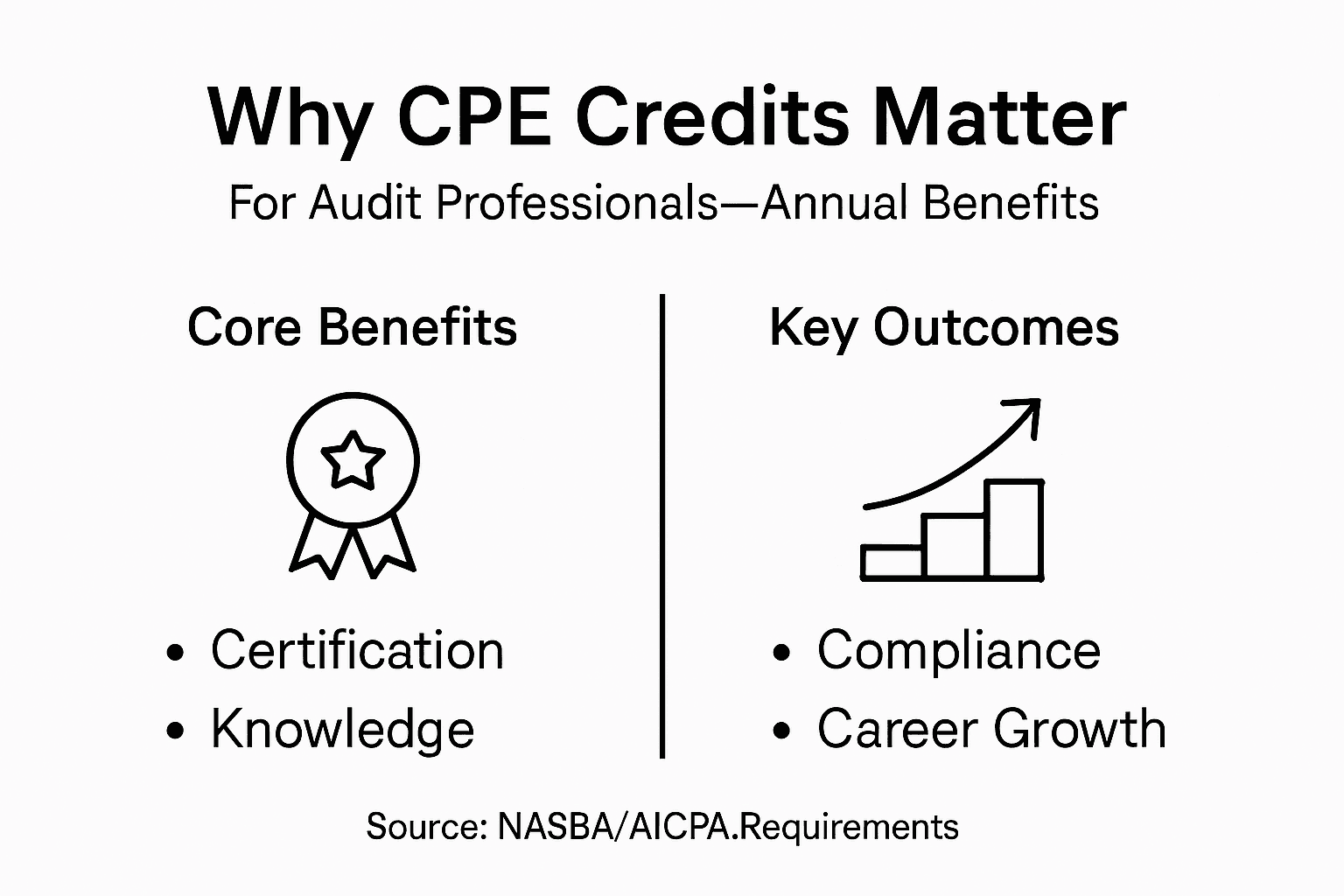
Here’s a summary of how different CPE credit sources impact professional development:
CPE Credit Source | Skill Depth Provided | Industry Relevance | Networking Potential |
Professional Conferences | Advanced learning | Latest industry topics | High, peer interaction |
Online Courses | Technical knowledge | Current regulations focus | Limited, virtual engagement |
Self-study Programs | Self-directed learning | Broad subject coverage | None, individual only |
Instructor-led Training | Structured instruction | Practical applications | Moderate, classroom peers |
Pro tip: Track your CPE credits systematically throughout the year to ensure you meet professional certification requirements without last-minute scrambling.
Types of Accepted CPE Learning Activities
Continuing Professional Education (CPE) for auditors encompasses a diverse range of learning activities designed to enhance professional knowledge and skills. These activities are carefully structured to ensure auditors remain current with evolving industry standards, regulatory requirements, and emerging technologies.
Government Auditing Standards specify several acceptable learning formats that contribute to an auditor’s professional development. The most common types of CPE learning activities include:
Formal Training Programs:
Full-day and half-day workshops
Professional conference presentations
Structured seminar series
Technical skills training sessions
Digital Learning Platforms:
Webinars and online courses
Self-paced e-learning modules
Virtual conference sessions
Interactive online training programs
Professional Development Activities:
Technical research publications
Professional committee participation
Teaching or presenting at professional conferences
Authoring industry-related articles or publications
The quality and relevance of CPE activities are paramount. Professional organizations carefully evaluate learning experiences to ensure they provide meaningful skill development and knowledge enhancement for audit professionals. Accreditation plays a crucial role in determining which activities qualify for CPE credit, with most certifying bodies requiring direct relevance to audit practices, emerging technologies, and regulatory compliance.

Professional auditors must be strategic in selecting CPE activities, focusing on programs that not only meet credit requirements but also directly improve their professional capabilities. Diversifying learning experiences across different formats helps auditors develop a comprehensive understanding of complex industry challenges.
Pro tip: Maintain a detailed log of your CPE activities, including dates, course descriptions, and learning outcomes to simplify annual certification reporting requirements.
Regulatory Standards and Compliance Requirements
Navigating the complex landscape of CPE compliance requires audit professionals to understand the intricate regulatory standards that govern continuing professional education. Government Auditing Standards mandate specific CPE requirements that professionals must carefully follow to maintain their certification and professional credibility.
The primary regulatory frameworks governing CPE compliance include:
Professional Certification Requirements:
Minimum annual CPE hours
Specific learning topic requirements
Documentation and reporting obligations
Periodic certification renewal processes
Regulatory Oversight Mechanisms:
NASBA credit validation
Professional board monitoring
Periodic professional competency assessments
Audit trail maintenance
Reporting Periods for CPE compliance typically span two years, with most professional bodies requiring auditors to complete a minimum of 40 hours annually. The Government Auditing Standards specifically outline that professionals must document:
Total CPE hours completed
Relevant learning subjects
Detailed course descriptions
Verification of educational content
Professional organizations emphasize the importance of strategic learning that goes beyond mere credit accumulation. The focus is on acquiring knowledge directly relevant to emerging audit practices, technological advancements, and regulatory changes that impact professional performance.
Compliance is not just about meeting hour requirements, but about maintaining the highest standards of professional competence and ethical practice.
Pro tip: Develop a systematic approach to tracking CPE activities, using digital tools or spreadsheets to record detailed information about each learning experience.
Impact of CPE Credits on Certification
Continuing Professional Education (CPE) credits serve as a critical gateway for audit professionals to maintain and advance their professional certifications. Earning these credits is not merely a bureaucratic requirement but a strategic mechanism for ensuring ongoing professional competence and relevance in a rapidly evolving industry landscape.
The impact of CPE credits on professional certification extends across multiple critical dimensions:
Certification Maintenance:
Direct requirement for credential renewal
Demonstrates continuous professional development
Validates ongoing learning commitment
Prevents certification expiration
Professional Credibility:
Signals commitment to professional standards
Provides evidence of current industry knowledge
Differentiates professionals in competitive markets
Enhances professional reputation
Skill Advancement:
Exposes professionals to emerging industry trends
Develops specialized technical competencies
Supports adaptation to technological changes
Promotes strategic career growth
Ethics CPE training plays a particularly crucial role in certification maintenance, as many professional bodies require specific ethical training hours. These specialized credits ensure that audit professionals not only maintain technical skills but also uphold the highest standards of professional conduct.
Certification is a continuous journey of learning, not a destination to be reached and forgotten.
Pro tip: Create a forward-looking CPE plan that anticipates certification requirements and aligns with your long-term professional development goals.
Risks of Neglecting Ongoing Education
Professional stagnation in audit practices represents a significant risk for audit professionals who fail to engage in continuous learning. Neglecting ongoing education can create substantial professional vulnerabilities that extend far beyond simple credential maintenance, potentially compromising an auditor’s effectiveness and career trajectory.
The specific risks associated with educational neglect include multiple critical professional challenges:
Certification Risks:
Potential loss of professional credentials
Automatic certification suspension
Mandatory recertification processes
Increased barriers to future credential restoration
Professional Competency Risks:
Outdated technical knowledge
Reduced understanding of emerging industry standards
Diminished ability to apply current regulatory frameworks
Compromised professional decision-making capabilities
Career Development Risks:
Limited promotional opportunities
Decreased market competitiveness
Reduced professional network engagement
Potential salary stagnation
Professional organizations recognize that continuous learning is not optional but essential. Ongoing education directly impacts professional credibility by ensuring auditors remain current with technological advancements, regulatory changes, and emerging industry best practices.
Professional obsolescence is the silent career killer that continuous learning prevents.
Pro tip: Schedule quarterly professional development reviews to proactively identify and address potential knowledge gaps before they become significant professional limitations.
Career Advancement Through Continuous Learning
Continuous learning represents a strategic pathway for audit professionals to differentiate themselves in an increasingly competitive and complex professional landscape. By systematically investing in professional development, auditors can transform CPE credits from a mere compliance requirement into a powerful career acceleration mechanism.
The strategic dimensions of career advancement through continuous learning include:
Professional Positioning:
Building specialized expertise
Developing unique skill combinations
Creating competitive differentiation
Expanding professional visibility
Knowledge Expansion:
Mastering emerging technological domains
Understanding complex regulatory frameworks
Developing cross-functional capabilities
Anticipating industry transformation trends
Career Trajectory Opportunities:
Qualifying for advanced roles
Increasing earning potential
Accessing leadership track positions
Enhancing professional credibility
Soft skills development plays a critical role in career advancement beyond technical competencies. Continuous learning enables professionals to cultivate communication, leadership, and strategic thinking abilities that distinguish top-performing audit professionals.
Intentional learning transforms career limitations into unlimited potential.
Pro tip: Develop a multi-year professional development roadmap that aligns CPE credits with your long-term career objectives and emerging industry skill requirements.
Compare short-term and long-term career benefits of continuous CPE learning:
Time Frame | Certification Stability | Career Mobility | Salary Growth Potential |
1-2 Years | Maintains credentials | Lateral role options | Modest increases, steady progress |
3-5 Years | Strengthens reputation | Advanced positions | Noticeable growth, new opportunities |
5+ Years | Sustained expertise | Leadership eligibility | Significant growth, senior-level roles |
Elevate Your Audit Career with Targeted CPE Training
Staying current with CPE credits is essential for audit professionals who want to maintain certification, sharpen technical skills, and enhance career prospects. This article highlights the critical need for ongoing education to avoid professional stagnation and certification risks. If you are looking to meet your annual CPE requirements with courses that directly align with internal audit standards, emerging regulations, and ethics training then Compliance Seminars offers a trusted solution tailored to your needs.
Explore our extensive catalog of NASBA-approved CPE courses, live webinars, and in-person seminars designed by industry experts from leading firms. Act now to secure your certification stability and career growth by enrolling in Continuing Professional Education offerings that guarantee practical knowledge and compliance. Visit Compliance Seminars to start your strategic path toward professional excellence today.
Frequently Asked Questions
Why are CPE credits important for auditors?
CPE credits are essential for auditors as they maintain professional certification, demonstrate ongoing learning, and ensure compliance with the latest regulations and industry standards.
How many CPE credits do auditors need annually?
Most professional organizations require auditors to earn between 20 to 40 CPE credits annually, depending on the specific certification they hold.
What types of activities qualify for CPE credits?
CPE credits can be earned through various activities, including formal training programs, online courses, webinars, professional conferences, and self-study programs that enhance auditors’ skills and knowledge.
What are the risks of not completing CPE requirements?
Neglecting CPE requirements can lead to certification loss, outdated professional knowledge, reduced career opportunities, and diminished credibility in the auditing profession.
Recommended
Comments