What Is Cloud Audit Risk for Auditors and Executives
- John C. Blackshire, Jr.

- May 22
- 9 min read

TL;DR:
Regulators focus on an organization’s actual security posture rather than cloud provider attestations or certifications.
Customer-owned controls, continuous compliance, and effective identity management are essential to managing cloud audit risk successfully.
Regulators do not care which cloud provider you use or how many certifications that provider holds. What regulators care about is your organization’s actual security posture, and that distinction sits at the heart of what is cloud audit risk. 82% of data breaches involve cloud-hosted data, and finance industry breach costs average $6.08M per incident, well above the global average. Yet audit teams and executives continue to treat cloud provider attestations as a compliance proxy. This article cuts through that confusion and gives you a working definition, a framework orientation, and practical steps to manage cloud audit risk with confidence.
Table of Contents
Key takeaways
Point | Details |
Cloud audit risk is customer-owned | Providers secure the infrastructure layer; customers own configurations, access, and data controls where most failures occur. |
Shared responsibility is frequently misread | Auditors and executives routinely treat SOC 2 or ISO 27001 provider certs as full compliance coverage, which regulators explicitly reject. |
Identity is now the primary risk vector | Over-permissioned accounts and delegated trust abuse have displaced technical exploits as the leading cause of cloud breaches. |
Continuous compliance replaces point-in-time audits | Configuration drift and automated environments make periodic manual audits structurally insufficient for cloud settings. |
Framework mapping is non-negotiable | NIST SP 800-53, FedRAMP, PCI DSS, and HIPAA all require customers to map and own a significant portion of the control set independently. |
What is cloud audit risk and why it matters
Cloud audit risk is the probability that a cloud-based environment contains material control failures that go undetected during an audit, resulting in regulatory noncompliance, financial loss, or reputational damage. It is distinct from general IT audit risk because cloud environments shift control ownership, compress audit timelines, and change how evidence is collected and retained.
The most dangerous misconception in this space is the belief that a cloud provider’s certifications transfer compliance to the customer. They do not. Regulatory liability remains with the customer regardless of any provider attestation or Business Associate Agreement. A hospital using AWS with a signed BAA is still fully responsible for configuring access controls correctly. A bank running workloads on Azure is still accountable for log retention aligned to PCI DSS.
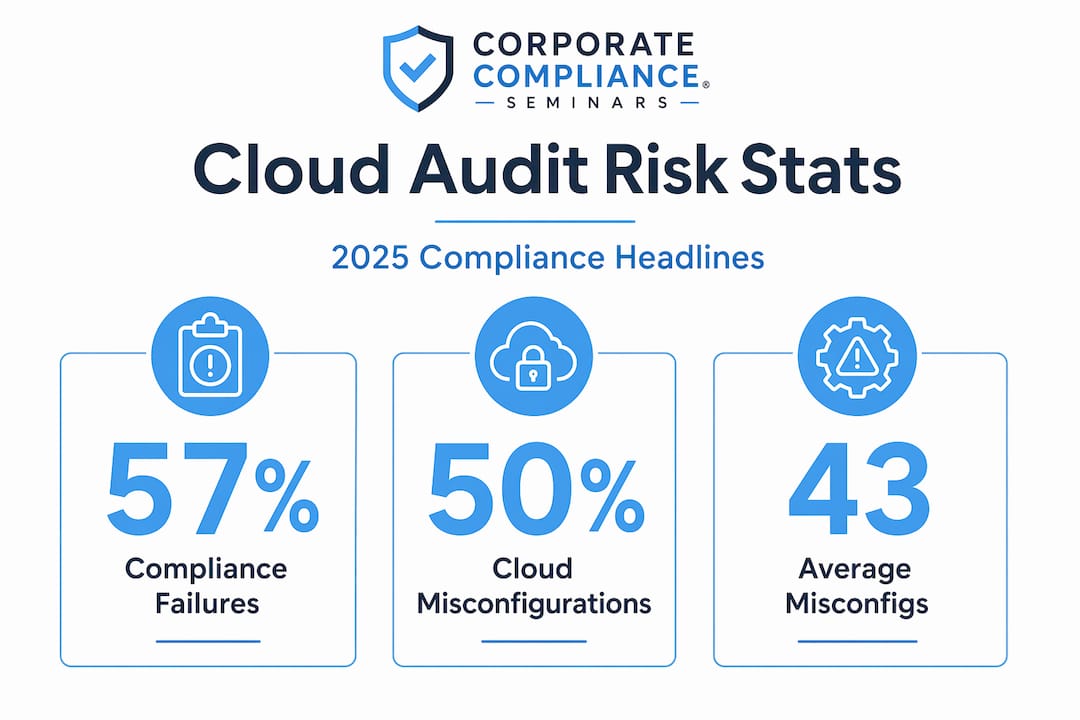
57% of organizations reported cloud-related compliance failures in 2025, with half of those failures traced directly to customer-side configuration errors. These are not infrastructure failures on the provider’s end. They are audit failures owned entirely by the customer. Understanding this is the first step toward doing something about it.
The shared responsibility model explained
The shared responsibility model defines which security and compliance controls belong to the cloud provider and which belong to the customer. The division shifts depending on the cloud service model in use.
In an Infrastructure-as-a-Service (IaaS) arrangement, the provider secures the physical data centers, networking hardware, and hypervisor layer. The customer owns the operating systems, applications, network configurations, identity management, and data. In a Platform-as-a-Service (PaaS) model, the provider takes on the runtime environment as well, but the customer still owns application security and data. In a Software-as-a-Service (SaaS) model, the provider owns nearly all infrastructure controls, but the customer retains ownership of user provisioning, data governance, and access configurations.
Layer | IaaS customer-owned | PaaS customer-owned | SaaS customer-owned |
Physical/network | Provider | Provider | Provider |
Operating system | Customer | Provider | Provider |
Application security | Customer | Customer | Provider |
Identity and access | Customer | Customer | Customer |
Data classification | Customer | Customer | Customer |
SOC 2 and ISO 27001 attestations cover only the provider’s infrastructure layer. Customers retain responsibility for data, configurations, and access management layers, where 95% of failures occur. This is where audit teams consistently get tripped up: they review the provider’s SOC 2 report, check a box, and move on without assessing what the customer actually controls.
Pro Tip: Ask your cloud provider for a formal responsibility matrix specific to your service tier. Use it to build a customer-owned control inventory before your audit planning even begins. Connecting this to solid audit planning practices will define your scope with precision.
Major cloud audit risks you cannot overlook
Three categories of risk account for the overwhelming majority of cloud audit findings. Recognizing them by name makes them considerably easier to test and document.
Misconfiguration of storage and encryption. 23% of cloud security incidents stem directly from misconfigurations, and 82% of those are caused by human error. An S3 bucket set to public access, an unencrypted database snapshot shared across accounts, or a firewall rule opened too broadly during a project sprint and never closed. These are not exotic attack scenarios. They are routine audit findings.
Logging and monitoring gaps. Providers generate logs, but customers must configure retention windows, alerting thresholds, and review processes. Customers must configure log retention per standards like PCI DSS v4.0, and provider-native logs alone do not satisfy compliance. 46% of organizations still rely on manual audits, and insufficient log review consistently ranks among the top audit deficiencies.
Identity and access management failures. This is the area that has shifted most dramatically in recent years. Identity design flaws now represent the primary cloud risk vector over technical exploits. Over-permissioned service accounts, OAuth token abuse, machine identities with excessive privileges, and cross-account role trust misconfigurations are no longer edge cases. They are the dominant attack surface in cloud environments.
Audit findings in these three categories do not stay in the IT column. They translate directly into financial control failures, SOX deficiencies, and regulatory sanctions for finance executives. Treating them as IT concerns alone is a governance mistake.
Regulatory frameworks that define your audit scope
Cloud audit risk does not exist in a vacuum. It is measured against specific regulatory requirements and control frameworks, and your audit scope depends on which apply to your organization.
Framework | Key cloud-relevant control families |
NIST SP 800-53 | Access Control (AC), Audit and Accountability (AU), Configuration Management (CM), System and Communications Protection (SC) |
FedRAMP | Inherits NIST 800-53; customer retains 50-80 controls at Moderate baseline |
PCI DSS v4.0 | Logging, encryption, access control, vulnerability management |
HIPAA Security Rule | Access management, audit controls, transmission security |
Cloud customers retain responsibility for 50 to 80 security controls under a FedRAMP Moderate baseline, even when the provider holds full FedRAMP authorization. This surprises many audit teams who assume the provider’s authorization covers the entire control set.
The practical challenge is evidence collection. In a traditional data center, an auditor can observe a configuration directly or pull a screenshot from a management console. In cloud environments, evidence may require API queries, infrastructure-as-code reviews, or cloud security posture management (CSPM) tool exports. The evidence exists, but only if the customer has configured the right logging and monitoring to capture it.
Pro Tip: Request your provider’s Customer Responsibility Matrix at the start of every cloud compliance assessment. Map each customer-owned control to an internal owner before the audit begins. Pair this with your third-party audit approach to clarify boundaries between provider and customer scope.
Continuous compliance and automated evidence collection
Traditional point-in-time audits were designed for environments that change slowly. Cloud environments do not change slowly. A developer can spin up a new compute instance, modify a security group rule, and deprovision a resource in the same afternoon. Manual, periodic audit snapshots cannot keep pace with that velocity.

Configuration drift causes over half of cloud breaches, and the average organization has approximately 43 misconfigurations active in its cloud accounts at any given moment. A quarterly manual audit will not find the misconfiguration introduced three days after the last review.
Continuous compliance programs with automated evidence collection address this gap directly by enabling real-time compliance posture visibility and audit-ready documentation throughout the cycle.
Here is how to build continuous compliance into your cloud audit program:
Deploy a CSPM tool aligned to your regulatory framework. Tools in this category continuously scan your cloud environment for deviations from approved configuration baselines and generate evidence automatically.
Define configuration baselines for every cloud service in scope. These baselines become the control standard against which CSPM findings are measured and documented.
Automate log retention configuration across all cloud accounts. Retention windows must match regulatory requirements for each framework that applies to the environment.
Establish real-time alerting for high-risk configuration changes, such as public access enabled on storage, security group rules modified, or IAM policy changes for privileged accounts.
Integrate evidence exports into your audit documentation workflow. Automated evidence collection only reduces audit risk if the evidence is organized, timestamped, and accessible for auditor review.
Pro Tip: When evaluating a client or business unit’s cloud environment, ask whether their CSPM tool is tuned to their specific regulatory framework or running generic cloud benchmarks. Generic benchmarks miss framework-specific requirements and create false confidence in compliance posture.
Practical steps to reduce cloud audit risk
Auditors and compliance professionals cannot wait for a formal audit cycle to assess cloud risk. The environment changes too quickly. These are the practices that close the gaps before they become findings.
Map your cloud architecture against the shared responsibility model at the start of every engagement. Identify which controls are provider-owned, which are customer-owned, and which require joint evidence from both parties.
Assign explicit control ownership. Every customer-owned control must have a named internal owner. Unassigned controls are unmanaged controls, and unmanaged controls become audit findings.
Implement standardized configuration baselines and run automated checks against them continuously. Use your selected frameworks (NIST, PCI DSS, HIPAA) as the baseline source rather than general cloud security benchmarks.
Conduct quarterly access reviews covering both human identities and machine identities. Pay particular attention to cross-account role trusts and OAuth integrations. Complex identity design flaws, including over-permissioned machine identities and OAuth misuse, represent dominant breach vectors in cloud environments.
Verify log retention configuration matches regulatory requirements for every cloud service in scope. Do not assume provider-default retention periods are compliant.
Maintain organized audit documentation with clear evidence trails. Solid audit documentation practices become critical when cloud evidence spans multiple services, accounts, and provider-generated reports.
Invest in ongoing education. Cloud platforms release new services and update security configurations continuously. Staying current requires deliberate, structured learning, not just on-the-job exposure.
My perspective on cloud audit risk in 2026
I have watched audit teams walk into cloud environments carrying frameworks built for on-premises infrastructure, and I have watched those teams leave with findings that could have been prevented. The core problem is not technical knowledge. It is a mindset gap.
The assumption that a provider’s certifications create a compliance shield for the customer is one of the most persistent and costly errors I have seen in practice. Regulators focus on the customer’s actual security posture, not on what the provider’s SOC 2 report says. Every time an audit team accepts a provider attestation at face value without testing customer controls, they are leaving a material risk unexamined.
What I have learned from repeated exposure to these failures is that identity governance is where the real audit work happens now. Over-permissioned service accounts, stale OAuth tokens, and misconfigured cross-account trusts are the new control gaps. They are harder to detect than a misconfigured firewall rule because they often look like legitimate access until something goes wrong.
My honest advice: if you are not embedding continuous compliance monitoring into your cloud audit approach, you are auditing a snapshot of an environment that no longer exists. The organizations getting this right are the ones that treat compliance readiness as an operational function, not an annual event. That shift in thinking is not optional anymore. It is what the risk demands.
— John
Advance your cloud audit skills with Compliance-seminars
Cloud audit risk is not static, and neither should your professional development be. Compliance-seminars offers CPE-eligible courses and live events designed specifically for auditors, compliance officers, and finance professionals who need to stay current with cloud security risks and regulatory requirements. Whether you prefer live in-person instruction or online webinars, the curriculum covers NIST frameworks, SOX IT controls, cybersecurity audit techniques, and more, all taught by instructors with Big 4 and regulatory backgrounds.
Browse the 2026 CPE event calendar for upcoming in-person training across U.S. cities, or explore cybersecurity CPE courses available online for auditors who need targeted cloud and cybersecurity training. Earning CPE credits while closing a genuine knowledge gap is time well spent.
FAQ
What is cloud audit risk in simple terms?
Cloud audit risk is the chance that an organization’s cloud environment contains undetected control failures that cause compliance violations or financial harm. Most of this risk sits on the customer side, not the provider’s.
Does a cloud provider’s SOC 2 report cover my compliance?
No. A SOC 2 report covers the provider’s infrastructure controls only. Customers remain responsible for configurations, access management, and data governance, where the majority of audit failures occur.
How to audit cloud services effectively?
Start by mapping your cloud architecture against the shared responsibility model, assign internal owners to every customer-controlled item, deploy a CSPM tool tuned to your regulatory framework, and verify log retention settings match compliance requirements.
What are the most common cloud security risks in audits?
Misconfigured storage and encryption, insufficient logging and monitoring, and identity governance failures (including over-permissioned accounts and OAuth misuse) are the three leading categories of cloud audit findings.
How does cloud risk management differ from traditional IT audit?
Cloud risk management requires continuous monitoring rather than periodic reviews, because cloud environments change too quickly for point-in-time audits to capture current risk. Evidence collection also shifts from direct observation to API queries, infrastructure-as-code reviews, and CSPM tool exports.
Recommended
Comments