What Are Audit Protocols: A Guide for Auditors

Updated: Sep 22

TL;DR:
Audit protocols are formal, documented frameworks that define systematic procedures, evidence standards, and timelines to support defensible audits, going beyond simple checklists. They help align scope with risks, set evidentiary and timing standards, and ensure consistency across audit cycles, while guiding technical procedures like inspection and inquiry. Effective protocols are dynamic, risk-driven, and rooted in auditor judgment, requiring continuous updates and professional development to address evolving regulations and complexities.
Most auditors, when asked to explain audit protocols, describe them as checklists. That answer is incomplete in ways that can genuinely cost you during a complex audit. What are audit protocols, really? They are formal, documented frameworks that define the systematic procedures, evidence requirements, timelines, and quality standards an auditor must follow to deliver a defensible audit. They tell you what to test, how to test it, what evidence counts, and in what sequence. Understanding that distinction — between a checklist and a protocol — is where competent auditing begins.
Table of Contents
Key Takeaways
Point | Details |
Protocols go beyond checklists | Audit protocols define scope, evidence standards, timelines, and testing methods — not just tasks to complete. |
Types differ by context | Internal, external, compliance, operational, and sector-specific protocols each carry distinct objectives and rigor levels. |
Phases structure every audit | Most protocols follow four phases: engagement, fieldwork, reporting, and closeout, with defined deliverables at each stage. |
Design must map to risk | Effective protocol creation requires linking each test step to a specific risk, control owner, and evidence source. |
Protocols guide, they do not guarantee | Protocols align resources and scope with organizational risk but cannot substitute for auditor judgment. |
What are audit protocols: definition and purpose
The formal audit protocols definition is this: a structured set of documented procedures that specify how an auditor will collect, evaluate, and report evidence to support an audit objective. They function as operational guides, not policy documents. This distinction matters. Protocols clarify monitoring and data requirements rather than substitute for the statutes or regulations they enforce.
Think of an audit protocol as the methodology behind the mission. Your audit objective might be to assess whether a Medicare Advantage plan is administering drug coverage correctly. The protocol is what defines the universe of files you will pull, the specific data fields you will test, the timeline for each phase, and the threshold at which a finding becomes reportable.
Key purposes that audit protocols serve include:
Aligning the audit scope with the organization’s specific risk profile
Defining evidentiary standards so every team member collects comparable, sufficient evidence
Setting timelines and deliverables that hold both auditors and auditees accountable
Creating consistency across audit cycles so results are comparable year over year
Providing documentation that supports audit quality reviews and regulatory defense
Audit protocols also separate the audit function from guesswork. Eight primary procedure types — including inspection, observation, inquiry, confirmation, recalculation, reperformance, and analytical procedures — form the technical backbone of most audit protocols. The protocol designates which procedures apply to which risk areas and why.
Pro Tip: When onboarding new staff to an audit engagement, hand them the protocol before any other document. If they cannot explain the audit objective and evidence standard after reading it, the protocol needs revision, not the staff member.
Types of audit protocols
Understanding the types of audit protocols requires you to think along two axes: who conducts the audit, and what the audit is designed to prove.
Internal vs. external audit protocols differ primarily in scope and authority. Internal audit protocols are designed and owned by the organization. They tend to focus on process improvement, root-cause analysis, and operational effectiveness. External audit protocols are set by regulators, standard-setters, or independent firms, and carry formal attestation requirements. Compliance audits produce formal attestations while internal audits carry more flexible scope and reporting structures.

Here is a comparison of the most common protocol types:
Protocol Type | Primary Objective | Typical Scope | Enforcement Implication |
Internal audit | Process improvement, risk identification | Flexible, organization-defined | Internal reporting and remediation |
External/regulatory audit | Regulatory adherence, formal attestation | Fixed by regulator or standard-setter | Legal or financial penalties possible |
Compliance audit | Framework adherence (SOX, HIPAA, ISO) | Defined by applicable regulation | Certification withdrawal, fines |
Operational audit | Efficiency and effectiveness of processes | Cross-functional, risk-based | Management action, not legal |
Cybersecurity audit | System controls, data protection | Technical and procedural | Regulatory notification, remediation |
Sector-specific variations add another layer of complexity. In healthcare, CMS program audit protocols govern Medicare Part C and D plan oversight with highly prescriptive data submission requirements. Cybersecurity audit protocols, often aligned with NIST or CMMC frameworks, test control implementation against defined maturity levels — a critical area covered in depth through cybersecurity audit training for professionals working in that space. In legal services, file audits evaluate AML compliance, record keeping, and supervision at the matter level, not just the policy level.
The choice of protocol type shapes everything downstream: evidence collection strategy, team composition, and how findings are communicated.
Phases and steps in audit protocols
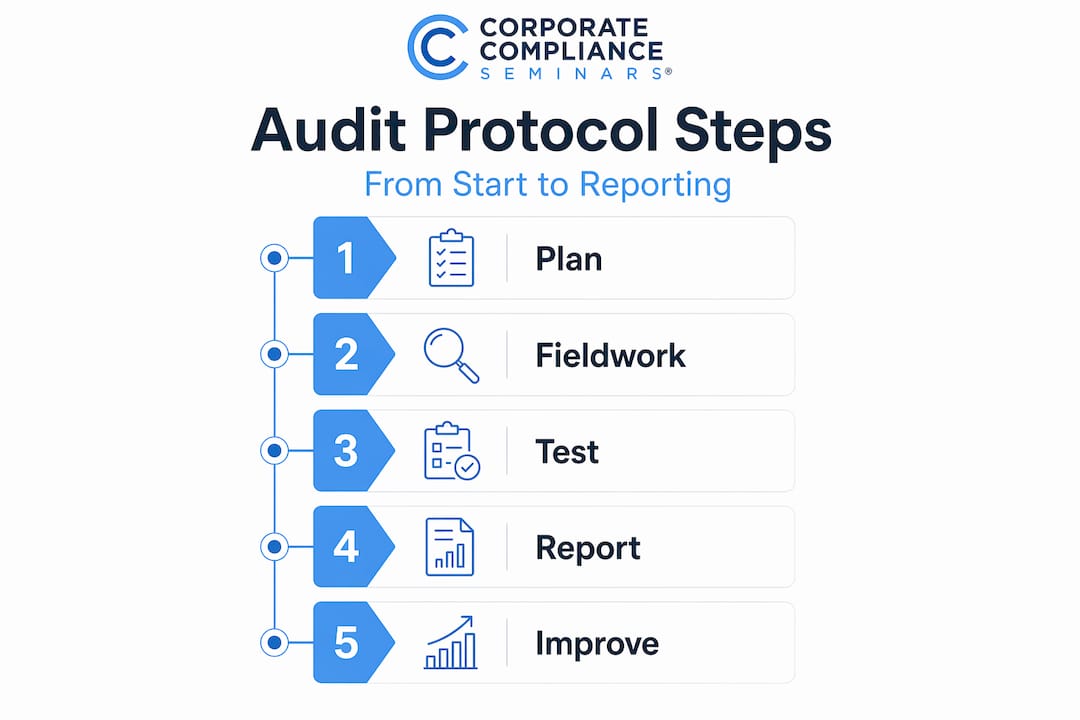
Most well-structured audit protocols follow four phases. Understanding what belongs in each phase prevents the common mistake of compressing fieldwork into planning or skipping closeout documentation when time runs short.
Audit engagement. This phase covers scope definition, risk assessment, engagement letter issuance, and universe submission. CMS program audits require universe submission within 15 business days of the engagement letter. Missing that deadline triggers an Invalid Data Submission finding before a single test has been run.
Fieldwork. This is where the testing procedures defined in the protocol are executed. Auditors apply inspection, reperformance, observation, and confirmation against the evidence specified in the protocol. Every sample selection, every test result, and every exception must be documented in a way the protocol can defend.
Audit reporting. Findings are drafted, supported by evidence, and issued in a format the protocol specifies. Compliance audits typically require formal written reports with pass/fail language. Internal audits may use narrative formats that emphasize root cause and recommendations over binary outcomes.
Validation and closeout. This phase often gets shortchanged. The protocol should specify how corrective action plans are tracked, how auditor responses are reviewed, and what constitutes a formally closed finding. CMS audits include a distinct validation phase where corrective actions are tested before the audit closes.
Pro Tip: Map each phase to a calendar before fieldwork begins. If your protocol mandates a 30-day reporting window and your fieldwork takes 25 days, you are already building toward a missed deadline. Build the timeline backward from the closeout date.
Within fieldwork, each test step should map to a specific risk, control owner, testing method, and evidence source. Protocols that skip this mapping create gaps that only appear when a finding is challenged during regulatory review.
How to create audit protocols
Designing an audit protocol from scratch is something you should approach methodically, not intuitively. Here is a process that actually holds up in practice.
Start with a risk assessment. Before writing a single test step, identify the key risks the audit must address. The risk assessment process for auditors should inform which risk areas receive the most test coverage and resource allocation. High-inherent-risk areas need more test steps, broader sample sizes, and more rigorous evidence standards.
Identify the applicable standards. Determine whether your protocol must align with COSO, IIA 2024 Global Internal Audit Standards, ISO 9001, HIPAA, or another framework. Audit protocols require integration with updated standards relevant to the organization’s regulatory environment. This is not optional for any audit that will face external scrutiny.
Map test steps to specific controls. Each test step in your protocol should identify the control being tested, the risk that control mitigates, the testing method (inquiry, inspection, reperformance), the evidence required, and the name or title of the control owner. A test step that lacks an evidence specification is not a test step. It is a question.
Define scope and sampling methodology. Your protocol must specify how the audit universe is constructed, what sampling approach is used (attribute, statistical, judgmental), and what exceptions look like. Vague scope definitions invite disputes during reporting.
Build in quality checkpoints. The protocol should include internal review steps where a senior auditor or quality reviewer confirms that fieldwork meets evidence standards before the audit moves to reporting.
Common pitfalls in protocol development: writing test steps so broadly that two auditors produce incomparable results, omitting evidence source specifications, and failing to update protocols when regulations change mid-cycle. The internal audit frameworks that organizations map protocols to should be reviewed annually at minimum.
Real-world application and challenges
Audit protocols meet reality in ways that classroom frameworks do not fully anticipate. Here is where the practical challenges concentrate.
Data submission failures derail audits before fieldwork. CMS’s requirement for exact submission formatting means a misformatted column header can trigger an audit finding before a single record is tested. Organizations that do not treat the engagement phase as substantive testing risk entering fieldwork already in a deficient position.
The system-based vs. file-based distinction is frequently misunderstood. A system-based audit confirms that a policy exists. A file-based audit confirms that the policy was actually applied at the transaction or matter level. A firm can have flawless documentation and still fail a file-based audit if execution-level evidence is absent. This distinction needs to be hardwired into every protocol your team designs.
Evidence source identification is an audit trail decision. Protocols that do not specify acceptable evidence sources leave auditors improvising. When a finding is challenged, “we used what was available” is not a defensible position. Specify whether screen captures, signed approvals, system logs, or original documents are acceptable for each test step.
Timeline compression is a chronic failure point. Regulatory audits with fixed-phase deadlines leave no room for scope creep. When a protocol is well-constructed, auditors can identify scope expansion risks early and raise them formally rather than absorbing them silently into fieldwork.
Audit protocols also create the documentation trail for corrective action plans and continuous improvement. When protocols are treated as fixed checklists rather than living documents, the lessons from one audit cycle do not improve the next. That is a governance failure organizations rarely recognize until they face a repeat finding.
My perspective: protocols as judgment frameworks
I’ve reviewed a lot of audit work over the years, and the pattern I keep encountering is this: teams that treat protocols as compliance theater produce audits that pass internal review and fail regulatory scrutiny. The protocol got followed. The judgment did not get applied.
What I have found consistently is that the most effective auditors use protocols as a floor, not a ceiling. They understand the why behind each test step well enough to recognize when an unusual transaction warrants a procedure the protocol did not anticipate. That kind of judgment does not come from reading a protocol once. It comes from understanding the risk landscape the protocol was designed to address.
My real concern with how protocols get deployed in many organizations is the cultural one. When the audit function exists primarily to produce documentation rather than to understand risk, protocols reinforce compliance-as-optics rather than compliance-as-substance. The fix is not a better protocol template. It is an investment in auditor judgment, which is why I believe ongoing professional development is not a box-checking exercise. It is what separates audits that actually protect organizations from audits that simply record what happened.
The other thing I would push back on is the idea that a protocol written two years ago is still fit for purpose today. Regulatory changes, new transaction types, and evolving fraud schemes require protocol updates on a defined cycle. Treating protocols as dynamic documents aligned with current compliance audit best practices is a governance standard, not a suggestion.
— John
Deepen your audit protocol expertise with CPE training
If this article sharpened your thinking about audit protocols, the next step is building the skills to apply them under real audit conditions.
Compliance-seminars offers CPE-accredited training designed specifically for internal auditors, external auditors, and compliance officers who need more than theory. From in-person audit and cybersecurity events across major U.S. cities to focused internal auditor webinars you can attend from your desk, the curriculum is built around practical, standards-based instruction. Courses cover COSO, IIA standards, SOX, HIPAA, NIST, and the regulatory contexts where audit protocols carry the most weight. Instructors bring Big 4 experience and translate it into audit techniques your team can use immediately.
FAQ
What is an audit protocol?
An audit protocol is a documented framework specifying the procedures, evidence requirements, timelines, and quality standards an auditor must follow to meet a defined audit objective. It operates as an operational guide, not a policy substitute.
What are the main types of audit protocols?
The main types include internal audit protocols, external and regulatory audit protocols, compliance audit protocols (covering frameworks like SOX and HIPAA), operational audit protocols, and sector-specific protocols such as cybersecurity and healthcare program audits.
How do you create an audit protocol?
Start with a risk assessment to identify priority areas, map each test step to a specific control and evidence source, align the protocol with applicable standards such as COSO or IIA, define the sampling methodology, and build in quality review checkpoints before fieldwork begins.
What is the difference between a system-based and file-based audit?
A system-based audit confirms that policies and controls exist at the organizational level. A file-based audit verifies that those controls were actually applied in individual transactions or cases. An organization can pass a system-based review and still fail a file-based audit if execution evidence is missing.
Why do audit protocols matter for compliance officers?
Audit protocols give compliance officers a documented, defensible basis for monitoring adherence to regulatory requirements. They define what evidence is acceptable, standardize how findings are reported, and create the audit trail needed to support corrective action and regulatory defense.
Recommended
Comments