Step by Step Compliance Process for Financial Professionals

Updated: Sep 22

TL;DR:
Effective compliance programs require documented, repeatable processes that map obligations, assess risks, and embed controls into business workflows. Continuous monitoring, independent testing, and thorough documentation are essential to maintain regulatory adherence and adapt to changing regulations. Building a culture of accountability and leveraging technology ensures sustained, defensible compliance under review.
Compliance officers managing overlapping regulations across multiple jurisdictions know this frustration well: you have policies on paper, a training program in place, and an audit scheduled next quarter, yet something still feels fragile. That feeling is usually the absence of a documented, repeatable step by step compliance process. Without a structured workflow, gaps multiply quietly until a regulator or internal audit team finds them first. This guide walks you through every stage of a defensible compliance process, from initial risk mapping through continuous monitoring, so your program holds up under scrutiny in 2026 and beyond.
Table of Contents
Key Takeaways
Point | Details |
Map obligations before acting | Identify all regulatory requirements across jurisdictions and business units before designing any controls. |
Build a control matrix | Link every control to a specific regulation so coverage gaps become visible at a glance. |
Distinguish monitoring from testing | Monitoring is ongoing observation; testing is a discrete, evidence-based evaluation required by many regulators. |
Document everything | If a compliance activity is not documented with evidence, regulators treat it as if it never happened. |
Treat compliance as dynamic | Regulations and business processes change constantly, so your compliance program must evolve with them. |
Prerequisites for an effective step by step compliance process
Before you execute a single control, you need a clear picture of what you are protecting against and who is responsible for protecting it. Skipping this preparation phase is the most common reason compliance programs fail their first real audit.
Map your regulatory obligations
Start by cataloging every law, regulation, and supervisory guidance that applies to your organization. For a regional bank, that list might include BSA/AML requirements, Regulation E, UDAAP, and state-specific consumer protection rules. For a publicly traded company, add SOX Section 302 and 404 obligations. The goal is a complete regulatory inventory, not a best-guess approximation.
Group obligations by business unit and jurisdiction. A payment processing team in New York faces different requirements than the same function in California or the EU. Mapping this at the outset prevents control duplication and coverage gaps later in your stepwise compliance guide.
Conduct a risk assessment
Once obligations are mapped, assess the likelihood and potential impact of failing to meet each one. A foundational risk assessment should prioritize risks by consequence, not alphabetical order. High-impact, high-likelihood risks need immediate control attention. Lower-risk areas can be addressed in later cycles.
Effective compliance management systems recognize board and management oversight as foundational, with compliance officers needing genuine authority and resources to act on their findings. Tone at the top is not a soft concept. It is a structural requirement. When leadership treats compliance as an afterthought, so does everyone else.
Pro Tip: Assign a named owner to every identified regulatory obligation, not just a department. Diffuse ownership creates accountability voids. If no individual is responsible, no one is.
The table below summarizes the key inputs you need before moving into execution.
Preparation element | What it produces |
Regulatory inventory | Complete list of applicable laws and guidance by business unit |
Risk assessment | Prioritized list of compliance risks with likelihood and impact ratings |
Governance structure | Clear authority lines and named compliance owners |
Technology and tools | Systems to document, automate, and report compliance activities |
With these inputs in hand, you are ready to build your controls.
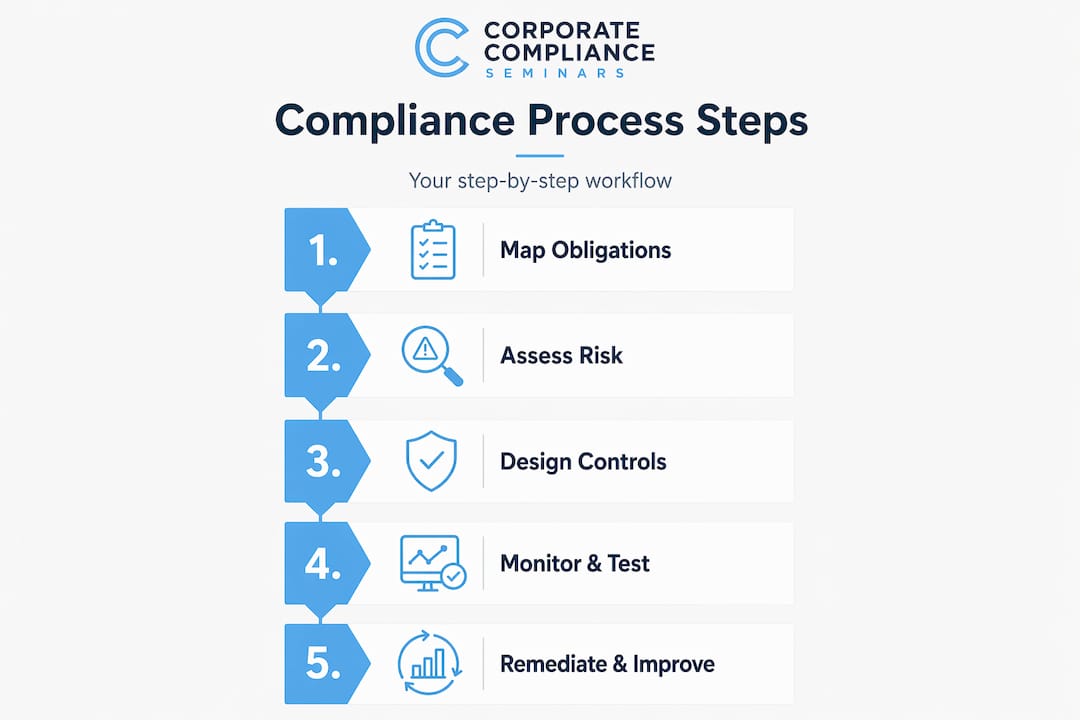
Executing the core compliance steps
This is where preparation converts into practice. The detailed compliance steps below follow a logical sequence: design your controls, embed them in business processes, and document everything with audit-ready evidence.
Define control objectives. For each regulatory obligation, write a clear statement of what your control is supposed to prevent or detect. A control objective for BSA/AML might read: “Detect and report suspicious transactions above $10,000 within required timeframes.” This precision prevents vague controls that satisfy no one.
Design preventive, detective, and corrective controls. Preventive controls stop violations before they occur. Detective controls identify them after the fact. Corrective controls remediate identified issues. Most effective compliance programs use all three types in combination because no single layer catches everything.
Embed controls into existing business processes. A control that lives outside the actual workflow will be bypassed under pressure. Work with operations and business unit leaders to integrate compliance checkpoints into the processes employees already use. An onboarding compliance check embedded in the CRM is far more effective than a separate manual review step.
Build a control matrix. Create a document that maps each control to its governing regulation, the responsible owner, the evidence required, and the testing frequency. This matrix becomes your single source of truth during audits and is central to any credible compliance process overview.
Capture evidence at the point of execution. Evidence collected after the fact is always weaker than evidence generated during the control activity. Configure your systems to automatically log approvals, timestamps, and exception reports. Complex regulatory environments, such as those governed by the EU AI Act, now require immutable audit trails for high-risk processes.
Leverage technology for automation. Manual compliance processes do not scale. Workflow tools, GRC platforms, and monitoring software reduce human error and create consistent, repeatable execution. Review 2026 financial compliance trends to understand where automation is delivering the most impact for compliance teams right now.
Review and update the control design. Business processes change. Regulations change. Schedule a formal control design review at least annually, and trigger ad hoc reviews after significant organizational or regulatory changes.
Pro Tip: Do not design controls in isolation. Involve the business unit manager responsible for the process. They know where workarounds happen and where your carefully designed control will get bypassed.
The comparison table below illustrates the difference between a weak and a strong control design.
Control attribute | Weak design | Strong design |
Objective | “Prevent fraud” | “Block ACH transfers over $50,000 without dual authorization” |
Evidence | Policy document exists | System-generated dual approval log with timestamps |
Ownership | Compliance department | Named process owner in the business unit |
Testing frequency | Annual | Quarterly for high-risk controls |
Monitoring, testing, and continuous improvement
Designing and implementing controls is not the finish line. A regulatory compliance process without active monitoring is a compliance program on paper only.

Understanding the difference between monitoring and testing
Monitoring identifies procedural weaknesses proactively through ongoing observation, while audits independently verify compliance adherence. Monitoring is frequent and less formal. Testing is a discrete evaluation, often required by specific regulations such as BSA/AML, and it must be conducted by someone independent of the controls being tested.
Many compliance officers conflate the two, which creates a false sense of security. You can monitor a control every day and still miss a systemic issue that only a structured test would reveal.
Building a risk-stratified monitoring cadence
Not every control needs the same level of scrutiny. Use your risk assessment to assign monitoring frequency.
High-risk controls: Monitor monthly or continuously with automated alerts; test quarterly.
Medium-risk controls: Monitor quarterly; test semi-annually.
Low-risk controls: Monitor semi-annually; test annually.
The NIST RMF continuous monitoring framework uses a structured task sequence, from system change tracking through control assessment and authorization, to maintain compliance posture over time. This applies well beyond cybersecurity. The logic of tracking changes, assessing impact, and reauthorizing decisions is directly transferable to financial and operational compliance programs.
Escalation and remediation protocols
Every monitoring finding needs a documented path forward. Define escalation thresholds in advance: which issues go to the business unit manager, which go to the Chief Compliance Officer, and which require board or audit committee notification.
Remediation is not optional, and it is not a checkbox. Testing programs that evolve with business changes and regulatory expectations gain credibility with regulators precisely because they show a closed loop from finding to fix to retest. Document every remediation action and every retest result. That paper trail is your defense when regulators ask what you did about a problem you found.
Monitoring element | Frequency | Owner | Output |
Automated control alerts | Continuous | System/GRC platform | Real-time exception reports |
Business unit self-assessment | Quarterly | Process owner | Attestation with supporting evidence |
Independent compliance testing | Varies by risk tier | Compliance testing team | Written test report |
Audit committee reporting | Semi-annually | Chief Compliance Officer | Dashboard with findings and remediation status |
Common pitfalls and how to avoid them
Even well-resourced compliance programs can erode over time. The following patterns are the most common causes of program failure, and each one is preventable.
Static programs that do not adapt. Regulations change. Business models change. A compliance program calibrated to your 2023 risk profile may completely miss risks that emerged in 2025. Schedule at least an annual program-level review against your current regulatory inventory and business activities.
Check-the-box documentation. Documentation without substantive evidence is viewed by regulators as non-existent. A policy that says employees complete anti-money laundering training is worthless without the completion records, assessment scores, and attestations to back it up.
Lack of testing independence. Independent testing must be separate from those responsible for the controls being tested. Having a business unit test its own controls is the compliance equivalent of grading your own exam. Regulators know what that looks like.
Ignoring emerging risks. AI governance is now a live compliance concern. The EU AI Act and related frameworks require organizations deploying AI in high-risk functions to maintain immutable audit trails and conduct regular impact assessments. Compliance guidelines that ignore technology risk are already outdated.
Underinvesting in compliance culture. Training and communication matter, but only when they reflect reality. Role-specific, scenario-based training tied to actual business processes is far more effective than a generic annual e-learning module.
“Compliance is a dynamic strategic goal requiring ongoing oversight and adaptation. Testing must target actual business workflows, not just policy existence, to identify risks effectively.” (What Makes a Great Compliance Testing Program)
My take on what actually moves the needle in compliance
I have seen compliance programs that looked impressive in a binder and collapsed during a regulatory examination. I have also seen leaner programs that held up because they were built on honest risk assessment and real evidence.
What separates them is not budget. It is discipline. The organizations that sustain defensible compliance programs treat the process as a living system. They revisit their risk assessments when the business changes, not just when the regulator asks. They push for genuine independence in testing, even when that creates friction with business unit leaders. And they invest in documentation that actually reflects what happened, not what was supposed to happen.
In my experience, the biggest obstacle is executive attention. Compliance officers often struggle to communicate program value to leadership until something goes wrong. My advice: frame compliance reporting in the language of risk exposure and financial consequence, not process milestones. A board that understands what a BSA/AML finding costs in fines, remediation, and reputational damage will fund your program differently.
Technology helps, but it does not substitute for judgment. Automation captures evidence and flags exceptions, but a compliance officer still needs to interpret findings, escalate appropriately, and push for real remediation. The essential tips for compliance officers that I keep returning to are the ones grounded in accountability: own your program, defend your findings, and never let documentation become theater.
— John
Strengthen your compliance program with targeted CPE training
Building and sustaining a defensible compliance program requires more than internal process work. Regulations shift, enforcement priorities change, and new frameworks like the NIST RMF updates and AI governance rules demand that compliance professionals stay current.
Compliance-seminars offers CPE-accredited training designed specifically for compliance officers, internal auditors, and financial professionals. Whether you prefer live webinars or in-person events, the curriculum covers SOX, BSA/AML, COSO, NIST, and emerging compliance topics delivered by instructors with real-world Big 4 experience. Browse the 2026 CPE event calendar to find upcoming in-person training sessions in your city, or explore compliance webinar credits for flexible learning that fits your schedule. Your compliance program is only as strong as the knowledge behind it.
FAQ
What are the core steps in a compliance process?
A defensible compliance process includes regulatory obligation mapping, risk assessment, control design and implementation, documentation, monitoring, independent testing, remediation, and program evaluation. Seven core elements are recognized as standard for effective compliance management systems in 2026.
How is compliance monitoring different from compliance testing?
Monitoring is ongoing, informal observation designed to catch procedural weaknesses early. Testing is a discrete, independent evaluation, often required by specific regulations like BSA/AML, and it produces formal written findings. Both are necessary and serve different purposes in a complete compliance process overview.
How often should compliance controls be tested?
Testing frequency should follow a risk-stratified approach: high-risk controls quarterly, medium-risk semi-annually, and low-risk annually. Risk-aligned, evidence-based testing that integrates with remediation cycles gains the highest credibility with regulators.
Why do compliance programs fail audits despite having documentation?
Documentation alone is not evidence. Regulators require proof that controls actually operated as described. Policies, training completion records, approval logs, and exception reports must all exist and be traceable to specific activities. A program that documents intentions rather than actual execution will fail examination.
What role does the NIST RMF play in a compliance process?
The NIST SP 800-37 Rev. 2 framework provides a seven-step lifecycle for managing cybersecurity-related compliance risk, and its logic applies broadly to any risk-based compliance program. The “Prepare” step, which establishes organizational context and risk tolerance, is particularly valuable as a foundation before executing any detailed compliance steps.
Recommended
Comments