What is operational auditing? A comprehensive 2026 guide


Many audit professionals mistakenly believe operational auditing is just compliance checking, but it actually drives strategic operational improvements and risk management. This guide clarifies operational auditing concepts, frameworks, and implementation. You’ll learn how it differs from financial and compliance audits, which frameworks guide best practices, and how to conduct operational audits that deliver measurable results.
Table of Contents
Key takeaways
Point | Details |
Strategic focus | Operational auditing evaluates efficiency, effectiveness, and risk management beyond financial accuracy. |
Established frameworks | Uses COSO, ISO 19011, and IIA standards to guide systematic audit approaches. |
Clear differentiation | Differs from financial and compliance audits in objectives and scope. |
Systematic process | Implementation follows planning, risk assessment, fieldwork, reporting, and follow-up phases. |
Measurable benefits | Delivers up to 25% cost savings and 15% efficiency improvements. |
Introduction to operational auditing
Operational auditing is a systematic, independent evaluation of business processes and practices. It examines how well your organization uses resources, manages risks, and achieves objectives. Unlike financial audits focused on statement accuracy, operational audits dig into the efficiency, effectiveness, and economy of operations.
This audit type supports organizational governance by identifying operational risks and improvement opportunities. You gain insights into process bottlenecks, resource waste, and control weaknesses that financial audits might miss. The scope extends beyond compliance to strategic operational performance.
Think of operational auditing as your organization’s performance diagnostic tool. It answers questions like: Are we using resources optimally? Do our processes achieve intended outcomes? Where are hidden risks lurking? These insights drive real operational improvements.
Core focus areas include:
Efficiency: measuring resource use against outputs
Effectiveness: evaluating goal achievement and outcome quality
Economy: assessing cost management and value for money
Risk management: identifying operational vulnerabilities and control gaps
Process optimization: finding improvement opportunities across functions
Operational audits complement financial and compliance audits. They provide the operational intelligence that helps you optimize performance while maintaining controls and compliance.
Core frameworks and standards guiding operational audits
Successful operational audits rely on established frameworks that ensure consistency and rigor. Understanding these standards helps you conduct audits that meet professional quality criteria and deliver reliable insights.
The COSO Internal Control Framework provides the foundation for evaluating control environments. Its five components (control environment, risk assessment, control activities, information and communication, monitoring) guide how you assess operational controls. You’ll evaluate whether controls effectively mitigate operational risks and support efficiency goals.

ISO 19011 offers internationally recognized guidelines for auditing management systems, supporting process audits aligned with quality standards. This framework emphasizes audit planning, competence, and evidence gathering. It’s particularly valuable when auditing quality management, environmental systems, or operational processes requiring systematic evaluation.
The Institute of Internal Auditors (IIA) provides specific guidance for internal auditors conducting operational reviews. IIA standards emphasize independence, objectivity, and professional competence. They outline how to plan audits, communicate findings, and follow up on recommendations effectively.
Framework | Primary Focus | Key Application |
COSO | Internal control components | Control environment and risk assessment |
ISO 19011 | Management system audits | Process evaluation and quality standards |
IIA Standards | Professional audit practice | Independence, objectivity, and reporting |
COBIT | IT governance and controls | Technology and information system audits |
Integrating these frameworks creates thorough audit programs. You’ll assess risks systematically, evaluate controls comprehensively, and deliver findings that stakeholders trust. The frameworks also support your internal audit standards compliance and professional development.
Pro Tip: Map your audit procedures to specific framework components. This documentation demonstrates audit rigor and helps explain your methodology to auditees and stakeholders.
You can find detailed guidance in examples of auditing standards and official ISO 19011 guidelines published by the International Organization for Standardization.
How operational auditing differs from financial and compliance audits
Understanding audit type differences prevents confusion and helps you set appropriate expectations. Each audit type serves distinct purposes with unique objectives and methodologies.
Operational audits primarily evaluate efficiency, risk, and process effectiveness. You’re looking for operational improvements, not just error detection. The focus is forward-looking: how can operations improve? What risks need mitigation? Where are efficiency opportunities?
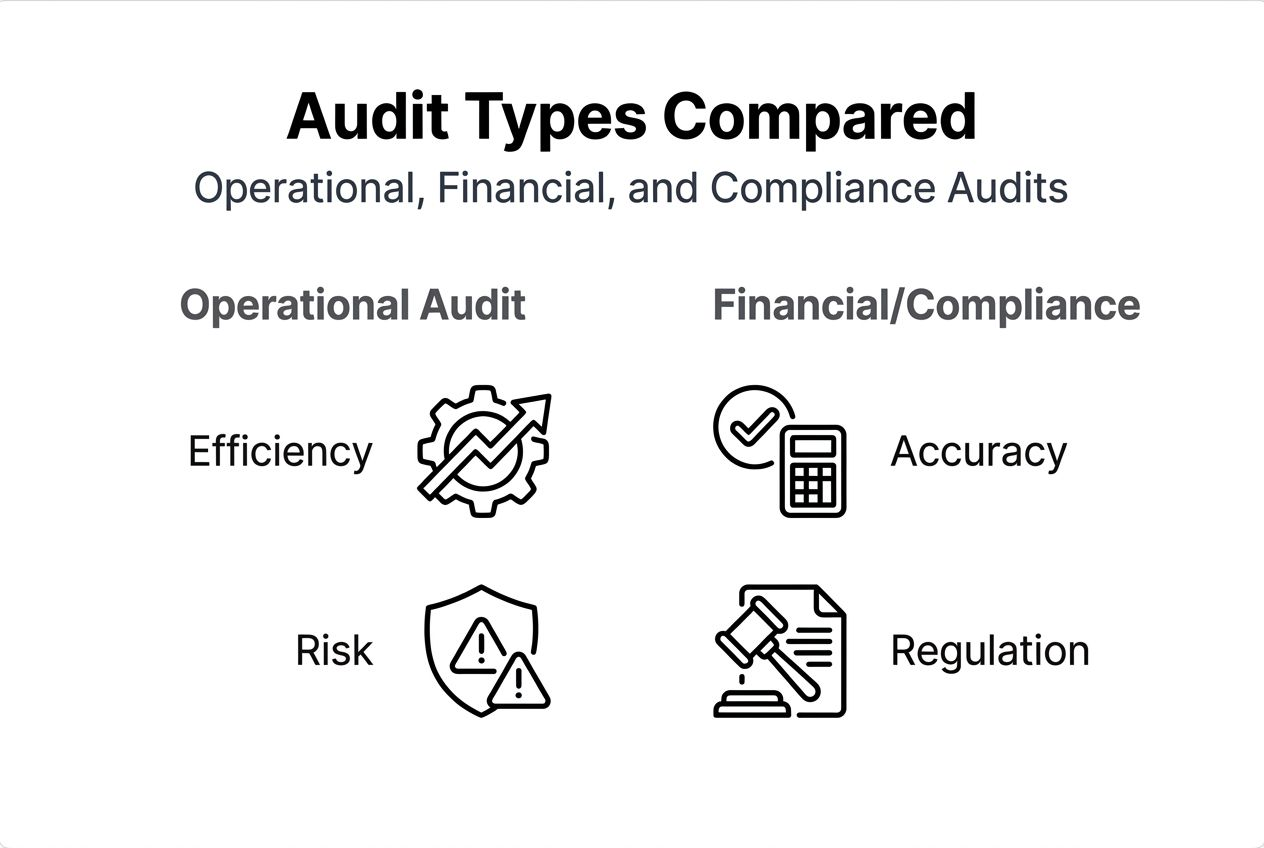
Financial audits focus on financial statement accuracy and detecting material misstatements. External auditors examine whether financial reports fairly represent the organization’s position. The objective is assurance on financial accuracy, not operational performance.
Compliance audits assess adherence to laws, policies, and regulatory requirements. You verify whether the organization follows applicable rules and internal policies. Success means demonstrating compliance, not necessarily operational excellence.
Audit Type | Primary Objective | Typical Focus Areas | Output |
Operational | Improve efficiency and effectiveness | Process performance, resource use, risk management | Improvement recommendations |
Financial | Verify financial accuracy | Account balances, transactions, financial statements | Opinion on financial statements |
Compliance | Confirm regulatory adherence | Policy compliance, legal requirements, controls | Compliance status report |
IT | Assess technology controls | System security, data integrity, IT governance | Technology risk assessment |
Operational audits complement rather than replace other audit types. An organization needs financial accuracy verified through financial audits. Regulatory compliance requires compliance audits. But operational excellence demands operational audits focused on performance improvement.
Consider these examples:
An operational audit examines whether procurement processes minimize costs while maintaining quality
A financial audit verifies procurement expenses are accurately recorded
A compliance audit confirms procurement follows policy and legal requirements
The operational audit might reveal that decentralized purchasing costs 15% more than centralized approaches. That insight drives operational change. Financial and compliance audits wouldn’t identify this efficiency opportunity.
Learn more about audit applications in why audit matters in financial services and compliance audit best practices.
Common misconceptions about operational auditing
Several misunderstandings reduce operational audit effectiveness. Addressing these misconceptions improves audit quality and organizational value.
Misconception one: operational auditing is only compliance checking. This confusion stems from seeing all audits as compliance focused. Reality: operational audits examine efficiency and effectiveness, not just rule following. You’re finding improvement opportunities, not just violations.
Misconception two: operational audits are similar or secondary to financial audits. Some professionals view operational audits as less rigorous or important. Truth: operational audits require equal rigor with different focus. They demand deep process understanding and analytical skills that financial audits don’t emphasize.
Misconception three: operational audits cannot produce measurable outcomes. Skeptics claim operational improvements are too subjective to quantify. Evidence proves otherwise: operational audits consistently deliver measurable cost savings, efficiency gains, and risk reductions.
Key clarifications:
Operational audits have broader scope than compliance reviews, examining entire value chains
They deliver strategic insights that financial audits miss by design
Measurable benefits include 10 to 25% cost reductions and 15% efficiency improvements
Operational audits identify risks before they become financial or compliance failures
They support continuous improvement culture beyond one time compliance checks
Pro Tip: When explaining operational audit value to stakeholders, lead with specific examples of cost savings and efficiency gains from past audits. Concrete results overcome misconceptions faster than theoretical explanations.
Recognizing these misconceptions helps you communicate audit value effectively. You’ll set appropriate expectations and gain stakeholder support for operational audit programs.
Step-by-step guide to conducting an operational audit
Executing effective operational audits requires systematic methodology. Follow these phases to deliver valuable audit outcomes.
Planning and risk assessment
Start by understanding organizational objectives and identifying highest risk areas. You’ll review strategic plans, prior audits, and performance data to focus your audit scope. Risk assessment determines which processes, functions, or departments need evaluation.
Develop your audit plan with clear objectives, scope boundaries, and resource requirements. Define what success looks like and how you’ll measure it. Engage stakeholders early to understand their concerns and expectations.
Understanding business processes and controls
Map the processes you’re auditing through interviews, observations, and document reviews. You need comprehensive understanding before evaluating effectiveness. Identify key controls, decision points, and performance metrics.
Document process flows and control points. This baseline understanding helps you spot inefficiencies and control gaps during fieldwork.
Fieldwork and evidence collection
Gather objective evidence through testing, sampling, and data analysis. You’ll conduct interviews, observe operations, and review documentation. Focus on evidence that supports findings and recommendations.
Use data analytics to identify patterns, anomalies, and improvement opportunities. Quantify issues whenever possible. Strong evidence makes findings undeniable and recommendations actionable.
Reporting findings with actionable recommendations
Communicate findings clearly with root cause analysis and practical recommendations. Your report should explain what’s wrong, why it matters, and how to fix it. Prioritize recommendations by impact and implementation difficulty.
Structure findings to facilitate management action. Include costs of inaction and benefits of implementation. Make recommendations specific enough that management knows exactly what to do.
Follow-up and continuous improvement
Track implementation of recommendations and verify effectiveness. Follow up ensures audit value translates to operational improvements. Document lessons learned to enhance future audits.
Best practice insights:
Avoid confusing operational audits with compliance reviews during scoping
Don’t neglect risk assessment in your eagerness to start fieldwork
Engage process owners throughout the audit to build buy in
Quantify findings whenever possible to demonstrate impact
Balance criticism with recognition of what’s working well
Explore detailed guidance in our effective internal audit success guide, step-by-step risk assessment guide, and internal audit process guide. Professional development through resources like develop a CPE training program strengthens audit skills. Master reporting techniques with internal audit reporting process 2026.
Quantified benefits and real-world case studies
Operational audits deliver tangible returns that justify investment. Data from organizations worldwide demonstrates consistent benefits across industries and audit types.
Cost savings represent the most visible benefit. Organizations typically achieve 10 to 25% cost reductions in audited processes within the first year. These savings come from eliminating waste, optimizing resource allocation, and improving procurement practices.
Efficiency improvements average 15% following audit recommendation implementation. Process cycle times decrease, resource utilization improves, and output quality increases. These gains compound over time as organizations embed operational excellence practices.
Benefit Category | Typical Range | Implementation Timeframe | Sustainability |
Cost savings | 10 to 25% | 6 to 12 months | High with monitoring |
Efficiency gains | 12 to 18% | 3 to 9 months | High with culture change |
Error reduction | 20 to 35% | 6 to 12 months | Very high with controls |
Risk mitigation | Varies by risk | Immediate to 12 months | High with governance |
A manufacturing company’s operational audit revealed redundant quality inspections costing $2.3 million annually. Streamlining inspection protocols reduced costs by 22% while maintaining quality standards. The audit also identified equipment maintenance inefficiencies contributing to 18% unplanned downtime.
A financial services firm’s operational audit found loan processing took 40% longer than industry benchmarks. Process redesign reduced cycle time by 30% and improved customer satisfaction scores by 25 points. The efficiency gain enabled the firm to handle 35% more volume without additional staff.
“Operational audits transformed how we think about performance. We moved from reactive problem solving to proactive improvement. The audit team identified $4.7 million in annual savings we hadn’t seen despite years of cost cutting efforts.”
Chief Operating Officer, Healthcare System
Risk mitigation benefits are harder to quantify but equally valuable. Operational audits identify control weaknesses before they cause financial losses or compliance failures. Early detection of operational risks prevents costly incidents.
Process failure reduction averages 25 to 35% after implementing audit recommendations. Fewer errors mean lower rework costs, better customer experiences, and reduced compliance risks. These improvements strengthen organizational resilience.
Conclusion and practical takeaways
Operational auditing drives organizational performance beyond what financial and compliance audits deliver. You’ve learned how it differs from other audit types, which frameworks guide professional practice, and how to conduct audits that produce measurable results.
Key insights to remember:
Operational auditing systematically evaluates efficiency, effectiveness, and risk management
COSO, ISO 19011, and IIA standards provide the frameworks for rigorous audits
Operational audits complement financial and compliance audits with unique performance focus
Systematic methodology from planning through follow-up ensures audit value
Benefits include 10 to 25% cost savings and 15% efficiency improvements
Successful operational auditors continuously refine their skills and methodologies. You need strong analytical abilities, process expertise, and communication skills to deliver audit value. Professional development through training and certification maintains your competence.
Apply these concepts to enhance your audit effectiveness. Start with risk assessment to focus on high impact areas. Use established frameworks to ensure rigor. Deliver recommendations that management can implement. Follow up to verify results.
Operational auditing represents a strategic opportunity to add organizational value. Your insights can transform operations, reduce costs, and strengthen risk management. Embrace continuous improvement in your audit practice to maximize impact.
Explore compliance seminars and training opportunities
Advance your operational auditing expertise through professional training designed for audit practitioners. Our 2026 CPE event calendar features in-person seminars across major cities covering operational audit methodologies and best practices.
Stay current with emerging audit techniques through our internal auditor CPE webinars, offering flexible learning on specialized topics. Whether you’re new to operational auditing or refining advanced skills, our internal auditing 101 basics training provides NASBA-approved CPE credits that support your professional development and credential maintenance.
Frequently asked questions
What is the primary goal of operational auditing?
The primary goal is assessing and improving organizational efficiency, effectiveness, and risk management beyond financial accuracy. Operational audits focus on identifying improvement opportunities and control weaknesses that enhance operational performance.
When should an organization opt for an operational audit instead of a financial audit?
Choose operational audits when focusing on process efficiency, effectiveness, and managing operational risks. They’re especially valuable for organizations seeking cost savings and performance improvements rather than just financial statement accuracy.
What are common misconceptions about operational auditing?
Many believe operational auditing is only compliance checking or identical to financial auditing. Others think it lacks measurable benefits. Reality: operational audits deliver quantifiable improvements in efficiency and cost management distinct from compliance reviews.
How does ISO 19011 support operational auditing?
ISO 19011 offers principles and guidance for conducting management system audits, helping auditors perform process-focused operational audits with recognized quality standards. It provides internationally accepted methodology for systematic audit approaches. Reference the official ISO 19011 guidelines for detailed implementation guidance.
Recommended
Comments