Why Audit Matters for Financial Services Compliance


Regulatory demands in the American financial services sector often seem relentless, pushing chief audit executives and internal auditors to rethink their compliance strategies. Robust audit practices are not just about verifying financial statements—they are about maintaining trustworthy operations and upholding accountability. This article breaks down the core purpose of audits, highlights systematic, independent examinations, and shows how effective frameworks drive compliance and transparency where it matters most.
Table of Contents
Key Takeaways
Point | Details |
Core Purpose of Audits | Audits ensure financial integrity and compliance through systematic evaluations of financial records and internal controls. |
Types of Audits | Key audit types include External Audits, Internal Audits, Regulatory Compliance Audits, and Operational Audits, each serving unique functions in risk management. |
Regulatory Standards | Adherence to standards like GAAP and SEC guidelines is critical for transparency and consistency in financial reporting. |
Professional Skepticism | Auditors must maintain professional skepticism and challenge assumptions to ensure thorough examination of financial documentation and operational integrity. |
Core Purpose and Definition of Audit
Audits serve as critical mechanisms for ensuring financial integrity, regulatory compliance, and organizational accountability across industries. At their core, audits represent systematic, independent examinations of an organization’s financial records, operational processes, and internal control mechanisms designed to verify accuracy, assess risk, and validate adherence to established standards.
Financial services audits focus on several key objectives:
Verifying the accuracy and completeness of financial statements
Assessing internal control effectiveness
Identifying potential risks and compliance vulnerabilities
Ensuring regulatory alignment with industry standards
Providing objective, third-party validation of organizational practices
Government audits ensure accountability by independently evaluating financial records and operational processes. These comprehensive reviews go beyond mere number-checking, providing a critical lens through which organizations can improve their performance, transparency, and trustworthiness.
The audit process typically involves multiple stages of meticulous examination, including planning, fieldwork, documentation review, risk assessment, and comprehensive reporting. Auditors must maintain professional skepticism, independence, and objectivity throughout their evaluations, ensuring their findings provide genuine insight rather than superficial compliance.
Pro tip: Develop a robust understanding of industry-specific audit standards and maintain consistent documentation to streamline future audit processes.
Types of Audits in Financial Services
Financial services organizations engage in multiple types of audits to ensure comprehensive risk management, regulatory compliance, and operational excellence. Government auditing standards recognize three primary audit types that provide critical insights into organizational performance and integrity.
Types of Financial Services Audits include:
External Audits: Independent reviews conducted by third-party accounting firms
Internal Audits: Systematic evaluations performed by an organization’s dedicated audit department
Regulatory Compliance Audits: Specialized assessments ensuring adherence to industry-specific regulations
Financial Statement Audits: Detailed examinations of financial reporting accuracy
Operational Audits: Evaluations of organizational efficiency and process effectiveness
External audits represent the most rigorous form of financial examination, where independent certified public accountants thoroughly review an organization’s financial statements, internal controls, and accounting practices. These audits provide stakeholders with an objective assessment of the organization’s financial health and reporting accuracy.
Internal audits play a crucial role in proactive risk management, focusing on identifying potential vulnerabilities, improving operational processes, and ensuring internal control mechanisms are functioning effectively. Unlike external audits, these reviews are conducted by the organization’s own audit team, allowing for continuous monitoring and immediate corrective actions.
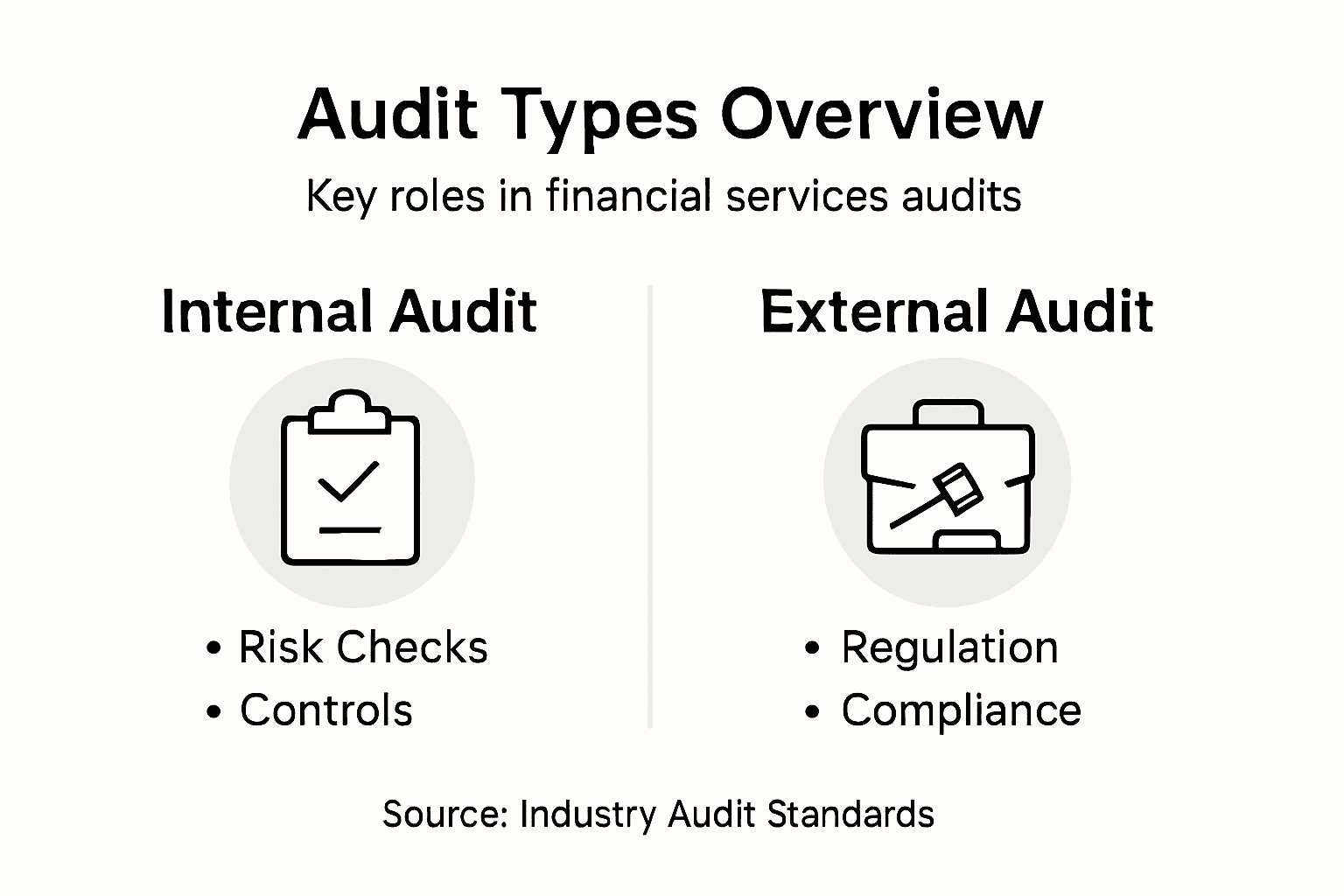
Here’s a quick comparison of major audit types and their unique business impacts:
Audit Type | Who Conducts It | Main Focus | Business Impact |
External Audit | Third-party accountants | Financial accuracy review | Builds stakeholder trust |
Internal Audit | Company audit team | Process improvement | Enhances operational efficiency |
Regulatory Compliance | Specialized auditors | Industry standards | Avoids legal penalties |
Operational Audit | Internal or external | Efficiency assessment | Drives productivity gains |
Pro tip: Implement a comprehensive audit calendar that rotates different audit types throughout the year to maintain continuous compliance and risk management.
Audit Process and Regulatory Standards
Accounting and auditing standards for financial services create a comprehensive framework that ensures transparency, accountability, and consistent financial reporting across different sectors. These standards serve as critical guidelines that govern how financial information is examined, validated, and presented to stakeholders.
Key Regulatory Standards and Frameworks include:
Generally Accepted Accounting Principles (GAAP)
Securities and Exchange Commission (SEC) guidelines
Generally Accepted Auditing Standards (GAAS)
Public Company Accounting Oversight Board (PCAOB) regulations
International Financial Reporting Standards (IFRS)
The audit process typically involves a systematic approach with multiple interconnected stages designed to provide comprehensive assessment and validation. These stages encompass initial planning, risk assessment, detailed testing of financial records, evaluation of internal controls, and comprehensive reporting of findings.

External regulatory bodies like the SEC play a crucial role in maintaining the integrity of financial reporting. They establish and enforce standards that require publicly traded companies to undergo independent external audits, ensuring that financial disclosures meet rigorous transparency and accuracy requirements. This oversight helps protect investors and maintain confidence in financial markets by promoting consistent and reliable financial reporting practices.
This reference table summarizes key regulatory bodies and their core responsibilities in financial auditing:
Regulatory Body | Core Function | Impact on Financial Reporting |
SEC | Oversees public companies | Enforces reporting transparency |
PCAOB | Sets audit standards | Monitors auditor performance |
FASB (GAAP) | Defines accounting principles | Guides financial statement accuracy |
IASB (IFRS) | Sets international standards | Supports global comparability |
Pro tip: Develop a robust documentation system that tracks regulatory changes and aligns your audit processes with the most current compliance standards.
Key Roles and Responsibilities in Auditing
Auditors have critical responsibilities that extend far beyond simple financial record checking. Their primary mandate involves providing independent, objective assessments of an organization’s financial health, internal controls, and operational effectiveness.
Core Responsibilities of Financial Auditors include:
Conducting comprehensive financial statement reviews
Assessing organizational risk management processes
Identifying potential compliance vulnerabilities
Maintaining strict professional independence
Communicating findings objectively to stakeholders
Ensuring transparency in financial reporting
Auditors must exercise professional skepticism throughout their engagement, critically examining financial documentation and challenging assumptions that might indicate potential misstatements or irregularities. This approach requires a delicate balance between thoroughness and objectivity, demanding both technical expertise and critical analytical skills.
In financial services, auditors navigate complex challenges including evolving regulatory landscapes, sophisticated technological ecosystems, and increasingly complex financial instruments. They serve as crucial gatekeepers, providing assurance that financial representations accurately reflect an organization’s true financial condition and operational integrity.
Pro tip: Develop a continuous learning strategy that keeps you updated on emerging regulatory changes and technological innovations in financial auditing.
Audit Risks, Pitfalls, and Best Practices
Audit procedures often fail to adequately address fraud risks, creating significant vulnerabilities in financial oversight. These shortcomings can emerge from standard approaches that lack depth, specificity, and critical analysis of potential irregularities.
Common Audit Risks and Challenges include:
Insufficient fraud detection mechanisms
Overlooking complex financial transactions
Inadequate documentation of risk assessments
Limited understanding of technological complexities
Lack of continuous professional development
Potential conflicts of interest
Professional skepticism represents the most critical defense against audit failures. Auditors must consistently challenge assumptions, dig deeper into financial documentation, and maintain an independent perspective that goes beyond surface-level compliance checks. This approach requires a combination of technical expertise, analytical thinking, and a commitment to uncovering potential misstatements.
Technology and regulatory landscapes are constantly evolving, demanding that auditors adapt their strategies continuously. Financial services organizations must implement robust control frameworks that leverage advanced technological tools, maintain ongoing training programs, and create cultures of transparency and accountability.
Pro tip: Develop a systematic approach to continuous learning that includes regular training on emerging fraud detection techniques and technological innovations in financial auditing.
Strengthen Your Financial Services Audit Skills Today
Auditing financial services is complex with evolving regulatory demands, intricate fraud risks, and the critical need for professional skepticism. This article highlights challenges like overcoming insufficient fraud detection, navigating GAAP and SEC standards, and maintaining independent, objective assessments. If you aim to master these audit pitfalls and boost your compliance expertise, targeted professional education is essential.
Take control of your audit effectiveness by exploring comprehensive Continuing Professional Education courses at Compliance Seminars. Our live webinars, in-person seminars, and flexible training options focus on core topics such as internal and external auditing, regulatory compliance frameworks, and emerging fraud detection methods. Designed for auditors, compliance officers, and risk managers, these programs empower you to stay ahead of regulatory changes and enhance your audit precision. Start advancing your skills with industry experts today and ensure your organization’s financial services audits exceed expectations. Visit https://compliance-seminars.com to view upcoming courses and register now.
Frequently Asked Questions
What is the primary purpose of an audit in financial services?
Audits serve as independent evaluations to verify the accuracy of financial statements, assess internal control effectiveness, identify risks, and ensure compliance with regulatory standards.
What are the different types of audits conducted in financial services?
The most common types include external audits, internal audits, regulatory compliance audits, financial statement audits, and operational audits, each focusing on different aspects of financial integrity and performance.
Why is professional skepticism important in the audit process?
Professional skepticism is crucial as it encourages auditors to critically assess financial documentation and challenge assumptions, helping to uncover potential misstatements or irregularities.
How can organizations enhance their auditing processes?
Organizations can improve auditing by developing a comprehensive audit calendar, maintaining robust documentation systems, implementing advanced technology for risk management, and promoting continuous professional development among auditors.
Recommended
Comments