Why audit analytics matters: transforming modern auditing


TL;DR:
Audit analytics enables complete population testing, improving risk detection and fraud identification.
Regulators now require full-population analysis and documented methodology, moving away from sampling.
Successful implementation relies on data quality, staff training, and integrating technology within audit processes.
Traditional audit sampling is a calculated bet. You test a fraction of transactions and hope the sample represents reality well enough to draw reliable conclusions. But what happens when the most significant fraud, the riskiest journal entry, or the largest control failure sits precisely in the slice of data you never tested? Audit analytics enables 100% population analysis rather than relying on samples, which means better coverage, sharper risk detection, and stronger fraud identification. This guide explains why audit analytics has become the new gold standard for assurance and what it means for your practice right now.
Table of Contents
Key Takeaways
Point | Details |
Full-population analysis | Audit analytics can test every transaction, not just random samples, increasing risk detection. |
Regulatory momentum | New PCAOB and AICPA standards increasingly require the use of analytics in audit programs. |
Efficiency and effectiveness | Analytics reduces audit hours, cuts costs, and improves fraud detection. |
Proper implementation needed | Success relies on quality data, well-governed tools, and staff training—not just software. |
The basics: What is audit analytics and why is it different?
Audit analytics is the structured use of technology to examine entire datasets, identify patterns, flag anomalies, and support evidence-based conclusions. It is not simply running a query or sorting a spreadsheet. It combines data extraction, transformation, statistical analysis, and visualization into a repeatable, documentable process that scales in ways manual review never could.
The contrast with traditional methods is stark. Classic audit approaches rely on stratified or random sampling, which means auditors test maybe 5% to 15% of a transaction population and extrapolate findings across the whole. This method has served the profession for decades, but it carries an inherent blind spot: outliers and anomalies tend to hide in the untested majority. A vendor payment slightly below the approval threshold, a journal entry posted at 11:58 PM on a Friday, a recurring duplicate invoice just different enough to avoid a match. These patterns escape sampling-based reviews with alarming regularity.
Audit analytics transforms how auditing works by enabling continuous control monitoring, automated red-flag detection, and pattern recognition across millions of records. Instead of hoping your sample is representative, you know you have reviewed the full population.
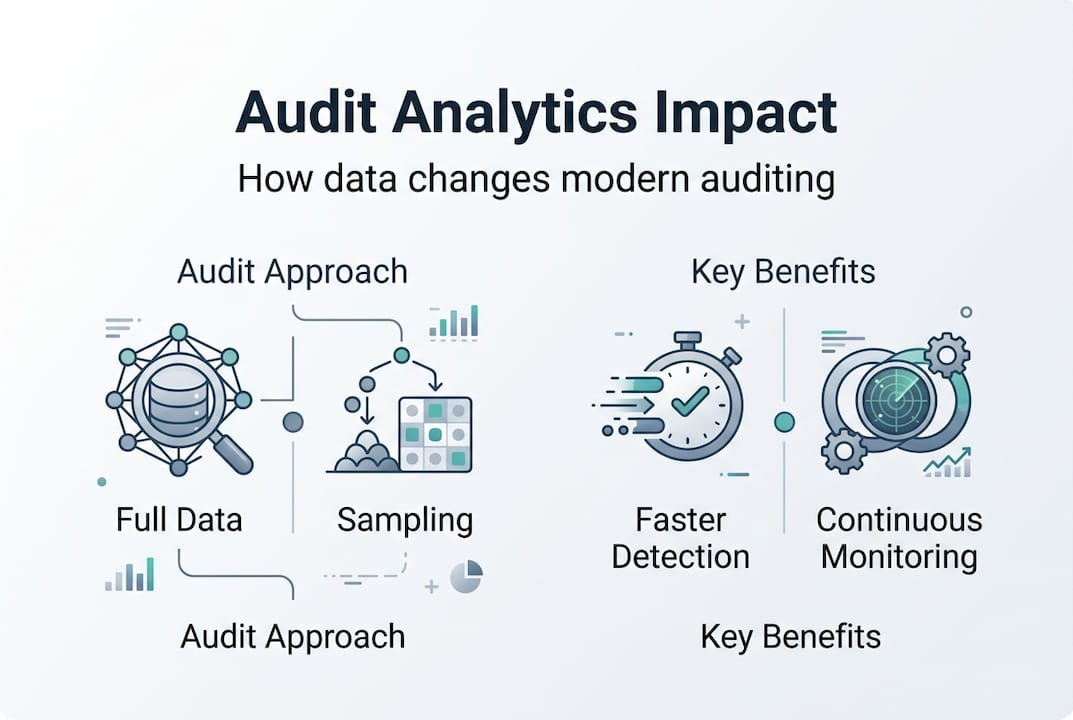
Here is a straightforward comparison to anchor the concept:
Feature | Traditional sampling | Audit analytics |
Population coverage | 5%–15% | 100% |
Anomaly detection | Limited by sample | Systematic and automated |
Fraud identification | Reactive | Proactive, pattern-based |
Scalability | Manual effort increases with volume | Technology scales with data |
Documentation | Paper-based, manual | Digital, reproducible |
“The shift from sample-based to population-based testing is not a technical upgrade. It is a fundamental change in how auditors define ‘sufficient appropriate evidence.’”
The core capabilities of audit analytics include:
Continuous monitoring: Automated routines that flag control exceptions as transactions occur, rather than during a periodic audit cycle
Benford’s Law analysis: Statistical testing to detect manipulated numbers in financial datasets based on expected digit frequency distributions
Duplicate detection: Matching algorithms that identify identical or near-identical transactions that manual review would miss
Trend and variance analysis: Comparing account balances, ratios, and transaction volumes against historical benchmarks to surface meaningful deviations
Journal entry testing: Systematic review of all journal entries for unusual characteristics, timing, or authorizations
Strong audit management strategies now incorporate these capabilities as baseline requirements, not optional enhancements.
Standards and evidence: What do regulators expect now?
Understanding the definition and key advantages, the next natural question is: what do the latest standards and your regulators actually require?
The answer is more demanding than many practitioners realize. PCAOB standards AS 1105 and AS 2315 now encourage technology-assisted analysis, full-population testing when feasible, and stronger evidence for journal entries and fraud risks. The AICPA’s updated guidance follows a parallel track, pushing auditors to document why they chose not to use available technology when relevant data was accessible and the tools were at hand.
This shift matters enormously. What was once considered best practice is now inching toward expected practice in peer reviews, inspection findings, and quality control evaluations. Auditors who continue to default to manual sampling without considering whether analytics is feasible are increasingly exposed to criticism.
Here is a comparison of the old versus current expectation landscape:
Standard area | Pre-analytics expectation | Current expectation |
Journal entry testing | Sample-based review | Technology-assisted full population |
Fraud risk procedures | Inquiry and observation | Analytics-supported anomaly detection |
Evidence quality | Representative sampling | Full-population documentation where feasible |
Documentation | Judgment-based rationale | Explicit methodology documentation |
To stay aligned with current standards, most audit teams need to make several concrete changes:
Assess data availability early: During planning, determine which data sources are accessible and in what format. The feasibility of full-population testing depends on data quality and extractability.
Document the analytics rationale: Whether you use analytics or not, document the decision. Inspectors want to see that the choice was deliberate.
Train staff on tool use and interpretation: Running a data query is not the same as interpreting the results. Both skills are essential.
Integrate analytics into risk assessment: Use preliminary data analysis during the risk assessment phase to inform scope and materiality decisions.
Review analytics outputs with professional skepticism: Results from automated tools must be critically evaluated, not accepted at face value.
Pro Tip: Review your firm’s or organization’s current quality control manual for any reference to technology-assisted analysis. If it is silent on the topic, that is itself a gap. Update your methodology documentation before your next peer review or inspection cycle.
Following compliance audit best practices now means having a defined analytics methodology that is reviewable, reproducible, and defensible. Staying current on AI in audit developments is equally essential as standards continue to evolve.
Major benefits: How analytics transforms assurance and fraud detection
With regulatory pressure mounting, it is vital to understand what concrete advantages analytics delivers over business-as-usual testing.
The fraud detection advantage is the most compelling. Traditional sampling leaves roughly 85% to 95% of transactions unreviewed in any given audit cycle. Fraudsters know this. Schemes are often deliberately structured to remain within dollar thresholds, timing windows, or approval hierarchies that auditors typically test. Audit analytics closes this gap by examining every transaction through automated pattern recognition, flagging anything that deviates from expected behavior.

Machine learning is accelerating this capability significantly. Random Forest models achieve an F1-score of 0.9012 in high-risk and fraud detection on Big Four data from 2020 to 2025. To put that in perspective, an F1-score approaching 1.0 indicates near-perfect balance between precision (correctly flagging actual fraud) and recall (catching all fraud that exists). That level of accuracy exceeds what even the most experienced human reviewer can consistently achieve at scale.
Beyond fraud, analytics drives measurable efficiency improvements across the entire audit cycle:
Benefit area | Analytics impact |
Audit hours | Reduced through automation of routine testing |
Risk identification | Earlier and more complete during planning |
Evidence documentation | Digital, reproducible, easier to defend |
Client communication | Data-driven findings more credible to management |
Scope refinement | Precision targeting of high-risk areas |
The efficiency gains matter for audit economics. Fewer hours on low-risk, high-volume transaction testing means more time for judgment-intensive work. That reallocation improves both audit quality and the value auditors deliver to clients and stakeholders.
Key benefits that analytics brings to the assurance process include:
Full-population coverage eliminates the statistical uncertainty inherent in sampling, providing a more defensible basis for conclusions
Automated exception reporting reduces the cognitive load on audit staff and allows focus on items that genuinely require judgment
Continuous auditing capability enables interim and real-time monitoring rather than point-in-time annual reviews
Stronger fraud deterrence because potential perpetrators understand that all transactions are subject to review, not just a sample
Better materiality calibration through data-driven understanding of transaction distributions, error rates, and control performance
It is worth noting one important caution: research also shows that looser materiality settings correlated with analytics can lead to more restatements if auditors over-rely on automated outputs without adequate professional judgment. The tool is powerful. The judgment behind it still defines quality.
A detailed fraud detection process guide can help you build a structured approach to integrating these analytics capabilities into your current engagement methodology.
Pro Tip: When presenting analytics-based findings to audit committees, pair the statistical output with a plain-language narrative that explains what the model detected and why it matters. Data without context rarely drives action.
Navigating challenges: Common pitfalls and how to address them
Given these benefits, why do analytics initiatives sometimes stumble? Here are the challenges that most often catch audit teams off guard.
Data quality and model bias are the most persistent obstacles. If the underlying data is incomplete, inconsistently formatted, or extracted incorrectly, the analysis will reflect those flaws regardless of how sophisticated the tool is. Garbage in, garbage out is not a cliché in audit analytics. It is a professional liability. Many firms discover during their first full-population extraction that client data is far messier than anyone anticipated.
Model bias is a subtler problem. If training data used to build a predictive model reflects historical patterns that were themselves biased (for example, prior years where certain transactions were never tested), the model will learn to ignore those transactions too. This is why model validation and periodic recalibration matter as much as initial model selection.
Additional challenges that teams commonly encounter include:
Explainability gaps: When a machine learning model flags a transaction, can you explain to a client or court why it was flagged? Tools based on neural networks or complex ensembles often lack transparency. Explainable AI techniques such as SHAP (SHapley Additive exPlanations) are increasingly used to make model outputs interpretable, but they require additional expertise to apply correctly.
Over-reliance on automation: There is a genuine risk that audit staff who grow comfortable with analytics outputs begin to accept those outputs without adequate skepticism. An automated tool that says “no anomalies detected” should not end the conversation. Professional skepticism requires asking whether the tool was set up correctly, whether the data was complete, and whether the model’s assumptions match the current engagement context.
Skills gaps: Running analytics tools effectively requires training that goes beyond basic Excel proficiency. Data normalization, query writing, statistical interpretation, and visualization literacy are distinct skills that most audit programs have not historically developed.
Independence concerns: Cloud-based analytics platforms raise questions about data privacy, custody, and auditor independence when client data is processed through third-party systems. These governance questions need clear answers before engagement work begins.
“The audit profession’s greatest risk with analytics is not the tool failing. It is the auditor stopping thinking.”
Addressing these challenges requires deliberate investment. Set data quality standards as a precondition to analytics use. Require training for staff before they use any tool on live engagement work. Establish governance policies that define how models are selected, validated, and documented. Learn about AI tools and explainability frameworks so you can apply them confidently and communicate results credibly.
Beyond the hype: What real audit transformation looks like
Every few years, a new technology arrives with promises that it will revolutionize auditing. We have seen this with data warehouses, ERP systems, robotic process automation, and now AI-powered analytics. Each wave delivers real value. Each also brings a wave of overstatement that can distort investment priorities.
Here is what I have observed consistently: the organizations that get lasting value from audit analytics are not the ones that bought the most sophisticated tools. They are the ones that invested in readiness first. Data governance, training, updated methodologies, and clear accountability structures. The technology matters, but it amplifies what you already have. If your data is unreliable or your team is not trained to question what a model tells them, the tool makes things faster without making them better.
Strategic value in audit analytics comes from proper implementation grounded in training and governance. That finding aligns with what practitioners see on the ground. The firms and internal audit functions that have genuinely transformed their assurance quality through analytics share a common thread: they treated it as a people and process initiative that happened to involve technology, not the other way around.
The urgency for professional development in this area is real and growing. Standards are tightening. Client expectations are rising. Peer reviewers and inspectors are increasingly asking about analytics methodology. Waiting to build these capabilities until they are formally required is a losing strategy. The time to develop your analytics competency is now, before the next inspection cycle or the next significant risk event that a sample-based approach would have missed.
Avoiding the AI use pitfalls in auditing is as important as adopting the tools themselves. Real transformation looks like auditors who use technology with clear eyes, who understand what their tools can and cannot do, and who never mistake automation for judgment.
Advance your audit analytics skills with targeted CPE training
Audit analytics is not a concept you can master through reading alone. Applying it effectively, staying current with evolving standards, and building your team’s capacity all require structured, ongoing learning.
At Compliance Seminars, we offer CPE training specifically designed for audit and finance professionals who need practical, standards-based instruction in analytics, AI applications, and regulatory compliance. Our Internal Auditor CPE Webinars cover current topics including technology-assisted analysis, fraud detection frameworks, and PCAOB/AICPA standards updates, delivered by instructors with Big 4 backgrounds who bring real engagement experience to every session. For broader professional development, our Accounting CPE Training events are available live and in-person across multiple U.S. cities. Whether you are building foundational analytics skills or advancing your team’s methodology, we have a training path that fits your schedule and certification requirements.
Frequently asked questions
What kinds of risks are better detected with audit analytics?
Audit analytics improves detection of fraud, anomalies, and control gaps that often go unseen with traditional sampling because full-population testing reveals patterns hidden in untested transactions. This includes duplicate payments, unauthorized journal entries, and threshold-avoidance schemes.
Are there certification requirements for using analytics in audits?
Professional certification specifically for analytics use is not mandatory, but PCAOB standards AS 1105 and AS 2315 now expect technology-assisted analysis where feasible, making specialized training strongly advisable for any practicing auditor.
What if my organization lacks resources for advanced analytics tools?
You can begin with accessible tools such as Excel, Access, or open-source platforms and focus first on data quality and access, which are the foundational requirements that determine whether any analytics effort succeeds. Start with simple exception reports before building toward more complex models.
How does audit analytics impact auditor judgment?
Analytics should strengthen, not replace, professional judgment, and over-reliance on tools that erodes skepticism is one of the documented risks of poor implementation. Auditors must critically evaluate what a model tells them and document the reasoning behind their conclusions.
Recommended
Comments