What Is Compliance Training and Why It Matters


Keeping up with expanding regulatory requirements has become a constant challenge for internal auditors and compliance officers across North America. As organizations navigate complex government standards and face rising expectations around ethical conduct, compliance training stands out as a vital tool for building confidence and competence. This resource unpacks what effective compliance education really means for audit professionals and highlights how tailored training can sharpen decision-making and reduce risk in a rapidly changing environment.
Table of Contents
Key Takeaways
Point | Details |
Importance of Compliance Training | Compliance training is crucial for audit professionals to understand and implement regulatory standards effectively. |
Diverse Training Programs | Various compliance training programs focus on regulatory compliance, financial crime prevention, and ethics, catering to different industries. |
Risks of Non-Compliance | Non-compliance can lead to significant financial, legal, and reputational consequences, emphasizing the need for proactive risk management. |
Ongoing Learning Process | Compliance training should be viewed as a continuous learning journey, requiring regular updates and assessments to stay relevant. |
Defining Compliance Training for Audit Professionals
Compliance training represents a structured educational approach designed specifically for audit professionals to understand, implement, and maintain regulatory standards within their organizations. At its core, this training equips auditors with critical knowledge about legal requirements, ethical guidelines, and procedural frameworks that govern professional conduct.
Across the audit landscape, compliance training encompasses several key components:
Regulatory understanding and interpretation
Risk assessment methodologies
Reporting and documentation protocols
Ethical decision-making frameworks
Industry-specific legal requirements
Professional audit training goes far beyond simply learning rules. Compliance auditing courses provide comprehensive instruction on planning, conducting, and reporting compliance audits aligned with government standards. These programs teach audit professionals how to effectively evaluate organizational practices against established policies and controls.
Understanding compliance training requires recognizing its multifaceted nature. Audit professionals must not only comprehend regulations but also develop skills to assess organizational risks, identify potential violations, and recommend corrective actions. This requires a sophisticated blend of technical knowledge, analytical thinking, and strategic insight.
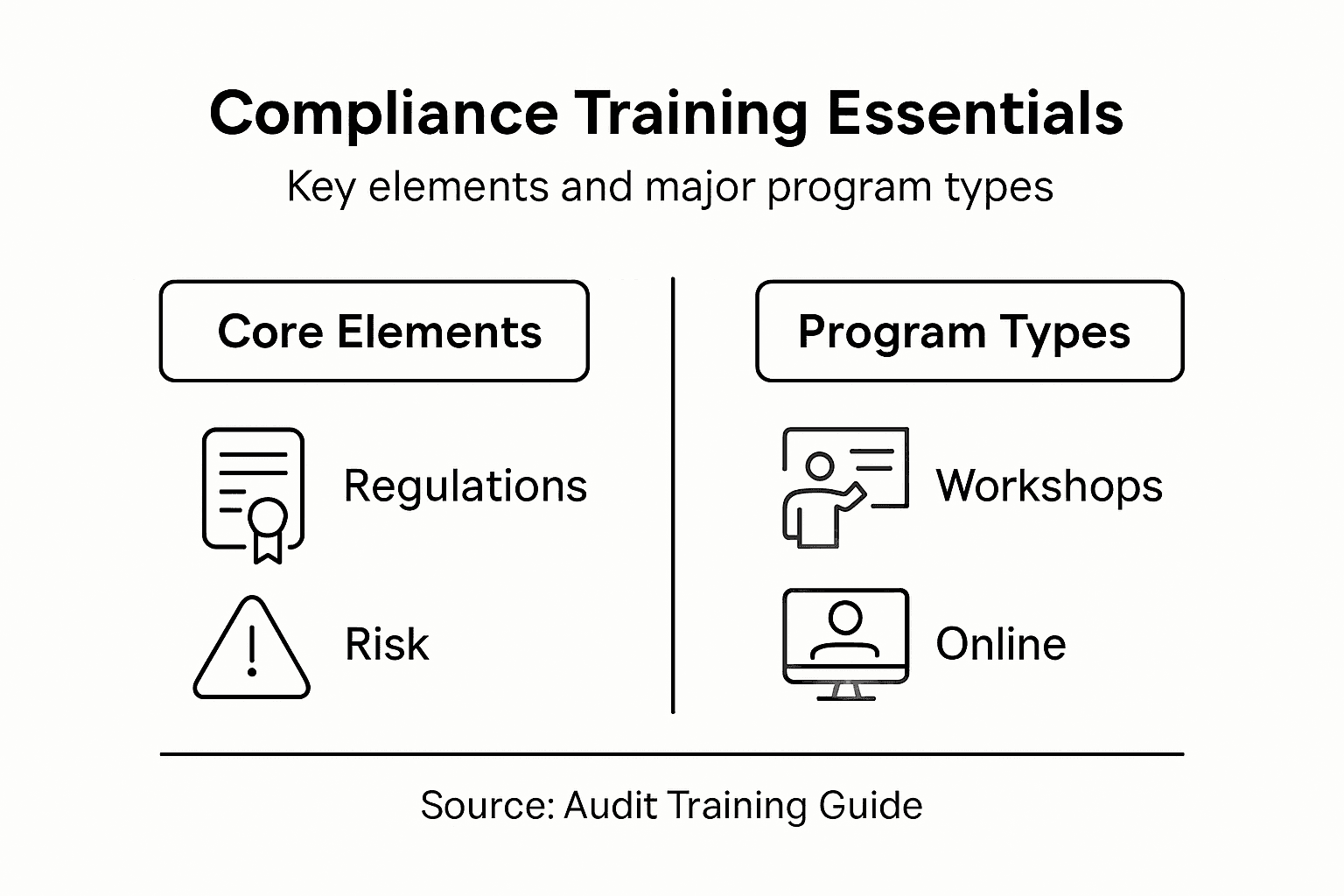
Pro tip: Always approach compliance training as an ongoing learning process, not a one-time checklist exercise.
Major Types of Compliance Training Programs
Compliance training programs represent a critical component of professional development for audit and finance professionals, offering diverse approaches to understanding regulatory requirements and ethical standards. These programs are designed to equip professionals with the knowledge and skills necessary to navigate complex regulatory landscapes across various industries.
Compliance training programs typically fall into several key categories:
Regulatory Compliance Training
Financial Crime Prevention
Ethics and Conduct Training
Data Privacy and Protection
Industry-Specific Compliance
Compliance training programs vary widely but consistently focus on practical skills needed for regulatory compliance. They cover critical areas such as financial crime, anti-money laundering, sanctions, customer due diligence, and specific regulatory frameworks like MiFID II. These comprehensive programs are strategically designed to prepare compliance professionals through assignments that directly mirror real-world compliance challenges.

The delivery formats for these training programs have evolved significantly, now encompassing multiple learning approaches to suit different professional needs. Organizations can choose from online modules, blended learning experiences, traditional classroom settings, and interactive workshops. Each format offers unique advantages, allowing professionals to select the most effective method for their learning style and organizational requirements.
Here’s how major compliance training delivery methods compare:
Method | Flexibility | Engagement Level | Typical Audience |
Online Modules | High | Moderate to low | Remote professionals |
Classroom Training | Low | High | In-office teams |
Workshops | Medium | Very high | Cross-functional groups |
Blended Learning | Very high | High | Large organizations |
Pro tip: Select compliance training programs that offer practical, scenario-based learning to maximize knowledge retention and real-world application.
Core Elements and Delivery Methods Explained
Compliance training programs are far more than simple educational exercises. They represent sophisticated systems designed to transform organizational culture and mitigate potential risks through structured, strategic learning approaches. Understanding the core elements and delivery methods is crucial for developing effective compliance education strategies.
Successful compliance training programs incorporate seven fundamental elements that form a comprehensive framework:
Written policies and procedures
Compliance leadership and oversight
Role-specific training and education
Effective communication channels
Enforcement standards with consequences
Continuous risk assessment
Prompt corrective action mechanisms
The delivery of compliance training has evolved significantly, moving beyond traditional lecture-based approaches to more dynamic and engaging methods. Modern organizations now leverage multiple learning modalities to ensure maximum knowledge retention and practical application. These approaches include online modules, interactive workshops, blended learning experiences, and technology-enhanced training platforms that adapt to different learning styles and organizational needs.
Organizational learning requires a systematic approach that goes beyond simple information transfer. The design and implementation of compliance training follow a rigorous cycle involving needs assessment, strategic content development, targeted delivery, and continuous evaluation. This ensures that training remains relevant, engaging, and aligned with both regulatory requirements and organizational objectives.
Pro tip: Regularly update your compliance training content to reflect the latest regulatory changes and emerging industry best practices.
Regulatory Drivers and Professional Standards
Navigating the complex landscape of regulatory compliance requires a deep understanding of the evolving drivers that shape organizational accountability and professional standards. Compliance training has become increasingly critical as government regulations continue to expand and become more sophisticated across multiple industries.
Regulatory pressures and government policies fundamentally drive the necessity for continuous compliance training. Understanding the lifecycle of regulatory development helps professionals anticipate and respond to emerging compliance challenges:
Government policy formation
Regulatory supervision mechanisms
Enforcement strategies
Ongoing policy evaluation
Risk mitigation frameworks
Professional standards in compliance demand more than simple rule adherence. They require organizations to develop robust monitoring programs, comprehensive risk management strategies, and training initiatives that cultivate a culture of ethical decision-making. These standards emphasize proactive approaches to preventing misconduct, understanding complex regulatory interactions, and implementing sustainable compliance practices.
The interaction between regulatory requirements and organizational response represents a dynamic ecosystem. Compliance professionals must translate external regulatory mandates into actionable internal control practices, ensuring that their organizations not only meet legal requirements but also maintain the highest levels of corporate governance and ethical standards.
Pro tip: Develop a systematic approach to tracking regulatory changes, creating a flexible compliance training framework that can quickly adapt to new requirements.
Risks of Non-Compliance and Common Mistakes
Compliance failures can devastate organizations, transforming seemingly minor oversights into catastrophic financial and reputational risks. Understanding these potential pitfalls is crucial for audit professionals seeking to protect their organizations from potentially devastating consequences.
Non-compliance risks encompass a wide range of significant challenges that can dramatically impact organizational stability:
This table summarizes the consequences of non-compliance and who is most impacted:
Consequence | Primary Impact | Potential Organization Loss |
Financial penalties | CFO, Legal, Board | Direct monetary costs |
Reputation damage | Marketing, Leadership | Lost clients, investor trust |
Legal action/litigation | Legal, Executives | Legal fees, settlements |
Operational disruptions | Operations, Front-line staff | Reduced productivity |
Certification loss | Compliance Officer, QA Dept. | Regulatory market exclusion |
Substantial financial penalties
Legal restrictions and potential litigation
Extensive remediation costs
Severe reputation damage
Loss of business certifications
Operational disruptions
Potential revenue loss
Common mistakes that frequently lead to non-compliance include inadequate documentation, poor communication, insufficient training, and outdated policies. These seemingly minor gaps can quickly escalate into major compliance breaches, creating substantial organizational vulnerabilities. Organizations must recognize that the cost of non-compliance typically far exceeds the investment required to maintain robust compliance frameworks.
Effective risk management demands a proactive approach. Compliance professionals must continuously assess internal processes, maintain comprehensive documentation, implement rigorous training programs, and develop adaptive strategies that anticipate potential regulatory shifts. This requires ongoing vigilance, strategic planning, and a commitment to creating a culture of compliance that permeates every level of the organization.
Pro tip: Conduct quarterly compliance audits to identify and address potential vulnerabilities before they become significant risks.
Strengthen Your Compliance Training to Protect Your Organization
Understanding the complexities of compliance training is essential for audit professionals to confidently navigate regulatory requirements and avoid costly non-compliance risks. If you are seeking to enhance your knowledge of regulatory standards, risk assessment, and ethical decision-making frameworks, practical and up-to-date training is critical to your success and your organization’s trustworthiness.
Take control of your compliance challenges today by exploring expert-led Continuing Professional Education (CPE) courses, webinars, and in-person seminars tailored specifically for audit and compliance professionals. Our offerings at Compliance Seminars cover vital topics such as internal controls, regulatory frameworks, and risk mitigation strategies taught by industry experts. Visit https://compliance-seminars.com to discover how you can build a proactive and resilient compliance program that meets evolving professional standards and safeguards your organization’s future.
Frequently Asked Questions
What is compliance training?
Compliance training is a structured educational program designed to help audit professionals understand and implement regulatory standards within their organizations. It covers legal requirements, ethical guidelines, and procedural frameworks governing professional conduct.
Why is compliance training important for audit professionals?
Compliance training is crucial for audit professionals as it equips them with the essential knowledge and skills to navigate complex regulatory landscapes, mitigate risks, and ensure adherence to laws and ethical standards, ultimately protecting the organization from potential penalties and reputational damage.
What are the main components of a compliance training program?
Key components of a compliance training program include regulatory understanding, risk assessment methodologies, reporting protocols, ethical decision-making frameworks, and industry-specific legal requirements.
How can organizations ensure effective compliance training?
Organizations can ensure effective compliance training by regularly updating training content, employing diverse training delivery methods (like online modules, workshops, and blended learning), and incorporating scenario-based learning to enhance knowledge retention and real-world application.
Recommended
Comments