What Is Compliance Risk and Why It Matters

Updated: Jan 24

Complex rules and shifting expectations press on every American organization, but compliance risk often hides where teams least expect it. Instead of just fearing audits or fines, compliance officers and internal auditors must tackle the challenge of protecting their company’s credibility and operations in the face of overlapping standards. By focusing on risk identification and management across fragmented departments, you gain practical tools to address regulatory, contractual, and reputational exposure before it threatens your license to operate.
Table of Contents
Key Takeaways
Point | Details |
Understanding Compliance Risk | Compliance risk involves potential failure to meet laws, regulations, and internal policies, significantly impacting an organization’s legitimacy. |
Categories of Compliance Risk | Compliance risk comprises regulatory, contractual, and reputational risks, each requiring unique controls and strategies for management. |
Role Clarity in Compliance | Compliance officers focus on day-to-day management while internal auditors provide independent assessments, maintaining necessary checks and balances. |
Active Risk Management | Organizations must proactively monitor compliance indicators to identify risks before they escalate into significant violations or penalties. |
Defining Compliance Risk in Modern Organizations
Compliance risk represents the threat that an organization will fail to adhere to applicable laws, regulations, contractual obligations, and internal policies. Unlike operational or market risks, compliance risk strikes at the core of legitimacy itself. Your organization faces this risk whenever there’s a gap between what you’re actually doing and what regulatory bodies, courts, or stakeholders expect you to do.
In modern organizations, compliance risk has become exponentially more complex. You’re not dealing with a single regulator anymore. A mid-sized American manufacturer might answer to the Environmental Protection Agency, the Occupational Safety and Health Administration, state environmental boards, local zoning authorities, and potentially international standards bodies if they export goods. Add in industry-specific requirements—NAIC Model Acts for insurance organizations, Sarbanes-Oxley for public companies, Healthcare Insurance Portability and Accountability Act for healthcare providers, Gramm-Leach-Bliley Act for financial institutions—and the compliance ecosystem becomes a labyrinth of overlapping, sometimes contradictory demands.
What makes compliance risk particularly dangerous is that it doesn’t always announce itself loudly. A missed deadline here, a procedural shortcut there, and suddenly you’re exposed to penalties, license revocation, criminal prosecution, or reputational damage that takes years to recover from. The risk compounds when you consider that risk identification and management frameworks must span departments that often operate in silos. Finance doesn’t always know what Operations committed to in writing. Human Resources might not understand the anti-corruption obligations that Sales assumed in a client contract. This fragmentation creates blind spots where compliance violations hide until regulators or auditors find them.
For compliance officers and internal auditors, understanding this definition means recognizing that compliance risk isn’t just about penalty avoidance. It’s about protecting shareholder value, maintaining stakeholder confidence, and ensuring the organization can operate without constant threat of enforcement action. The stakes are tangible and immediate—your organization’s ability to function depends on staying inside regulatory boundaries.
Pro tip: Every organization needs to have a comprehensive list of it’s regulatory obligations by jurisdiction and function, then identify which departments own each requirement. This single exercise often reveals surprising gaps where nobody assumes responsibility for a specific compliance area. This exercise should lead to the creation of a comprehensive compliance risk assessment. This assessment shows the match: compliance objectives, compliance risks and compliance controls.
Categories of Compliance Risk and Key Distinctions
Compliance risk breaks down into several distinct categories, and understanding these differences is crucial for your organization’s risk management strategy. The most common framework separates compliance risk into regulatory compliance risk, contractual compliance risk, and reputational compliance risk. Each operates differently, requires different controls, and carries different consequences when things go wrong.
Regulatory compliance risk stems directly from laws, rules, and regulations imposed by government agencies at federal, state, and local levels. This is the most visible category because the penalties are often public and severe. If your organization fails to comply with Environmental Protection Agency emissions standards, that violation gets documented, potentially fined, and possibly prosecuted. Similarly, tax compliance risk involves adhering to Internal Revenue Service requirements and state tax codes. Financial services firms face regulatory risk from the Securities and Exchange Commission, the Federal Reserve, and state banking regulators. The distinguishing characteristic here is that the rules come from outside your organization, and you have no negotiating power over them.

Contractual compliance risk involves obligations you’ve voluntarily accepted through agreements with customers, vendors, partners, or lenders. When you sign a master service agreement with a client, you’re accepting compliance obligations specific to that relationship. These might include data privacy requirements, service level agreements, reporting deadlines, or confidentiality restrictions. What makes contractual risk distinct is that you negotiated it, sometimes with room to modify terms. However, breach carries financial penalties and relationship damage. Cybersecurity risks represent a growing subcategory of contractual compliance, particularly when contracts include data protection and breach notification requirements.
Reputational compliance risk operates differently from the other two. It emerges when regulatory or contractual violations become public. A violation that never reaches the media carries reputational risk equal to zero. But the same violation that hits the news, social media, and industry publications can destroy stakeholder confidence faster than any fine. For public companies especially, this risk directly impacts stock price and investor sentiment. Unlike regulatory penalties that have defined amounts, reputational damage is unpredictable and potentially unlimited in scope.
These categories overlap and reinforce each other. A single incident can trigger all three simultaneously. For your organization, the practical implication is that compliance programs must address all three categories, not just the regulatory ones that feel most urgent.
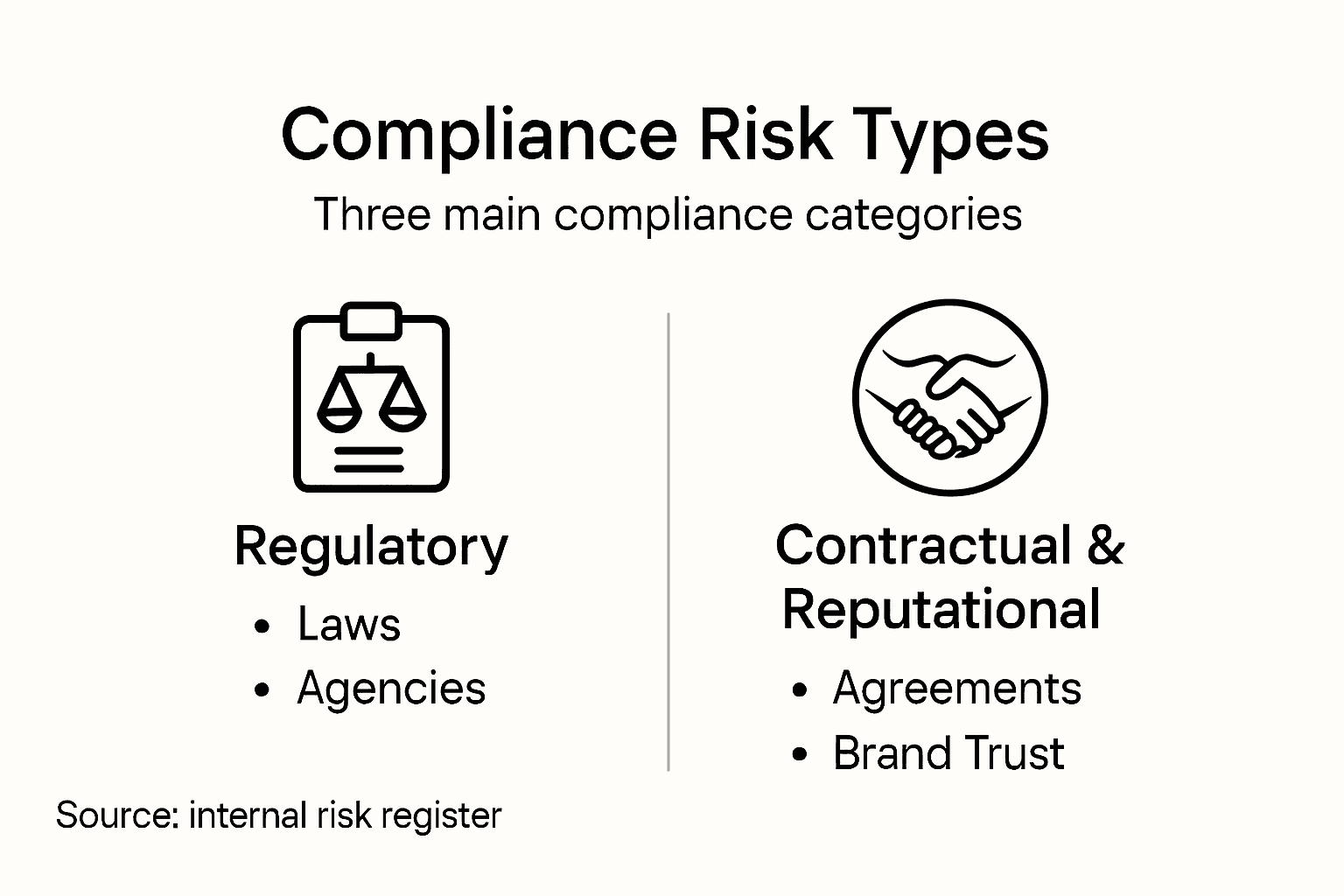
Here’s a summary of the main compliance risk categories and their unique business impacts:
Compliance Risk Type | Source of Obligation | Typical Consequences | Business Impact |
Regulatory Compliance Risk | Laws and regulations | Fines, prosecution | Legal standing threatened |
Contractual Compliance Risk | Contracts/agreements | Damages, lost deals | Revenue loss, partnerships |
Reputational Compliance Risk | Public perception | Trust loss, stock fall | Stakeholder confidence drops |
Pro tip: When documenting compliance obligations in your risk register, separate them by category and note which penalties apply to each: regulatory fines, contract damages, or reputational harm. This clarity helps prioritize which violations your organization must prevent at all costs.
Regulatory Frameworks Governing Compliance Risk
Compliance risk doesn’t exist in a vacuum. It lives within a complex web of regulatory frameworks that vary by industry, geography, and organizational type. For compliance officers and internal auditors, understanding which frameworks actually govern your organization separates effective risk management from wasted effort chasing irrelevant requirements.
The most foundational framework for most American organizations is Sarbanes-Oxley Act (SOX) compliance, particularly for public companies. SOX mandates rigorous internal controls over financial reporting, requires certification of financial statements by executives, and establishes audit committee requirements. Section 404 alone has reshaped how organizations approach compliance risk because it explicitly requires management to assess the effectiveness of internal controls and auditors to attest to that assessment. Beyond SOX, the COSO Internal Control Framework provides the theoretical structure that most auditors use to evaluate whether controls are actually effective. Using COSO Framework for Compliance and SOX helps your organization translate abstract control concepts into measurable, testable requirements.
Beyond financial controls, industry specific frameworks dominate the compliance landscape. Healthcare organizations navigate the Health Insurance Portability and Accountability Act, which governs patient privacy and data security with teeth—violations carry penalties up to $1.5 million per year per violation category. Financial institutions answer to the Gramm-Leach-Bliley Act and regulations from the Federal Reserve and Office of the Comptroller of the Currency. Environmental compliance falls under the Clean Air Act, Clean Water Act, and Resource Conservation and Recovery Act. Each framework creates distinct compliance obligations, audit trails, and reporting requirements. The challenge intensifies when your organization operates across multiple jurisdictions or industries, forcing you to track overlapping and sometimes contradictory requirements simultaneously.
Regulatory frameworks also evolve. The Securities and Exchange Commission continuously updates disclosure requirements. State attorneys general introduce new privacy laws (California Consumer Privacy Act, Virginia Consumer Data Protection Act) that affect any organization handling resident data. International frameworks like the General Data Protection Regulation impact American companies serving European customers. Your compliance program must accommodate this constant flux without becoming paralyzed by regulatory change.
What separates mature compliance programs from reactive ones is the recognition that regulatory frameworks are interconnected. SOX controls reinforce COSO principles. COSO principles inform how you design controls for industry-specific regulations. The common thread is internal control assessment across all frameworks, which means your audit methodology can leverage the same fundamental approach across multiple regulatory domains.
Pro tip: Create a regulatory requirements matrix that maps each framework governing your organization to specific departments and business processes. Update it quarterly as new regulations emerge, then use it to prioritize audit activities based on which frameworks carry the highest financial or operational risk.
Causes and Indicators of Elevated Compliance Risk
Elevated compliance risk doesn’t appear overnight. It builds gradually through organizational decisions, system failures, and cultural choices that accumulate over time. Understanding what causes this escalation allows you to identify problems before regulators do.
The most common cause is inadequate resource allocation to compliance functions. When organizations treat compliance as a cost center rather than a risk management necessity, they chronically understaff audit teams, defer system upgrades, and skip training cycles. You end up with two compliance officers covering 47 regulatory requirements while the marketing department gets four dedicated resources. This imbalance creates blind spots and delays in identifying violations. Related to this is poor governance and oversight. When audit committees don’t meet regularly, when they lack financial literacy or industry expertise, or when management ignores audit recommendations, compliance risk escalates rapidly. Audit recommendations that sit unaddressed for 18 months signal that your organization doesn’t take control deficiencies seriously.
Cultural causes are equally dangerous. Organizations with aggressive growth targets but weak integrity cultures experience explosive compliance risk. Pressure to meet quarterly earnings targets can incentivize cutting corners on compliance procedures. When senior leaders prioritize speed over accuracy or avoid difficult conversations about risk, that tone cascades through the organization. Employees learn that compliance is optional when meeting business objectives. Additionally, inadequate training and communication means frontline staff don’t understand compliance obligations. Employees handling customer data who never received privacy training, or sales representatives unfamiliar with anti-corruption requirements, create vulnerabilities that span entire business processes.
Specific indicators signal elevated compliance risk. These include high turnover in compliance roles, which disrupts institutional knowledge and creates continuity gaps. Look for delayed financial statement closings or repeated audit adjustments, which suggest internal control weaknesses over financial reporting. Regulatory correspondence increases when agencies send warning letters, requests for information, or examination notices. Consider red flags in high risk transactions across your transaction monitoring systems as early warning signals. Prior regulatory violations that remain unresolved, or violations in similar areas recurring despite corrective action, indicate systemic problems rather than isolated incidents. Finally, significant system or process changes implemented without corresponding control updates create gaps where violations hide.
The practical implication is that compliance risk requires active monitoring. Waiting for an external audit or regulator examination to discover problems means you’re already behind the compliance curve.
Pro tip: Establish a compliance risk scorecard that tracks leading indicators monthly: audit recommendation aging, compliance training completion rates, regulatory correspondence volume, and system change backlogs. Rising trends in any indicator warrant immediate investigation and resource allocation.
Role of Auditors and Officers in Mitigating Risks
Compliance risk doesn’t self-correct. It requires deliberate action from two distinct but complementary roles: compliance officers who own the day-to-day risk management function, and internal auditors who provide independent assessment of whether those risk management efforts actually work. Understanding how these roles interact, where they overlap, and where they diverge is essential for your organization’s compliance effectiveness.
Compliance officers serve as the organization’s primary defense against compliance risk. Your responsibility spans identifying applicable regulations, designing controls to prevent violations, monitoring day-to-day compliance activities, and responding when issues surface. You’re accountable for building a compliance culture where employees understand their obligations and see compliance as a core business responsibility rather than a bureaucratic burden. This means developing training programs, creating compliance calendars that track regulatory deadlines, establishing escalation procedures for violations, and coordinating with business units to embed compliance into standard operations. Compliance officers work operationally, embedded in the business, solving problems in real time. When sales receives a contract with unusual terms, you review it. When operations implements a new process, you assess compliance implications. This positioning gives you speed and context but also potential bias toward the business objectives compliance is meant to constrain.
Internal auditors provide the independent verification that compliance frameworks actually function. Your role involves identifying and assessing risks of material misstatement across compliance domains, testing whether controls operate as designed, and reporting findings to audit committees and senior management. Unlike compliance officers who own compliance outcomes, auditors own the truth about whether compliance controls work. This independence is critical. Auditors should develop findings without pressure to downplay problems or accommodate business objectives. Your credibility depends on reporting what you actually find, not what management wants to hear. Internal audit brings skepticism—questioning whether supposedly operating controls actually operate, whether documented procedures match actual practice, and whether compliance monitoring systems provide adequate coverage.
The two roles work best when operating in clear partnership with distinct accountability. Compliance officers improve control design and day-to-day execution. Internal auditors assess whether these efforts translate to effective risk mitigation. Tension between the roles is healthy. It means compliance officers face scrutiny and auditors maintain independence. Problems emerge when roles blur. Compliance officers who become auditors lack independence. Auditors who take on compliance responsibilities lose objectivity. Similarly, silent auditors who discover problems but fail to report them effectively enable compliance risk to persist.
The table below contrasts the roles of compliance officers and internal auditors in managing compliance risk:
Role | Core Responsibilities | Perspective | Potential Challenges |
Compliance Officer | Design controls, training | Embedded, hands-on | May favor business priorities |
Internal Auditor | Assess, test controls | Independent, critical | Risk of blurred responsibilities |
Pro tip: Document clear reporting lines in your audit charter: internal auditors report functionally to the audit committee, not to the compliance officer. Meet quarterly with audit leadership to discuss findings and ensure audit recommendations receive appropriate attention and resource allocation.
Strengthen Your Defense Against Compliance Risk Today
Navigating the evolving landscape of compliance risk requires more than awareness. The challenges of overlapping regulatory obligations, contractual demands, and reputational exposure demand proactive solutions that go beyond theory. If your organization struggles with fragmented compliance ownership or inconsistent training, you are not alone. The critical takeaway from the article is that compliance risk must be actively managed through clear controls, rigorous internal audits, and continuous education.
Empower your team with expert-led Continuing Professional Education that focuses on practical approaches to internal controls, regulatory frameworks such as SOX and COSO, and risk identification strategies. At Compliance Seminars, we specialize in tailored webinars, in-person seminars, and corporate training designed for compliance officers, auditors, and risk managers who want to close gaps before violations occur. Visit Compliance Seminars now to access courses that translate complex compliance risk concepts into actionable skills. Take the next step to protect your organization’s reputation, legal standing, and financial health by investing in training that makes a measurable difference.
Frequently Asked Questions
What is compliance risk?
Compliance risk refers to the threat that an organization may fail to adhere to laws, regulations, contractual obligations, and internal policies, jeopardizing its legitimacy and operations.
What are the main categories of compliance risk?
The main categories of compliance risk include regulatory compliance risk, contractual compliance risk, and reputational compliance risk, each with distinct sources and consequences.
Why is understanding compliance risk important for organizations?
Understanding compliance risk is crucial for protecting shareholder value, maintaining stakeholder confidence, and ensuring that operations remain within regulatory boundaries to avoid penalties and other negative impacts.
How can organizations effectively manage compliance risk?
Organizations can effectively manage compliance risk by mapping regulatory obligations, establishing clear ownership of compliance requirements across departments, and actively monitoring compliance activities to identify and address vulnerabilities.
Recommended
Comments