What is CISA certification? Complete 2026 guide for auditors
- Леонид Ложкарев
- Mar 15
- 9 min read

Updated: Mar 31

Many professionals believe their years of IT audit experience guarantee they’ll pass the CISA exam without structured preparation. This misconception leads countless candidates to underestimate what CISA certification truly demands. The Certified Information Systems Auditor credential represents far more than a test of experience. It validates your mastery of specific frameworks, governance principles, and risk assessment methodologies that over 151,000 professionals worldwide have demonstrated. This guide breaks down exactly what CISA certification means, how the exam is structured, what makes it challenging, and how to prepare effectively for success in 2026.
Table of Contents
Key takeaways
Point | Details |
CISA validates specialized expertise | The certification proves competency in auditing, controlling, and assessing IT and business systems beyond general experience. |
Exam covers five updated domains | The 2024 refresh includes 150 questions across governance, acquisition, operations, protection, and audit process domains. |
Pass rates reveal moderate difficulty | Between 45% and 55% of candidates pass, requiring dedicated preparation beyond relying on work experience alone. |
Strong career demand exists | Over 52,000 U.S. job openings seek CISA holders while only 35,812 professionals currently hold the credential. |
Preparation takes 3 to 6 months | Consistent study using ISACA frameworks, practice exams, and active recall techniques significantly improves success rates. |
What is CISA certification and why does it matter?
The CISA certification signifies expertise in auditing, controlling, monitoring, and assessing an organization’s information technology and business systems. Offered by ISACA since 1978, it has become the definitive credential for IT audit and assurance professionals. The certification validates that you can evaluate whether information systems protect organizational assets, maintain data integrity, and align with business objectives.
What sets CISA apart is its global recognition and rigorous standards. The CISA certification is the gold standard for IT audit, control, and assurance professionals, held by over 151,000 globally. Employers across industries recognize this credential as proof that you understand not just technology, but how to assess risk, ensure compliance, and provide assurance that controls function effectively.
CISA holders perform critical activities that protect organizations:
Evaluate information system controls and identify vulnerabilities before they become incidents
Assess whether IT governance frameworks align with business strategy and regulatory requirements
Provide independent assurance that data protection measures meet security standards
Guide organizations through complex compliance landscapes involving multiple frameworks and regulations
For professionals in auditing and compliance, CISA certification demonstrates specialized knowledge that general IT experience cannot prove. You might excel at implementing security controls or managing infrastructure, but CISA shows you can independently evaluate and attest to the effectiveness of those controls. This distinction matters when organizations need objective assessments of their risk posture.
The certification also opens doors to advanced roles. Chief audit executives, IT audit managers, and compliance directors frequently require or strongly prefer CISA certification because it provides a common language and framework for evaluating complex systems. When you pursue internal audit training in Austin TX or similar professional development, CISA certification ensures you can apply those learnings within recognized industry standards.
“CISA certification bridges the gap between technical knowledge and audit judgment, enabling professionals to provide the independent assurance that boards and executives rely on for critical decisions.”
Overview of the CISA exam structure and domains
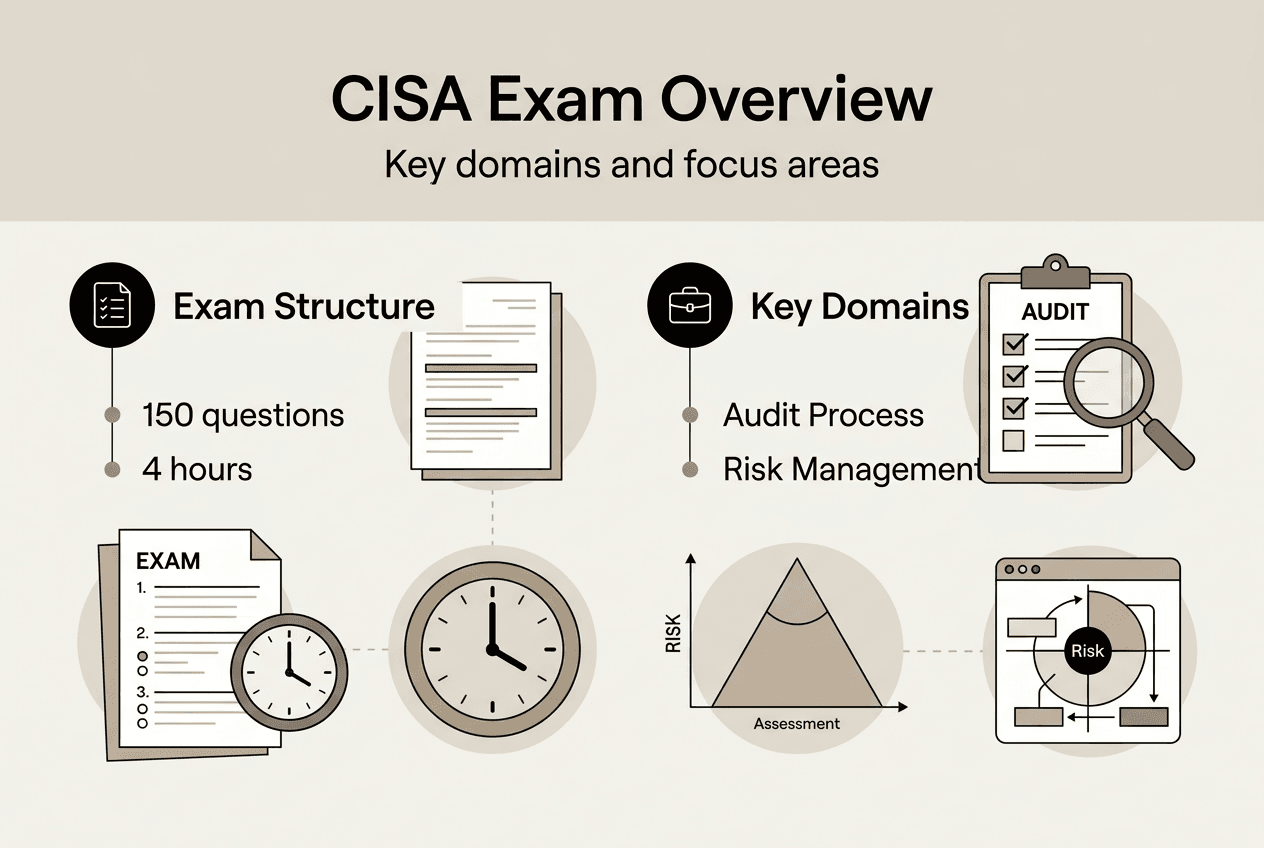
The CISA exam has 150 multiple-choice questions and candidates have about 4 hours to complete it, needing a score of 450 to pass. The scoring scale ranges from 200 to 800, with 450 representing the minimum competency threshold. You’ll face scenario-based questions that test judgment and application rather than simple memorization of facts.

The CISA exam covers five domains updated in August 2024 to reflect new technologies, risk management, and governance frameworks. These updates ensure the certification remains relevant as cloud computing, artificial intelligence, and evolving cyber threats reshape the audit landscape.
Domain | Weight | Focus Areas |
Information Systems Auditing Process | 21% | Audit planning, risk assessment, evidence collection, reporting standards |
Governance and Management of IT | 16% | IT strategy alignment, governance frameworks, resource management |
Information Systems Acquisition, Development, and Implementation | 16% | Project management, system development lifecycle, change control |
Information Systems Operations and Business Resilience | 23% | Service delivery, incident management, business continuity, disaster recovery |
Protection of Information Assets | 24% | Security architecture, access controls, encryption, data classification |
The exam emphasizes practical application over theoretical knowledge. Questions present realistic scenarios where multiple answers might seem partially correct. You must identify the BEST response based on ISACA frameworks and industry best practices, not just what might work in your specific organization.
Time management becomes critical with 150 questions in 4 hours. That gives you roughly 96 seconds per question, including time to read scenarios, analyze options, and mark answers. Many candidates report feeling rushed, especially on complex scenario questions that require careful analysis.
Pro Tip: During the exam, flag questions you’re uncertain about and move forward rather than getting stuck. Your first instinct is often correct with ISACA exams, but you need to complete all questions to maximize your score potential.
The domains interconnect significantly. A question about business resilience might also test your understanding of governance frameworks. Protection of information assets overlaps with acquisition and development when evaluating security controls in new systems. This integration reflects real-world audit work, where you rarely evaluate one domain in isolation.
Professionals seeking to strengthen their foundation should consider internal audit training in San Antonio TX or internal audit training in Chicago IL to build practical skills that complement exam preparation.
Challenges of the CISA exam and expert preparation strategies
The CISA exam pass rate is estimated to be between 45% and 55%, reflecting its moderate to high difficulty. This means nearly half of all candidates fail on their first attempt, despite many having extensive IT and audit experience. Understanding why candidates struggle helps you avoid common pitfalls.
Candidates often fail because they underestimate the exam and assume experience alone is enough. The exam tests specific ISACA frameworks and methodologies that may differ from your organization’s practices. Your company might use proprietary risk assessment tools or custom governance structures, but CISA questions expect answers aligned with COBIT, ITIL, and ISACA audit standards.
Time pressure creates significant challenges. With roughly 96 seconds per question, you must quickly parse scenarios, eliminate obviously wrong answers, and choose the best remaining option. Candidates who spend too long on difficult questions often rush through later sections, making careless errors on questions they could have answered correctly.
Ambiguous wording trips up many test-takers. ISACA deliberately crafts questions where multiple answers seem plausible. You’re not looking for a correct answer versus wrong answers. You’re identifying the MOST appropriate response based on audit principles, risk prioritization, and governance best practices. This requires deep understanding of underlying frameworks, not surface-level familiarity.
Successful preparation typically follows these evidence-based strategies:
Allocate 3 to 6 months for consistent study, dedicating at least 10 to 15 hours weekly to review materials and practice questions.
Master the ISACA frameworks first, especially COBIT for governance and risk management, before diving into domain-specific content.
Use practice exams extensively to identify weak areas and get comfortable with question formats and time constraints.
Focus heavily on governance and risk topics, as these concepts appear across multiple domains and form the foundation for audit judgment.
Create active recall systems like flashcards for key concepts, frameworks, and terminology rather than passively reading review materials.
Join study groups or online communities where you can discuss difficult concepts and learn from others’ perspectives on ambiguous scenarios.
Pro Tip: When practicing questions, don’t just check if you got the right answer. Read the explanations for ALL options to understand why wrong answers are incorrect and what makes the best answer superior.
Many candidates benefit from structured training that reinforces ISACA methodologies. Programs like internal audit training in Houston TX or specialized ethics training for CISA help bridge the gap between practical experience and exam requirements.
“The CISA exam doesn’t test whether you can do the job. It tests whether you can evaluate and provide assurance on how others do the job, which requires a fundamentally different knowledge framework.”
Don’t underestimate the mental endurance required. Four hours of intense concentration, analyzing complex scenarios, and making judgment calls creates cognitive fatigue. Practice taking full-length exams under timed conditions to build the stamina you’ll need on test day.
Career benefits and real-world application of CISA certification
In the U.S., 35,812 professionals hold the CISA while 52,337 job openings seek this certification, signaling strong market demand. This supply-demand gap creates significant opportunities for certified professionals. Organizations struggling to fill audit and compliance roles often offer premium compensation and advancement opportunities to attract CISA holders.
The certification enhances your capabilities across multiple professional contexts:
IT audit departments gain credibility when team members hold recognized certifications that validate their assessment methodologies
Risk management functions benefit from CISA-trained professionals who can evaluate technical controls and translate findings into business risk language
Compliance teams leverage CISA expertise to assess whether IT controls meet regulatory requirements across frameworks like SOX, HIPAA, and GDPR
Consulting firms require CISA certification for client-facing roles where independent assurance and recognized credentials matter
CISA certification also provides a common professional language. When you discuss control objectives, risk ratings, or audit findings with other certified professionals, you’re working from shared frameworks and methodologies. This standardization improves collaboration and reduces misunderstandings that can occur when organizations use proprietary or inconsistent approaches.
Aspect | CISA Certified | Non-Certified |
Average Salary Premium | 15% to 25% higher | Baseline compensation |
Senior Role Eligibility | Qualified for chief audit executive, IT audit manager positions | Often excluded from consideration |
Client-Facing Work | Preferred or required for external audit and consulting engagements | Limited to internal roles |
Career Mobility | Transferable credential recognized across industries and geographies | Experience may not translate across organizations |
Professional Development | Access to ISACA resources, conferences, and continuing education networks | Dependent on employer-specific training |
The real-world application of CISA skills extends beyond traditional audit roles. Information security teams increasingly seek professionals who can assess controls from an audit perspective. Business analysts leverage CISA frameworks to evaluate system implementations. Even developers benefit from understanding how auditors will evaluate the controls they build into applications.
Pro Tip: Maintain your CISA certification through continuing professional education to stay current with evolving frameworks and technologies. This ongoing learning ensures your skills remain relevant as cloud computing, artificial intelligence, and new regulatory requirements reshape the audit landscape.
Professionals can enhance their CISA credentials through complementary training. Exploring IT auditing training events provides practical applications of certification concepts and helps you stay current with emerging audit methodologies.
The certification also signals commitment to professional standards and ethics. ISACA’s code of ethics requires certified professionals to maintain objectivity, competence, and confidentiality. This ethical framework builds trust with stakeholders who rely on your independent assessments to make critical business decisions.
Enhance your CISA journey with expert training and CPE courses
Achieving CISA certification marks the beginning of your professional development journey, not the end. Maintaining the credential requires ongoing education that keeps your skills sharp and your knowledge current with evolving technologies and frameworks.
Compliance Seminars offers comprehensive training designed specifically for audit and cybersecurity professionals. Our 2026 CPE event calendar features in-person seminars across major U.S. cities, delivering practical instruction from experts with Big 4 backgrounds. These sessions go beyond theory to provide actionable frameworks you can immediately apply in your audit work. For professionals with demanding schedules, our Internal auditor CPE webinars offer flexible online learning that meets NASBA standards while fitting into your calendar. Specialized Cybersecurity CPE training events complement your CISA certification by deepening your expertise in emerging threat landscapes, security frameworks, and risk assessment methodologies that auditors increasingly need to evaluate.
FAQ
What is the CISA certification exam format?
The exam consists of 150 multiple-choice questions that you must complete within approximately 4 hours. Each question presents a scenario or concept with four possible answers, requiring you to select the single best response based on ISACA frameworks and audit principles. Candidates need a score of 450 or higher on a scale of 200 to 800 to pass, with the scoring algorithm accounting for question difficulty and overall performance.
How long should I prepare for the CISA exam?
Most candidates spend 3 to 6 months preparing, dedicating 10 to 15 hours weekly to study materials, practice questions, and framework review. The exact timeline depends on your existing knowledge of ISACA standards, audit experience, and learning style. Consistent study over several months proves more effective than cramming, as the exam tests deep understanding and application rather than memorization.
Which areas does the CISA exam focus on?
The exam covers five domains: Information Systems Auditing Process, Governance and Management of IT, Information Systems Acquisition Development and Implementation, Information Systems Operations and Business Resilience, and Protection of Information Assets. These domains were updated in August 2024 to reflect current technologies, emerging risks, and evolving governance frameworks. The weighting ranges from 16% to 24% per domain, with Protection of Information Assets and Operations and Business Resilience receiving the heaviest emphasis.
Can experience alone guarantee passing the CISA exam?
Experience provides valuable context but does not guarantee exam success without aligning that experience with ISACA frameworks and methodologies. Many seasoned IT professionals fail because they answer questions based on their organization’s specific practices rather than recognized audit standards. The exam tests your ability to apply COBIT, ITIL, and ISACA audit principles to scenarios that may differ from your day-to-day work, requiring dedicated study of these frameworks regardless of your experience level.
Recommended
Comments