SOX Compliance Checklist 2026: Ensure Full Regulatory Readiness
- Леонид Ложкарев
- Feb 5
- 7 min read


Keeping up with regulatory shifts can feel like chasing a moving target for SOX compliance professionals and internal auditors in the public companies. With new expectations for technology, ESG reporting, and data analytics shaping Sarbanes-Oxley requirements, missing critical updates could leave your controls exposed. This guide breaks down each step you need to review changing rules, document robust controls, and stay audit-ready so your compliance program remains resilient. Stay ahead by focusing on the most current and practical strategies for enhanced compliance.
Table of Contents
Quick Summary
Key Point | Explanation |
1. Assess Regulatory Changes | Continuously review updates from regulatory bodies to understand changes affecting SOX compliance. |
2. Establish Internal Controls | Develop comprehensive documentation of internal controls to ensure accountability and financial integrity. |
3. Implement Control Testing | Create a systematic approach for regular control testing to identify and address vulnerabilities promptly. |
4. Conduct Independent Reviews | Engage external auditors for unbiased assessments to validate compliance and enhance stakeholder trust. |
5. Maintain Ongoing Documentation | Develop a dynamic documentation system to support continuous compliance and audit readiness. |
Step 1: Assess regulatory changes impacting SOX requirements
Navigating the evolving landscape of Sarbanes-Oxley (SOX) compliance requires a strategic and proactive approach to understanding emerging regulatory shifts. Your primary goal in this step is to systematically review and analyze the most recent changes that could impact your organization’s internal control frameworks and reporting mechanisms.
To effectively assess regulatory changes, start by conducting a comprehensive review of recent updates from key regulatory bodies. The evolving SOX regulatory landscape demands careful attention to multiple dimensions of compliance. Here are critical areas to investigate:
Emerging technology integration requirements
Changes in reporting standards
New data analytics and automation expectations
Environmental, Social, and Governance (ESG) reporting mandates
Cybersecurity control enhancements
Pay special attention to how technological advancements and global regulatory trends might reshape SOX compliance expectations. This means understanding not just the technical requirements, but also the strategic implications for your organization’s internal audit and control processes.
Regulatory vigilance is not a one-time event, but a continuous journey of adaptation and strategic alignment.
Key steps in your assessment should include reviewing official publications from the Securities and Exchange Commission (SEC), analyzing recent PCAOB guidelines, and consulting industry expert reports that track SOX regulatory developments.
Pro tip: Establish a dedicated compliance tracking system that provides real-time updates on regulatory changes to stay ahead of potential compliance challenges.
Step 2: Establish entity-level internal controls and documentation
Building a robust SOX compliance framework requires a comprehensive approach to establishing internal controls that span your entire organization. Your objective is to create a systematic, well-documented control environment that ensures financial reporting integrity and mitigates potential risks.
Comprehensive documentation of internal controls is critical for meeting SOX requirements and demonstrating organizational accountability. To achieve this, focus on developing a structured methodology that addresses key control components:
Identify critical financial reporting processes
Map existing control mechanisms
Assess potential fraud and operational risks
Develop clear documentation standards
Establish accountability for control implementation
Your documentation should encompass detailed process descriptions, risk assessments, control objectives, and specific procedures for monitoring and testing internal controls. Pay special attention to leadership responsibilities under Sections 302 and 404, which require executives to personally validate the effectiveness of internal control structures.
Effective internal controls are not just a compliance requirement, but a strategic framework for organizational resilience and financial transparency.
Key documentation elements should include process flowcharts, risk matrices, control activity descriptions, and evidence of regular control effectiveness testing. Ensure that your documentation is clear, consistent, and provides a comprehensive audit trail that can withstand rigorous external scrutiny.

Pro tip: Create a centralized control documentation repository with version tracking to maintain real-time visibility and enable seamless updates across your organization.
Step 3: Implement control testing and remediation procedures
Effective SOX compliance hinges on a rigorous approach to control testing and swift remediation of any identified weaknesses. Your primary objective is to develop a systematic process that continuously validates the effectiveness of your internal control mechanisms and promptly addresses any potential gaps.
Continuous control testing strategies are critical for maintaining financial reporting integrity and demonstrating regulatory compliance. Implementing a comprehensive testing framework requires a structured methodology that encompasses multiple dimensions of control assessment:
Develop detailed testing protocols
Establish frequency of control evaluations
Create clear documentation standards
Define specific remediation workflows
Set accountability metrics for control improvements
Your testing approach should incorporate both automated and manual review processes, with a focus on key financial reporting controls. Pay special attention to emerging risk areas such as cybersecurity, technological integrations, and complex financial instruments that might introduce new control vulnerabilities.
Compare manual vs. automated control testing:
Approach | Efficiency | Accuracy | Scalability |
Manual | Time-consuming | Prone to human error | Difficult for large datasets |
Automated | Fast and consistent | Higher precision | Scales across systems easily |
Control testing is not a one-time event, but a continuous journey of organizational risk management and financial integrity.
Each identified control weakness must trigger a structured remediation process that includes root cause analysis, immediate mitigation strategies, and long-term prevention plans. Ensure your documentation provides a clear audit trail that demonstrates proactive management of potential compliance risks.
Pro tip: Implement a centralized tracking system that provides real-time visibility into control testing results and remediation progress across your entire organization.
Step 4: Validate compliance through independent review
Independent review represents the critical final checkpoint in your SOX compliance strategy, ensuring that your internal controls meet the highest standards of regulatory scrutiny. Your objective is to obtain an unbiased, comprehensive assessment of your organization’s control environment through systematic and objective evaluation.
Independent compliance validation strategies are essential for confirming the effectiveness of your internal control mechanisms. A robust independent review process should encompass multiple evaluation dimensions:
Engage external audit professionals
Conduct comprehensive control assessments
Verify management’s compliance assertions
Document review findings systematically
Develop actionable remediation recommendations
Your independent review should focus on key compliance validation elements, including thorough examination of financial reporting controls, risk management processes, and operational effectiveness. Special attention must be paid to areas of potential vulnerability, such as emerging technological risks, complex financial transactions, and potential control design weaknesses.
An effective independent review transforms compliance from a checkbox exercise into a strategic organizational capability.
Ensure that your review process includes detailed documentation of findings, with clear recommendations for improvement and a transparent mechanism for tracking and implementing suggested changes. The goal is not just to identify issues, but to create a pathway for continuous control enhancement.
Pro tip: Rotate your independent review teams periodically to maintain objectivity and bring fresh perspectives to your compliance assessment process.
Step 5: Maintain ongoing SOX documentation and audit readiness
Sustaining SOX compliance requires more than periodic checks. Your goal is to create a dynamic, real-time documentation system that provides continuous evidence of your organization’s financial control effectiveness and regulatory adherence.
Continuous compliance documentation strategies are essential for modern regulatory environments. A robust documentation approach should include comprehensive tracking and monitoring mechanisms:
Implement real-time control monitoring
Preserve detailed financial transaction records
Create systematic audit trail documentation
Establish automated compliance evidence collection
Develop consistent reporting frameworks
Your documentation strategy must focus on proactive compliance management, which means maintaining contemporaneous evidence that can be instantly retrieved and verified. This requires integrating technological solutions that enable seamless tracking of financial controls, risk assessments, and remediation activities.
Documentation is not just a regulatory requirement, but a strategic asset that demonstrates organizational integrity and financial discipline.
Ensure your documentation practices include comprehensive logging of control activities, clear accountability mechanisms, and transparent processes that can withstand rigorous external audit scrutiny. Technology-enabled solutions can help automate and streamline these critical documentation requirements.
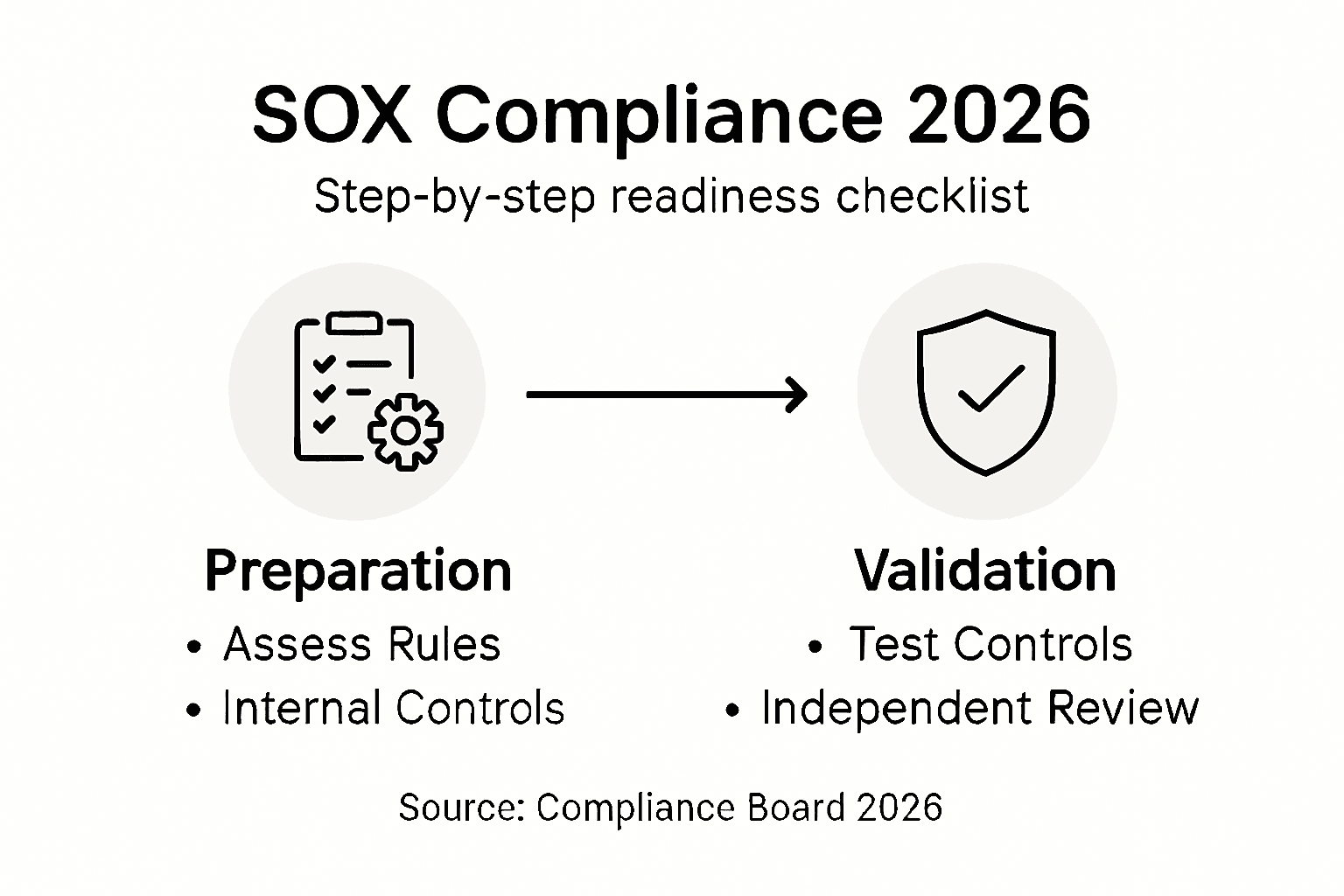
Here’s a summary of key SOX compliance activities and their business impact:
Activity | Purpose | Business Impact |
Regulatory Assessment | Monitor new rules and trends | Minimizes compliance risk exposure |
Internal Controls | Prevent errors and fraud | Improves financial reliability |
Control Testing | Validate effectiveness | Ensures ongoing compliance integrity |
Independent Review | Provide unbiased evaluation | Builds stakeholder trust |
Audit Readiness | Maintain documentation | Enhances external audit response |
Pro tip: Develop a centralized digital repository with version control and access tracking to ensure your SOX documentation remains organized, secure, and instantly accessible.
Master SOX Compliance with Expert Training and Real-World Guidance
Facing the evolving regulatory challenges outlined in the “SOX Compliance Checklist 2026” article means staying ahead in areas like internal controls, control testing, and independent audits. You need proven strategies to build strong documentation, implement effective control testing, and ensure audit readiness with confidence. The complexity of regulatory changes and the need for continuous compliance demand specialized knowledge and hands-on skills.
Take charge of your SOX compliance journey today by exploring professional education at Compliance Seminars. Our comprehensive courses and live webinars are tailored for audit professionals, compliance officers, and finance leaders seeking to master internal control frameworks and regulatory standards such as SOX, COSO, and SEC requirements. Don’t leave your compliance success to chance. Visit Compliance Seminars now to strengthen your expertise and ensure full regulatory readiness with practical training led by industry experts.
Frequently Asked Questions
How can I assess regulatory changes for SOX compliance in 2026?
To assess regulatory changes for SOX compliance in 2026, begin by reviewing recent updates from key regulatory bodies. Establish a compliance tracking system to monitor new requirements continuously, ensuring you’re informed within 30 days of any significant changes.
What steps should I take to establish entity-wide internal controls for SOX?
To establish entity-wide internal controls for SOX, identify key financial reporting processes and map existing control mechanisms. Focus on creating documentation standards and clear accountability for control implementation within the next quarter.
How do I implement control testing and remediation procedures under SOX?
Implement control testing by developing testing protocols and establishing how frequently controls will be evaluated. Set up a remediation process to address any identified weaknesses within 60 days of testing results to maintain compliance integrity.
What does an independent review for SOX compliance involve?
An independent review for SOX compliance involves engaging external auditors to conduct comprehensive assessments of your internal controls. Document the findings and develop actionable recommendations, aiming to complete the review before your next reporting period.
How can I maintain ongoing SOX documentation and audit readiness?
To maintain ongoing SOX documentation and audit readiness, focus on implementing real-time control monitoring and preserving detailed financial transaction records. Create a digital repository to track compliance activities continuously, updating documentation as needed.
What are the key compliance activities I should prioritize for SOX in 2026?
Prioritize five key compliance activities: regulatory assessment, internal controls, control testing, independent review, and audit readiness. Create a timeline to systematically address each activity, aiming for complete preparedness by the end of the fiscal year.
Recommended
Comments