Role of Audits in Cybersecurity: Enhancing Risk Defense


Every global financial institution faces a growing challenge when it comes to protecting digital assets and meeting strict regulatory demands. As cyber threats evolve, your role requires a sophisticated approach that blends technical expertise with strategic oversight. Defining a cybersecurity audit means adopting a structured framework, like the NIST Cybersecurity Framework, to bridge governance, risk management, and control processes. This article highlights how a comprehensive governance framework shapes audit effectiveness, empowering your team to safeguard organizational resilience.
Table of Contents
Key Takeaways
Point | Details |
Understanding Cybersecurity Audits | Cybersecurity audits assess an organization’s ability to protect its digital assets, going beyond compliance to evaluate prevention, detection, and response capabilities. |
Importance of Frameworks and Regulations | Utilizing frameworks like the NIST Cybersecurity Framework can enhance audit effectiveness, ensuring compliance with various regulatory requirements. |
Diverse Audit Types | Employing multiple audit approaches, such as compliance audits and penetration testing, is critical for comprehensive coverage of cybersecurity risks. |
Addressing Common Pitfalls | Audit teams should avoid a checkbox mentality and focus on proactive risk management while fostering collaboration with IT and security functions. |
Defining Cybersecurity Audits and Core Concepts
A cybersecurity audit is a systematic examination of your organization’s information systems, controls, and processes to identify vulnerabilities, assess compliance with security standards, and evaluate the effectiveness of risk management strategies. Unlike operational audits, cybersecurity audits focus specifically on threats to digital assets and the controls designed to protect them.
For chief audit executives, this means moving beyond traditional IT audits into a comprehensive governance framework. Your audit function now operates at the intersection of technology, compliance, and business risk—a position that demands both technical knowledge and strategic thinking.
What Makes Cybersecurity Audits Different
Cybersecurity audits differ from standard IT audits in scope, methodology, and outcomes. They examine not just whether systems are secure, but whether your organization can detect, respond to, and recover from threats. This includes evaluating human factors, process controls, and strategic preparedness—not just technical infrastructure.
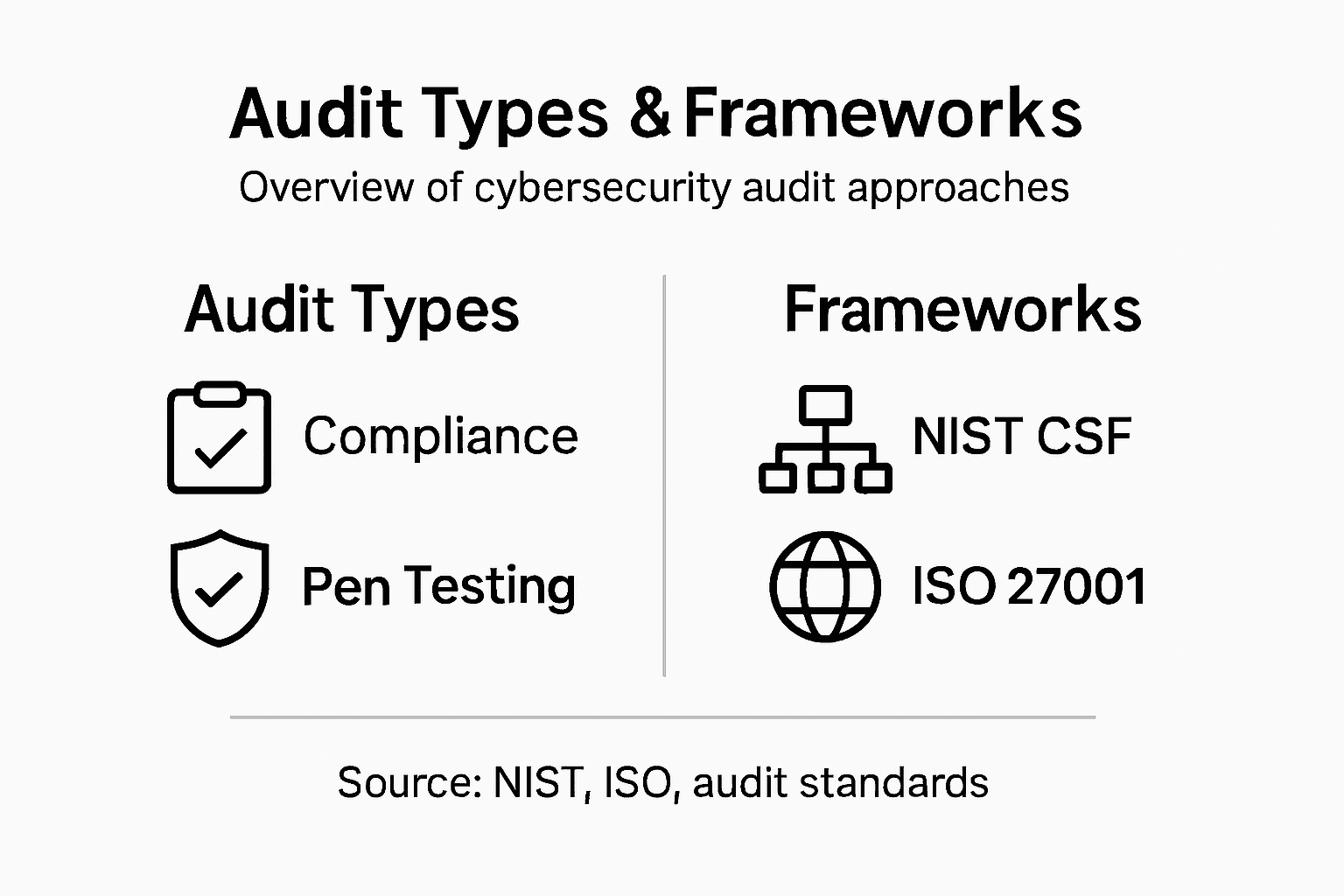
The NIST Cybersecurity Framework provides foundational guidance to manage cybersecurity risks through outcomes applicable across industries, linking governance, risk management, and control processes into a structured audit approach.
Core Audit Concepts
Three foundational concepts shape modern cybersecurity audits:
Risk assessment: Identifying threats, vulnerabilities, and potential impacts on your organization’s critical assets and operations.
Control evaluation: Testing whether existing security controls actually work as designed and whether gaps exist in your defense layers.
Compliance alignment: Verifying adherence to relevant regulations, frameworks, and industry standards applicable to your sector.
These three work together. Your audit team identifies risks, evaluates the controls designed to mitigate them, and confirms compliance with applicable standards.
Why This Matters for Your Role
As a chief audit executive in a financial institution, cybersecurity audits have become non-negotiable. Regulators increasingly expect boards and audit committees to demonstrate rigorous oversight of cyber risk management. Your audit function provides the independent assurance that governance structures, risk management processes, and technical controls are functioning as intended.
This is also where cybersecurity in auditing enhances your overall assurance strategy, positioning your department as a trusted advisor on organizational resilience.
The Audit Perspective
Cybersecurity audits operate from three critical angles:
Prevention: Do your controls prevent unauthorized access and data compromise?
Detection: Can your systems identify when security incidents occur?
Response: Are procedures in place to contain threats and recover operations?
Your audit scope should cover all three. Many organizations excel at prevention but fail at detection and response—areas where audits reveal critical gaps.
Cybersecurity audits assess not just whether systems are secure today, but whether your organization can detect and respond to threats when they occur.
Pro tip: Define your audit scope using a risk-based approach: focus audit resources first on systems processing sensitive data, critical operations, and areas with prior security incidents.
Types of Audits in Cybersecurity Programs
Cybersecurity audits come in several distinct flavors, each serving a different purpose within your overall assurance strategy. Understanding which audit type addresses which risks is critical for designing an effective audit plan that covers your organization’s most vulnerable areas.
Your audit committee needs to know the difference between these approaches. They’re not interchangeable, and using the wrong audit type can leave significant gaps in your risk coverage.
Compliance Audits
Compliance audits verify whether your organization meets regulatory requirements, industry standards, and internal policies. In financial institutions, this means assessing adherence to regulations like the Gramm-Leach-Bliley Act, SOX requirements, and banking secrecy standards.
Compliance audits answer a straightforward question: Are we following the rules? They focus on documentation, policy implementation, and control existence rather than testing whether controls actually prevent breaches.
These audits work best when paired with other audit types. Compliance alone doesn’t tell you if your controls are effective.
Vulnerability and Penetration Testing Audits
These audits simulate real-world attacks to identify exploitable weaknesses. Your team (or external specialists) attempts to breach systems, escalate privileges, or access sensitive data to prove vulnerabilities exist.
Penetration testing provides concrete evidence of security gaps. It moves beyond theoretical vulnerabilities to demonstrate actual exploitation paths attackers could use.
This audit type is highly technical and often requires specialized expertise. Many organizations partner with external firms to conduct these assessments objectively.
Operational Effectiveness Audits
Operational effectiveness audits test whether security controls actually work as designed during normal operations. This includes testing access controls, monitoring systems, and incident response procedures.

Your team might sample transactions, review logs, or simulate incidents to verify controls function properly. This is where you discover that a control exists on paper but fails in practice.
These audits bridge the gap between compliance (control exists) and vulnerability testing (can we break it). They answer the critical question: Does this control do what it’s supposed to do?
Key Audit Types at a Glance
Compliance audits: Verify adherence to regulations and standards.
Vulnerability assessments: Identify technical weaknesses without exploitation attempts.
Penetration testing: Simulate attacks to prove vulnerabilities can be exploited.
Operational effectiveness: Test whether controls work as designed in practice.
Risk-based audits: Focus resources on systems and processes with highest risk exposure.
Your audit strategy should include all these elements. When auditing cybersecurity and computer security programs, you’re essentially combining these audit types into a cohesive annual plan.
Here’s a comparison of major cybersecurity audit types and what each provides:
Audit Type | Main Objective | Key Benefit | Typical Limitation |
Compliance Audit | Verify regulatory adherence | Satisfies external requirements | May miss control failures |
Vulnerability Assessment | Identify weaknesses | Pinpoints technical gaps | Does not simulate real attacks |
Penetration Testing | Demonstrate exploitability | Reveals real-world risks | Requires expert testers |
Operational Effectiveness | Test control operation | Confirms controls work as designed | Time-consuming, can miss config flaws |
Risk-Based Audit | Focus on priority areas | Maximizes audit value | Needs strong risk data |
A balanced cybersecurity audit program uses multiple audit types because no single approach covers all risk dimensions.
Pro tip: Rotate audit types across your annual plan—dedicate year one to compliance and operational effectiveness, year two to vulnerability assessments, and coordinate external penetration testing every 18 to 24 months for fresh, unbiased perspective.
Key Frameworks and Regulatory Requirements
Your cybersecurity audit function operates within a complex web of frameworks, standards, and regulatory mandates. Each defines expectations differently, but they share a common goal: structured risk management and control effectiveness.
As a chief audit executive, you need frameworks that align with your organization’s risk profile while satisfying regulators. Choosing the right framework—or combining multiple frameworks—determines your audit strategy’s credibility.
The NIST Cybersecurity Framework
The NIST Cybersecurity Framework outlines best practices for managing cybersecurity risks through structured governance, risk management, and control processes. Version 2.0 supports organizations globally to improve their cybersecurity posture while integrating with other frameworks and regulatory requirements.
NIST CSF uses five core functions: Govern, Identify, Protect, Detect, and Respond. This structure provides a common language for auditors, management, and boards to discuss cybersecurity risk.
Most financial institutions use NIST as their baseline framework. It’s flexible enough to adapt to specific regulatory environments without requiring complete redesign.
Regulatory Requirements by Sector
Your audit scope must address sector-specific regulations. Financial institutions face particularly stringent requirements.
Gramm-Leach-Bliley Act (GLBA): Requires safeguards for customer information and privacy controls.
SOX compliance: Mandates auditing controls over financial reporting systems and data integrity.
Banking regulations: Federal Reserve, OCC, and FDIC requirements for operational resilience and incident reporting.
International standards: ISO/IEC 27001 and local data protection laws apply if your organization operates globally.
These aren’t optional. Regulators expect your audit committee to demonstrate active oversight of compliance with these requirements.
Integration and Mapping
Frameworks and regulations don’t always align perfectly. Your audit strategy must bridge these gaps. Many organizations map their audit objectives to multiple frameworks simultaneously.
For example, NIST CSF’s “Detect” function aligns with ISO 27001’s monitoring requirements and regulatory incident detection mandates. Smart audit planning uses this overlap to maximize coverage while managing resource constraints.
Why This Matters
Different frameworks emphasize different risk dimensions. NIST focuses on governance and outcomes. ISO 27001 emphasizes technical controls. Regulatory requirements emphasize compliance and reporting.
Your audit program needs coverage across all three perspectives. Using a single framework leaves exposure gaps.
Effective cybersecurity audits integrate multiple frameworks because no single standard covers all regulatory and risk management requirements your organization faces.
Pro tip: Map your organization’s regulatory requirements to NIST CSF functions, then build your annual audit plan around this matrix—this ensures each audit addresses both framework expectations and regulatory mandates without redundancy.
Critical Controls: Access, Incident, and Data Protection
Three control areas sit at the foundation of every cybersecurity audit: access management, incident response, and data protection. These aren’t optional add-ons—they’re the core defenses that determine whether your organization can survive a breach.
Your audit team needs deep expertise in all three areas. Gaps in any single category expose your organization to significant risk.
Access Control: The First Line of Defense
Access control ensures only authorized users can enter systems and access sensitive data. This includes authentication mechanisms, role-based access controls, and privilege management.
Your audit should verify that access controls actually prevent unauthorized entry. This means testing whether inactive accounts remain disabled, whether privileged access is monitored, and whether access rights match job responsibilities.
Access control failures create cascading vulnerabilities. One compromised user account becomes a pathway for attackers to move laterally through your network.
Test for common weaknesses like shared credentials, unnecessary administrative access, and lack of multi-factor authentication. These issues appear repeatedly in breach investigations.
Incident Response: Detection and Recovery
Incident response plans prepare your organization to detect, manage, and recover from cybersecurity events when they occur. Without a plan, even detected incidents spiral into costly, prolonged breaches.
Your audit evaluates whether incident response procedures actually exist, whether they’re documented, and whether staff know their roles. Testing incident response plans through tabletop exercises reveals gaps before real incidents occur.
Effective incident response includes defined escalation paths, communication protocols, and recovery timelines. Many organizations have plans that sound good on paper but fail during actual incidents because responsibilities are unclear.
Data Protection: Encryption, Backup, and Handling
Data protection encompasses encryption at rest and in transit, backup procedures, and secure handling of sensitive information. Critical cybersecurity controls reduce risk exposure through comprehensive data protection measures across all organizational sectors.
Your audit verifies that sensitive data is encrypted, that backups exist and can be restored, and that data classification policies guide handling practices. Test encryption key management, backup restoration times, and data destruction procedures.
Many organizations encrypt data but fail to manage encryption keys securely. Others backup data but have never tested whether backups actually restore successfully.
What Your Audit Should Cover
Access controls: Authentication strength, privilege escalation risks, access provisioning and deprovisioning processes.
Incident response: Plan completeness, staff training, tabletop exercise results, detection capability testing.
Data protection: Encryption implementation, backup frequency and restoration testing, classification enforcement, secure deletion processes.
These three areas interconnect. Strong access controls limit damage when breaches occur. Effective incident response depends on detecting anomalies in access logs. Data protection ensures that even compromised data cannot be exploited.
The table below summarizes critical controls and their audit focus:
Control Area | Audit Focus | Common Failure Point |
Access Management | Rights match roles, unused accounts disabled | Excessive privilege, orphaned accounts |
Incident Response | Procedures tested, staff trained | Undefined escalation, poor communication |
Data Protection | Encryption applied, backups tested | Weak key management, untested restores |
The most dangerous cybersecurity gaps exist in controls that look complete but fail during actual incidents—audits must test, not just verify existence.
Pro tip: Conduct a data flow analysis first: map where sensitive data moves through your systems, then build your audit scope around those pathways—this focuses testing effort on the highest-risk data and control areas.
Audit Roles, Challenges, and Common Pitfalls
Your audit function operates at a critical intersection: you must provide independent assurance while remaining collaborative with operations and management. This dual role creates inherent tensions that define the cybersecurity audit challenge.
Understands this tension shapes audit effectiveness. Ignore it, and you’ll struggle to gain stakeholder buy-in. Manage it well, and you become a trusted advisor rather than a compliance obstacle.
Your Evolving Role as Chief Audit Executive
Cybersecurity audits demand that your function take on responsibilities beyond traditional audit scope. You’re now accountable for identifying emerging threats, understanding sophisticated attack vectors, and assessing whether your organization can respond to incidents that haven’t yet occurred.
This expanded role requires deep technical knowledge your audit team may not possess. It also demands strategic thinking about organizational resilience—moving beyond “Did we follow the rules?” to “Can we survive a breach?”
Your board now expects cyber risk assurance. This positions audit as a strategic function, not just a compliance checker.
The Challenge: Rapidly Evolving Threats
Common challenges in cybersecurity audits arise from rapidly changing threat environments and complex regulatory demands. What was secure last year becomes vulnerable this year as attackers develop new techniques.
Your audit procedures must keep pace with these changes. Static audit programs become obsolete within months. Many organizations struggle because their audits lag behind actual threat landscapes.
This means continuous learning for your team. Industry certifications, threat intelligence subscriptions, and peer networks become operational necessities.
Common Pitfalls You’ll Encounter
Audit teams consistently stumble on predictable issues:
Compliance checkbox mentality: Testing whether controls exist, not whether they actually work under attack conditions.
Insufficient stakeholder coordination: Failing to align audit objectives with IT, operations, and security teams, leading to defensive responses and poor remediation.
Reactive instead of proactive approaches: Auditing only after incidents occur rather than identifying vulnerabilities before attackers find them.
Poor communication of findings: Using technical jargon that boards and executives don’t understand, reducing impact of audit recommendations.
Narrow audit scope: Focusing only on IT infrastructure while ignoring human factors, third-party risks, and organizational processes.
These pitfalls stem from audit teams trying to operate independently without building relationships with the business and security functions.
Shifting Your Approach
Effective cybersecurity audits require a risk-based methodology that focuses resources where threats are highest. This means deep engagement with business leaders to understand critical assets, regulatory priorities, and organizational vulnerabilities.
You’ll also need to balance independence with collaboration. Coordinate with IT security teams during planning, but maintain objectivity during testing. Communicate findings in business language, not technical specifications.
The most effective auditors position themselves as partners in risk management, not adversaries evaluating control failures.
Pro tip: Build a quarterly threat briefing process with your security team—use this intelligence to continuously update your audit risk assessment and adjust your annual plan before threats materialize rather than after your organization is attacked.
Strengthen Your Cybersecurity Audits to Defend Against Emerging Risks
Facing the growing complexity of cybersecurity threats requires more than just traditional audit approaches. This article highlights critical challenges like evolving attack vectors, compliance pressures, and the need to assess operational effectiveness and incident response alongside compliance. Chief audit executives and audit professionals must overcome common pitfalls such as reactive auditing and limited scopes that miss real vulnerabilities. If your goal is to transform your audit function into a powerful risk management partner skilled at preventing, detecting, and responding to cyber threats then targeted professional education is essential.
Explore tailored Continuing Professional Education courses developed specifically for audit and cybersecurity professionals. Gain practical skills in frameworks like NIST and SOX compliance, master risk-based audit planning, and learn how to communicate findings effectively to leadership. Start enhancing your audit program today with expert-led webinars and seminars that equip you with strategies to turn audits into a proactive defense. Visit Compliance Seminars now to secure your organization’s resilience through smarter audits and advance your career with recognized certifications.
Frequently Asked Questions
What is a cybersecurity audit?
A cybersecurity audit is a systematic examination of an organization’s information systems, controls, and processes to identify vulnerabilities, assess compliance with security standards, and evaluate the effectiveness of risk management strategies.
How do cybersecurity audits differ from standard IT audits?
Cybersecurity audits focus specifically on threats to digital assets and the controls protecting them, while standard IT audits may cover broader operational areas. Cybersecurity audits assess an organization’s ability to detect, respond to, and recover from cyber threats.
What are the main types of audits involved in cybersecurity?
The main types of cybersecurity audits include compliance audits, vulnerability assessments, penetration testing, and operational effectiveness audits. Each type addresses different aspects of cybersecurity risks and control effectiveness.
Why are cybersecurity audits important for financial institutions?
Cybersecurity audits are crucial for financial institutions as regulators expect rigorous oversight of cyber risk management. They provide independent assurance that governance structures, risk management processes, and technical controls are functioning effectively.
Recommended
Comments