Cybersecurity in Auditing: Enhancing Assurance


Traditional control checklists no longer capture the risks facing financial institutions in North America. Cybersecurity now stands at the center of audit work, pushing auditors to go beyond financial reviews and address technology threats that directly impact data integrity. As cybersecurity assurance is inseparable from financial assurance and audit functions demand digital knowledge, this shift calls for new skills and strategic approaches to help auditors protect both their organizations and their audit opinions.
Table of Contents
Key Takeaways
Point | Details |
Evolving Audit Role | Cybersecurity is now integral to auditing, requiring auditors to assess data integrity, IT governance, and the effectiveness of security controls. |
New Skills Required | Auditors must develop digital knowledge and cybersecurity awareness, as traditional audit training is insufficient for current needs. |
Regulatory Compliance | Regulators mandate cybersecurity audits for financial institutions, making it essential for auditors to validate controls and assess incident response capabilities. |
Continuous Improvement | Ongoing skill development and proactive risk identification are crucial for effective auditing in a rapidly changing cybersecurity landscape. |
Cybersecurity’s Evolving Role in Auditing
The audit function has undergone a dramatic transformation. Traditional assurance work—reviewing financial records, testing controls, ensuring compliance—remains important. But cybersecurity now sits at the center of what auditors must understand and assess.
Digital disruption has forced this shift. Data breaches, ransomware attacks, and system compromises don’t just create operational headaches. They threaten the integrity of financial reporting itself. When your organization’s IT infrastructure is compromised, your audit opinion becomes questionable.
Recent research highlights this trend. Bibliometric studies reveal cybersecurity-focused auditing is growing rapidly across financial institutions worldwide. Organizations now recognize that strong cybersecurity assurance is inseparable from financial assurance.
Your audit responsibilities now include:
Evaluating whether data integrity controls are effective
Assessing IT governance and access management
Testing detection systems for unauthorized changes to financial records
Understanding how technology risks impact audit evidence quality
Consulting with management on cybersecurity maturity
What changed? Three critical factors drive this evolution.
First, the threat landscape expanded. Your institution faces threats that didn’t exist a decade ago. Attackers target financial systems directly. They understand that compromised financial data equals stolen assets.
Second, auditors discovered a competency gap. Internal audit functions now require digital knowledge and cybersecurity awareness to fulfill their mission. Traditional audit training didn’t cover IT security assessments. Now it’s non-negotiable.
Third, regulators expect it. Financial institution regulators in North America assume your internal audit function can identify and evaluate cybersecurity risks. This isn’t optional anymore.
The result? Auditors need new skills. Data analytics capabilities matter. Understanding how systems log transactions, how access controls function, and how security monitoring works has become baseline knowledge for your audit team.
Your role expanded from reviewing what happened to preventing bad things from happening in the first place.
This doesn’t replace traditional auditing. Financial statement audits remain essential. But now you’re also assessing whether the systems generating those statements are secure, properly monitored, and resilient against attack.
Pro tip: Start building cybersecurity competency in your audit team now by identifying team members with IT backgrounds or security interest, then invest in targeted training on NIST frameworks and data integrity controls specific to your institution’s critical systems.
Types of Cybersecurity Audits and Frameworks
Not all cybersecurity audits are created equal. Your organization needs different types of audits to address different risks. Understanding which audit type fits which situation is critical for your audit plan.
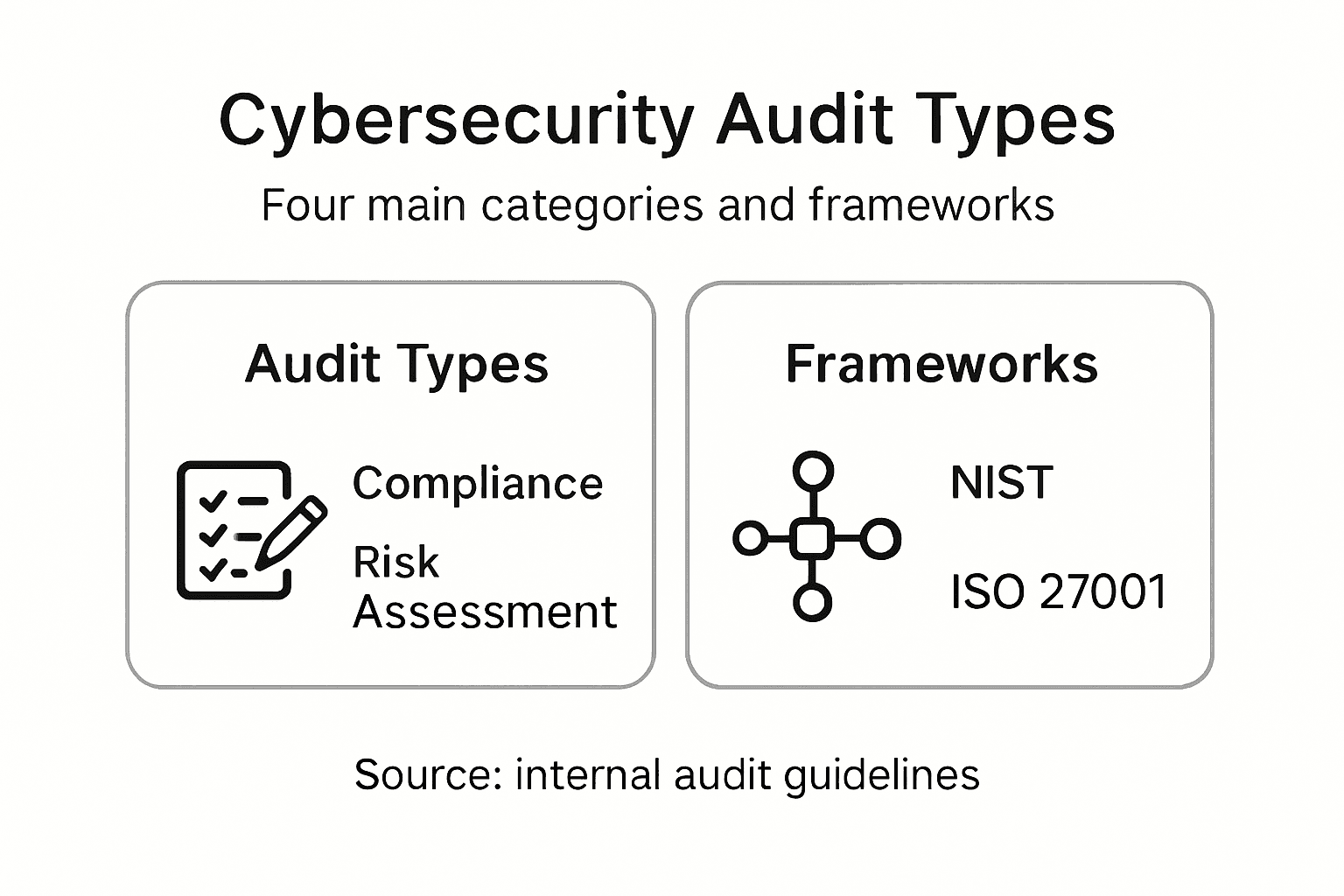
The audit landscape breaks down into four main categories. Each serves a distinct purpose and requires different skills from your team.
Compliance audits verify that your institution meets regulatory requirements. You’re checking whether controls exist to satisfy legal obligations. Banks in North America face requirements from regulators like the OCC and Federal Reserve regarding data protection, access controls, and incident reporting.
Risk assessments identify where cybersecurity weaknesses exist. Your team evaluates the organization’s threat landscape and control gaps. This isn’t about proving compliance. It’s about discovering what could go wrong before it does.

Penetration testing goes further. Authorized security professionals attempt to breach your systems using real attack techniques. Think of it as a controlled attack that your organization authorizes to find vulnerabilities.
Control evaluations examine whether specific security controls actually work as designed. You’re not just confirming they exist on paper. You’re testing whether they function effectively in practice.
To help clarify the differences, here is a comparison of cybersecurity audit types and what each delivers:
Audit Type | Main Objective | Outcome for Organizations |
Compliance | Meet regulatory standards | Demonstrates legal conformity |
Risk Assessment | Identify potential weaknesses | Informs risk mitigation strategy |
Penetration Testing | Test defenses with real attacks | Reveals exploitable vulnerabilities |
Control Evaluation | Validate control effectiveness | Confirms controls actually work |
Now here’s where frameworks come in. Cybersecurity audits employ frameworks systematically to ensure comprehensive review and consistency across your organization.
Three frameworks dominate the financial services space:
ISO/IEC 27001 provides a global standard for information security management. It’s recognized internationally and focuses on establishing systematic security controls.
NIST Cybersecurity Framework breaks security into five core functions: Identify, Protect, Detect, Respond, and Recover. Most financial institutions in North America use this framework.
COBIT emphasizes governance and control evaluation. It connects IT governance to organizational objectives and risk management.
Which framework should you use? That depends on your regulatory environment and organizational needs.
Here’s a summary comparing major cybersecurity audit frameworks and their key areas of focus:
Framework | Primary Focus | Typical Use Case |
ISO/IEC 27001 | Information security management | Global certification and corporate governance |
NIST Cybersecurity Framework | Risk management and critical infrastructure | North American financial regulators |
COBIT | IT governance and control assessment | Aligning IT goals with business strategy |
Don’t try to use all three frameworks simultaneously. Pick one that aligns with your regulator’s expectations and industry practice, then use it consistently.
Your audit program should map audit types to framework domains. For example, your compliance audit might verify NIST Protect controls. Your penetration test might address the Detect function. Your risk assessment covers gaps across all five NIST functions.
This structured approach prevents audit gaps. You’re not testing randomly. You’re systematically covering risk areas using a recognized framework your board understands.
Pro tip: Create an audit universe document that maps your organization’s critical systems to audit types and framework domains, then schedule audits to systematically cover all high-risk areas over a 24-36 month cycle.
Assessing Controls and Managing Cyber Risks
Assessing cybersecurity controls requires a different mindset than traditional financial controls testing. You’re not just confirming controls exist. You’re evaluating whether they actually prevent, detect, or correct unauthorized access and system compromise.
Control types break down into three categories. Preventive controls stop bad things from happening. Access restrictions, encryption, and authentication systems fall here. Detective controls identify when something goes wrong. Intrusion detection systems and security logs belong in this category. Corrective controls respond after an incident occurs, like incident response procedures and backup restoration processes.
Your assessment process should evaluate each type systematically. Cyber risk assessment involves evaluating the adequacy and effectiveness of cybersecurity controls across your organization’s critical systems.
Here’s what effective control assessment looks like:
Map critical systems and data flows
Identify controls protecting each system
Test whether preventive controls actually restrict access
Verify detective controls generate alerts when tested
Confirm corrective procedures actually restore systems
Document control gaps and weaknesses
Governance structures matter more than most auditors realize. Does your organization have clear accountability for cybersecurity decisions? Is the Chief Information Security Officer empowered to enforce controls? Without proper governance, even well-designed controls fail because nobody enforces them consistently.
Your risk prioritization approach is critical here. Not every control weakness deserves equal attention. Focus on risks that could compromise financial data or reporting integrity. A misconfigured access control affecting the payroll system requires immediate attention. A password policy violation in a non-critical system needs remediation, but poses less urgent risk.
Managing cyber risks means accepting you’ll never eliminate them completely. Your job is reducing them to acceptable levels while maintaining operational continuity.
Continuous monitoring is your ongoing responsibility. Cybersecurity risks evolve constantly as threat actors develop new techniques. Controls that worked six months ago may no longer address current threats. Your audit plan should include periodic reassessments, not just annual reviews.
Incident response mechanisms deserve special audit attention. When a breach occurs, does your team have a documented plan? Can they isolate affected systems quickly? Do they preserve evidence for investigation? These aren’t theoretical questions anymore.
Managing cyber risks also means understanding your organizational resilience. Can your institution continue operations if key systems go offline? Do you have backups? Can you restore them quickly? These questions go beyond cybersecurity into business continuity.
Pro tip: Document your organization’s risk appetite for cybersecurity explicitly, then use that appetite to guide your control assessment priorities. Focus audit resources on controls protecting systems that exceed your risk tolerance if compromised.
Regulatory Compliance and Auditor Responsibilities
Regulatory requirements for cybersecurity auditing have exploded in the past five years. Your audit function is no longer optional. Regulators now explicitly require it. Your responsibilities extend beyond traditional financial auditing into cybersecurity governance and control effectiveness.
Financial institutions in North America face requirements from multiple regulators. The Federal Reserve, Office of the Comptroller of the Currency, and Federal Deposit Insurance Corporation all mandate cybersecurity controls and audit oversight. These aren’t suggestions. They’re regulatory expectations backed by enforcement authority.
Your audit responsibilities break down into specific areas.
Validate control effectiveness across IT systems supporting financial operations
Assess governance structures ensuring cybersecurity decisions receive appropriate oversight
Evaluate incident response capabilities to verify your organization can detect and contain breaches
Monitor compliance with regulatory-mandated security standards and frameworks
Report findings to the audit committee and board with clarity about cyber risk
Recommend improvements based on control gaps and emerging threats
Regulatory expectations differ by your institution’s size and risk profile. Larger banks face more intensive scrutiny than community banks. Institutions handling sensitive data face higher standards than those with minimal customer information exposure.
Understanding why audit matters for financial services compliance helps you position your cybersecurity audit work strategically within your organization’s broader compliance framework.
Documentation is critical. Regulators expect clear evidence that you assessed cybersecurity controls. Your workpapers should demonstrate testing performed, results obtained, and conclusions reached. If you can’t document it, regulators assume you didn’t do it.
Scope definition matters significantly. Don’t try to audit every system simultaneously. Identify your institution’s critical systems—those supporting payment processing, loan origination, deposit taking, or financial reporting. These are your audit priorities. Less critical systems get less intensive testing.
Your audit responsibility isn’t eliminating all cyber risk. It’s providing reasonable assurance that management has implemented controls addressing known threats to financial data and operations.
Testing frequency is a compliance question. How often should you test specific controls? Regulatory guidance suggests annual testing for critical controls. Detective controls monitoring access logs might need quarterly evaluation. Your test plan should reflect risk significance and control criticality.
Reporting findings requires judgment. Not every control gap is equally serious. A missing encryption certificate on a non-critical development system differs significantly from weak access controls on the general ledger server. Prioritize your findings based on financial impact and breach likelihood.
Management remediation tracking is part of your ongoing responsibility. When you identify findings, management commits to corrective action. Your audit function should follow up to confirm remediation actually occurred and controls now operate effectively.
Pro tip: Create a regulatory requirements matrix mapping your institution’s specific regulators to their cybersecurity audit expectations, then use it to design your annual audit plan ensuring you cover all regulatory mandates systematically.
Common Challenges and Best Practices
Cybersecurity auditing exposes a harsh reality: most audit teams lack the expertise their role now demands. You’re asked to evaluate technical systems using skills developed for financial statement audits. That mismatch creates real problems.
Talent shortage sits at the top of the challenge list. Auditors with both deep cybersecurity knowledge and audit experience are rare. Your organization competes for these professionals against IT security firms paying significantly more. Building this competency internally takes time and sustained investment.
Threat velocity creates a second major challenge. Cybersecurity evolves at breakneck speed. A framework you mastered last year includes new controls this year. Zero-day vulnerabilities emerge constantly. Your audit procedures become outdated faster than you can update them.
Technology integration complexity amplifies these challenges. Your institution adopts new systems—cloud platforms, API connections, machine learning models—faster than traditional audit can assess them. How do you audit artificial intelligence systems? Your traditional control testing approaches don’t apply.
Overcoming these challenges requires specific best practices:
Invest in continuous education for audit team members through certifications and specialized training
Collaborate directly with IT and security teams rather than auditing from a distance
Adopt automation tools to handle routine testing and free team capacity for complex assessments
Leverage advanced analytics to identify patterns and anomalies traditional testing misses
Position audit as a consultant, not just a critic, helping management strengthen controls
Auditors must be agile and proactive, continuously updating their skills to keep pace with evolving cybersecurity risks. This isn’t optional anymore. Your audit effectiveness depends on it.
Cross-functional communication prevents audit gaps. When security teams discover a new threat, your auditors should know about it within days. When audit identifies a control weakness, IT should understand its business impact immediately. Silos destroy effectiveness.
Proactive risk identification differentiates strong audit programs from average ones. Don’t wait for incidents to discover vulnerabilities. Use threat intelligence, industry reports, and regulatory guidance to anticipate emerging risks. Test your controls against those anticipated threats before they materialize.
The best cybersecurity auditors spend as much time preventing problems as proving they don’t exist.
Innovation adoption keeps your audit program relevant. Consider tools like automated vulnerability scanners, security information and event management dashboards, and AI-powered log analysis. These aren’t replacements for auditor judgment. They’re force multipliers making your team more effective.
Consulting activities add value beyond traditional assurance. Help management evaluate new security technologies before implementation. Support security team capability assessments. Provide input on governance structure improvements. This consulting strengthens your organization’s overall resilience.
Training programs must be ongoing, not annual. Quarterly lunch-and-learn sessions on emerging threats, monthly technical training on new tools, annual certification updates. Budget for this consistently.
Pro tip: Identify one team member with demonstrated cybersecurity interest, sponsor their CISA or similar certification, then use them as your in-house expert to build competency across the entire audit team through mentoring and shared learning.
Strengthen Your Cybersecurity Auditing Skills Today
The growing challenge of integrating cybersecurity into auditing demands sharp, relevant skills and up-to-date knowledge. As the article highlights, auditors face evolving threats, complex regulatory requirements, and a pressing need to assess cybersecurity controls effectively. Many struggle with the competency gap and the urgency to stay current on frameworks like NIST and ISO/IEC 27001 while delivering assurance that management’s controls truly protect financial data and operations.
Empower yourself and your audit team with specialized training designed to meet these challenges. Explore comprehensive courses and live seminars at compliance-seminars.com tailored specifically for auditing professionals seeking to master cybersecurity auditing, risk assessment, and regulatory compliance. Join other internal auditors, CPAs, and risk managers advancing their expertise with programs aligned to your certifications including CISA and CIA. Visit Compliance Seminars now to gain the confidence to navigate this critical intersection of technology and audit. Your next step toward bridging the cybersecurity audit gap starts here.
Frequently Asked Questions
What is the evolving role of cybersecurity in auditing?
Cybersecurity is now central to auditing, moving beyond traditional financial record review to assess the security and integrity of IT systems that affect financial reporting.
What are the different types of cybersecurity audits?
The main types of cybersecurity audits include compliance audits, risk assessments, penetration testing, and control evaluations, each serving distinct purposes and requiring different approaches.
How can auditors assess the effectiveness of cybersecurity controls?
Auditors can evaluate cybersecurity controls by testing preventive measures, verifying detection capabilities, and confirming corrective procedures, ensuring that all controls are functioning as intended.
What are some regulatory requirements for cybersecurity auditing?
Regulatory bodies expect audits to validate control effectiveness, assess governance structures, and evaluate incident response capabilities, requiring detailed documentation and compliance with mandated standards.
Recommended
Comments