NASBA CPE: Why Compliance Matters for CPAs


Sorting out NASBA CPE credits often feels like unraveling a puzzle with hidden pieces. For compliance officers and internal auditors, the fine print behind CPE calculations is never just academic—missing key details can put a hard-earned CPA license at risk. This article breaks down how a NASBA CPE credit means exactly 50 minutes of approved instruction and clears up misconceptions, so you can meet your firm’s state and professional obligations with confidence and efficiency.
Table of Contents
Key Takeaways
Point | Details |
Understanding CPE Credits | A NASBA CPE credit equals 50 minutes of instruction, and different formats yield different credit values; verify with state regulations before enrollment. |
Myth-Busting CPE | Not all CPE credits are interchangeable; specific state requirements dictate the acceptance of general versus specialized credits. |
Documentation Is Crucial | Maintaining detailed records of CPE credits, including the provider’s NASBA approval, is essential for compliance during audits. |
Plan for Compliance | Create an annual CPE plan to secure required credits, reducing last-minute scrambles and ensuring all courses meet state requirements. |
NASBA CPE Credits Explained and Debunked
NASBA CPE credits can feel like a mysterious system with hidden rules and contradictions. Let’s cut through the confusion and explain what these credits actually are and why the numbers matter for your compliance obligations.
What Exactly Is a NASBA CPE Credit?
A NASBA CPE credit is not like a college credit or a generic professional development unit. The Statement on Standards for CPE Programs defines it precisely: one credit equals 50 minutes of instruction time in a qualifying learning activity.
That’s the baseline. But here’s where it gets specific.
One hour of classroom instruction = 1.2 credits
One hour of self-study = 1 credit
One hour of structured online training = 1 credit (if it meets NASBA standards)
The difference matters because your state board counts credits differently depending on the delivery method. Some states cap self-study credits. Others limit online hours. Your firm’s compliance officer needs to know these rules for your specific jurisdiction.
One CPE credit equals exactly 50 minutes of instruction—not an hour, not “approximately an hour.” The precision matters for audit trails.
Common Myths About NASBA CPE Credits
Misunderstandings about CPE credits lead to non-compliance. Let’s address the biggest ones.
Myth 1: All CPE credits are created equal. False. Your state board distinguishes between general CPE and specialized CPE. A cybersecurity course might count toward your required continuing education but not toward your auditing requirement. Check your state’s specific requirements before enrolling.
Myth 2: Online courses always count as full credits. Not automatically. The updated CPE Standards from NASBA and AICPA specify that self-directed online learning must meet particular standards for documentation, assessment, and instructor credentials. A recorded webinar without interaction might qualify. A passive video might not.
Myth 3: Your firm’s in-house training counts as CPE. Typically no. Internal compliance workshops don’t qualify unless they’re delivered by a NASBA-approved provider with proper documentation and learning objectives.
Myth 4: Once you earn a credit, it’s good anywhere. Wrong. Credits earned in one state may not transfer fully to another. Some states accept NASBA credits at face value. Others apply restrictions or require additional documentation.
How Credits Apply to Your Compliance Requirements
Your CPE obligations are state-specific, not federal. Most states require CPAs to complete 40 CPE credits every two years, but the composition matters.
Typical state requirements include:
At least 20 credits in accounting or auditing
At least 4 credits in ethics or professional responsibility
Remaining credits in approved professional development
As an internal auditor or compliance officer, you likely need auditing-specific credits. Many compliance-focused courses qualify, but verify that your intended course meets your state’s definition of “auditing.” A course on internal controls might satisfy accounting requirements but not auditing requirements.
Documentation is non-negotiable. Your firm must maintain records showing the provider’s NASBA approval status, the course title, the date completed, credits earned, and the delivery method. Auditors expect this paperwork. State boards demand it during reviews.
The Real Impact on Your Firm
Failing to track CPE credits correctly creates liability. If you claim credits you didn’t properly earn, your state board can impose penalties ranging from fines to credential suspension. Audit firms have faced enforcement actions for systematically overstating CPE credits earned by staff.
Your compliance officer should implement a tracking system that flags non-qualifying courses before registration. This prevents wasted money and eliminates audit risk.
Pro tip: Create a pre-approval process where your compliance team reviews any proposed CPE course against your state’s specific requirements before your staff registers. This one step prevents 95% of CPE compliance issues and saves time during annual audits.
Recognized CPE Delivery Methods and Formats
NASBA recognizes far more than just classroom seminars these days. The learning formats that count toward your CPE requirements have expanded dramatically, and understanding which methods qualify is critical for your compliance strategy.
Live and In-Person Learning
Live seminars remain the gold standard for CPE delivery. Classroom instruction, whether in-person at a hotel conference center or an office training room, generates CPE credits at the straightforward rate of 1.2 credits per hour.
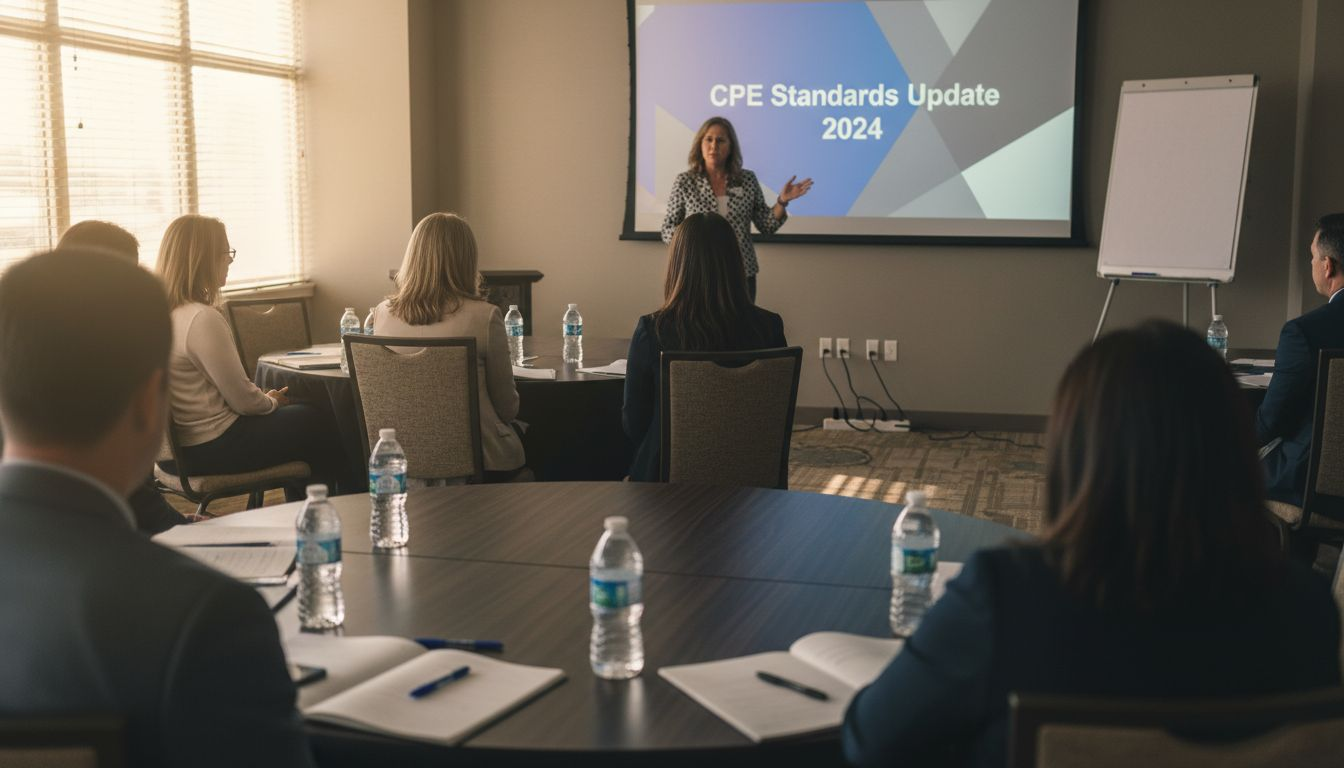
The key requirement: A qualified instructor must be present, and you must attend the full session. Partial attendance typically doesn’t count. Your compliance officer should track attendance records meticulously—auditors will ask for sign-in sheets and instructor credentials.
In-person learning has one undeniable advantage: engagement and networking with peers. You’re learning compliance standards while building relationships with professionals from other firms. That’s valuable.
Virtual and Synchronous Learning
Live webinars and virtual instructor-led training count as CPE credits just like in-person seminars, provided they meet specific standards. The instructor must be present and interactive, not delivering a pre-recorded presentation.
The recognized delivery methods for CPE include live online training with real-time interaction, polling, or Q&A sessions. A passive recorded webinar does not qualify as live learning, even if you watch it at the scheduled time.
Your firm likely used virtual training extensively during remote work periods. Track those credits carefully—NASBA distinguishes between live webinars and recorded webinars, and the rules differ.
Self-Study and Independent Learning
Self-study CPE includes reading books, watching recorded courses, and completing online modules at your own pace. The credit calculation differs from live learning: one hour of self-study typically equals one CPE credit, not 1.2.
Self-study formats that qualify include:
Online courses with documented learning objectives
Published books on auditing, accounting, or compliance topics
Industry webinars (if properly documented)
Technical publications and journals
The catch: Your state may cap self-study credits. Some states allow only 50% of your total CPE through self-study. Others restrict self-study to specific subject areas. Check your state board’s rules before relying heavily on this method.

Blended and Modern Learning Formats
NASBA now recognizes blended learning and nano-learning formats as valid CPE delivery methods. Blended learning combines synchronous (live) and asynchronous (self-paced) components.
Microlearning, also called nano-learning, involves short focused lessons—sometimes 10 to 20 minutes—on specific compliance topics. These are popular because they fit into busy schedules.
Modern CPE formats must maintain rigor. A five-minute compliance tip on LinkedIn doesn’t qualify, but a structured 30-minute nano-learning module on SOX controls does.
Adaptive learning approaches, where the content adjusts based on your performance, also qualify if delivered by NASBA-approved providers. These formats reflect how modern professionals actually learn.
Here is a comparison of NASBA-recognized CPE delivery formats and their typical compliance risks:
Delivery Method | Typical Credit Value | Main Compliance Risk | Engagement Level |
Live Classroom | 1.2 credits/hour | Partial attendance often missed | High interaction, networking |
Live Webinar | 1 credit/hour | Confusing live vs. recorded status | Interactive if facilitated |
Self-Study Online | 1 credit/hour | State caps or lack of structure | Varies, usually low |
Blended/Nano-Learning | 1 credit (min. 50 min) | Unverified provider credentialing | Short, focused engagement |
Documentation and Approval Requirements
Regardless of delivery method, your firm must document which provider delivered the CPE and whether they hold NASBA approval. A course from compliance seminars automatically carries NASBA recognition. A course from your firm’s internal training department does not.
Keep detailed records showing:
Provider name and NASBA approval status
Course title and learning objectives
Date completed and hours attended
Delivery method (live, recorded, self-study, blended)
Your name and credentials earned
State auditors expect this documentation. Without it, claimed credits become questionable.
Pro tip: Before approving any CPE course for your team, verify the provider’s NASBA status on the official NASBA website and confirm the delivery method matches your state’s requirements—this single verification step eliminates 90% of downstream compliance disputes.
Meeting Annual NASBA CPE Requirements
Your annual CPE obligation is not a suggestion or a nice-to-have. It’s a hard compliance requirement tied directly to your CPA license. Missing the deadline creates legal and professional consequences. Here’s what you need to know to stay compliant.
Understanding the Annual Threshold
NASBA sets a clear annual requirement: CPAs must complete 2,000 CPE minutes within each calendar year. That converts to roughly 33 hours, or about 40 CPE credits using standard conversion rates.
This is not negotiable. Your state board enforces this requirement as a condition of maintaining your active CPA license. Failure to meet the threshold can result in license suspension or revocation.
The annual NASBA CPE requirements mandate applies to all active CPAs, though newly licensed professionals have prorated thresholds in their first year.
2,000 minutes per year equals approximately 33 hours. Track your progress monthly, not just at year-end.
Calculating Your Total Minutes
Not all CPE minutes count equally toward your annual total. You must understand how different formats add up.
Calculate your minutes this way:
Live classroom instruction: 50 minutes per CPE credit
Self-study courses: 50 minutes per CPE credit
Webinars (live, interactive): 50 minutes per CPE credit
Recorded webinars: 50 minutes per CPE credit (if NASBA-approved)
Nano-learning modules: 50 minutes per CPE credit (if structured)
Your compliance officer should maintain a running spreadsheet tracking each course, format, credits earned, and cumulative minutes. This prevents scrambling in December to meet the deadline.
State-Specific Requirements and Deadlines
While NASBA sets the baseline, your specific state board may add restrictions or earlier deadlines. Some states require CPE completion by December 31st. Others use fiscal years or different cutoff dates.
Check your state board’s website for:
Exact deadline date and time for submitting credits
Any subject area requirements beyond the 2,000-minute total
Restrictions on self-study or online learning percentages
Grace periods or late-filing penalties
Missing your state’s deadline by even one day can trigger automatic compliance violations, even if you complete the hours later.
Documentation and Certificate Requirements
Completing CPE is only half the battle. You must properly document and report it. CPAs must accurately report and retain documentation of earned CPE credits to comply with annual requirements.
Your documentation file should contain:
Certificate of completion for each course
Provider name and NASBA approval status
Course title and learning objectives
Date completed and total hours
Your name and CPA license number
State auditors request these documents during compliance reviews. Digital copies are acceptable, but originals should be retained for at least five years.
Use this summary to check paperwork completeness for NASBA CPE compliance:
Required Document | Why Needed for Compliance | How Long to Retain |
Course Certificate | Proof of completion | At least 5 years |
Provider NASBA Approval | Validates course legitimacy | At least 5 years |
Course Title and Objectives | Verify subject area coverage | At least 5 years |
Attendance Record/Date | Confirms participation date | At least 5 years |
Building Your Annual Plan
Don’t treat CPE as a last-minute scramble. Plan your compliance year in advance. Identify the specific auditing and compliance courses you need, register early, and space courses throughout the year.
A realistic annual plan might look like:
Enroll in one multi-day live seminar (16-20 CPE credits)
Complete two online courses on specialized topics (8-12 CPE credits)
Attend monthly webinars on emerging compliance issues (8-12 CPE credits)
Self-study technical updates (remaining credits to reach 2,000 minutes)
This approach spreads your learning across the year, prevents burnout, and ensures you maintain current knowledge throughout your business cycle.
Pro tip: Create a calendar reminder for September 1st to audit your year-to-date CPE credits and identify any gaps. This gives you a full three months to close any shortfall without the panic of last-minute registration.
Common Pitfalls and How to Stay Compliant
Most CPE compliance failures aren’t intentional. They result from overlooked details, unclear policies, or simple miscommunication within your firm. Understanding the most common pitfalls puts you ahead of the audit curve.
Pitfall 1: Enrolling in Non-Approved Courses
This is the most frequent mistake. Your compliance officer registers staff for a course that sounds legitimate but hasn’t been approved by NASBA. The hours get claimed. The credits get counted. Then the state board audit reveals the issue.
Not all training providers hold NASBA approval. A course on “Compliance Best Practices” from a consulting firm might be excellent content but carry zero CPE value. Your staff completes it, your firm budgets the cost, and the credits evaporate during audit.
Common compliance pitfalls include failing to verify CPE sponsor approval before registration. Always check the NASBA provider directory before enrolling anyone in a course.
Verification steps:
Search the NASBA registry for the provider name
Confirm the specific course is listed and approved
Document the approval status in your tracking system
Save the verification email or screenshot
Before you register, verify the provider. A five-minute check prevents months of compliance headaches.
Pitfall 2: Misreporting Credit Types or Quantities
Your compliance officer accurately tracks CPE hours but misclassifies them. A cybersecurity course gets counted as auditing CPE when your state requires it to be general CPE. A 40-minute course gets recorded as one full CPE credit instead of 0.8.
These errors compound. Your annual report shows you met requirements when you actually fell short. The state board catches the discrepancy during a compliance review.
Accurate reporting requires understanding your state’s specific definitions. A course on internal controls might satisfy accounting requirements in one state but auditing requirements in another.
Pitfall 3: Inadequate Documentation and Record Retention
You completed the CPE, earned the credits, and filed the report. Then you deleted the email confirmations and threw away the certificates. Three years later, the state board audits your file and requests proof of completion.
You cannot reconstruct the documentation. The provider moved locations. Your emails are archived. Now you’re defending yourself against compliance violations.
Proper documentation includes:
Original certificates of completion
Course titles and learning objectives
Provider name and approval status
Attendance dates and hours claimed
Your CPA license number
Retain these records for at least five years in accessible, organized files.
Pitfall 4: Relying Solely on Self-Study or Unstructured Learning
Your team reads compliance articles, watches videos, and attends internal meetings. You count all of it as CPE self-study. State boards cap self-study credits precisely because unstructured learning doesn’t guarantee competence maintenance.
Structured self-study—an online course with learning objectives and assessment—qualifies. Reading a blog post does not.
How to Build a Compliant System
Stop relying on individual memory or scattered spreadsheets. Implement a centralized CPE management process.
Your compliance system should include:
Pre-approval protocol for all CPE courses before staff registration
Centralized tracking spreadsheet with all required details
Digital filing system for certificates and documentation
Monthly status reports to leadership on compliance progress
Annual compliance audit checklist reviewed with your state board
Policy document specifying CPE requirements for your firm
This approach prevents nearly all compliance violations.
Pro tip: Implement a simple rule: no CPE course gets approved until your compliance officer confirms the provider in the NASBA directory and verifies the delivery method matches your state’s requirements. Make this non-negotiable before budget approval.
Stay Ahead with Trusted NASBA-Approved CPE Solutions
Navigating NASBA CPE requirements can feel overwhelming with intricate rules about credit types and documentation. This article highlights the challenges many CPAs and compliance officers face such as tracking valid credits, meeting state-specific criteria, and avoiding costly compliance pitfalls. You need reliable, NASBA-approved courses that clearly align with your annual credit goals while offering comprehensive coverage on auditing, internal controls, and cybersecurity.
Compliance Seminars offers a broad selection of live webinars and in-person training designed specifically to help professionals like you meet NASBA standards confidently. Our expert-led courses focus on the crucial content areas your state requires and provide thorough documentation to streamline your audit preparations. Avoid last-minute compliance stress with structured learning formats and pre-approved providers.
Take control of your CPA CPE compliance today by exploring Compliance Seminars for courses tailored to your needs. Visit our homepage now to find expert-led auditing and compliance training that keeps your license in good standing without the headache. The time to act is now because missing your annual NASBA requirements can jeopardize your professional standing.
Frequently Asked Questions
What is a NASBA CPE credit?
A NASBA CPE credit represents 50 minutes of instruction time in a qualifying learning activity, with specific credit values assigned based on the delivery method.
How do self-study CPE credits differ from live seminar credits?
Self-study CPE credits generally equal 1 credit per hour of study, while live classroom instruction typically counts for 1.2 credits per hour.
Why is it important to track CPE credits carefully?
Accurate tracking is critical to ensure compliance with state board requirements, as misreported or misclassified credits can lead to penalties, including fines or credential suspension.
What should be included in CPE documentation for compliance?
Documentation must include the provider’s NASBA approval status, course title, date completed, credits earned, and delivery method to meet audit requirements.
Recommended
Comments