Role of audit committees in 2026: 93% prioritize cybersecurity


Audit committees once focused exclusively on financial reporting and internal controls. Today, their agenda looks dramatically different. Cybersecurity tops the priority list for 93% of audit committees, signaling a fundamental transformation in governance oversight. This shift reflects the reality that financial health depends on managing technology risks, enterprise exposure, and regulatory compliance in an interconnected world. Understanding these evolving responsibilities helps audit committee members navigate their expanded roles effectively.
Table of Contents
Key takeaways
Point | Details |
Cybersecurity dominance | 93% of audit committees rank cybersecurity in their top three priorities, with 71% including it in quarterly agendas. |
Expanded oversight scope | Audit committees now integrate enterprise risk management, technology risks, and compliance alongside traditional financial oversight. |
Regulatory pressure | SEC cybersecurity rules and Delaware case law have increased audit committee liability and compliance responsibilities. |
Skills gap challenge | 31% identify cybersecurity expertise as the skill most needed to improve committee effectiveness. |
Framework adoption | Model charters, checklists, and self-evaluations systematically improve governance quality and risk management. |
Introduction to audit committees and their traditional role
Audit committees emerged to strengthen oversight of financial reporting and internal controls in publicly traded companies. Their foundational responsibilities focused on financial statement accuracy and ensuring transparency for investors. These committees act as the bridge between external auditors, internal audit functions, and the board of directors.
Regulatory bodies shaped their mandate over decades. The Securities and Exchange Commission, Public Company Accounting Oversight Board, New York Stock Exchange, and Nasdaq all established rules defining audit committee composition and responsibilities. These requirements centered on financial expertise and independence.
Traditional audit committee duties included:
Overseeing the integrity of financial statements and disclosures
Monitoring internal control effectiveness over financial reporting
Selecting and supervising external auditors
Reviewing significant accounting policies and estimates
Ensuring compliance with financial regulations
This financial focus made sense when business risks primarily involved accounting accuracy and fraud prevention. However, the risk landscape has fundamentally changed. Technology failures, data breaches, and interconnected supply chains now pose threats equal to or greater than traditional financial risks. The baseline understanding of these historical responsibilities helps contextualize how dramatically audit committee roles have evolved to address modern enterprise challenges.
Top priority areas for audit committees in 2026
The expansion beyond financial oversight represents the most significant shift in audit committee responsibilities in decades. Cybersecurity appears on 93% of audit committee agendas as a top-three priority, fundamentally reshaping how these committees allocate time and attention. This isn’t a temporary trend but a permanent governance evolution.
Enterprise risk management integration stands as another critical priority. Audit committees increasingly coordinate with risk committees or assume direct ERM oversight when separate risk committees don’t exist. This holistic approach recognizes that financial, operational, strategic, and compliance risks interconnect in complex ways.
The talent challenge looms large. Committee composition traditionally emphasized financial accounting expertise, but 31% of committees now identify cybersecurity expertise as the skill most likely to improve effectiveness. Finding directors who combine financial acumen with cybersecurity knowledge remains difficult.
Quarterly cybersecurity updates have become standard practice rather than annual reviews. Committees receive detailed briefings on:
Threat landscape changes and incident response readiness
Vulnerability assessments and penetration testing results
Security investments and technology stack updates
Third-party risk management and vendor security
Regulatory compliance status and audit findings
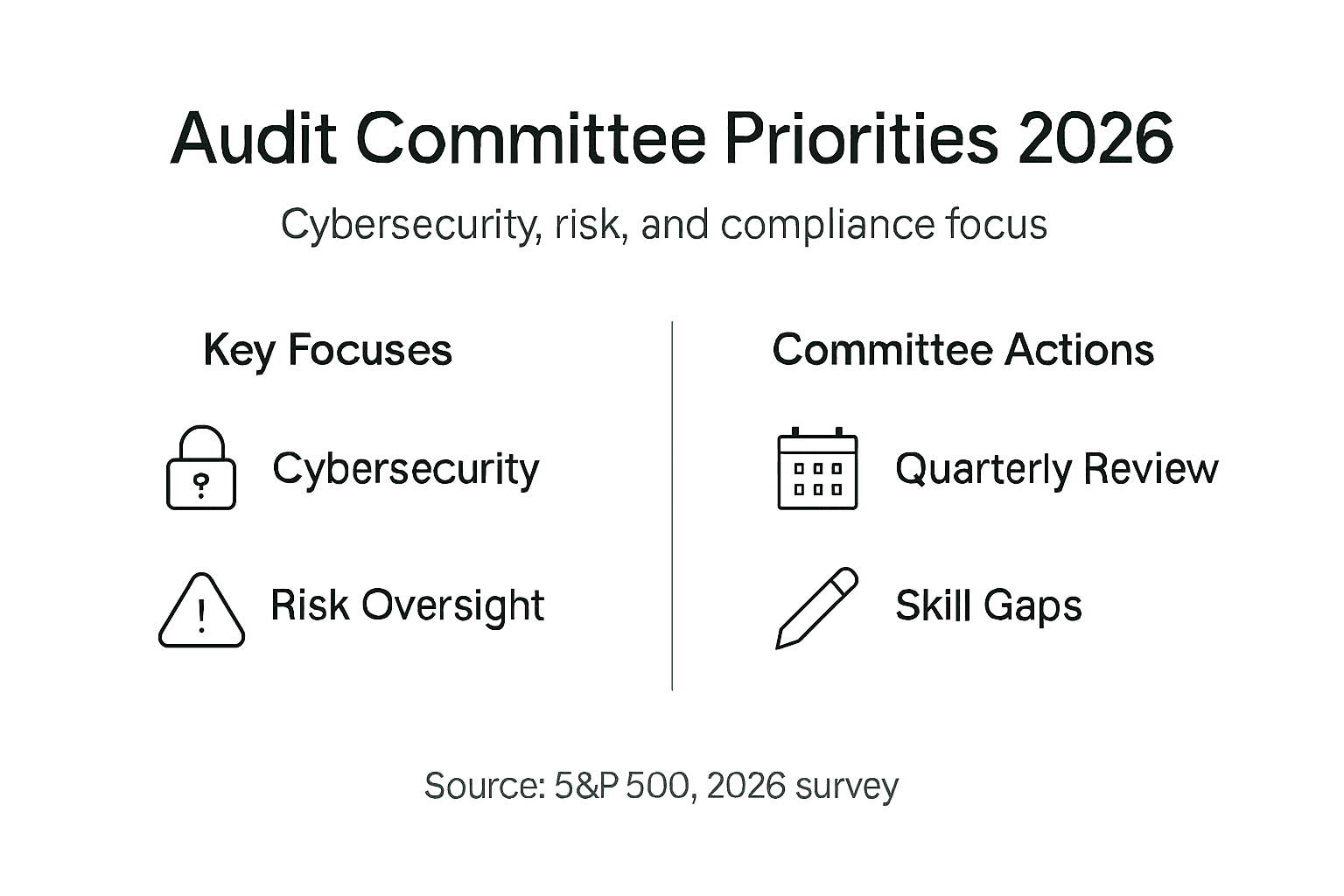
Cybersecurity Priority Statistics: 93% rank it in top three priorities, 71% review it quarterly, 64% of S&P 500 audit committees formally oversee it.

The skills gap persists despite recognition of its importance. Many committees rely on management presentations without possessing the technical depth to ask probing questions. Bridging this gap requires recruiting new members, extensive continuing education, or engaging independent cybersecurity advisors. The committees that successfully navigate these priorities position their organizations to manage twenty-first century risks effectively.
Regulatory compliance and evolving SEC expectations
Regulatory requirements have intensified audit committee responsibilities significantly. The SEC’s Cybersecurity Risk Management Rule, finalized in 2023 and fully effective by 2026, mandates disclosure of material cybersecurity incidents within four business days. This rule fundamentally changed audit committee oversight by making cybersecurity a formal compliance obligation rather than a discretionary governance matter.
64% of S&P 500 audit committees now oversee cybersecurity formally, up from 59% the previous year, directly responding to SEC expectations. Committees must understand what constitutes materiality in cyber incidents, how management assesses threats, and whether disclosure controls adequately capture reportable events.
Delaware case law has heightened liability risks. Recent decisions suggest directors may face personal liability for failing to implement adequate information systems or ignoring red flags about significant risks. Courts increasingly view cybersecurity oversight as a fiduciary duty, not merely a best practice.
Audit committees now enforce compliance across multiple dimensions:
Financial reporting accuracy under Sarbanes-Oxley and SEC rules
Cybersecurity incident disclosure and risk management processes
Internal control effectiveness including IT general controls
Whistleblower program operation and complaint investigation
Foreign Corrupt Practices Act compliance and anti-bribery controls
The internal audit function’s role in cybersecurity compliance has become a key focus area. Committees ensure internal auditors possess skills to assess IT controls, evaluate security architectures, and test incident response capabilities. This requires internal audit to evolve beyond traditional financial auditing.
Enforcement trends show regulators scrutinizing audit committee effectiveness more closely. The SEC examines meeting minutes, information flow to committees, and whether committees asked appropriate questions during examinations. Committees must document their oversight activities thoroughly and demonstrate they challenged management assertions. Adapting to this regulatory environment requires committees to stay informed about rule changes, invest in member education, and maintain robust documentation of their oversight activities.
Integration of enterprise risk management into audit committee oversight
Enterprise risk management represents a comprehensive approach to identifying, assessing, and managing risks across all organizational dimensions. Audit committees increasingly integrate ERM into their oversight rather than treating it as a separate management function. This integration reflects recognition that risks don’t respect organizational boundaries and require coordinated governance.
ERM ownership is often shared between audit committees, risk committees, and full boards, creating both opportunities and coordination challenges. In organizations with dedicated risk committees, audit committees typically focus on financial and compliance risks while risk committees handle strategic and operational risks. Where no separate risk committee exists, audit committees assume broader ERM responsibilities.
Scenario planning has emerged as a valuable ERM tool. Rather than reviewing static risk registers, committees engage in dynamic discussions about potential future scenarios. These exercises explore how multiple risks might interact, creating cascading effects that threaten strategic objectives. This forward-looking approach improves organizational preparedness.
Portfolio risk views help committees understand aggregate exposure. Instead of reviewing individual risks in isolation, committees examine:
Risk concentration across business units or geographies
Interconnections between different risk types
Correlation effects during stress scenarios
Aggregate exposure relative to risk appetite
Mitigation strategy effectiveness across the portfolio
Integrated frameworks support comprehensive governance. The Committee of Sponsoring Organizations Enterprise Risk Management framework provides structure for identifying and managing risks systematically. Committees that adopt such frameworks ensure consistency in risk assessment and create common language for risk discussions between management and the board.
Integrated risk management addresses the dynamic, interconnected nature of modern threats. Cyber risks affect operations, operations affect reputation, reputation affects financial performance. Siloed risk management misses these connections. Effective audit committees break down silos by facilitating conversations across risk domains and ensuring management considers second and third order effects when developing mitigation strategies.
Challenges and common misconceptions about audit committee roles
A persistent misconception limits audit committee effectiveness: the belief that committees oversee only financial reporting. Many stakeholders mistakenly assume audit committees focus exclusively on financial statements, ignoring their expanded responsibilities for cybersecurity, technology risks, and enterprise risk management. This narrow view prevents committees from allocating sufficient attention to non-financial risks.
Reality looks quite different. Modern audit committee responsibilities include:
Financial reporting integrity and accounting policy oversight
Cybersecurity risk management and incident response preparedness
Enterprise risk management framework effectiveness
Technology infrastructure reliability and IT general controls
Regulatory compliance across financial and operational domains
Internal audit function effectiveness and resource adequacy
External auditor independence and audit quality
Whistleblower programs and ethics compliance
Misconception | Reality |
Focus only on financial statements | Oversee cybersecurity, ERM, technology, compliance, and financial risks |
Meet quarterly for routine updates | Engage year-round on complex, evolving risk issues |
Rely entirely on management | Challenge assumptions and seek independent information sources |
Defer technology decisions to IT | Understand technology risks well enough to provide meaningful oversight |
Expanded roles create significant workload challenges. Committees struggle to cover traditional financial oversight thoroughly while adding substantial time for cybersecurity, ERM, and compliance discussions. Meeting agendas overflow, forcing difficult prioritization decisions. Some organizations respond by increasing meeting frequency or extending meeting duration, but time remains constrained.
Boundary setting between audit committees, risk committees, compensation committees, and the full board creates friction. When multiple committees oversee related risks, coordination gaps emerge. Clear delineation of responsibilities prevents important issues from falling through cracks or receiving redundant attention.
Pro Tip: Develop a responsibility matrix mapping specific risk categories to committee oversight. Review and update this matrix annually to ensure clarity as risks evolve and committee compositions change.
Role conflict requires active management rather than passive acceptance. Effective committees negotiate boundaries with other governance bodies, document agreed divisions of responsibility, and establish communication protocols for issues that span multiple committees. This proactive approach improves governance quality and reduces duplicative effort.
Audit committee composition and skill set requirements
Assembling audit committees with appropriate expertise has become dramatically more complex. Traditional emphasis on financial accounting knowledge remains essential, but 31% of committees identify cybersecurity expertise as critical for improving effectiveness, creating tension in member selection. Committees typically comprise three to five directors, making every seat precious.
Balancing expertise requires strategic thinking about committee composition. Organizations need members who:
Possess deep financial reporting and accounting knowledge to satisfy listing standards
Understand cybersecurity risks sufficiently to challenge management
Grasp enterprise risk management principles and frameworks
Bring industry-specific knowledge relevant to company operations
Maintain independence and skepticism toward management
Recruiting directors with this combination proves difficult. Candidates with strong financial backgrounds often lack technology expertise. Cybersecurity professionals may not meet financial expert requirements under SEC and exchange rules. Organizations increasingly seek candidates with hybrid experience, such as former CFOs who led digital transformations or audit partners with technology audit backgrounds.
Ongoing education ensures members stay current despite rapid change. Effective committees invest in:
Quarterly or semi-annual deep dives on emerging risk topics
Site visits to understand operations and technology infrastructure
External expert presentations on regulatory developments
Attendance at industry conferences focused on governance
Structured audit committee skill development programs
Pro Tip: Create individual development plans for each committee member identifying knowledge gaps and learning opportunities. This personalized approach ensures the collective committee strengthens capabilities systematically rather than relying on ad hoc education.
Diverse skill sets enhance strategic discussions beyond checking compliance boxes. When committee members bring varied perspectives, they identify risks and opportunities management might miss. A former technology executive asks different questions than a former investment banker, and both perspectives add value. This diversity of thought improves decision quality and strengthens organizational resilience.
Best practices and frameworks for audit committee effectiveness
Systematic approaches to governance improve audit committee performance significantly. Rather than reinventing oversight processes, committees benefit from adopting proven frameworks and tools developed by professional organizations and regulatory bodies. These resources provide structure and ensure comprehensive coverage of responsibilities.
Model audit committee charters recommended by NYSE and Nasdaq offer excellent starting points. These templates address regulatory requirements and incorporate best practices observed across high-performing committees. Customizing these models to organizational specifics creates clear mandates and reduces ambiguity about committee authority.
Role-specific checklists systematize oversight activities:
Financial reporting checklist: earnings releases, 10-Q/10-K reviews, accounting policy changes, significant estimates
Cybersecurity checklist: threat assessments, incident response testing, vendor security reviews, insurance coverage
ERM checklist: risk appetite alignment, emerging risk identification, mitigation strategy effectiveness, scenario analysis
Compliance checklist: regulatory updates, control testing results, whistleblower complaints, internal audit findings
Regular self-evaluations identify improvement opportunities before problems emerge. Effective committees assess:
Meeting effectiveness: Are agendas appropriate? Is information timely and useful? Do discussions drive value?
Member engagement: Do all directors participate actively? Are questions sufficiently probing?
Information quality: Does management provide the right level of detail? Are materials clear and actionable?
Relationship management: Is the committee’s interaction with auditors, management, and other committees productive?
Skill sufficiency: Do members possess knowledge needed for current oversight responsibilities?
Continuous education programs maintain committee competence as risks evolve. Audit committee best practice frameworks provide structured learning opportunities covering emerging topics, regulatory changes, and governance innovations. Investing in education demonstrates commitment to excellence and improves oversight quality.
Framework Element | Purpose | Implementation Approach |
Charter | Define authority and responsibilities | Review annually, update for regulatory changes |
Annual calendar | Plan meeting agendas and key activities | Align with financial reporting and risk cycles |
Evaluation | Assess committee performance | Anonymous surveys with full board discussion |
Education plan | Maintain member knowledge | Quarterly sessions on rotating topics |
Number-based prioritization helps manage expanding agendas. Committees score risks using consistent criteria: likelihood, impact, velocity, and mitigation effectiveness. This systematic approach ensures attention flows to highest-priority issues rather than those most recently presented or easiest to understand. Structured frameworks transform audit committee oversight from reactive to proactive, improving governance outcomes and organizational resilience.
Risk management and emerging technological risks
Emerging technologies create risks that evolve faster than traditional governance processes can handle. Artificial intelligence, machine learning, Internet of Things devices, and cloud computing transform business models while introducing novel vulnerabilities. Audit committees must manage nonlinear, volatile risks including AI and cyber threats that don’t follow historical patterns.
These risks exhibit distinctive characteristics that challenge conventional oversight:
Acceleration: Technology changes occur in months rather than years, compressing response timelines
Interconnection: Failures cascade across systems and organizations through digital dependencies
Opacity: Complex algorithms and third-party components obscure how systems actually function
Asymmetry: Attackers need one vulnerability while defenders must protect everything
Permanence: Data breaches and AI model compromises create lasting exposure
AI introduces specific governance challenges. Algorithms make consequential decisions about credit, hiring, pricing, and operations with limited transparency. Bias embedded in training data perpetuates discrimination. Model drift degrades performance over time. Adversarial attacks manipulate AI outputs. Audit committees must understand these risks without becoming technology experts.
Cybersecurity threats grow more sophisticated annually. Ransomware gangs operate as professional businesses with customer service teams. Nation-state actors target critical infrastructure and intellectual property. Supply chain compromises affect thousands of organizations simultaneously. Social engineering exploits human vulnerabilities that technology can’t patch. Traditional perimeter defenses prove inadequate against these threats.
Scenario planning and portfolio risk views improve preparedness for low-probability, high-impact events. Rather than relying on historical data, committees explore potential futures:
What happens if a critical cloud provider experiences prolonged outage?
How would simultaneous cyber and physical disruptions affect operations?
Could AI model failures create regulatory liability or reputation damage?
What if a major supplier or customer suffers a data breach compromising our systems?
Collaboration between audit committees and management proves essential for understanding emerging technological risks. Committees can’t oversee what they don’t understand, yet management may lack perspective to identify strategic risks amid tactical pressures. Regular dialogue builds shared understanding and enables effective challenge.
Dynamic risk governance matches organizational agility to risk velocity. Traditional annual risk assessments miss fast-moving threats. Committees increasingly adopt continuous monitoring approaches, receiving real-time dashboards on key risk indicators. When thresholds breach, committees convene special sessions rather than waiting for scheduled meetings. This responsive approach improves organizational resilience against rapidly evolving technological threats.
Strengthen your audit committee expertise
Audit committees face unprecedented complexity as their responsibilities expand beyond traditional financial oversight. The statistics tell a compelling story: 93% prioritize cybersecurity, 64% formally oversee cyber risks, and 31% identify cybersecurity expertise as their greatest need. These numbers reflect a governance transformation that demands new knowledge and capabilities.
Your committee can’t effectively oversee risks you don’t fully understand. That’s where specialized training becomes essential. Our audit committee best practices program equips directors with practical frameworks for integrated risk oversight, while our cybersecurity for auditors curriculum builds technical fluency in this critical domain. We’ve helped hundreds of audit committees strengthen their oversight capabilities through NASBA-approved programs delivered by former Big 4 partners.
The expanded audit committee role isn’t temporary. Cybersecurity threats, enterprise risk complexity, and regulatory expectations will only intensify. Investing in committee education now positions your organization to navigate future challenges confidently while meeting fiduciary obligations to shareholders and stakeholders.
Frequently asked questions
What is the primary role of an audit committee in 2026?
Audit committees oversee financial reporting integrity, cybersecurity risk management, enterprise risk frameworks, internal controls, and regulatory compliance while supervising internal and external audit functions.
How has cybersecurity changed audit committee responsibilities?
Cybersecurity now appears in 93% of committees’ top three priorities, requiring quarterly oversight, incident response review, SEC disclosure compliance, and integration with enterprise risk management strategies.
What skills do audit committee members need today?
Members require financial reporting expertise mandated by regulations plus cybersecurity knowledge, enterprise risk management understanding, technology literacy, and industry-specific operational insight.
How do audit committees coordinate with risk committees?
Committees typically divide responsibilities with audit committees handling financial, compliance, and cyber risks while risk committees oversee strategic and operational risks, communicating regularly to address overlaps.
What frameworks improve audit committee effectiveness?
Model charters from NYSE and Nasdaq, role-specific oversight checklists, annual self-evaluations, structured education programs, and COSO Enterprise Risk Management framework enhance systematic governance.
Recommended
Comments