Role of Auditors in Compliance: Banking Impact


Compliance expectations never stand still in the American banking sector. Internal audit managers face mounting pressure to offer more than checklist reviews as regulators from the Federal Reserve, OCC, and FDIC increase scrutiny. Today, effective auditors serve as independent assurance providers who support transparency and help banks stay ahead of costly compliance failures. This guide clarifies the true role of auditors and outlines practical ways to make your audit function a proactive force for risk mitigation and business value.
Table of Contents
Key Takeaways
Point | Details |
Role of Auditors | Auditors serve as independent assurance providers, helping banks understand compliance and risk exposure rather than acting as enforcement agents. |
Types of Audits | Banks must distinguish between compliance, operational, and risk audits to ensure comprehensive coverage and effective resource allocation. |
Regulatory Complexity | Auditors must navigate a complex landscape of regulatory requirements, ensuring that audit activities align with the specific obligations applicable to their institution. |
Cultural Impact | The approach of auditors can shape the compliance culture within a bank, influencing behaviors and management responses to audit findings. |
Defining the Role of Auditors in Compliance
Auditors in banking serve a fundamentally different purpose than many assume. They are not compliance police who punish violations. Instead, they act as independent assurance providers who help your institution understand whether regulatory requirements are actually being met. This distinction matters because it shapes how you position auditing within your organization and how your teams respond to audit findings.
In the banking sector, the auditor’s compliance role splits into two interconnected responsibilities. First, auditors monitor whether your organization adheres to regulatory requirements from entities like the Federal Reserve, the OCC, or the FDIC. They examine whether internal control procedures actually work as designed and whether risk mitigation strategies are effective. Second, auditors provide senior management and the board with independent assurance about the state of compliance across the institution. This transparency allows decision-makers to understand their organization’s risk exposure and make informed choices about resource allocation and strategic direction.
What separates effective auditors from those who simply check boxes is their ability to help your bank move beyond risk-aversion toward proactive compliance. Research on regulatory compliance and audit quality shows that auditors enhance organizational transparency and help mitigate compliance violations, yet external pressures and resource constraints often limit their effectiveness. This means your audit function must be strategically designed and properly staffed. Many banks discover too late that they underfunded their compliance and audit departments, only to face examination findings that indicate widespread control weaknesses. The auditor’s role is to catch these issues before regulators do.
Within banking specifically, auditors evaluate compliance across lending practices, anti-money laundering protocols, fair lending standards, data security requirements, and deposit insurance requirements. They conduct PCAOB audit tradecraft when external auditors examine your financial statements, but internal auditors go deeper into operational compliance. The auditor’s scope determines what gets examined, what risks get prioritized, and ultimately what your institution learns about itself. A well-defined audit scope tells auditors exactly what compliance domains they own, preventing gaps where critical areas go unexamined.
Pro tip: Define your auditor’s compliance responsibilities in writing before the audit cycle begins. Specify which regulatory requirements each audit team member evaluates and establish clear escalation paths for findings that indicate systemic control weaknesses.
Types of Audits in the Banking Sector
Banks don’t operate under a single audit framework. Instead, your institution likely manages three distinct audit types, each serving a different purpose and requiring different skill sets from your audit team. Understanding these categories helps you structure your audit function properly and ensures you’re not missing critical areas of exposure. A bank that conflates compliance audits with operational audits often ends up with shallow coverage in both areas.
The first type is the compliance audit, which focuses specifically on regulatory adherence. This audit examines whether your bank meets requirements from federal regulators, state authorities, and applicable laws like the Bank Secrecy Act, the Community Reinvestment Act, and fair lending regulations. Compliance audit approaches in banking typically involve risk assessment, control testing, and detailed documentation of regulatory requirements. A compliance auditor reviews loan files for proper disclosures, evaluates anti-money laundering procedures, assesses customer identification protocols, and verifies that your bank reports suspicious activity correctly. The compliance audit is backward-looking. It asks whether you followed the rules you were supposed to follow.
The second type is the operational audit, which examines process efficiency and effectiveness. This audit asks whether your operations are running smoothly, whether staff have the right tools, and whether procedures actually work as documented. An operational auditor might evaluate whether your deposit processing meets service level agreements, whether your loan origination system is functioning optimally, or whether your branch network allocation is cost-effective. Many internal audit managers find operational audits valuable because they uncover inefficiencies that drain profitability. A branch might be processing deposits in five steps when the best practice is three steps. An operational audit catches that.
The third type is the risk audit (sometimes called control audit), which evaluates the effectiveness of your internal control environment. This audit examines whether your risk management frameworks actually prevent bad outcomes. Risk audits assess your information technology controls, your vendor management processes, your liquidity management, and your credit risk assessment procedures. They ask whether your internal controls are designed to mitigate the risks your bank actually faces. An effective risk audit identifies control gaps before regulators find them during an examination.
Many banks struggle because they assign staff to conduct internal auditing in the banking industry without clarifying which audit type each assignment covers. This creates overlap, confusion, and wasted effort. A single audit assignment might touch all three types, but the auditor must know which aspect is their primary focus.
The following table compares the three main types of audits in the banking sector by their primary focus and typical business impact:
Audit Type | Main Focus | Typical Scope | Business Impact |
Compliance Audit | Regulatory adherence | Laws, regulations, disclosures | Prevents penalties & maintains trust |
Operational Audit | Efficiency and effectiveness | Processes, workflows, resource usage | Improves profit, reduces waste |
Risk/Control Audit | Internal control strength | Controls over risks, technology, vendor management | Reduces losses and identifies gaps |
Pro tip: Document which audit type each position on your team owns, then rotate auditors between types annually to develop well-rounded expertise and prevent audit fatigue in any single domain.
Regulatory Frameworks and Legal Standards
Your audit function operates within a complex web of regulatory requirements that shift based on your bank’s size, geography, and business lines. Unlike a private company that answers primarily to shareholders, banks answer to multiple regulators simultaneously. The Federal Reserve, the Office of the Comptroller of the Currency, the Federal Deposit Insurance Corporation, state banking regulators, and various other agencies all maintain oversight authority. This creates a challenge for internal audit managers: you must design compliance and audit programs that satisfy multiple masters without becoming paralyzed by conflicting guidance.

The foundational legal standards that shape banking audits include the Bank Secrecy Act, which requires robust anti-money laundering programs and suspicious activity reporting. The Gramm-Leach-Bliley Act mandates safeguards for customer information and privacy protections. The Dodd-Frank Act established enhanced requirements for larger institutions and created ongoing regulatory obligations. The Fair Housing Act and Equal Credit Opportunity Act require fair lending compliance audits. These laws are not suggestions. Violations carry civil penalties, criminal liability, and reputational damage that can erode customer trust. Your audit program must demonstrate that you are testing controls related to each legal requirement your bank is subject to.
Beyond domestic requirements, external auditors navigating international regulatory frameworks must address Basel III capital standards, the Foreign Account Tax Compliance Act, and increasingly stringent cybersecurity regulations. If your bank operates across state lines or internationally, you inherit the regulatory requirements of each jurisdiction. A bank with branches in New York, Florida, and California must comply with federal standards plus the specific requirements of three different state regulators. This complexity explains why larger banks invest heavily in compliance technology and why audit scope becomes such a critical planning document.
What separates strong audit programs from weak ones is the ability to map regulatory requirements to specific audit activities. A compliance audit checklist should reference which regulation requires what control, then document how the audit tested that control. This traceability matters because during examinations, regulators expect to see evidence that your audit function identified the regulatory landscape, assessed risk within that landscape, and tested controls accordingly. Banks that skip this mapping exercise often face criticism from examiners who find audit gaps where critical regulations were inadequately tested.
Regulatory frameworks also drive audit frequency. High-risk areas like lending, deposit operations, and anti-money laundering require annual or more frequent audits. Lower-risk operational areas might be audited every two to three years. Your audit plan should reflect this risk-based approach, allocating more audit resources to areas where regulatory violations carry the most severe consequences.
Pro tip: Create a regulatory requirements matrix that lists each applicable law, the regulatory requirement it imposes, and which audit work addresses it, then update this matrix annually when new regulations or guidance emerges.
Key Responsibilities and Required Competencies
Auditors in banking carry responsibilities that extend far beyond checking boxes on compliance checklists. Your audit team must assess risk, evaluate control effectiveness, communicate findings clearly to senior leadership, and maintain independence from the functions they audit. These responsibilities demand a specific skill set that many banks struggle to develop internally. The gap between what auditors should do and what they actually accomplish often comes down to whether your institution hired people with the right competencies.
The core responsibilities start with risk assessment and prioritization. Auditors must understand which risks could cause the most damage to your bank, then allocate audit resources accordingly. This requires judgment. A bank with weak lending controls faces different risks than a bank with weak deposit operations. Your audit team must analyze your bank’s business model, identify where the greatest exposure exists, and build an audit plan that addresses those areas. The second major responsibility is control evaluation. Auditors test whether controls actually work as designed. They examine whether loan approvals follow policy, whether exceptions are documented, and whether supervisory reviews catch exceptions. Testing controls requires patience and attention to detail. Many auditors rush through control testing and miss the small breakdowns that precede larger failures.
The third responsibility is communication. After auditors identify findings, they must explain those findings to people who may not be as technically immersed in audit work. Board members, senior management, and operational leaders need to understand what the audit discovered, why it matters, and what should change. Auditors who cannot communicate findings clearly might as well not have conducted the audit. The fourth responsibility is independence and objectivity. Internal auditors maintaining financial integrity must remain independent from the functions they audit and must resist pressure to downgrade findings because of business relationships. This is where organizational structure matters. An internal audit function that reports to the Chief Financial Officer lacks the independence an audit function reporting to the Audit Committee possesses.
The competencies required to fulfill these responsibilities include strong regulatory knowledge. Your auditors must understand the regulations your bank operates under and how violations manifest in day-to-day operations. They must also possess solid technical audit skills, including sampling methodology, evidence evaluation, and documentation practices. Risk assessment competency allows auditors to distinguish between minor control weaknesses and material exposures. Increasingly, auditors require cybersecurity and information systems expertise to evaluate technology controls and assess operational resilience. Finally, auditors need strong communication and interpersonal skills to work effectively with business leaders and present findings diplomatically yet clearly.
Most banks cannot hire ready-made auditors with all these competencies. Instead, you must develop them through training, mentoring, and rotation across different audit areas. An auditor who spends five years conducting only lending audits may lack operational audit experience or cybersecurity knowledge.
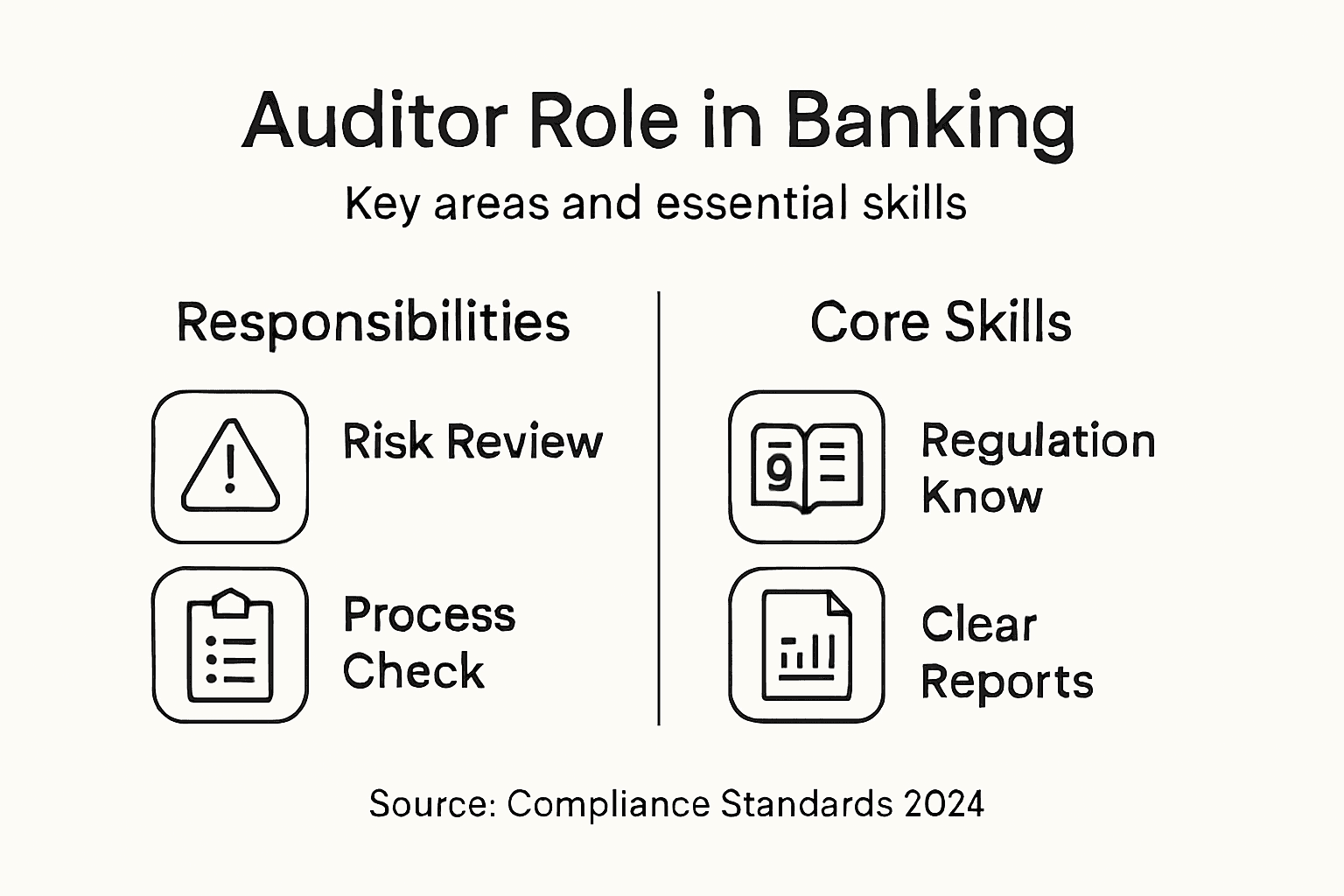
Here is a quick reference table summarizing core auditor responsibilities and the critical skills required to fulfill them:
Key Responsibility | Essential Skill Required | Why It Matters |
Risk Assessment | Analytical judgment | Prioritizes areas of greatest exposure |
Control Evaluation | Attention to detail | Detects issues before major failures |
Reporting/Communication | Effective writing and speaking | Ensures findings lead to real changes |
Independence & Objectivity | Professional skepticism | Maintains credibility and impartiality |
Pro tip: Design a competency development plan for each auditor that includes at least two CPE courses annually focused on skill gaps, plus a rotation to a different audit area every three years to broaden expertise.
Risks, Challenges, and Common Pitfalls
Every internal audit manager knows the feeling. You identify a control weakness, document it thoroughly, present it to management, and then watch as nothing changes. Six months later, the same weakness appears again in your follow-up testing. This cycle repeats because audit functions face real constraints that prevent them from being as effective as they should be. Understanding these challenges helps you navigate them strategically instead of blaming yourself when obstacles emerge.
The first major challenge is resource scarcity. Most audit departments operate with skeleton crews. You need auditors with regulatory expertise, technology knowledge, and operational understanding, but budgets rarely support hiring people with all these qualifications. Banks that underfund audit often discover this mistake when regulators criticize the scope and depth of audit work during examinations. Many audit managers describe the constant tension between the audit work that needs to happen and the staff available to conduct it. A mid-sized bank might need 12 auditors to cover all required areas adequately but operates with 8. This forces prioritization that always leaves something undone.
The second challenge is keeping pace with regulatory change. Regulations evolve constantly. A new guidance document from the Federal Reserve, a court decision affecting fair lending interpretation, or emerging cybersecurity threats all require audit adjustments. Navigating evolving regulatory challenges means auditors must continuously update their knowledge or risk testing outdated requirements. Many banks address this through CPE training, but training alone doesn’t solve the problem when regulations change faster than audit cycles can incorporate them. An auditor might complete fair lending training in January, then discover new guidance in March that changes testing methodology.
The third challenge involves assessing complex instruments and controls. Modern banks use sophisticated financial products, algorithms, and interconnected systems that create opacity for auditors. Assessing complex financial instruments and controls requires technical expertise many auditors lack. A bank that uses machine learning for credit decisions faces a testing problem. How do you audit an algorithm? Traditional control testing assumes you can understand cause and effect. With machine learning models, even the engineers who built them cannot fully explain every decision the model makes.
Common pitfalls emerge from these challenges. Banks often focus audit effort on areas where findings are easiest to identify, avoiding the complex areas where significant risks actually hide. Others conduct audits that check compliance without assessing whether controls actually prevent problems. Auditors might test whether loan files contain the required documentation without evaluating whether the documentation is accurate or meaningful. Management pressure to avoid finding problems also corrupts audit quality. When auditors know that finding issues creates friction with business leaders, they unconsciously become more lenient in their evaluations.
Pro tip: Build your audit work program by starting with your highest-risk areas, then systematically document why each area received its risk rating and audit frequency; this defensible prioritization protects your audit function when resource constraints force deferral of lower-priority work.
Auditors’ Influence on Compliance Culture
Compliance culture is not something your bank purchases or installs. It grows from how people at every level respond to risk, how they handle exceptions, and whether they view compliance as a burden or as part of doing business responsibly. Auditors shape this culture more than many internal audit managers realize. Your audit function either reinforces a compliance mindset or enables a culture where shortcuts are tolerated. The difference often comes down to how auditors approach their work and how management responds to their findings.
When auditors conduct their work with rigor and transparency, they send a powerful message to your organization. Staff see that controls are actually tested, that exceptions are actually documented, and that management takes audit findings seriously. This visibility changes behavior. Employees start following procedures more carefully because they know auditors will verify compliance. Managers allocate resources to fixing control weaknesses because they understand audit findings carry weight with the board. Internal auditors shape compliance culture by promoting accountability and transparency throughout your institution. This happens gradually. A single audit finding doesn’t transform culture. But after years of consistent auditing and management follow-up, staff internalize the message that compliance matters.
The inverse is also true. When audits are shallow, when findings go unaddressed for months, or when auditors soften critical findings to avoid friction with business leaders, your organization learns that compliance is optional. People notice when an audit identifies a control weakness but management does nothing. They remember that the compliance officer discovered a fair lending violation but faced no consequences. Culture erodes quickly under these conditions. Within a year, compliance slips from a shared value to something the compliance department owns while everyone else ignores it.
Auditors also influence culture through their communication and advisory role. Beyond identifying problems, auditors reinforce control frameworks and educate staff about why controls matter. An auditor who explains to loan officers why documentation standards exist helps them understand compliance as a risk management tool rather than bureaucratic overhead. When auditors present findings to the board with clear business impact explanations, board members understand their role in supporting compliance. This educational aspect separates audit functions that merely point out violations from those that actively shape institutional values.
Building a strong compliance culture also requires auditors to balance accountability with support. An audit function that operates as the compliance police creates resentment and defensiveness. One that positions itself as a trusted advisor helps business leaders understand their control responsibilities and supports them in building effective processes. This balance is difficult to achieve, but banks that manage it develop compliance cultures where people actively want to do the right thing rather than simply fear getting caught.
Pro tip: After each significant audit finding, have your audit team meet with the affected business unit not just to document the issue but to discuss root causes and help develop solutions, positioning audit as a partner in building better controls.
Strengthen Your Bank’s Audit and Compliance Capabilities Today
Understanding the multifaceted role of auditors in banking compliance is only the first step. Many financial institutions struggle with resource scarcity, regulatory complexity, and maintaining independence while assessing risk and controls effectively. If you recognize these challenges from the article, you are not alone. Your audit teams need continuous skill development in areas like regulatory knowledge, risk assessment, and operational auditing to truly make an impact and foster a strong compliance culture.
Take proactive control of your bank’s audit effectiveness with expert-led training from Compliance Seminars. Our comprehensive Continuing Professional Education courses cover key topics like internal and external auditing standards, risk and control assessments, and emerging compliance frameworks tailored specifically for banking professionals. Whether you want to deepen your team’s regulatory expertise or expand their technical competencies, our live webinars and in-person seminars offer practical tools to prevent costly audit gaps and elevate your institution’s compliance culture. Don’t wait until audit findings turn into regulatory penalties. Visit Compliance Seminars now and empower your audit staff to exceed expectations.
Frequently Asked Questions
What is the primary role of auditors in banking compliance?
Auditors in banking serve as independent assurance providers, helping institutions understand whether they are meeting regulatory requirements rather than acting as compliance police.
How do auditors help improve compliance culture in a bank?
Auditors influence compliance culture by demonstrating the importance of effective controls, documenting exceptions, and ensuring management takes audit findings seriously, which encourages staff to adhere to compliance standards.
What are the main types of audits conducted in the banking sector?
The three main types of audits in banking are compliance audits (focused on regulatory adherence), operational audits (evaluating process efficiency), and risk/control audits (assessing the effectiveness of internal controls).
Why is it essential to define auditors’ compliance responsibilities in writing?
Defining auditors’ compliance responsibilities in writing ensures clarity on which regulatory requirements each auditor evaluates and establishes clear escalation paths for addressing critical findings.
Recommended
Comments