Role of Internal Controls in Banking Operations


In banking, even a small oversight in internal controls can unravel years of trusted operations. Internal auditors and compliance officers across North American banks understand that pinpointing effective controls means the difference between passing regulatory scrutiny and facing operational setbacks. With evolving threats and complex requirements, mastering the core pillars of internal controls becomes a necessary foundation for protecting assets, maintaining compliance, and driving efficiency in today’s competitive industry.
Table of Contents
Key Takeaways
Point | Details |
Importance of Internal Controls | Effective internal controls are essential for ensuring financial accuracy, compliance, and asset protection in banking. They help maintain customer trust and prevent regulatory scrutiny. |
Holistic Risk Management | Internal controls must evolve to address emerging threats like cyber risks and ensure ongoing evaluation to match the current landscape. Prioritize assessments on top operational risks for effective resource allocation. |
Coordination Among Functions | Strong internal audit and compliance collaboration is vital to prevent control gaps. Regular communication helps align priorities and enhances overall effectiveness. |
Lessons from Recent Failures | Control effectiveness testing should assess management’s response to risk findings. Encourage transparency and open discussions about control environments to prevent complacency. |
Defining Internal Controls in Modern Banking
Internal controls form the backbone of modern banking operations, yet many compliance officers and internal auditors find the concept slippery when trying to implement it effectively across their institutions. At its core, internal controls are the policies, procedures, and systems that banks establish to ensure accuracy in financial reporting, compliance with laws and regulations, and protection of assets. But here’s what makes banking different from other industries: the stakes are exponentially higher. A breakdown in controls doesn’t just cost money. It erodes customer trust, invites regulatory scrutiny, and can threaten the stability of entire financial systems.
The structure of internal controls in banking rests on three foundational pillars. First, the control environment sets the ethical tone across the organization, from the board of directors down to the frontline teller. Second, risk assessment requires your institution to identify threats specific to its operations, whether that’s credit risk, operational risk, cybersecurity threats, or compliance gaps. Third, control activities are the actual mechanisms you deploy like segregation of duties, transaction authorization protocols, and system access restrictions. When these dimensions work together harmoniously, research confirms internal control systems enhance operational efficiency and competitive advantage across banking institutions globally. However, when one pillar weakens, the entire structure becomes vulnerable.
In modern banking, internal controls extend beyond traditional financial controls into areas like digital security, third-party vendor management, and regulatory compliance across multiple jurisdictions. Your control framework must adapt continuously. A control that protected against wire fraud ten years ago looks inadequate today against sophisticated social engineering attacks. That’s why defining internal controls isn’t a one-time exercise. It requires ongoing evaluation of effectiveness, regular updates to address emerging risks, and honest assessment of gaps between what controls should do and what they actually accomplish in practice. Understanding how these elements interact across your entire institution creates the foundation for meaningful control improvement and regulatory confidence.
Pro tip: Start your control assessment by mapping which controls address your top five operational risks rather than documenting every control your bank uses. This prioritized approach helps internal audit focus limited resources where they matter most for both risk management and regulatory compliance.
Types and Key Components of Bank Controls
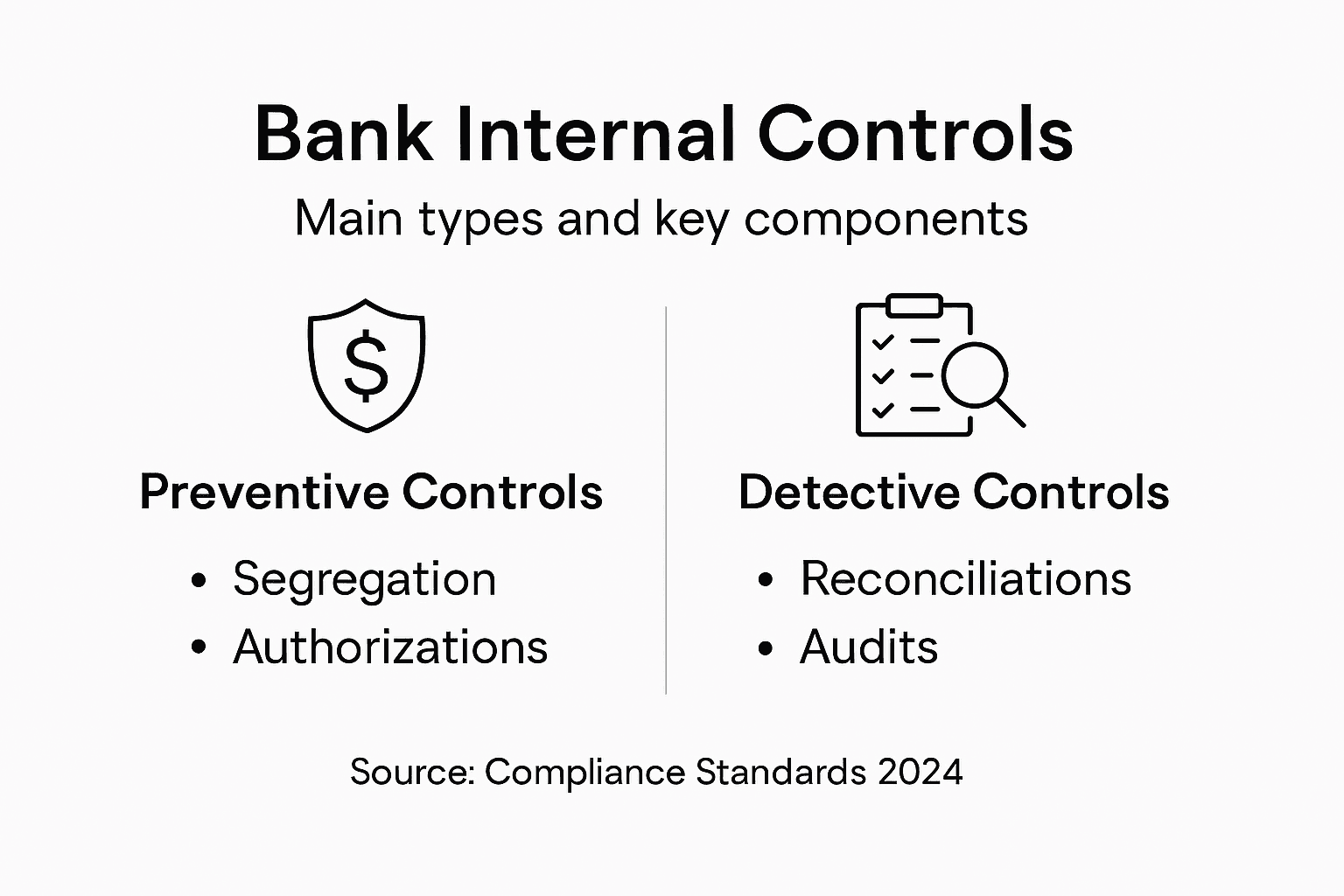
Bank controls fall into two broad categories that work in tandem to protect your institution. Preventive controls stop problems before they happen, like requiring dual approval signatures on wire transfers above certain thresholds or implementing system access restrictions that prevent unauthorized users from entering sensitive areas. Detective controls identify issues after they occur, such as reconciliation procedures that catch discrepancies between general ledger and subsidiary accounts, or exception reports that flag unusual transaction patterns. Most banks discover that relying solely on preventive controls creates a false sense of security. You need both working together because no preventive control catches everything, and detective controls catch what slips through.

Here’s a comparison of preventive and detective controls in banking:
Control Type | Primary Purpose | Example Activity | Typical Business Impact |
Preventive | Stop issues before they occur | Dual sign-off for wire transfers | Reduces risk of fraud or error |
Detective | Identify problems after occurrence | Reconciliation of ledger accounts | Enhances error detection and correction |
Within these categories, the core operational components that drive effectiveness include control activities which are the specific actions your staff executes daily, information and communication systems that ensure the right people know what they need to know when they need to know it, and monitoring mechanisms that continuously assess whether controls function as designed. Control activities, information systems, and monitoring significantly influence financial performance by ensuring compliance and protecting assets across banking operations. Beyond these mechanics, the organizational structure matters enormously. The internal audit function serves as your independent control evaluator, reporting directly to the audit committee rather than operational management. The risk control functions like compliance, operational risk, and credit risk teams work alongside internal audit as complementary control layers, each bringing specialized expertise to different risk domains.
Here’s what separates banks with robust controls from those that struggle: coordination across these functions. When your internal audit team, risk officers, and operational staff work in isolation, control gaps appear. You get duplicate efforts in some areas and blind spots in others. Effective banks establish clear communication channels and regular touchpoints where these groups share findings and align on control priorities. This coordination requires governance clarity around the audit function’s role and resource allocation to ensure internal audit has sufficient independence and credibility. Without this structure, even the best individual controls fail because nobody owns the oversight responsibility.
Pro tip: Map your control activities against your top operational risks and identify which function owns each control. This control ownership matrix prevents orphaned controls and ensures someone is accountable for monitoring each one’s effectiveness.
Legal Frameworks and Regulatory Expectations
Your internal control framework doesn’t exist in a vacuum. It operates within a complex web of legal requirements that vary significantly depending on your bank’s size, charter type, and geographic footprint. For North American banks, the foundation starts with the Federal Reserve’s expectations outlined in the Bank Service Company Act and the Gramm-Leach-Bliley Act, which explicitly require financial institutions to maintain effective internal controls. Beyond these baseline requirements, your institution likely faces expectations from multiple regulators. National banks answer to the Office of the Comptroller of the Currency, state-chartered banks to state banking regulators, and all FDIC-insured institutions to Federal Deposit Insurance Corporation oversight. Each regulator publishes guidance documents and examination manuals that detail what constitutes acceptable control frameworks, and these expectations evolve constantly as risks change.
International standards add another layer of complexity, particularly if your bank operates across borders or serves multinational clients. Basel III establishes minimum capital requirements and supervisory expectations that apply to internationally active banks, creating a floor below which no major institution can operate. These requirements force banks to think differently about operational risk, not just credit risk and market risk. Additionally, European Banking Authority guidelines require binding internal policies and procedures to ensure compliance with sanctions and anti-money laundering obligations, establishing governance structures and due diligence measures that represent industry best practices increasingly adopted globally. If your bank processes transactions involving European entities or accounts, you must comply with these standards regardless of your home jurisdiction.
The practical challenge for your compliance and audit teams involves translating these regulatory expectations into specific control design and operating procedures. Regulations typically describe outcomes and principles rather than prescribing exact control mechanisms, which means you must exercise judgment about how to achieve compliance while operating efficiently. A preventive control that works perfectly for a community bank may fail at a regional bank’s scale. Your risk assessment process must identify which regulatory expectations present the highest operational risk for your institution’s specific business model, then allocate resources accordingly. Examiners understand that perfect compliance across every regulatory nuance is impossible, but they expect documented evidence that you systematically identify applicable requirements, assess control effectiveness against those requirements, and remediate deficiencies when detected.
The table below summarizes major regulatory frameworks impacting bank internal controls:
Regulatory Body or Standard | Geographic Scope | Focus Area | Compliance Challenge |
Federal Reserve | United States | Control design and operation | Interpreting principle-based guidance |
Basel III | International | Capital and risk management | Harmonizing with national regulations |
European Banking Authority | Europe/global | Anti-money laundering, sanctions | Adapting to frequent policy updates |
Pro tip: Create a compliance calendar that maps regulatory examination cycles, rule implementation dates, and regulatory guidance updates for your institution. This prevents surprises when examiners appear and helps your team plan control enhancements proactively rather than reactively.
Auditor and Compliance Officer Responsibilities
Your role as an internal auditor or compliance officer places you at the critical intersection where control theory meets operational reality. These aren’t interchangeable positions, though they sometimes overlap in smaller institutions. Internal auditors function as the third line of defense, providing independent, objective assurance about whether your bank’s control framework actually works. Your job involves evaluating the design of controls, testing whether they operate as intended, and reporting findings to senior management and the audit committee. This independence matters enormously because management often has incentives to understate control weaknesses. Compliance officers, by contrast, focus on ensuring the bank aligns with external regulations and internal policies. You identify regulatory requirements, translate them into operational expectations, coordinate training, maintain documentation, and serve as the primary liaison with external regulators. When an examiner arrives, compliance officers typically brief them on the bank’s control environment while internal auditors provide test results and audit opinions.
The separation between these functions creates natural friction that actually strengthens your bank’s control structure. Internal audit shouldn’t report to compliance, and compliance shouldn’t direct audit planning. Yet you must coordinate constantly. Internal audit functions serve as the third line of defense by independently reviewing control framework effectiveness through systematic audit cycles and monitoring, which means your audit work directly informs what compliance needs to monitor going forward. Meanwhile, compliance officers’ ongoing monitoring between audits often surfaces issues that audit teams should investigate more deeply. This dynamic tension prevents blind spots. Your compliance responsibilities span several critical domains: banking compliance officers oversee regulatory alignment, risk identification, and internal policy enforcement while managing the documentation trail that examiners scrutinize during examinations. When regulators identify control deficiencies, compliance officers coordinate remediation efforts and ensure corrective actions stick.
Practically speaking, your effectiveness depends on several factors that operate outside your formal job description. First, you need credibility with operational leadership. If line managers view audit or compliance as obstacles rather than partners, they’ll hide problems instead of reporting them. Second, you need sufficient resources and access. An auditor without adequate staff or compliance officer without system access becomes a figurehead. Third, you need executive air cover. When compliance recommends rejecting a profitable transaction that violates policy, or audit identifies a control deficiency management wants to ignore, someone at the senior leadership level must back you. Fourth, you must maintain documentation that proves you performed your responsibilities competently. Your work papers, audit reports, compliance monitoring logs, and remediation tracking become critical evidence during examinations or if regulatory enforcement actions occur.
Pro tip: Establish a quarterly meeting between your chief audit executive and chief compliance officer to review findings, discuss remediation progress, and identify control gaps that neither team independently discovered. This structured coordination multiplies your effectiveness without creating turf wars.
Major Risks, Failures, and Lessons Learned
The 2023 banking turmoil delivered a stark reminder that even large, regulated institutions can collapse when control breakdowns compound. Silicon Valley Bank, Signature Bank, and First Republic Bank weren’t victims of fraud or criminal activity. They failed because of accumulated control weaknesses that management and boards either missed or ignored. The common thread wasn’t complexity. It was complacency. These banks had control frameworks on paper that should have prevented the problems that destroyed them. What went wrong offers critical lessons for your institution. The failures revealed that risk management frameworks existed but weren’t taken seriously. Silicon Valley Bank’s board received warnings about interest rate risk for years. Management understood the mathematical problem. They simply chose not to address it aggressively because fixing it would have reduced profitability in the short term. Meanwhile, liquidity planning was theoretical rather than practical. Banks modeled stress scenarios but hadn’t genuinely stress tested what would happen if depositors suddenly demanded their money back during a market panic. When that panic arrived in March 2023, three major banks discovered their liquidity plans assumed conditions that no longer existed.
The 2023 bank failures highlighted fundamental weaknesses in risk governance and liquidity planning, exposing gaps between what boards thought they understood and what was actually happening operationally. Regulators responded by demanding immediate improvements in how banks measure, monitor, and report liquidity risk. More critically, the 2023 banking turmoil revealed failures in risk management and supervision requiring improved risk culture and better governance across the industry. The lesson isn’t that internal controls are worthless. It’s that controls fail when leadership treats them as compliance checkboxes rather than essential safeguards. Your audit committee received presentations on interest rate risk. Your risk management function calculated exposures. Your compliance team documented policies. None of that mattered because nobody connected the dots or escalated findings aggressively enough. The board wanted reassurance, not warnings, and management provided the former instead of the latter.
For your institution, the 2023 failures offer three actionable insights. First, control testing must include testing of management’s response to findings. A control isn’t effective if risk officers identify a problem and management ignores it. Your audit work should specifically document whether management actually implements the corrective actions you recommend and whether those actions genuinely reduce risk. Second, your risk assessment process must explicitly evaluate interconnections between different risk types. Interest rate risk doesn’t exist in isolation. It connects to liquidity risk, credit risk, and funding risk. A bank that focuses narrowly on individual risk categories while missing how they reinforce each other creates a dangerous blind spot. Third, your board and senior leadership need regular discussions about whether your control environment genuinely prevents bad decisions or simply creates an appearance of control. This requires honest conversations where audit and compliance teams voice concerns without fear of retaliation, and where board members ask uncomfortable questions that don’t have comfortable answers.
Pro tip: Include a quarterly “control effectiveness” discussion in your audit committee meetings where you specifically address whether recent audit findings indicate control design problems or control operating problems, then track whether management’s corrective actions address the actual root cause.
Strengthen Your Bank’s Internal Controls with Expert Training
Banks face increasing challenges in maintaining effective internal controls amidst complex regulatory demands and evolving risks. If you have struggled with aligning preventive and detective controls, managing risk assessment, or ensuring compliance with frameworks like COSO and Basel III, you are not alone. This article highlights how fragmented oversight or complacency can cause critical control failures—risks every audit and compliance professional must address proactively.
Take control of your bank’s risk management by enhancing your skills through practical, expert-led education. At Compliance Seminars, we offer NASBA-recognized Continuing Professional Education courses and webinars tailored for internal auditors and compliance officers. Learn how to design robust internal control frameworks, coordinate audit and compliance functions effectively, and navigate complex regulatory environments confidently. Don’t wait for the next risk event to expose gaps in your controls. Visit Compliance Seminars today to explore our live sessions and in-person events that empower banking professionals like you to turn internal control challenges into lasting strengths.
Elevate your expertise and safeguard your institution now by starting with our proven training solutions at Compliance Seminars. Your next essential step toward stronger banking operations is just a click away.
Frequently Asked Questions
What are internal controls in banking?
Internal controls in banking are the policies, procedures, and systems established to ensure accurate financial reporting, compliance with laws and regulations, and protection of assets within an institution.
Why are internal controls important in banking operations?
Internal controls are vital in banking because they help prevent financial loss, maintain customer trust, and ensure compliance with regulatory requirements. A breakdown in these controls can lead to significant operational failures and regulatory scrutiny.
What are the key components of an effective internal control system in banks?
The key components of an effective internal control system in banks include a strong control environment, ongoing risk assessment, preventive and detective control activities, and continuous monitoring to ensure controls function as intended.
How do preventive and detective controls work together in banking?
Preventive controls aim to stop issues before they occur, such as requiring multi-level approvals for transactions, while detective controls identify problems after they have occurred, like utilizing reconciliation procedures to catch discrepancies. Both types are necessary for a robust banking control system.
Recommended
Internal Auditing in the Banking Industry | CPE Training Events
Internal Auditing in the Banking Industry - In-Person | CPE Training Events
Testing the Operating Effectiveness of Internal Controls - In-Person | CPE Training Events
Internal Auditing in the Insurance Industry | CPE Training Events
Λογιστικός Έλεγχος: Γιατί Είναι Αναγκαίος στις Επιχειρήσεις - Χρήστος Καβαλλάρης - Λογιστής
Comments