Internal Audit Standards: Safeguarding Compliance and Trust


Navigating new regulations and shifting business environments is routine for internal audit professionals in banking and finance, yet ensuring alignment with the most current internal audit standards can quickly become a complex challenge. These standards provide the backbone for consistent, ethical, and risk-aware practices across organizations, helping maintain trust and transparency from Canada to Singapore. This overview highlights the unified framework presented by the 2024 Global Internal Audit Standards, offering practical guidance for establishing reliability and quality in audit processes worldwide.
Table of Contents
Key Takeaways
Point | Details |
Internal Audit Standards | The updated Global Internal Audit Standards provide a comprehensive framework for ensuring ethical and effective audit practices. |
Frameworks for Guidance | Key frameworks such as COSO, ISO 31000, IIA Global Standards, and COBIT help standardize approaches to risk management and governance. |
Audit Process Stages | Internal audit processes consist of planning, risk assessment, fieldwork, reporting, and follow-up, each essential for thorough evaluations. |
Consequences of Noncompliance | Failing to adhere to internal audit standards can result in financial penalties, operational disruptions, and reputational damage for organizations. |
Defining Internal Audit Standards and Principles
Internal audit standards serve as the foundational blueprint for professional audit practices, establishing critical guidelines that ensure systematic, reliable, and ethical evaluation of organizational processes. These standards are not merely recommendations but comprehensive frameworks that define the core principles and mandatory requirements for conducting effective internal audits.
The Global Internal Audit Standards, recently updated in 2024, represent a significant evolution in establishing consistent professional practices. Global Internal Audit Standards framework consolidates multiple critical components into a unified approach, including:
Mission: Defining the fundamental purpose of internal auditing
Core Principles: Establishing foundational ethical and professional guidelines
Code of Ethics: Outlining expected behavioral standards
Mandatory Requirements: Specifying precise operational expectations
These standards are strategically structured across five essential domains that comprehensively cover internal audit operations:
Organizational Objectives
Professional Ethics
Governance Frameworks
Operational Management
Audit Execution Protocols
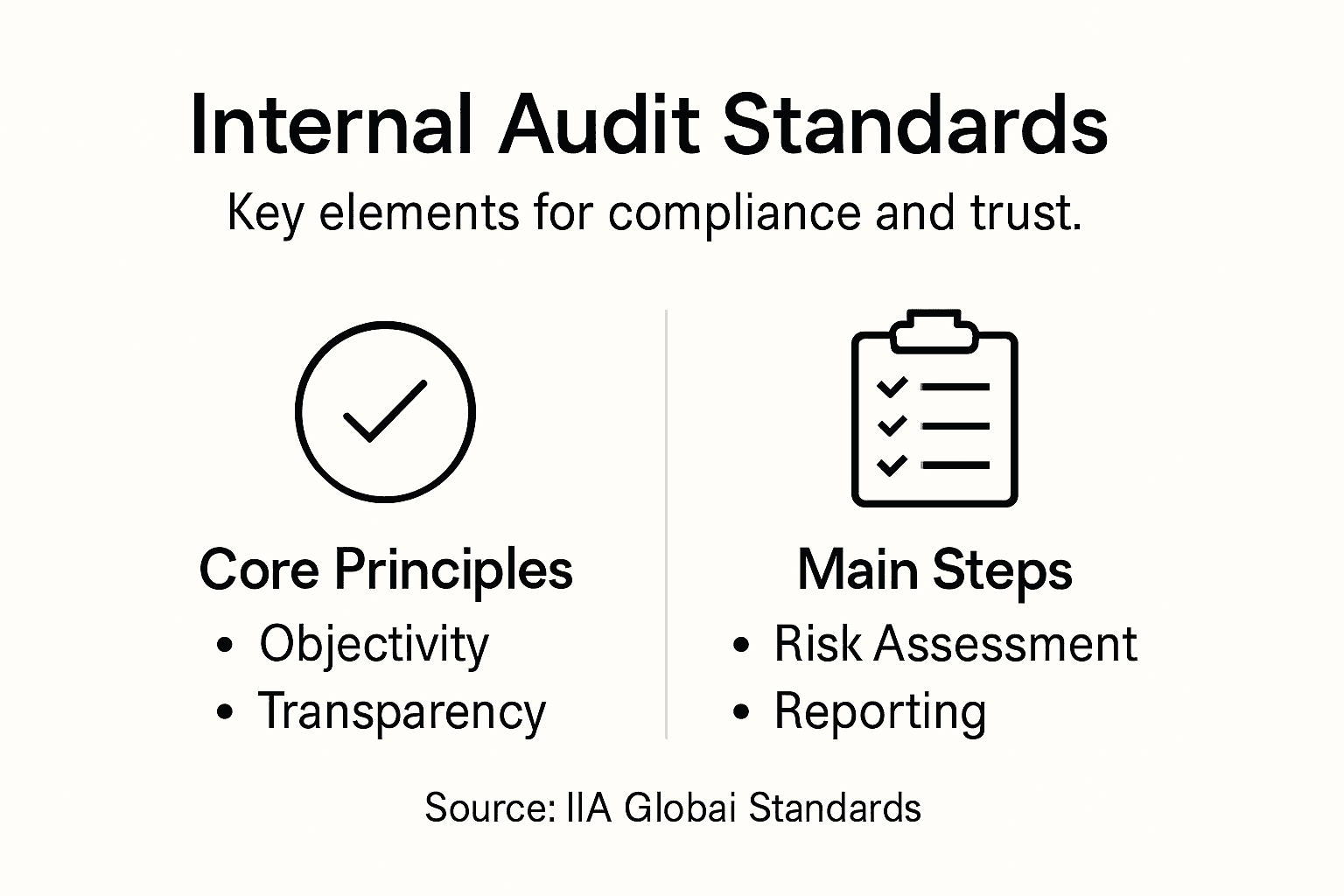
By creating a principle-focused approach, these standards drive consistency, transparency, and trust in internal audit activities worldwide. They provide a universal language for audit professionals, ensuring that regardless of geographic location or specific industry, fundamental quality and integrity remain paramount.
Pro tip: Always cross-reference your internal audit practices against the most recent Global Internal Audit Standards to maintain compliance and professional excellence.
Key Types and Frameworks in Use Globally
Internal audit professionals rely on several critical frameworks to guide their practice, ensuring comprehensive and standardized approaches to organizational risk assessment and governance. Global Internal Audit Standards represent the most comprehensive and universally recognized framework, providing a structured approach to audit methodologies worldwide.
The primary global frameworks used by internal audit professionals include:
COSO Internal Control Framework: Focuses on enterprise risk management and internal control effectiveness
ISO 31000: Provides risk management guidelines and principles
IIA Global Standards: Establishes professional practice standards for internal auditing
COBIT: Offers governance and management framework for enterprise information technology
These frameworks are not mutually exclusive but complementary, allowing organizations to develop robust internal audit strategies. Each framework addresses different aspects of organizational governance:
The following table summarizes the main global internal audit frameworks and their unique focus areas:
Framework | Main Objective | Industry Emphasis |
COSO | Enterprise risk control | All industries |
ISO 31000 | Risk management principles | General, adaptable |
IIA Global Standards | Professional audit practices | Internal audit functions |
COBIT | IT governance and controls | Technology-driven sectors |
Risk identification and assessment
Control mechanism design
Operational efficiency evaluation
Compliance verification
Strategic alignment assessment
The most significant recent development is the 2024 revision of Global Internal Audit Standards, which consolidates previous guidelines into a unified approach. This update reflects the evolving landscape of governance, technology, and emerging risks, providing internal audit professionals with more comprehensive and adaptable standards.
Pro tip: Integrate multiple framework perspectives to create a holistic and dynamic internal audit approach that addresses complex organizational challenges.
Core Components of Internal Audit Processes
Internal audit processes form a comprehensive systematic approach to evaluating and improving an organization’s risk management, control, and governance mechanisms. Internal audit processes typically involve a structured methodology designed to provide independent and objective assurance to management and stakeholders.
The core components of internal audit processes can be categorized into several critical stages:
Planning: Establishing audit scope, objectives, and resource allocation
Risk Assessment: Identifying and prioritizing potential organizational risks
Fieldwork: Conducting detailed examinations and collecting evidence
Reporting: Documenting findings and developing recommendations
Follow-up: Tracking implementation of recommended improvements
Each stage requires specific technical and professional skills to ensure comprehensive organizational evaluation. The process demands meticulous attention to detail, strategic thinking, and a systematic approach to uncovering potential vulnerabilities:

Here is a quick reference guide to the stages of an internal audit process and their corresponding deliverables:
Audit Stage | Key Activities | Main Output |
Planning | Define scope and resources | Audit plan |
Risk Assessment | Assess vulnerabilities | Risk register |
Fieldwork | Test and gather evidence | Working papers |
Reporting | Summarize findings | Audit report |
Follow-up | Check implementation | Status updates |
Initial engagement and understanding of organizational context
Comprehensive risk landscape analysis
Detailed testing and validation of control mechanisms
Critical evaluation of existing governance structures
Development of actionable improvement strategies
Successful internal audit processes rely on a combination of technical expertise, professional skepticism, and robust methodology. Auditors must maintain independence, demonstrate professional competence, and provide value-added insights that support organizational effectiveness and risk mitigation.
Pro tip: Develop a flexible and adaptable audit approach that can quickly respond to emerging organizational risks and changing business environments.
Roles and Responsibilities of Audit Professionals
Audit professionals play a critical role in safeguarding organizational integrity, risk management, and financial transparency. Auditor responsibilities encompass a complex set of professional obligations that extend far beyond simple compliance checking.
The core responsibilities of audit professionals include:
Independence: Maintaining objective and unbiased evaluation
Risk Assessment: Identifying and analyzing organizational vulnerabilities
Compliance Verification: Ensuring adherence to legal and regulatory standards
Financial Reporting: Validating accuracy and completeness of financial statements
Governance Support: Providing insights to improve organizational control mechanisms
Audit professionals must demonstrate a comprehensive skill set that combines technical expertise with strategic thinking:
Technical knowledge of accounting and regulatory frameworks
Strong analytical and critical thinking capabilities
Exceptional communication and reporting skills
Ethical judgment and professional skepticism
Adaptability to changing organizational landscapes
In public and private sectors, these professionals serve as critical guardians of organizational transparency and accountability. They are responsible for conducting thorough examinations, documenting evidence, and delivering actionable recommendations that help organizations mitigate risks and improve operational effectiveness.
Pro tip: Continuously develop your professional skills and maintain a comprehensive understanding of emerging regulatory and technological trends to remain an effective and valuable audit professional.
Risks and Consequences of Noncompliance
Noncompliance with internal audit standards represents a significant organizational threat that extends far beyond simple regulatory penalties. Compliance risk consequences can create devastating financial and reputational impacts that potentially compromise an entire organization’s integrity and future sustainability.
The most critical risks of noncompliance include:
Financial Penalties: Substantial regulatory fines and legal sanctions
Operational Disruption: Potential suspension of business activities
Reputation Damage: Loss of stakeholder and investor trust
Certification Revocation: Potential loss of critical industry certifications
Legal Exposure: Increased vulnerability to litigation and legal challenges
Organizations face multilayered consequences when failing to maintain rigorous compliance standards:
Immediate financial losses from regulatory penalties
Long-term reputational damage
Potential leadership accountability and legal prosecution
Reduced market valuation
Diminished competitive positioning
The complexity of noncompliance risks underscores the critical importance of proactive compliance management. Even minor oversights can escalate into significant organizational vulnerabilities, making continuous monitoring and robust internal control mechanisms essential for sustainable business operations.
Pro tip: Implement a comprehensive compliance tracking system that provides real-time insights and enables immediate corrective action for potential regulatory deviations.
Elevate Your Internal Audit Expertise to Meet Global Standards
Navigating the complex demands of Global Internal Audit Standards and integrating frameworks like COSO and ISO 31000 can be overwhelming. If your organization struggles with maintaining compliance, ensuring transparency, or managing risks effectively you are not alone. This article highlights key challenges such as adhering to evolving standards, conducting thorough risk assessments, and preventing noncompliance that can lead to serious financial and reputational consequences.
At Compliance Seminars, we understand these pain points and offer targeted Continuing Professional Education (CPE) designed for audit professionals who want to master internal controls, governance frameworks, and audit execution. Our comprehensive courses and live webinars are tailored to help you stay current with the latest internal audit processes, principles, and professional ethics. Through practical, standards-based training led by industry experts, you can sharpen your skills and deliver real organizational value.
Discover how you can build trustworthy audit functions, reduce compliance risks, and enhance governance by enrolling in our specialized training programs at Compliance Seminars. Take action now to strengthen your audit capabilities and safeguard your organization’s future.
Frequently Asked Questions
What are internal audit standards?
Internal audit standards provide a foundational guideline for conducting internal audits, outlining the principles and mandatory requirements that ensure reliable and ethical evaluations of an organization’s processes.
Why are the Global Internal Audit Standards important?
The Global Internal Audit Standards establish consistent professional practices that enhance transparency, accountability, and trust in internal audit activities across various industries and geographic locations.
What are the core components of the internal audit process?
The core components of the internal audit process include planning, risk assessment, fieldwork, reporting, and follow-up. Each stage is crucial for comprehensive evaluation and improvement of organizational systems.
What are the risks of noncompliance with internal audit standards?
Noncompliance with internal audit standards can lead to significant risks, including financial penalties, operational disruptions, reputational damage, and potential legal exposure, highlighting the necessity for rigorous compliance management.
Recommended
Comments