How to document internal controls for effective compliance
- John C. Blackshire, Jr.

- 11 minutes ago
- 8 min read

TL;DR:
Effective internal control documentation is essential for compliance, audit readiness, and operational transparency.
Maintaining current, detailed, and risk-aligned records prevents weaknesses and regulatory penalties.
Viewing documentation as a live asset, continuously updated and integrated into operations, enhances audit performance.
Poor internal control documentation is one of the most common reasons organizations face audit findings, regulatory penalties, and operational breakdowns. When controls exist in practice but not on paper, or when documentation is outdated and disconnected from actual processes, auditors have little to work with and regulators have little to trust. The gap between what your controls do and what your records say they do is where compliance risk lives. This guide walks you through what effective documentation looks like, what you need to get started, and how to build a framework that holds up under scrutiny. You will also find practical tools, templates, and pro tips drawn from real audit environments.
Table of Contents
Key Takeaways
Point | Details |
Document for compliance | Accurate internal control documentation is essential for regulatory compliance and smooth audits. |
Use proven templates | Leverage templates and standard checklists to streamline and standardize your process. |
Update documentation regularly | Review and adjust documents whenever business processes or regulations change to stay audit-ready. |
Avoid common pitfalls | Watch out for incomplete, outdated, or unclear documentation that can lead to audit findings. |
Understanding the role of internal control documentation
Internal control documentation is the formal record of how an organization identifies, manages, and monitors risks through structured processes and procedures. It captures what controls exist, who owns them, how they operate, and what evidence confirms they are working. Think of it as the paper trail that connects your risk management strategy to day-to-day operations.
This documentation sits at the intersection of several major compliance frameworks. Under the Sarbanes-Oxley Act (SOX), public companies must document and test internal controls over financial reporting. The Committee of Sponsoring Organizations (COSO) framework provides a structure for designing and evaluating those controls. The Public Company Accounting Oversight Board (PCAOB) sets standards that external auditors use when reviewing that documentation. Without solid records, your organization cannot demonstrate compliance with any of these frameworks.
The benefits go beyond regulatory checkboxes. Strong documentation creates:
A clear audit trail that supports both internal and external reviews
Transparency into business processes for new staff and cross-functional teams
A foundation for identifying control gaps before auditors do
Evidence of management’s accountability and oversight
Faster remediation when issues arise, because root causes are easier to trace
As noted in internal audit standards, documentation is essential to pass compliance audits and reduce organizational risk. That is not an overstatement. Auditors who cannot find documented evidence of a control will treat it as if the control does not exist.
Organizations that skip or rush documentation often face a predictable set of problems: controls that exist in someone’s head but nowhere else, procedures that describe how things used to work, and ownership that is unclear when something goes wrong. These are not minor inconveniences. They are material weaknesses waiting to be discovered.
“A control that cannot be demonstrated through documentation is, for audit purposes, a control that does not exist.”
Reviewing an internal controls implementation guide before you start can help you align your documentation approach with recognized frameworks. Pairing that with an internal control checklist ensures you cover every required element without gaps. Industry internal controls trends also show that organizations investing in structured documentation consistently outperform peers in audit outcomes.
What you need before you begin: Tools, templates, and prerequisites
Before you write a single procedure, you need the right inputs. Jumping into documentation without a foundation leads to inconsistency, rework, and records that do not reflect actual risk.
Here is what to gather first:
Organizational policies and procedures: These are your source of truth. Documentation should reflect what is actually approved and in practice.
A risk register: You need to know which risks exist before you can document the controls designed to address them.
A chosen control framework: Whether you use COSO, COBIT, or a hybrid, your documentation structure should align with it.
Process maps or narratives: These describe how work flows through the organization, which helps you identify where controls sit.
Access to prior audit reports: These reveal existing gaps and help you prioritize where documentation needs the most attention.
On the tools side, the right software makes a significant difference. Here is a comparison of common documentation tools:
Tool type | Best use | Example tools |
Document management | Version control and storage | SharePoint, Confluence |
Flowcharting software | Process and control mapping | Lucidchart, Visio |
GRC platforms | Integrated risk and control tracking | AuditBoard, Workiva |
Spreadsheets | Simple control matrices and checklists | Excel, Google Sheets |
Using standard templates and checklists streamlines documentation and ensures consistency across departments and audit cycles. Templates reduce the risk of missing required elements and make it easier for reviewers to compare controls across processes.
Do not overlook the human side of preparation. You need buy-in from process owners, clear communication about roles, and a shared understanding of what “complete” documentation looks like. Pulling in your internal audit team early prevents rework later.

Pro Tip: Schedule a kickoff meeting with process owners and internal auditors before documentation begins. Aligning on format, scope, and timelines upfront cuts revision cycles in half and builds the cross-functional trust that makes documentation sustainable.
An internal audit checklist can help you confirm that your prerequisites are in place before you start writing. Skipping this step is one of the most common reasons documentation projects stall midway.
Step-by-step guide: How to document internal controls
With your tools and inputs ready, you can move through the documentation process systematically. Here is a practical sequence that works across industries and frameworks.
Identify key processes and associated risks. Start with high-risk areas: financial reporting, revenue recognition, payroll, and IT access controls. Map each process and note where errors or fraud could occur.
Define control objectives. For each risk, state what the control is designed to achieve. A control objective for accounts payable might be: “Ensure all payments are authorized before processing.”
Document control procedures. Describe how each control operates, who performs it, how often, and what tools or systems are involved. Be specific. Vague descriptions like “management reviews reports” are not sufficient.
Map controls to risks. Use a risk-control matrix to show which control addresses which risk. This mapping is critical for auditors evaluating coverage and for identifying gaps.
Choose your documentation format. Narratives work well for straightforward processes. Flowcharts are better for complex, multi-step workflows. Matrices are ideal for summarizing controls across a large scope.
Document evidence and ownership. Specify what evidence the control produces (approval signatures, system logs, reconciliation reports) and name the individual responsible for each control.
Establish version control and change logs. Every update to documentation should be tracked with a date, description of the change, and the name of the person who made it.
Here is a quick comparison of documentation formats:
Format | Strengths | Limitations |
Narrative | Detailed, easy to read | Can become lengthy and hard to scan |
Flowchart | Visual, shows process flow clearly | Requires software and design skill |
Control matrix | Concise, easy to cross-reference | Less detail on how controls operate |
Following a clear structure when documenting controls leads to audit-readiness and fewer remediation findings. Reviewing examples of internal controls across different process areas can help you calibrate the right level of detail. Once your initial documentation is complete, evaluating control documentation against your framework ensures nothing critical was missed.
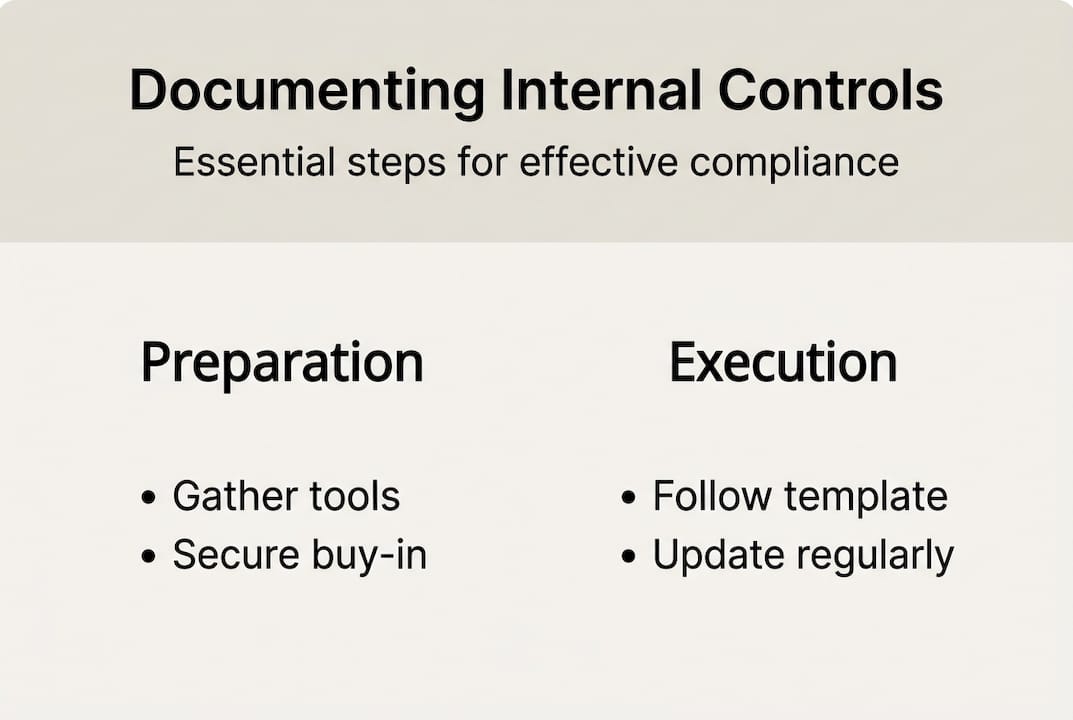
Pro Tip: Treat your change log as a compliance asset, not just an administrative task. Auditors increasingly ask for evidence that documentation has been actively maintained. A detailed change log demonstrates exactly that.
Common mistakes and how to avoid them
Even well-intentioned documentation efforts run into problems. Knowing where teams typically go wrong helps you avoid the same traps.
Incomplete or outdated documentation is the most frequent issue. Controls get updated when processes change, but documentation lags behind. The result is records that describe a process that no longer exists.
Solution: Build documentation reviews into your annual risk assessment cycle and trigger reviews whenever a significant process change occurs.
Unclear ownership creates accountability gaps. When no one is named as the control owner, no one feels responsible for keeping documentation current.
Solution: Assign a named individual (not just a job title) to each control. Include their role in the documentation itself.
Overly vague descriptions undermine the documentation’s usefulness. Phrases like “appropriate review” or “periodic monitoring” tell auditors nothing about frequency, method, or evidence.
Solution: Use precise language. State who does what, how often, using which system, and what output is produced.
Misalignment with actual business risks happens when documentation is built around a template rather than the organization’s specific risk profile. Controls look good on paper but do not address the risks that actually matter.
Solution: Anchor every control to a specific risk in your risk register. If you cannot draw that line, reconsider whether the control belongs in your documentation.
“Documentation that does not reflect real risk is not a control framework. It is a compliance costume.”
As PCAOB 2023 inspection reports confirm, common documentation errors lead to regulatory findings and audit failures. Understanding why internal controls fail at a structural level helps you build more resilient documentation from the start. Reviewing your internal audit process guide alongside your documentation can reveal mismatches before auditors do.
A new perspective: Documentation as a live asset, not a checkbox
Here is something we see consistently in audit environments: organizations treat internal control documentation as something you produce for an audit and then file away. That mindset is exactly why so many documentation efforts fail between audit cycles.
Static documentation decays. Processes evolve, people change roles, systems get upgraded, and regulations shift. If your documentation does not move with those changes, it becomes a liability rather than an asset.
The organizations that consistently perform well in audits treat documentation as a living part of their operations. They embed documentation updates into change management processes. They review controls during quarterly business reviews, not just at year-end. They train process owners to see documentation as a tool for doing their jobs better, not a burden imposed by compliance.
This shift in mindset also reduces audit stress significantly. When documentation is current and actively used, audit preparation is not a scramble. It is a confirmation.
We recommend building a documentation calendar tied to your internal controls implementation guide. Schedule reviews, assign owners, and track completion the same way you track any other business objective. Documentation that lives in your operations will always outperform documentation that lives in a drawer.
Advance your expertise with professional CPE training
Building a strong internal control documentation framework is a skill that develops with structured learning and practical exposure. Reading guides helps, but working through real scenarios with expert instructors accelerates your ability to apply these concepts under pressure.
At compliance-seminars.com, our internal auditor CPE webinars cover documentation frameworks, risk-control mapping, and audit-readiness strategies in depth. If you are building foundational skills, our internal auditor basic training program provides a structured path from core concepts to practical application. For professionals working at the intersection of technology and controls, our IT auditing and internal controls events address the documentation requirements specific to IT environments. All programs are NASBA-recognized and designed for CPAs, CIAs, CISAs, and CFEs.
Frequently asked questions
What are the main types of internal control documentation?
Common types include narratives, flowcharts, control matrices, and checklists that outline procedures, risks, and controls. Using varied formats ensures documentation is thorough and accessible to different audiences.
How often should internal control documentation be updated?
Documentation should be reviewed and updated at least annually or whenever processes or regulations change. Regular updates are essential for maintaining audit readiness throughout the year.
Who is responsible for maintaining internal control documentation?
Process owners are typically responsible for maintaining documentation, with oversight from internal audit or compliance teams. Clarifying responsibility at the individual level ensures accountability and prevents gaps.
What are signs that control documentation is insufficient?
Red flags include outdated procedures, missing approvals, lack of risk mapping, and recurring audit findings in the same areas. Deficient documentation is one of the leading contributors to negative audit outcomes and regulatory action.
Recommended
Comments