Auditor Independence: Principles, Rules, and Real Impact


Many audit professionals treat independence as a compliance formality, a box to check before signing off on an engagement. That mindset is dangerous. Auditor independence requires freedom in fact and appearance from relationships that could impair objectivity. When you overlook its nuances, you risk your professional credibility and invite regulatory consequences that can derail careers and damage firms. This guide clarifies the frameworks, rules, and real-world implications you need to maintain genuine independence in every engagement.
Table of Contents
Defining auditor independence: Fact, appearance, and professional skepticism
Key regulatory frameworks: SEC, PCAOB, GAO and AICPA perspectives
Four principles of independence: What truly impairs objectivity?
Recent case studies: Audit firm switches, inspection scandals, and lessons learned
Best practices for maintaining auditor independence in your organization
Advance your understanding: CPE events and training for audit professionals
Key Takeaways
Point | Details |
Independence defined | Auditor independence means not only being objective but also appearing unbiased to the public and regulators. |
Frameworks vary | SEC and PCAOB enforce rules-based standards for public companies, while GOA and AICPA use a principles-based approach. |
Avoid common pitfalls | Steer clear of prohibited services and regularly assess for conflict risks to protect audit quality. |
Learn from case studies | Major audit failures highlight the consequences of lapses and the need for continuous vigilance. |
Ongoing education | Regular compliance training and policy updates are vital to sustaining genuine auditor independence. |
Defining auditor independence: Fact, appearance, and professional skepticism
After establishing why independence is more than a checkbox, let’s dive into how the profession defines and applies it. Auditor independence means being free in fact and appearance from any relationship or service that could compromise objectivity. Independence in fact refers to your actual mental state, your ability to maintain objectivity and exercise professional judgment without bias. Independence in appearance addresses how reasonable third parties perceive your objectivity. Both matter equally because audit integrity depends on reality and perception.
Professional skepticism is related but distinct. It’s the questioning mindset you bring to evidence evaluation, while independence is the structural freedom from conflicts that allows skepticism to function. Without independence, skepticism becomes theater. You can’t question management’s assertions effectively if you’re also performing management functions or have financial ties to the client.
“Auditors must fulfill dual expectations: maintaining actual objectivity while ensuring that informed third parties would conclude they are objective based on observable facts and relationships.”
Threats to independence come in predictable forms:
Self-interest threats arise when financial or other interests could inappropriately influence your judgment
Self-review threats occur when you audit your own work or work performed by your firm
Familiarity threats develop from close relationships that make you too sympathetic to client interests
Intimidation threats emerge when client pressure or fear of losing the engagement compromises your judgment
Recognizing these threats early is essential. The role of auditors in compliance demands constant vigilance about relationships that could undermine your objectivity, whether you’re conducting financial statement audits or specialized compliance reviews.
Key regulatory frameworks: SEC, PCAOB, GAO and AICPA perspectives
Now that you know what independence means, you need to understand which bodies govern its enforcement and in what contexts. The SEC holds ultimate authority over auditor independence for public companies, delegating standard-setting and inspection to the PCAOB. The AICPA governs independence for private company audits and provides ethical guidance for all CPAs. The GAO Yellow Book governs independence for governmental clients and must be followed to have acceptable opinions on the related financial statements. Each framework has distinct characteristics that affect how you apply independence rules.
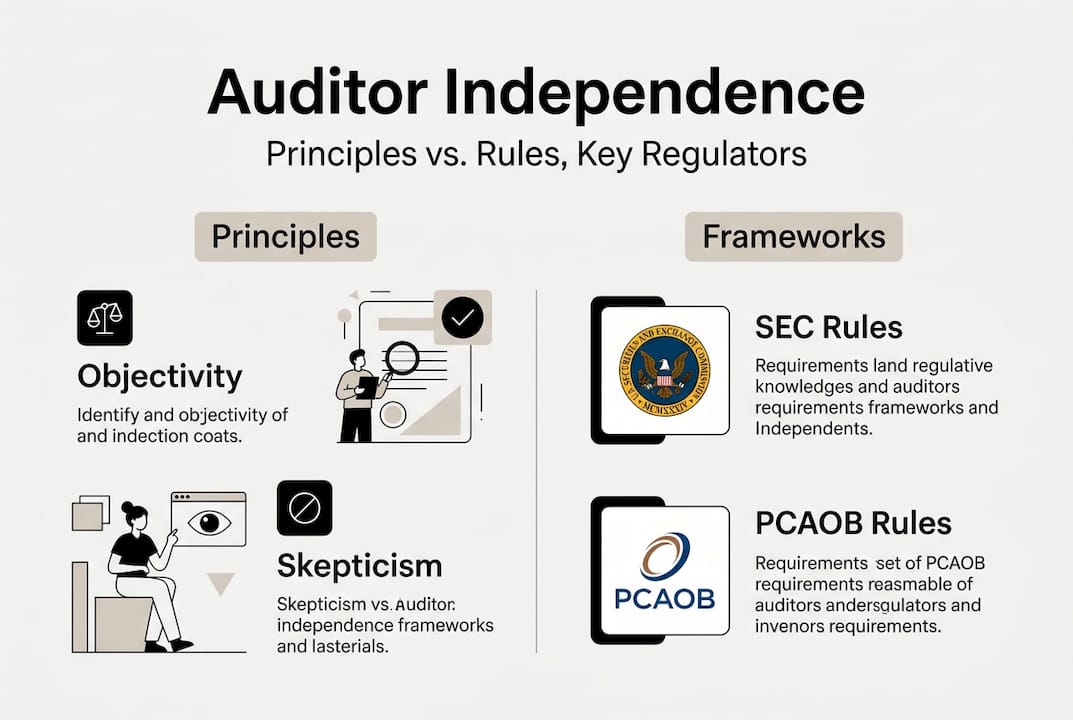
PCAOB Rule 3520 mandates independence for registered firms’ audit clients throughout the engagement period, with the Rules 3500 series covering ethics and independence comprehensively. The SEC and PCAOB take a rules-based approach, providing specific prohibitions and requirements. The AICPA uses a principles-based conceptual framework that requires you to identify threats, evaluate their significance, and apply safeguards.
Framework | Approach | Primary Application | Key Characteristic |
SEC/PCAOB | Rules-based | Public company audits | Specific prohibitions, bright-line tests |
AICPA | Principles-based | Private company audits, all CPA ethics | Conceptual framework, professional judgment |
State Boards | Varies | License requirements | Often adopt AICPA standards |
When to follow which rulebook:
Public company audits: SEC and PCAOB rules apply, with AICPA providing supplemental guidance
Private company audits: AICPA conceptual framework governs, though many firms apply PCAOB standards as best practice
Government audits: GAO Yellow Book standards apply, incorporating AICPA principles with additional requirements
Internal audit functions: Principles-based approach typically applies, though public company internal auditors should align with external audit independence concepts
Understanding these distinctions matters because applying the wrong framework or missing applicable requirements creates independence violations.
The GAO Yellow Book highlights:
Identify threats to independence
Evaluate the significance of those threats
Apply safeguards or decline the engagement
Auditors cannot perform management functions or make management decisions
Under the Yellow Book, you can comply with every rule and still fail independence
The PCAOB engagement metrics and audit standards show how regulators scrutinize independence compliance during inspections.
Four principles of independence: What truly impairs objectivity?
Building on the frameworks, let’s clarify the concrete ethical tests that determine real-world independence. The SEC’s four general principles provide clear boundaries. Independence is impaired if the auditor:
Acts as an advocate for the client: You can’t promote the client’s interests or position, such as representing them in litigation or negotiating on their behalf with third parties.
Functions as management or an employee: You can’t make management decisions, prepare source documents, or perform ongoing monitoring or control activities that management should perform. One common failure under the GAO Yellow book is preparing financial statements without proper safeguards
Audits their own work: You can’t provide services that you would later audit, creating a situation where you’re reviewing your own judgments and conclusions.
Has a mutually conflicting interest with the client: You can’t have financial interests or relationships that create incentives contrary to audit quality and objectivity.
These principles translate into practical tests you can apply before accepting any engagement or additional service. Ask yourself: Would this service require me to make decisions that are management’s responsibility? Will I be auditing work I performed or supervised? Does this relationship create financial incentives that conflict with my audit obligations? Would a reasonable observer question my objectivity?
Pro Tip: Develop a pre-engagement independence checklist that walks through each principle with specific yes/no questions. Review it with your engagement team and document your analysis. This creates an audit trail and forces deliberate consideration of independence before problems arise.
Practical examples illuminate these principles. Acting as an advocate occurs when you help a client negotiate a bank loan or represent them in a tax dispute. Functioning as management happens when you design internal controls, select vendors, or approve transactions. Auditing your own work occurs when you prepare financial statements and then audit them. Conflicting interests arise from direct financial investments, contingent fee arrangements, or close family relationships with client management.

The compliance audit best practices we recommend incorporate these principles into every phase of audit planning and execution.
Prohibited non-audit services and common pitfalls
With the core rules in mind, let’s provide actionable guidance on avoiding the most frequent and costly mistakes. The SEC and PCAOB prohibit specific non-audit services for public company audit clients. These prohibitions exist because the services inherently violate one or more of the four principles.
Prohibited Service | Why It Impairs Independence | Common Scenario |
Bookkeeping | Auditing own work | Recording transactions, maintaining general ledger |
Financial information systems design | Management function, auditing own work | Designing or implementing ERP systems |
Valuation services | Auditing own work | Valuing assets for financial statements |
Internal audit outsourcing | Management function | Performing ongoing monitoring activities |
Management functions | Acting as management | Making policy decisions, supervising employees |
Human resources | Management function | Recruiting executives, setting compensation |
Broker-dealer services | Conflicting interest | Executing securities transactions for client |
Legal services | Advocacy, management function | Providing legal advice or representation |
Actuarial services | Auditing own work | Determining insurance reserves or pension obligations |
Most common mistakes leading to unintentional breaches:
Scope creep: An advisory project gradually expands into management decision-making without formal independence review
Informal assistance: Helping a client “just this once” with a task that constitutes a prohibited service
Family relationships: Failing to identify or disclose close family members in client management or financial roles
Financial interests: Indirect investments through mutual funds, retirement accounts, or trusts that hold client securities
Employment discussions: Negotiating future employment with a client during the audit period
Pro Tip: Document all client relationships and services in a centralized independence tracking system. Require quarterly attestations from all engagement team members about financial interests, relationships, and outside activities. Review the system before accepting new services or when personnel changes occur.
The PCAOB ethics rules and regulatory compliance examples we’ve analyzed show that documentation failures compound independence violations. When inspectors find prohibited services, they also find inadequate independence monitoring and consultation processes.
Recent case studies: Audit firm switches, inspection scandals, and lessons learned
To ground the rules in reality, let’s examine landmark incidents and what all professionals can learn from them. Recent empirical research reveals troubling patterns. Aggressive accounting firms are more likely to switch auditors after receiving favorable opinions, often moving to smaller firms with less rigorous independence standards. This 2002-2018 US sample demonstrates how independence pressures manifest in auditor selection and retention decisions.
The data is stark: companies with aggressive accounting practices show significantly higher auditor switching rates following clean opinions, suggesting they seek auditors who won’t challenge questionable positions. This pattern undermines the entire premise of independent auditing and highlights why regulators scrutinize auditor changes so carefully.
The 2017 KPMG inspection scandal provides instructive lessons. KPMG professionals improperly obtained confidential PCAOB inspection information and altered audit work in advance of inspections. The fallout was severe: criminal charges, firm-wide remediation, and intense regulatory scrutiny. Yet research shows KPMG improved audit quality post-event compared to other Big 4 firms, demonstrating that comprehensive quality remediation can work when firms commit to cultural change.
“The KPMG scandal revealed how independence violations often accompany broader quality control failures. Firms that prioritize client retention over audit quality create environments where independence becomes negotiable.”
Lessons learned from these cases:
Culture matters more than rules: Firms with strong quality cultures identify and address independence threats proactively, while firms focused primarily on revenue growth rationalize violations
Documentation is your defense: When independence questions arise, contemporaneous documentation of your analysis and consultation is essential evidence of good faith compliance
Consultation prevents problems: Complex independence questions require consultation with independence specialists before you proceed, not after problems surface
Remediation requires commitment: Superficial responses to independence violations don’t work; meaningful change requires leadership commitment and resource investment
The PCAOB’s oversight role, industry-specific inspection issues, and common audit deficiencies all reflect independence as a recurring concern in regulatory findings.
Best practices for maintaining auditor independence in your organization
Let’s conclude the core guide with practical steps organizations can act on today, synthesizing all previous lessons. Establishing robust independence policies requires systematic attention to structure, training, monitoring, and culture.
Develop comprehensive independence policies: Document specific requirements based on applicable frameworks, including prohibited services, financial interest restrictions, and relationship disclosure requirements. Make policies accessible and update them when standards change.
Implement mandatory training programs: Require annual independence training for all professionals, with specialized training for partners and managers who make independence decisions. Use case studies and scenarios relevant to your practice areas.
Create independence consultation protocols: Designate independence specialists who can provide real-time guidance on complex situations. Require consultation before accepting engagements or services that raise independence questions.
Establish monitoring and testing procedures: Conduct periodic reviews of engagement files for independence compliance. Test compliance with financial interest restrictions and relationship disclosure requirements.
Require regular attestations: Have all professionals confirm compliance with independence policies quarterly or when circumstances change. Follow up on exceptions immediately.
Build independence into engagement acceptance: Make independence evaluation a formal step in client acceptance and continuance decisions. Document your analysis and any safeguards applied.
Foster a quality-focused culture: Leadership must consistently prioritize audit quality and independence over short-term revenue considerations. Address violations promptly and transparently.
Best practices for vetting external consultants or firms include verifying their independence policies, requiring written independence confirmations, and establishing clear boundaries about prohibited services in engagement letters. When you outsource any audit-related work, you remain responsible for independence compliance.
Pro Tip: Conduct “independence audits” at regular intervals beyond basic compliance checks. Have an independent reviewer examine your independence monitoring system, test a sample of engagements for compliance, and interview professionals about their understanding of requirements. This proactive approach identifies weaknesses before regulators do.
The PCAOB Rule 3520 requirements for maintaining independence throughout the engagement period underscore that independence isn’t a one-time determination but an ongoing responsibility requiring constant attention.
Advance your understanding: CPE events and training for audit professionals
Maintaining auditor independence requires staying current with evolving standards, regulatory expectations, and industry best practices. The frameworks we’ve covered form your foundation, but practical application demands ongoing professional development and peer learning.
We’ve designed our training programs specifically for audit professionals who need to translate independence principles into daily practice. Our 2026 CPE event calendar includes in-person seminars across major US cities, covering auditor independence within broader audit quality and ethics programs. These sessions provide the hands-on case analysis and peer discussion that deepen your judgment skills.
For internal auditors, our specialized CPE webinars address independence from the internal audit perspective, including organizational independence, objectivity in consulting engagements, and managing relationships with management and the board. Our ethics CPE programs integrate independence principles with broader professional responsibility topics, meeting certification requirements while building practical skills you’ll use in every engagement.
Frequently asked questions
What is auditor independence, and why does it matter?
Auditor independence means being impartial both in fact and appearance, essential for credible audits and public trust in financial reporting.
What are examples of prohibited non-audit services?
Prohibited services include bookkeeping, HR consulting, legal, broker-dealer, internal audit outsourcing, and IT design for public company clients.
Who sets auditor independence rules for public companies in the United States?
The SEC and PCAOB develop and enforce auditor independence rules for audits of public companies.
What is the difference between rules-based and principles-based independence?
Rules-based frameworks prescribe specific prohibitions, while principles-based frameworks focus on overall ethical concepts to guide auditor behavior.
How can organizations ensure ongoing auditor independence?
Organizations should conduct regular independence reviews, educate staff, and establish clear compliance documentation processes per PCAOB Rule 3520 requirements.
Recommended
Comments