Financial compliance trends: Key strategies for 2026

Updated: Mar 31

Compliance workload is not shrinking. If anything, the assumption that regulatory pressure would ease in 2026 has proven dangerously wrong. Regulators are shifting from rulemaking to active enforcement and validation of embedded compliance programs, while staffing budgets remain flat and AI adoption accelerates. For compliance officers and financial professionals, this convergence of forces demands sharper strategies, not just updated checklists. This article walks through the most consequential trends reshaping U.S. financial compliance and translates them into practical steps you can act on now.
Table of Contents
Key Takeaways
Point | Details |
Enforcement is program-based | Regulators now prioritize validating compliance programs embedded within operations, not just written policies. |
Staffing and automation | Resource constraints make automation crucial for maintaining regulatory adherence and reducing manual errors. |
AI governance challenges | Explainable AI models and robust data management are key for compliance risk management in 2026. |
Global regulatory divergence | Multinational professionals must adapt strategies to contrasting U.S. and EU regulatory philosophies. |
AML and third-party risks | High false positive rates, expensive enforcement, and third-party risk demand new solutions and vigilance. |
Regulatory enforcement: From rules to real-world validation
Regulators are no longer satisfied with written policies. They want proof that compliance is woven into how your institution actually operates, not just what it documents. The Federal Reserve and other supervisory bodies are testing embedded compliance in operating models through new supervisory principles that go well beyond traditional guidance reviews.
This shift has real consequences. Exam questions are deeper, more operational, and harder to answer with policy binders alone. Examiners want to see workflows, system controls, and evidence of ongoing monitoring. Reviewing US regulatory developments confirms that validation, not just guidance, is now the standard.
Dimension | Rule-based compliance | Embedded/validated compliance |
Focus | Written policies | Operational workflows |
Examiner interest | Policy existence | Proof of daily practice |
Documentation | Static manuals | Dynamic audit trails |
Risk signal | Policy gaps | Process breakdowns |
For compliance officers, this means rethinking how you demonstrate adherence. It is not enough to have a compliance program. You need to show it runs continuously.
Map compliance controls directly to operational processes
Maintain real-time monitoring logs that examiners can review
Conduct internal validation exercises before scheduled exams
Train operational staff, not just compliance teams, on regulatory requirements
Understanding compliance management in finance is now a cross-functional responsibility, not a siloed function. Bank officers especially should review a solid regulatory compliance guide to understand what examiners expect at the operational level.
Pro Tip: Build an audit-ready documentation package that includes process maps, system screenshots, and monitoring logs. Update it quarterly so you are never scrambling before an exam.
Resource constraints: Staffing, budget, and automation adoption
Here is a number that should stop you cold: 38% of U.S. financial institutions have only one or two compliance staff members, and 64% expect flat or decreasing budgets in 2026. That is a structural problem, not a temporary squeeze.

When manual processes rely on scarce staff, examiner scrutiny multiplies. Institutions with thin teams report receiving significantly more follow-up questions during exams, creating a feedback loop where limited resources generate more regulatory friction, not less.
Metric | Current reality |
Institutions with 1-2 compliance staff | 38% |
Institutions expecting flat/declining budgets | 64% |
Institutions adopting automation tools | Growing rapidly |
Examiner question volume (manual vs. automated) | Up to 7x higher for manual |
Automation is not optional anymore. It is the only realistic path to maintaining coverage when headcount cannot grow. Here is a practical sequence for getting there:
Audit your current manual processes and rank them by time cost and error risk
Identify repetitive monitoring tasks that technology can handle without judgment calls
Pilot one automation tool in a low-risk area before scaling
Measure examiner response quality before and after automation to build the business case
Redirect freed staff time toward high-judgment work like risk assessments and policy reviews
Strong risk management strategies for 2026 consistently point to automation as a force multiplier for lean teams. Pairing automation with solid risk management best practices ensures you are not just moving fast but moving in the right direction. Improving financial reporting processes also reduces the manual burden on compliance staff who often support reporting functions.
Pro Tip: Automate repetitive compliance monitoring first. Even basic workflow tools can cut manual review time by 40% or more, freeing your team for the work that actually requires professional judgment.
AI and technology: Governance, data quality, and risk prioritization
AI adoption in compliance is accelerating fast. 61% of banks have implemented or are actively piloting AI in their compliance functions. But the top challenge is not the technology itself. It is data quality, cited by 48% of institutions as their primary obstacle.
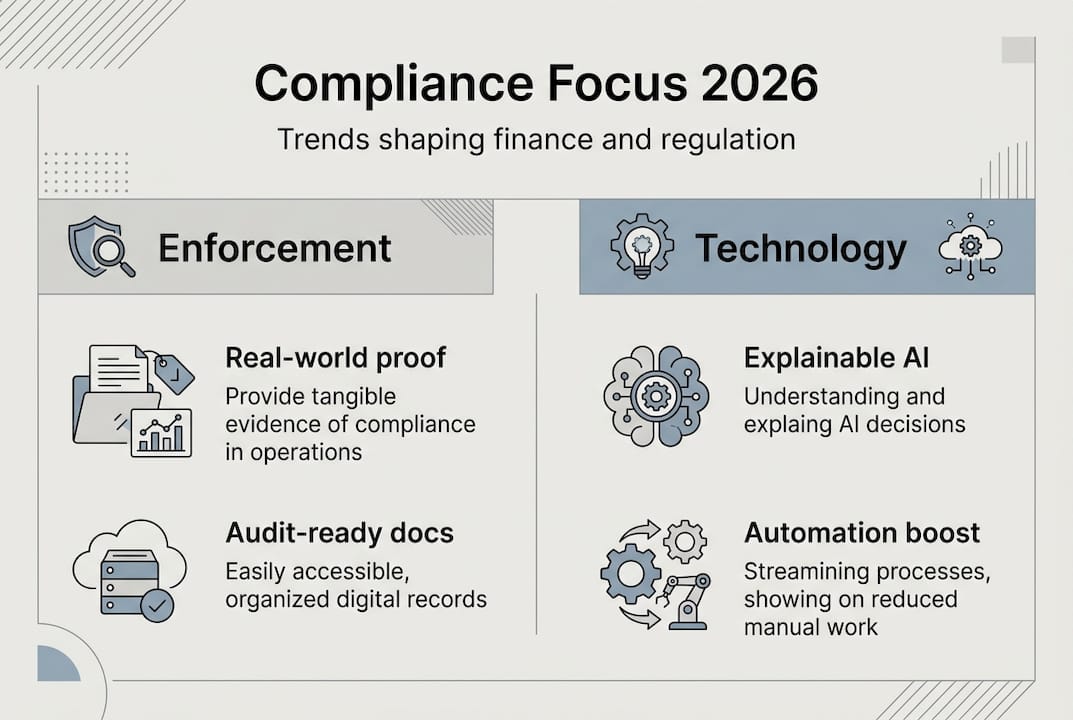
Bad data fed into an AI model does not produce smart compliance. It produces confident-sounding errors. That distinction matters enormously when regulators ask you to explain why your system flagged or cleared a transaction.
Current AI use cases in compliance include:
Transaction screening and sanctions monitoring
Suspicious activity report (SAR) drafting and review
Regulatory change management and policy mapping
Risk scoring and customer due diligence (CDD) workflows
Governance challenges are equally significant. Who owns the model? Who validates it? What happens when it produces an unexplainable output? These are not hypothetical questions. Regulators are already asking them.
“AI is valuable for efficiency, but must be explainable and risk-prioritized to satisfy regulatory expectations and maintain institutional accountability.”
The forces reshaping AML and compliance in 2026 make clear that explainability is not a nice-to-have. It is a regulatory requirement in practice, even where formal rules have not yet caught up. Reviewing AI compliance strategies can help you build a governance framework that satisfies both internal audit and external examiners.
Pro Tip: When piloting AI tools, choose models that produce explainable outputs over black-box risk scores. Your examiners will ask why the system made a decision. You need a clear answer.
Regulatory divergence: U.S. versus global approaches
If your institution operates across borders, the regulatory landscape just got more complicated. U.S. deregulatory trends and a focus on innovation contrast sharply with EU harmonization efforts and the UK’s return to core mission supervision.
Dimension | U.S. approach | EU/UK approach |
Regulatory philosophy | Deregulation and innovation | Harmonization and core mission |
Supervisory focus | State-level activity filling gaps | Centralized oversight |
AI regulation | Emerging, fragmented | Structured frameworks (EU AI Act) |
Crypto/digital assets | Evolving, less restrictive | Stricter, more defined |
For multinational compliance teams, this divergence creates real friction:
Policies written for U.S. flexibility may not satisfy EU requirements
State-level U.S. regulations are filling gaps left by federal deregulation, adding a patchwork layer
Sanctions screening must account for different jurisdictional standards, as highlighted in recent sanctions due diligence guidance
PCAOB inspection findings, reviewed in PCAOB inspection issues, reflect how audit quality expectations differ across jurisdictions
State regulators in New York, California, and Texas are increasingly active, issuing guidance and enforcement actions that fill the space where federal agencies have pulled back. Multinational teams cannot afford to track only federal developments.
AML, third-party risk, and enforcement hot spots
Anti-money laundering (AML) compliance remains one of the most resource-intensive and enforcement-heavy areas in financial regulation. The numbers are staggering.
AML metric | 2026 reality |
Global AML compliance costs | |
False positive alert rates | 85% to 95% |
Daily alerts at large institutions | Exceeds 10,000 |
Regulatory fines for AML failures | Hundreds of millions per action |
Those false positive rates are not just an efficiency problem. They create alert fatigue, which means real suspicious activity can get buried under noise. Managing that ratio is now a core compliance skill.
Emerging AML risks that deserve your attention include:
Synthetic identity fraud using AI-generated documentation
Deepfake-enabled account takeover and onboarding fraud
Virtual IBANs obscuring the true origin of funds
Sanctions screening gaps in correspondent banking relationships
“Failures trigger regulatory action even when internal controls exist on paper. Examiners look at outcomes, not intentions.”
Third-party risk management is now an AML enforcement priority, with FINRA and the SEC focusing heavily on AML programs, Regulation Best Interest (Reg BI), and cybersecurity controls. Reviewing practical regulatory compliance examples can sharpen your understanding of what enforcement actions actually look like in practice. For hands-on preparation, AML and BSA compliance training provides structured, exam-focused instruction. The 2026 AML outlook reinforces that proactive controls, not reactive fixes, define successful programs.
Practical strategies for U.S. compliance professionals in 2026
Pulling these trends together, here is a framework for navigating 2026 with confidence rather than anxiety.
Embed compliance into operations. Move beyond policy documentation. Map every regulatory requirement to a specific operational control and assign ownership.
Prioritize regulatory uncertainty. 38% of compliance professionals cite regulatory uncertainty as their top concern, with fair lending close behind at 33%. Build scenario planning into your compliance calendar.
Automate before you hire. With budgets flat, automation is your best lever for expanding coverage without adding headcount.
Govern your AI tools. Establish model ownership, validation schedules, and explainability standards before regulators ask for them.
Strengthen third-party risk controls. Vendor due diligence and ongoing monitoring are no longer optional extras. They are exam priorities.
Trend | Action step |
Enforcement shift | Build audit-ready operational documentation |
Resource constraints | Automate repetitive monitoring tasks |
AI adoption | Implement explainable model governance |
Regulatory divergence | Track state-level and international requirements |
AML pressure | Reduce false positives and tighten third-party controls |
The risk management strategies that work in 2026 are proactive, documented, and technology-supported. Combining them with risk management best practices gives your program the structure examiners expect. Exploring automated cybersecurity training can also support your team’s readiness across the cybersecurity compliance front.
Pro Tip: Focus on explainable AI and robust third-party risk processes. These two areas are generating the most examiner questions in 2026, and being ahead of them signals program maturity.
Advance your compliance expertise with CPE events
The trends covered in this article are not abstract. They are showing up in exam rooms, enforcement actions, and board-level conversations right now. Staying current requires more than reading updates. It requires structured, practical training that translates regulatory shifts into skills you can apply immediately.
Our 2026 CPE event calendar features in-person and live webinar sessions designed specifically for compliance officers, risk managers, and financial professionals navigating today’s enforcement environment. Whether you are building foundational skills through internal auditor basics training or staying sharp on emerging threats through cybersecurity CPE events, our NASBA-recognized programs deliver practical, expert-led instruction that counts toward your CPA, CIA, CISA, or CFE certification requirements.
Frequently asked questions
What is embedded compliance, and why is it important in 2026?
Embedded compliance means integrating regulatory requirements directly into day-to-day operational workflows rather than maintaining them as separate policy documents. It matters because regulators now validate whether programs are truly operational, not just written.
How can small compliance teams maximize effectiveness with limited resources?
Small teams should automate routine monitoring tasks and concentrate human judgment on high-risk areas. With 64% of institutions expecting flat or declining budgets, technology is the most practical way to maintain coverage without adding staff.
What are the biggest technology challenges in financial compliance for 2026?
Data quality and model explainability are the leading obstacles, especially as 61% of banks implement or pilot AI in compliance functions. Poor data undermines even the most sophisticated tools.
What AML trends should compliance professionals prioritize this year?
Managing high false positive rates, strengthening third-party risk controls, and tracking FINRA and SEC enforcement priorities are the most urgent focus areas. Global AML costs exceed $200 billion annually, making efficiency and accuracy equally critical.
How do U.S. compliance trends differ from global regulatory shifts?
The U.S. is leaning toward deregulation and state-level activity, while the EU and UK are pursuing harmonization and structured oversight frameworks. This divergence requires multinational teams to maintain jurisdiction-specific compliance strategies rather than relying on a single global policy.
Recommended
Comments