What is ethics training? Guide for organizations & compliance teams

Updated: Mar 31

Most compliance officers have seen it: the annual ethics course gets assigned in January, employees click through it by February, and by March the knowledge has largely faded. Research confirms this pattern is real. Annual training is often insufficient due to the forgetting curve, and continuous learning methods consistently yield better results. If your organization treats ethics training as a once-a-year checkbox, you are likely leaving significant compliance risk on the table. This guide breaks down what ethics training actually is, how it should be delivered, and how to measure whether it is working.
Table of Contents
Key Takeaways
Point | Details |
Structured for compliance | Ethics training ensures employees understand laws, policies, and ethical standards vital to compliance. |
Modern methods work best | Continuous and scenario-based ethics training leads to higher retention and engagement than annual sessions. |
Measure real behavior | Assess program effectiveness with behavioral metrics, not just knowledge quizzes. |
Adapt for new risks | Update ethics training regularly to address emerging challenges like AI, third-party risk, and global diversity. |
Culture drives results | Building an ethical culture creates more sustainable impact than checking compliance boxes. |
Definition and core objectives of ethics training
Now that we have challenged the misconception about training frequency, let us clarify what ethics training actually is and why it matters.
Ethics training educates employees on organizational principles, policies, laws, regulations, and ethical standards to guide proper workplace behavior. It is not simply a legal formality. It is a structured effort to align individual behavior with organizational values and regulatory expectations.
For compliance officers and HR professionals, the objectives are concrete:
Guide behavior by giving employees clear frameworks for decision-making in gray areas
Reduce legal and regulatory risk under frameworks like the FCPA (Foreign Corrupt Practices Act) and GDPR (General Data Protection Regulation)
Protect organizational reputation by preventing misconduct before it escalates
Support audit readiness by demonstrating a culture of accountability to regulators and auditors
Understanding the role of ethics in auditing is especially important for organizations subject to external review. Auditors look for evidence that ethics is embedded in operations, not just documented in a policy manual.
“Ethics training is not a one-time event. It is an ongoing organizational commitment that shapes how people act when no one is watching.”
The importance of ethics in accounting extends this point further. When financial professionals lack ethical grounding, the consequences can reach far beyond internal policy violations.
Core methodologies and formats of modern ethics training
With the fundamentals established, it is vital to understand how ethics training is actually delivered in 2026.

Key methodologies include scenario-based learning, microlearning, online platforms, peer discussion, role-playing, and risk-based content tailored to FCPA, GDPR, and anti-bribery regulations. Each format serves a different purpose, and the best programs blend several of them.
Here is a comparison of the most common formats:
Format | Best use case | Retention strength |
Annual online course | Baseline awareness | Low |
Scenario-based modules | Decision-making practice | High |
Microlearning (5-10 min) | Ongoing reinforcement | High |
In-person workshops | Culture building, discussion | Medium to high |
Peer discussion groups | Applying ethics to real work | Medium |
Understanding what is compliance training helps clarify how ethics training fits within a broader compliance program. Ethics training focuses on values and judgment; compliance training focuses on rules and procedures. Both are necessary.
For organizations with specific regulatory exposure, content should be tailored. A financial services firm needs anti-bribery and conflicts-of-interest modules. A healthcare organization needs patient privacy and billing ethics content. Reviewing regulatory compliance examples can help you identify which risk areas deserve dedicated training tracks.
Pro Tip: Build a central ethics portal where employees can access short refresher modules, report concerns, and review updated policies. Centralizing access dramatically improves engagement and knowledge retention over time.
Measuring effectiveness: What works and what doesn’t
Knowing the different training methods is only half the equation. Real value comes from measuring what actually works.
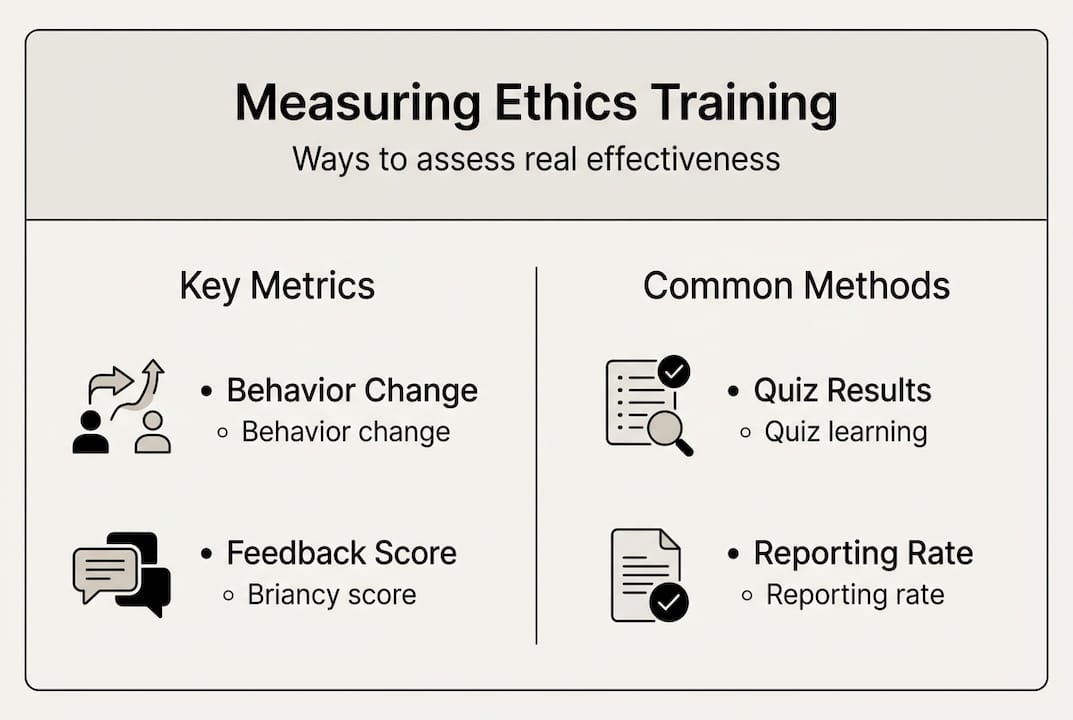
Most organizations default to quiz scores as their primary metric. That is a mistake. Effectiveness is measured by Kirkpatrick levels, pre-post tests, self-assessments, and program engagement indicators like reporting rates and employee relations claim reductions. The Kirkpatrick model evaluates training across four levels: reaction, learning, behavior, and results.
Here is what a more complete measurement approach looks like:
Metric | What it measures | Target outcome |
Pre-post knowledge test | Learning gain | 15-25% improvement |
Ethics hotline usage | Reporting culture | Increase over baseline |
ER claim frequency | Behavioral impact | Reduction year over year |
Manager observation scores | On-the-job behavior | Consistent improvement |
Employee survey results | Perceived culture | Positive trend |
Steps to measure beyond quizzes:
Establish a baseline using pre-training assessments before any new program launches
Track hotline and reporting data quarterly to identify cultural shifts
Survey employees on perceived ethical culture, not just training satisfaction
Review employee relations claims and disciplinary actions annually
Conduct behavioral observations or manager check-ins tied to training topics
Empirical studies indicate that training improves moral efficacy and motivation, but its impact on ethical sensitivity is weaker. This means organizations cannot rely on training alone. The program must be reinforced by leadership behavior and organizational culture.
Connecting training outcomes to risk management through ethics training gives compliance teams a stronger business case when presenting program results to leadership.
Emerging risks and future-proofing ethics training
Once effectiveness is understood, organizations need to ensure their programs actually keep pace with emerging risks and industry changes.
Emerging nuances include varying team culture dimensions, new importance for AI and third-party risk, and the need for frequent refreshers as annual training is no longer sufficient. The pace of regulatory and technological change has simply outrun the annual training cycle.
Key areas your program should now address:
AI ethics and algorithmic bias: Employees using AI tools need guidance on data use, transparency, and accountability
Third-party and supply chain risk: Ethics obligations extend beyond your walls to vendors and partners
Cross-cultural ethics: Global teams require content that accounts for different cultural norms and legal environments
Data privacy and cybersecurity ethics: Misuse of personal data is both a legal and ethical issue
The risks of AI transcription in internal auditing illustrate how quickly new ethical dilemmas emerge from technology adoption. Your training program needs to keep up.
“Organizations that update ethics content only annually are essentially teaching employees to navigate today’s risks with last year’s map.”
Reviewing AI in compliance strategy and 2026 compliance best practices can help you identify which new topics belong in your next training cycle.
Pro Tip: Involve cross-functional teams, including legal, IT, HR, and operations, when updating ethics training content. Each function sees different risks, and their input makes the program far more relevant and credible.
Culture change vs. check-the-box: What actually drives impact?
Understanding what makes ethics training future-ready sets the stage for evaluating what truly drives impact across organizations.
Direct behavior change from training is limited. Results rely on broader ethical culture, and while some evidence of performance and risk reduction exists, measurement varies widely. This is the core tension in ethics training: you can design a technically excellent program and still see minimal behavioral change if the organizational culture does not support it.
What separates culture-driven programs from check-the-box ones:
Leadership modeling: Executives and managers visibly demonstrate the values being taught
Performance integration: Ethics behaviors are included in performance reviews and promotion criteria
Psychological safety: Employees feel safe raising concerns without fear of retaliation
Consistent reinforcement: Ethics topics appear in team meetings, not just formal training sessions
Accountability mechanisms: Violations are addressed consistently, regardless of seniority
Check-the-box programs focus on completion rates. Culture-driven programs focus on whether behavior actually changes. The difference shows up in audit findings, regulatory examinations, and employee relations data.
For organizations focused on advancing risk management, the investment in culture-driven ethics training pays dividends well beyond avoiding fines. It builds the kind of organizational integrity that regulators and auditors recognize and reward.
Practical steps to implement or upgrade ethics training in your organization
To move from theory to action, here is a straightforward guide to launch or improve your ethics training program right away.
Best practice is to shift from annual to continuous training, use central portals, and tie reinforcement to performance management. Here is how to put that into practice:
Conduct a needs assessment: Identify your highest-risk areas, regulatory obligations, and any recent incidents or near-misses that signal gaps
Set measurable goals: Define what success looks like using behavioral metrics, not just completion rates
Design role-specific content: Generic training rarely sticks. Tailor modules to job function, risk exposure, and seniority level
Select the right technology: Choose a platform that supports microlearning, tracks engagement, and integrates with your HR systems
Establish ongoing measurement: Schedule quarterly reviews of reporting data, survey results, and behavioral indicators
Link to performance management: Include ethics-related behaviors in performance reviews to signal that this is not optional
Review ethics program benchmarks to calibrate your goals against industry standards before you finalize your program design.
Pro Tip: Build anonymous feedback channels into your ethics program from day one. Employees who feel safe reporting concerns early give your organization the chance to address issues before they become regulatory problems. Track remediation actions to demonstrate program accountability.
Working with CCS expert training resources can accelerate your program design, especially if you are building from scratch or overhauling an outdated curriculum.
Specialized ethics and compliance training for your 2026 needs
Ready to put these strategies into action? Here is where to find the latest, most relevant ethics and compliance training opportunities for your team.
Building a strong ethics program requires more than internal effort. It requires access to current, expert-led content that reflects today’s regulatory environment and emerging risks.
Our 2026 CPE event calendar features live and digital sessions designed specifically for compliance officers, HR professionals, and audit teams navigating complex ethics obligations. If you are looking for structured, credential-recognized training, our Ethics CPE in-person events offer practical, scenario-driven content that meets CPA, CIA, CFE, and CISA requirements. Every session is led by practitioners with real-world experience, not just theory. Explore our full expert CPE training offerings to find the right fit for your team’s 2026 development plan.
Frequently asked questions
What is the main goal of ethics training in the workplace?
Ethics training educates employees on organizational principles, policies, laws, and ethical standards to guide responsible behavior and support regulatory compliance across all levels of the organization.
How often should ethics training be delivered?
Experts recommend quarterly or microlearning formats rather than relying solely on annual training. Annual training is insufficient to reinforce retention and adapt to new and emerging risks.
How can organizations measure the effectiveness of ethics programs?
Use behavioral metrics, pre-post assessments, and reporting rates rather than quiz scores alone. Effectiveness is measured by Kirkpatrick levels, behavioral indicators, and program engagement data.
What new challenges should modern ethics training address?
Emerging areas include AI ethics, third-party risk, and adapting to diverse cultural environments. AI ethics and third-party risks are now key frontiers that annual programs rarely cover adequately.
What’s the difference between check-the-box and culture-driven ethics training?
Check-the-box programs prioritize completion; culture-driven programs aim for lasting behavioral and cultural transformation. Culture-change approaches consistently outperform compliance-only models in producing sustainable results.
Recommended
Comments