How to evaluate internal controls effectively in 2026


Evaluating internal controls is a cornerstone of audit quality, yet many professionals struggle to assess control design and operating effectiveness systematically. Weak evaluations expose organizations to compliance failures, financial misstatements, and operational disruptions. This guide provides a step-by-step framework to help auditors, compliance officers, and risk managers evaluate internal controls with precision using COSO principles and PCAOB standards.
Table of Contents
Key takeaways
Point | Details |
COSO framework essentials | The globally recognized model for designing, implementing, and evaluating internal controls across industries. |
Assessment components | Evaluation requires testing control design, operating effectiveness, and documentation completeness. |
PCAOB documentation | Management review controls must include precise thresholds, contemporaneous evidence, and documented reviewer authority. |
Financial reporting focus | Internal controls over financial reporting (ICFR) ensure accuracy and compliance with SOX and SEC regulations. |
Continuous improvement | Ongoing monitoring, testing, and remediation maintain control effectiveness and adapt to evolving risks. |
Understanding internal controls and the COSO framework
Internal controls are policies, procedures, and activities designed to safeguard assets, ensure reliable financial reporting, and promote compliance with laws and regulations. They represent the first line of defense against fraud, errors, and operational inefficiencies. The COSO Framework provides globally recognized guidance to help organizations design, implement, and enhance their internal control environments.
Originally published in 1992 by the Committee of Sponsoring Organizations of the Treadway Commission, COSO was updated in 2013 to clarify principles and address emerging risks. The framework comprises five interrelated components: control environment, risk assessment, control activities, information and communication, and monitoring activities. Each component contains principles that guide the design and implementation of controls.
Why does COSO matter for your evaluation process? Internal controls and effective risk management are essential for operational resilience, compliance, and strategic success. Organizations across banking, healthcare, manufacturing, and technology rely on COSO to structure their control frameworks. The model’s flexibility allows adaptation to different risk profiles while maintaining consistency in evaluation criteria.
Key benefits of using COSO include:
Enhanced operational efficiency through streamlined processes and clear accountability
Improved security and fraud prevention via segregation of duties and authorization controls
Greater organizational resilience by identifying and mitigating risks proactively
Regulatory compliance with SOX, FDICIA, and industry-specific requirements
Understanding why internal controls matter helps evaluators focus on the right objectives. The control environment sets the tone at the top, establishing ethical standards and governance structure. Risk assessment identifies and analyzes threats to achieving objectives. Control activities are the specific actions, like approvals and reconciliations, that mitigate risks. Information and communication ensure relevant data flows to the right people. Monitoring activities provide ongoing oversight and validation.
“The COSO framework is not a checklist but a principles-based approach that requires professional judgment and customization to fit each organization’s unique risk landscape and business model.”
Preparing to evaluate internal controls: prerequisites and planning
Effective evaluation starts long before you test a single control. Proper planning defines scope, identifies stakeholders, and sets clear objectives that align with regulatory expectations and organizational goals. Without this foundation, evaluations become scattered and miss critical control gaps.

Begin by defining your evaluation scope precisely. Are you focused on financial reporting controls for SOX compliance, operational controls for process efficiency, or compliance controls for regulatory adherence? Each scope requires different testing approaches and documentation standards. Financial reporting controls demand the highest rigor due to external audit and SEC scrutiny.
Identify key stakeholders early in the planning phase. Internal control is a continuous process spearheaded by an organization’s board of directors, compliance managers, internal audit directors and other relevant personnel. Process owners provide operational knowledge. Controllers and accounting managers understand financial reporting requirements. IT teams explain system controls and access management. External auditors offer perspectives on audit evidence quality.
Gather essential documentation before testing begins:
Process narratives and flowcharts showing transaction flows and control points
Prior audit reports highlighting deficiencies and management responses
Risk assessments identifying material risks and corresponding controls
Policy manuals documenting control procedures and responsibilities
System reports showing access logs, exception reports, and automated control outputs
Review applicable regulatory requirements that shape your evaluation criteria. SOX Section 404 mandates annual assessments of internal controls over financial reporting for public companies. Banking regulations like FDICIA impose similar requirements for financial institutions. Industry standards such as ISO 31000 for risk management or NIST frameworks for cybersecurity may apply.
Set clear evaluation objectives and criteria before testing. What constitutes effective control design? How will you measure operating effectiveness? What sample sizes and testing methods will provide sufficient evidence? Reference your internal control checklist 2026 audit efficiency to ensure comprehensive coverage.
Pro Tip: Create a detailed evaluation plan that documents scope, objectives, testing approach, timeline, and resource requirements. Share this plan with stakeholders to confirm expectations and secure necessary access to systems and personnel.
Step-by-step process to evaluate internal controls effectively
Systematic evaluation follows a logical sequence from understanding control design to testing execution to documentation review. This structured approach ensures consistent, thorough assessments that meet professional standards and regulatory expectations.
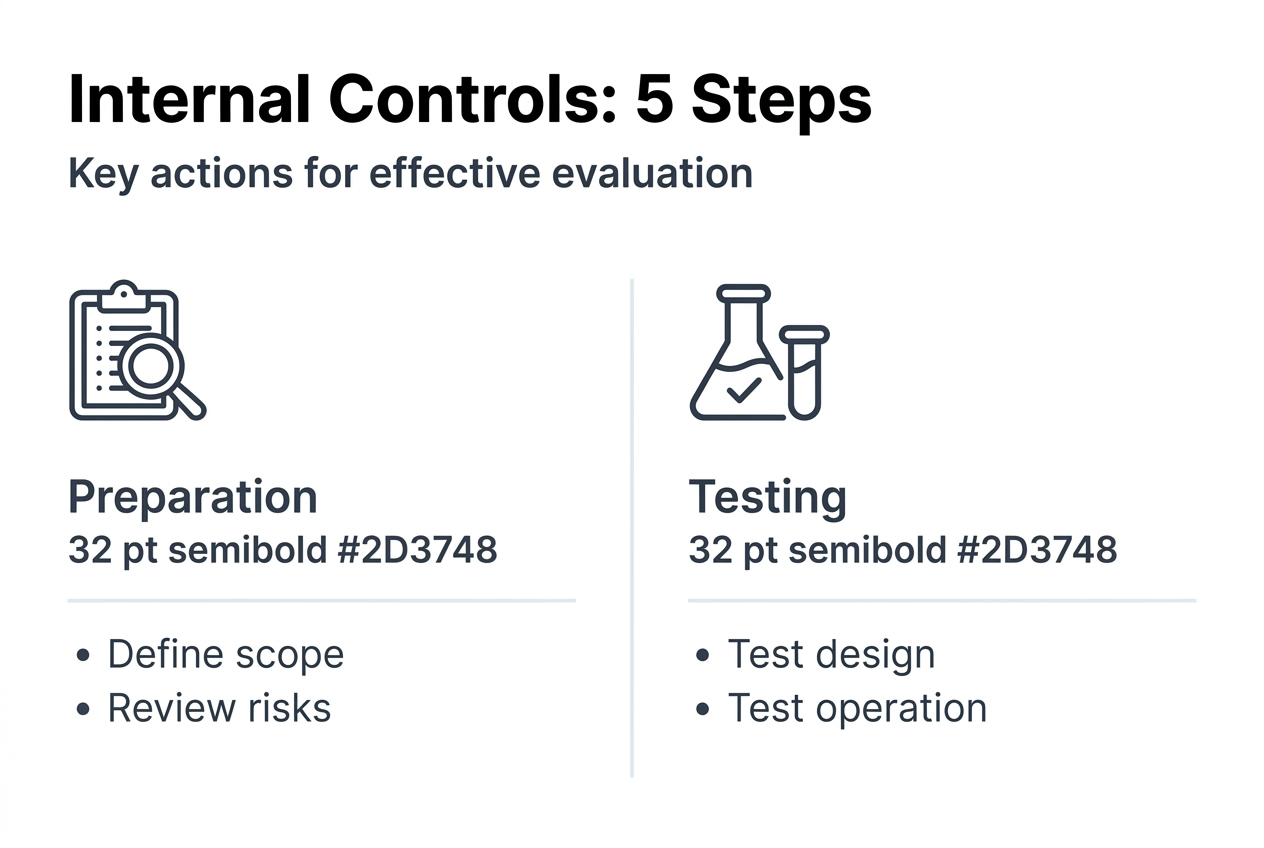
Step 1: Understand and evaluate control design. Start by documenting how each control is designed to prevent or detect specific risks. The COSO framework guides corporations to design and implement internal control systems and continually assess their effectiveness. Identify the control objective, the risk being addressed, and the specific procedure performed. Assess whether the control design is theoretically capable of achieving its objective. A well-designed control has clear triggers, defined procedures, competent personnel, and appropriate authority levels.
Step 2: Test operating effectiveness through direct evidence. Design alone is insufficient. You must verify that controls operate as intended throughout the evaluation period. Use these testing methods:
Inquiry: Interview control performers to understand their procedures and decision-making
Observation: Watch controls being executed in real time
Inspection: Examine documentary evidence like approvals, reconciliations, and exception reports
Reperformance: Execute the control yourself to verify accuracy and completeness
Automated testing: Use data analytics to test populations rather than samples for system controls
Step 3: Assess documentation completeness and quality. PCAOB expects evidence including which items were investigated, follow-up procedures, and conclusions to verify the control operated as designed. Management review controls require especially rigorous documentation showing the reviewer’s thought process, items examined, exceptions identified, and resolution actions taken.
Step 4: Evaluate management review controls with precision. These controls involve managers reviewing reports, investigating anomalies, and taking corrective action. Common deficiencies include vague thresholds that fail to identify material items, incomplete documentation of review procedures, and reviewers lacking sufficient expertise. Ensure review controls specify:
Precise dollar thresholds or percentage variances that trigger investigation
Clear criteria for what constitutes an acceptable explanation
Documentation of items reviewed, questions asked, and conclusions reached
Evidence of timely follow-up on identified exceptions
Step 5: Document findings and evaluate overall effectiveness. Compile test results into a coherent assessment of control effectiveness. Classify deficiencies by severity: control deficiencies, significant deficiencies, or material weaknesses under PCAOB standards. Reference sox compliance steps for internal auditors for classification guidance.
Evaluation Criteria | Testing Method | Key Documents |
Control design adequacy | Walkthrough and inquiry | Process narratives, policy manuals |
Operating effectiveness | Sampling and reperformance | Transaction records, approvals |
Documentation quality | Inspection and review | Control evidence, audit trails |
Reviewer competence | Inquiry and observation | Organization charts, training records |
Remediation timeliness | Follow-up testing | Corrective action plans, retest results |
Pro Tip: Use stratified sampling to ensure your test samples cover high-risk transactions, unusual items, and representative normal transactions. Random sampling alone may miss the exact scenarios where controls are most likely to fail.
Common pitfalls and how to verify evaluation results
Even experienced auditors encounter challenges that compromise evaluation quality. Recognizing these pitfalls and implementing verification procedures strengthens your assessment and builds stakeholder confidence in your conclusions.
Insufficient control documentation undermines audit evidence and makes it impossible to demonstrate control effectiveness to external auditors or regulators. PCAOB highlights common issues: weak documentation and imprecise management review controls can miss material misstatements. Without contemporaneous evidence showing what was reviewed, what questions were asked, and what conclusions were reached, you cannot prove a control operated.
Overly broad thresholds reduce control effectiveness in detecting errors. A management review control that only investigates variances exceeding 20% of budget may miss multiple smaller misstatements that aggregate to material amounts. Precision matters. Set thresholds at levels that catch potentially material items individually or in combination.
Lack of reviewer expertise or independence compromises control reliability. A reviewer who lacks sufficient knowledge of the business process or accounting standards cannot identify errors effectively. Similarly, a reviewer who reports to the person whose work they are reviewing lacks independence. Verify that reviewers possess:
Technical knowledge appropriate to the items being reviewed
Sufficient authority to require corrective action
Independence from the activities and personnel being reviewed
Adequate time and resources to perform thorough reviews
Verifying evaluation results requires independent validation of your conclusions. Have a second reviewer examine your test results and documentation. Perform follow-up testing on any controls where initial results were unclear or borderline. Compare your findings to prior period assessments to identify trends or recurring issues.
Align your evaluation methodology and conclusions with regulatory standards relevant to your organization. Public companies must meet PCAOB AS 2201 requirements for auditing internal control over financial reporting. Private companies may follow COSO guidance or industry-specific frameworks. Government entities often apply GAO standards for internal control in federal agencies.
Present findings clearly to stakeholders for remediation and continuous improvement. Structure your communication around:
Control deficiencies identified with root cause analysis
Risk implications of each deficiency
Recommended remediation actions with implementation timelines
Responsibilities for corrective action and follow-up testing
Impact on financial statement reliability and regulatory compliance
“Effective communication of evaluation results requires balancing technical accuracy with accessibility. Tailor your presentation to each audience: detailed technical findings for audit committees, high-level risk summaries for executive management, and specific action items for process owners.”
Understanding how to comply with sox requirements helps frame your evaluation methodology and reporting in language that resonates with boards and executive management who make remediation decisions.
Enhance your internal control expertise with targeted CPE training
Mastering internal control evaluation requires continuous learning as frameworks evolve, regulations change, and new risks emerge. Specialized continuing professional education keeps your skills sharp and your knowledge current.
Our comprehensive CPE courses cover internal control frameworks, SOX compliance, COSO implementation, and advanced auditing techniques.
Learn from instructors with Big 4 backgrounds who bring real-world experience to every session. Participate in 2026 CPE event calendar in-person training across multiple cities or join internal auditor CPE webinars from anywhere. Earn NASBA-approved credits that count toward your CPA, CIA, CISA, or CFE certification requirements while building practical skills you can apply immediately.
Frequently asked questions
How do I identify ineffective internal controls during evaluation?
Look for controls with poor design that do not address the underlying risk, lack of consistent operation evidenced by missing approvals or incomplete reconciliations, incomplete documentation that fails PCAOB standards, and failure to detect key risks during testing. Review audit evidence critically and perform reperformance testing to verify control execution matches documented procedures.
What role does the COSO framework play in control evaluation?
COSO provides a structured approach to designing, implementing, and assessing internal controls across five integrated components and 17 principles. It ensures consistent evaluation criteria across organizations and industries while allowing flexibility to address unique risks. Using COSO aligns your evaluation with globally recognized best practices and regulatory expectations.
How can I ensure compliance with PCAOB documentation standards?
Maintain contemporaneous, detailed records of control tests including dates performed, items examined, procedures executed, and conclusions reached. Document follow-up procedures on exceptions and their resolution. Ensure reviewers’ technical knowledge, authority levels, and independence are clearly documented. Keep audit evidence organized and readily accessible for external auditor review.
What are effective strategies for ongoing monitoring of internal controls?
Implement regular control self-assessments where process owners evaluate their own controls quarterly. Establish management review meetings to discuss control performance metrics and emerging risks. Update control designs and testing procedures as business processes change or new risks emerge. Leverage technology like continuous auditing tools for real-time monitoring of automated controls and exception reporting.
Recommended
Comments