Why compliance audits fail: key pitfalls to avoid


TL;DR:
Passing compliance scores often conceal underlying operational weaknesses and risks.
Continuous controls monitoring and swift remediation are key to effective audits.
Organizational culture that values honest findings improves long-term compliance resilience.
Passing a compliance audit feels like a win. Reports get filed, boxes get checked, and leadership breathes a sigh of relief. But here is the uncomfortable reality: passing grades and genuine compliance are not the same thing. Recent data shows that 45% of banks failed internal AML audits in 2023, and 76% of NIST CSF assessments revealed significant cybersecurity control gaps. These numbers signal that even organizations with robust-looking programs are harboring serious operational weaknesses. This article breaks down exactly why compliance audits fail and what audit and compliance leaders can do to move from surface-level scores to real, lasting accountability.
Table of Contents
Key Takeaways
Point | Details |
Passing audits isn’t enough | Organizations can pass audits but still have major compliance gaps. |
Continuous monitoring beats periodic checks | Ongoing compliance programs catch risks that snapshot audits miss. |
Audit theater is a major risk | Focusing on appearances instead of substance undermines true compliance. |
Close findings quickly | Acting on audit results and remediating issues promptly drives real improvement. |
Defining audit success: more than just passing the test
Most organizations define audit success by the outcome: did we pass? That framing is understandable, but it creates a dangerous blind spot. A passing grade tells you that, at a particular point in time, documentation and controls appeared sufficient to the reviewer. It does not tell you whether those controls are actually operating as intended, whether exceptions are being managed properly, or whether your team understands why those controls exist in the first place.
This is where the concept of “compliance theater” becomes important. Compliance theater refers to polished reports that mask operational weaknesses, including stale exceptions and poor remediation, creating false confidence despite passing audits. Think of it like a restaurant that passes its health inspection by scrubbing surfaces the day before the inspector arrives, then returns to business as usual the next morning. The score looks clean. The kitchen is not.
“A compliance score is a lagging indicator. By the time it reflects a problem, the damage is often already done.”
The organizational cost of this kind of false confidence is significant. Leaders make resource allocation decisions based on audit outcomes. If those outcomes overstate actual compliance health, resources flow away from the areas that need attention most. Over time, this compounds. Small gaps become systemic weaknesses.
Consider a financial services firm that consistently receives satisfactory ratings on its vendor risk assessments but has never actually tested whether those vendor controls are operationally enforced. The documentation checks out, but the actual exposure is real and growing. This is exactly the type of gap that good audit practice, focused on reducing risk for executives, is designed to surface.
Signs your audit scores may be giving you false security:
Findings are repeated cycle after cycle with minimal change
Control owners cannot explain the purpose of the controls they operate
Remediation timelines extend indefinitely without escalation
Audit prep consumes disproportionate resources versus ongoing compliance activity
Exception reports are filed but never analyzed for root cause
Common reasons compliance audits fail
With an understanding that surface-level scores can mislead, let’s break down the specific pitfalls that cause audits to fail. These are not theoretical. They show up consistently across industries, organization sizes, and regulatory frameworks.
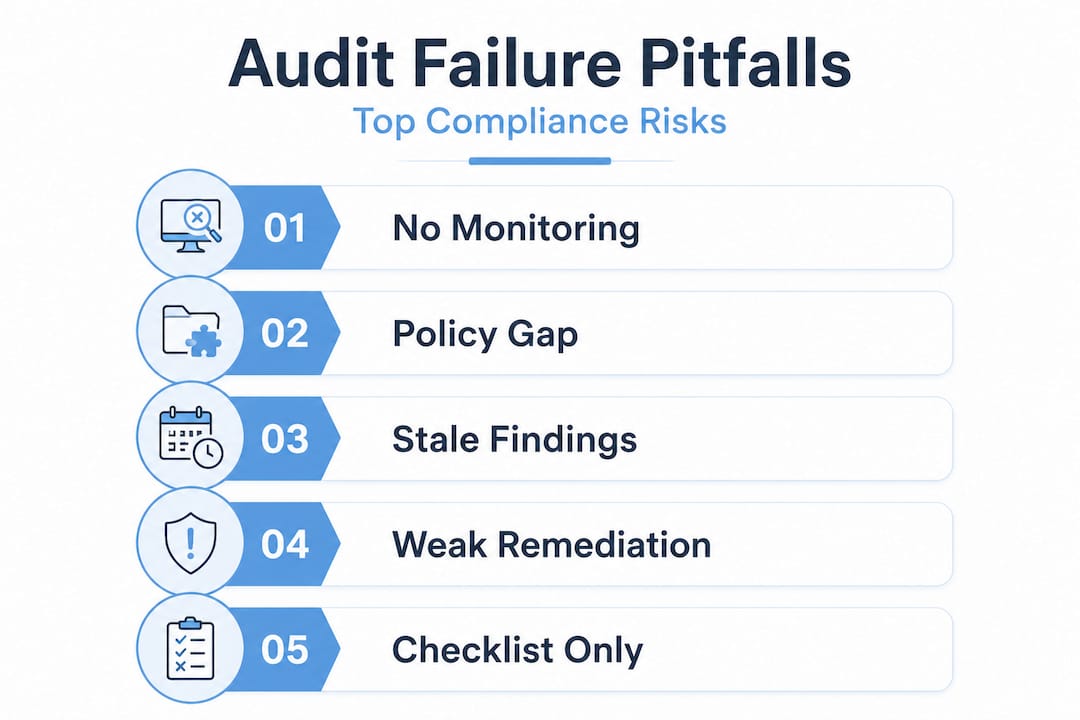
1. Lack of continuous controls monitoring
Most organizations treat compliance as a periodic event rather than an ongoing discipline. Controls get tested ahead of the audit, gaps get patched just in time, and the cycle repeats. The problem is that dynamic environments outpace periodic audit models. A control that was functioning in January may have broken down by March due to a system upgrade, a process change, or staff turnover. If you are only looking once a year, you simply will not know.

2. Policy-execution gaps: documented but not operationalized
This is one of the most common findings in audit deficiency reports. Policies exist in writing, but they are not embedded into daily workflows. Staff follow workarounds because the official process is cumbersome. Training happened once at onboarding and was never reinforced. Reviewing audit deficiency examples from PCAOB inspection reports repeatedly reveals this pattern: the policy was there, but the practice diverged years ago.
3. Stale exceptions and unaddressed findings
Exceptions are a normal part of any compliance program. The problem is when exceptions age without resolution. An exception logged six months ago and still listed as “in remediation” is not being managed; it is being ignored. Stale exceptions signal to regulators, external auditors, and internal stakeholders that accountability mechanisms have broken down.
4. Insufficient remediation and follow-up
Finding an issue is only half the job. Fixing it completely, verifying the fix, and confirming the root cause has been addressed is the other half. Many programs are good at identifying issues and poor at closing them out permanently. Repeat findings, which show up in audit after audit, are a direct symptom of weak remediation.
5. Overreliance on checklist-based audits
Checklists are useful tools, but they are not substitutes for judgment. A checklist tells you whether a control exists; it does not tell you whether that control is effective, appropriately scoped, or understood by the people operating it. Organizations that want to strengthen compliance programs need to move beyond checkbox thinking toward risk-based, evidence-driven evaluation.
Audit pitfall | Common symptom | Root cause |
No continuous monitoring | Controls fail between cycles | Periodic-only mindset |
Policy-execution gap | Staff use workarounds | Training and reinforcement failure |
Stale exceptions | Findings repeat year over year | Weak accountability structures |
Poor remediation | Root cause never addressed | Shallow follow-up processes |
Checklist reliance | Controls exist but are ineffective | Lack of substantive testing |
Pro Tip: Track the average age of open audit findings in your program. If your mean days-to-close exceeds 90 days for high-risk findings, you have a remediation discipline problem that no new policy will fix on its own.
The limitations of traditional periodic audits
Understanding the root causes primes us to examine why traditional audit models often fail organizations today. The periodic, point-in-time audit has been the standard for decades. For a relatively stable regulatory environment with slow-moving risks, it was adequate. That environment no longer exists.
Today’s organizations face continuous regulatory updates, rapid technology change, frequent workforce shifts, and interconnected third-party risk. A traditional periodic model simply cannot keep pace with this velocity. By the time an annual audit captures a control failure, the organization may have been exposed for eleven months without knowing it.
The gaps that emerge between audit cycles are not trivial. They include configuration drift in IT systems where security settings revert or change after updates, access control violations where terminated employees retain system access for weeks or months, and contract compliance failures where vendor obligations go unmonitored between review periods.
Continuous compliance programs address these gaps by embedding monitoring into daily operations rather than treating compliance as a separate event. This means automated control testing, real-time alerting on exceptions, and regular evidence collection throughout the year. It requires upfront investment but dramatically reduces the cost and risk of late-stage discovery. Organizations implementing continuous compliance strategies consistently report fewer surprises at audit time and faster regulatory response.
Audit model | Frequency | Gap risk | Cost profile | Regulator preference |
Traditional periodic | Annual or quarterly | High between cycles | Lower upfront, higher remediation | Decreasing |
Continuous compliance | Ongoing | Low | Higher upfront, lower remediation | Increasing |
Hybrid approach | Continuous monitoring with formal periodic reviews | Moderate | Moderate across program | Currently dominant |
For organizations just beginning this shift, reviewing compliance officer tips on building sustainable monitoring frameworks is a practical starting point. For more complex environments, especially those navigating defense or federal contractor requirements, working with expert CMMC compliance consulting can accelerate the transition considerably.
Pro Tip: You do not have to move to full continuous compliance overnight. Start by automating monitoring for your top five highest-risk controls. The visibility you gain will make the case for expanding the program far better than any internal pitch deck.
Practical steps to improve audit effectiveness
With clear evidence for why traditional approaches are falling short, it is time to focus on what actually works to improve audit outcomes. These steps are prioritized by impact, not by ease of implementation.
1. Adopt a continuous monitoring mindset
Shift the organizational default from “we audit annually” to “we monitor always.” This does not mean every control needs automated testing. It means building a rhythm of regular check-ins, evidence collection, and exception review that keeps your program current between formal audit cycles. Data consistently shows that organizations relying solely on periodic reviews face dramatically higher rates of control failure.
2. Rationalize and automate controls where possible
Many compliance programs carry controls inherited from prior frameworks that are redundant, overlapping, or no longer relevant to current risks. Conduct a controls rationalization exercise to identify which controls are delivering genuine risk reduction and which exist purely for historical compliance reasons. Once rationalized, automate testing and evidence collection for high-frequency controls. Tools that feed directly into your GRC platform reduce manual burden and improve accuracy.
3. Close policy-practice gaps with real-world simulation exercises
Rather than relying on policy reviews to confirm compliance, run tabletop exercises and walkthroughs with the actual staff who operate the controls. Ask them to demonstrate the process, not just describe it. You will surface gaps between written policy and actual practice faster than any document review. This is a core strategy in compliance management in finance environments where regulatory expectations are high and operational complexity is significant.
4. Document and remediate exceptions swiftly
Set hard deadlines for exception remediation tied to risk severity. High-risk findings should have a 30-day maximum resolution target with weekly status updates. Medium-risk findings should close within 60 days. Track these in a system of record, not a spreadsheet. Make aging exceptions visible to leadership so accountability is structural, not dependent on individual diligence.
5. Use post-audit feedback to inform ongoing improvements
After every audit cycle, conduct a formal retrospective. What did auditors find that you did not anticipate? Where did your controls underperform? What evidence collection took longer than it should have? Feeding these answers back into your 2026 compliance risk management planning process ensures each cycle leaves the program stronger than it started.
Additional practices worth building into your program:
Review website security best practices as part of IT control rationalization, especially for public-facing systems
Establish cross-functional compliance working groups that meet monthly, not just at audit time
Build a culture where control owners flag issues proactively rather than waiting for auditors to find them
Tie audit performance metrics to team-level goals, not just compliance department outcomes
A practitioner’s perspective: moving beyond audit theater
Here is something that rarely gets said plainly: most organizations do not fail audits because they lack policies, frameworks, or sophisticated GRC tools. They fail, or they pass while quietly harboring serious risks, because of culture. Leadership tolerates the appearance of compliance more easily than the discomfort of honest findings.
I have seen this pattern repeatedly. An audit team surfaces a troubling control gap. The response from leadership is not curiosity or a genuine drive to fix the root cause. It is damage control: “How do we document this so it does not look as bad?” That instinct is understandable. No one wants a negative audit finding on their record. But compliance theater is precisely the product of that instinct operating unchecked over time.
The organizations that actually improve their compliance posture are the ones that genuinely value uncomfortable findings. They treat a critical audit observation as useful information, not as a threat to manage. They ask hard questions: How long has this been broken? Who knew? What does this reveal about our monitoring capabilities?
A common blind spot we see is metrics obsession. Leadership tracks the number of findings closed, the percentage of controls passing, the audit score itself. These are lagging indicators. They tell you how you performed in a moment that has already passed. What they do not measure is whether your team is building the judgment and awareness needed to prevent the next gap from appearing in the first place.
The fix is not more audits. It is better conversations after audits. Structured post-audit reviews that involve operational leaders, not just the compliance team, create shared ownership of results. When the head of operations understands why a particular finding matters beyond the audit score, remediation becomes a business priority rather than a compliance task. That shift in ownership is what separates organizations that genuinely manage compliance risk well from those that just look like they do.
Embracing uncomfortable truths in audit findings is not a weakness. It is the most reliable predictor of long-term compliance resilience. The organizations that audit well are the ones that have learned to be honest with themselves, year after year, regardless of what the score says.
Take the next step to more effective audits
If this article has made one thing clear, it is that better audit outcomes require more than good intentions. They require structured knowledge, practical frameworks, and the skills to apply them under real-world conditions.
At compliance-seminars.com, we offer CPE-eligible training specifically designed for audit and compliance professionals who want to move beyond checkboxes and build genuinely effective programs. Whether you prefer live instruction or flexible online learning, our upcoming compliance training events cover the full range of audit, controls, and risk management topics your team needs. For professionals seeking targeted, time-efficient development, our internal auditor CPE webinars deliver practical insights in one-to-two hour sessions recognized across CPA, CIA, and CISA certification frameworks. Real improvement starts with the right education.
Frequently asked questions
What is compliance theater, and how does it impact audit outcomes?
Compliance theater occurs when organizations optimize for audit appearance rather than real operational effectiveness, producing polished reports that mask ongoing weaknesses like stale exceptions and unresolved findings. The result is passing audit scores that give leadership false confidence while real risks remain unaddressed.
Why do periodic compliance audits struggle to catch real issues?
Periodic audits provide only a point-in-time snapshot, and dynamic environments generate new risks and control failures continuously between those fixed review windows. Gaps in access controls, system configurations, and vendor compliance can persist for months before the next audit cycle surfaces them.
How common are audit failures even in regulated industries?
More common than most leaders assume: AML audit data shows 45% of banks failed internal AML audits in 2023, and 76% of NIST CSF assessments revealed significant cybersecurity control gaps across organizations of varying maturity.
What is the most important step for improving audit results?
Adopting continuous compliance monitoring and building a disciplined, time-bound remediation process are the two changes with the greatest sustained impact, because they address both ongoing control gaps and the accountability failures that allow those gaps to persist.
Recommended
Comments