Why Audit Quality Is Essential for Trust and Performance


TL;DR:
Nearly 40% of audits fall below key quality benchmarks, impacting trust, market stability, and organizational credibility.
Effective audit management requires a multidimensional approach, considering inputs, processes, outcomes, and context.
Implementing robust, unpredictable internal inspections and fostering a culture of professional skepticism are essential for sustaining audit quality.
Nearly 40% of audits still fall short of key quality benchmarks, and that number has real consequences for your organization, your investors, and the markets you serve. Audit quality is not an abstract ideal reserved for regulators and standard-setters. It drives whether financial statements can be trusted, whether capital flows to the right places, and whether organizations can actually learn from their own controls. This article unpacks what audit quality means across stakeholder groups, what the evidence tells us about its impact, and what practical frameworks you can use to raise the bar.
Table of Contents
Defining audit quality: Perspectives and the challenge of measurement
Why audit quality matters: Organizational and market outcomes
Practical application: Ensuring audit quality within organizations
The uncomfortable truth about audit quality: What most articles miss
Next steps: Training and resources for audit quality excellence
Key Takeaways
Point | Details |
Multi-perspective approach | Audit quality should be defined through compliance, efficiency, and reliability frameworks, never by a single standard. |
Market impact | High audit quality safeguards organizational trust, investor confidence, and broader market integrity. |
Robust frameworks | The PCAOB’s four pillars and deficiency rate benchmarks are effective tools for evaluating and improving quality. |
Practical improvement | Strategies like unpredictable internal inspections and targeted CPE training ensure meaningful advances in audit quality. |
Defining audit quality: Perspectives and the challenge of measurement
Audit quality sounds straightforward until you try to define it precisely. Ask a regulator, a senior audit partner, and an institutional investor the same question, and you will get three meaningfully different answers.
No single agreed definition of audit quality exists; stakeholders view it differently. Regulators focus on compliance with professional standards and independence requirements. Audit firms emphasize operational efficiency and risk management. Investors care primarily about the reliability of financial disclosures. Each perspective is legitimate, and none alone tells the full story.
This tension matters practically. When your internal quality review program is built around one perspective while the PCAOB (Public Company Accounting Oversight Board) inspects through another lens, gaps emerge. And those gaps show up in inspection findings, restatements, and eroded stakeholder trust.
The PCAOB has made clear that audit quality underpins investor confidence, market integrity, and efficient capital allocation. That framing positions auditors not just as technicians but as guardians of the financial system. It is a weighty responsibility that demands a multidimensional approach to evaluation.
What does multidimensional mean in practice? Consider these key dimensions:
Inputs: Auditor competence, firm culture, independence, and access to relevant expertise
Process: Rigor of risk assessment, adequacy of evidence gathering, professional skepticism applied during fieldwork
Outcomes: Deficiency rates, restatement frequency, consistency of opinions with actual financial reality
Context: Industry complexity, client size, and engagement-specific risk factors
Relying on a single benchmark, such as whether an engagement met its deadline, tells you almost nothing about whether the audit was actually good. Tracking audit quality indicators across all four dimensions gives you a far more complete picture.
“Audit quality is best understood not as a single bar to clear, but as an ongoing commitment to getting it right across every engagement, every team, and every client relationship.”
That mindset shift, from event to commitment, is what separates organizations with genuinely strong audit functions from those that pass inspections but fall apart under real pressure.
Why audit quality matters: Organizational and market outcomes
Definitions matter, but outcomes matter more. The evidence on what audit quality actually produces, at the organizational level and across capital markets, is compelling and at times alarming.
High-quality audits build trust and confidence in financial statements, enabling capital flow and economic growth. When investors trust audited financials, cost of capital decreases, investment decisions improve, and organizations gain access to resources they need to grow. Poor audit quality reverses all of that.
One of the most striking data points involves auditor changes and restatements. 29% of Big R restatements from 2005 to 2024 followed an auditor change the previous year. This directly links low audit quality, or at least disruption in audit relationships, to higher restatement risk. For a compliance officer or chief audit executive, that finding demands attention any time auditor continuity is disrupted.
Here are the primary ways poor audit quality ripples through organizations:
Financial restatements: Corrections to previously issued financials signal a breakdown in either the audit or management’s financial reporting process, both of which damage credibility.
Regulatory enforcement actions: PCAOB and SEC enforcement actions carry reputational and financial penalties that can impair an entire firm’s market position.
Capital market instability: Systemic audit failures, as seen in high-profile scandals, create volatility and undermine the foundational trust that markets depend on.
Internal resource waste: Rework after a failed audit cycle consumes staff time, budget, and leadership attention that would be far better spent on higher-value activities.
Erosion of board confidence: Audit committees and boards that lose confidence in audit quality often initiate costly reviews and personnel changes that disrupt operations.
Pro Tip: If your organization has changed auditors in the last 18 months, conduct an independent internal review of the most recent audit cycle’s documentation quality. Do not wait for an external finding to surface vulnerabilities that your team can address proactively.
Tracking audit deficiency trends across your engagement portfolio is a practical first step toward understanding where your organization stands relative to peer organizations and regulatory expectations.
Audit quality frameworks: The four pillars and benchmarks
Understanding what audit quality means and why it matters sets the stage for a harder question: how do you actually measure it and manage it systematically? This is where formal frameworks become essential.
The PCAOB has proposed a four-pillar framework for evaluating audit quality: ethical foundations and independence, professional capability and competence, execution discipline and performance, and measurable outcomes and impact. Each pillar addresses a distinct dimension of the audit function, and together they create a structure that is genuinely useful for both external inspection and internal management.
Here is how each pillar maps to practical application:
Ethical foundations and independence: Are auditors truly independent, both in fact and in appearance? Are conflicts identified and managed consistently?
Professional capability and competence: Do engagement teams have the technical skills and industry knowledge the audit actually requires? Is there a system for continuous learning?
Execution discipline and performance: Are risk assessments rigorous? Is professional skepticism applied consistently throughout fieldwork rather than just at the beginning?
Measurable outcomes and impact: What do deficiency rates, restatement data, and regulatory findings actually show about the quality of work delivered?
On the outcomes side, PCAOB Part I.A deficiency rates serve as key audit quality benchmarks, with rates decreasing from 46% in 2023 to 39% in 2024 overall. The Big Four achieved a 20% rate in 2024, significantly outperforming smaller registered firms.
Firm category | 2023 deficiency rate | 2024 deficiency rate | Change |
Big Four | ~26% | 20% | Improved |
All firms (overall) | 46% | 39% | Improved |
Non-Big Four firms | Significantly higher | Significantly higher | Marginal change |
The gap between the Big Four and non-Big Four firms is not primarily about resources. It reflects systematic investments in quality control infrastructure, training, and supervision protocols built over decades. Smaller firms can close that gap, but it requires intentional effort, not just goodwill.
Understanding firm quality control standards under the PCAOB’s evolving framework is now essential for any audit professional responsible for managing engagement quality. Equally important is staying current on audit engagement metrics as the PCAOB continues to expand transparency requirements around firm and engagement-level data.
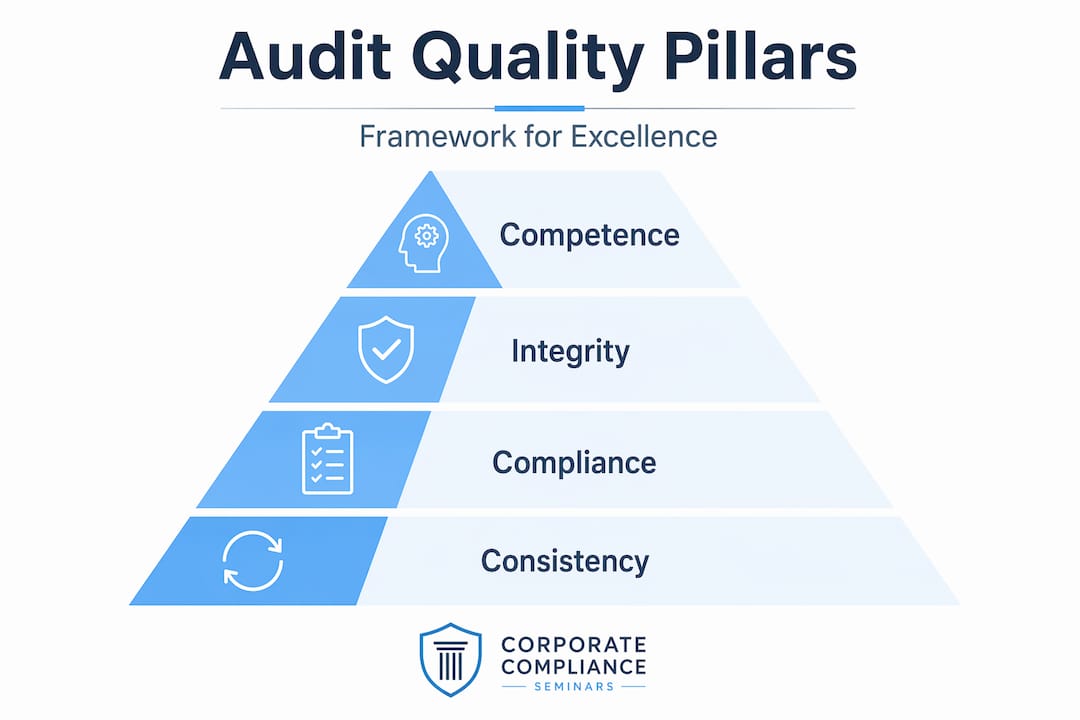
Benchmarking against deficiency rates without understanding the underlying causes is a common mistake. Context matters enormously. A 20% deficiency rate at one firm may reflect high-complexity engagements with inherently difficult judgment areas, while the same rate at another firm may reflect chronic supervision failures. Always read the data alongside the inspection narrative.
Practical application: Ensuring audit quality within organizations
Frameworks and benchmarks are only as good as the programs built to implement them. For chief audit executives and compliance teams, the real question is operational: what actually works?
Effective internal inspections improve reporting quality, but only if the program itself is effective. Weak or predictable inspection programs produce the opposite outcome, creating excessive documentation burdens without improving actual audit quality. This research finding from the PCAOB is one of the most practically important, and most frequently ignored, in the field.

Program characteristic | Effective outcome | Ineffective outcome |
Unpredictable timing | Prevents gaming; reflects real quality | Predictable timing allows preparation |
Clear remediation protocols | Drives genuine improvement | No follow-through; findings ignored |
Independent review teams | Objective findings | Conflicts bias the review |
Integrated training response | Closes competency gaps | Training disconnected from findings |
What does a well-designed internal quality assurance program actually include? Consider these critical elements:
Independence of reviewers: Review teams should not inspect their own engagements. Cross-office or third-party review adds objectivity.
Unpredictable selection: Rotate which engagements and which time periods are selected. Predictable patterns allow teams to game the process.
Root cause analysis: Every finding should trigger a structured root cause inquiry, not just a corrective action on the surface symptom.
Escalation protocols: Clear criteria for when findings escalate to leadership, the audit committee, or external regulators should be established in advance.
Feedback loops: Results from inspections should feed directly into training programs and supervision protocols, closing the loop between finding and improvement.
Pro Tip: Use an internal audit checklist as a living document that evolves with your findings. A checklist that has not changed in three years is almost certainly not reflecting your current risk environment.
Building a strong quality assurance program also requires honest leadership conversations about what acceptable quality actually looks like. If leadership treats inspections as administrative obligations rather than genuine learning opportunities, the culture will follow. Review the effective audit success guide for a structured approach to embedding quality into the engagement lifecycle rather than treating it as an end-of-cycle review.
The uncomfortable truth about audit quality: What most articles miss
Most discussions of audit quality focus on metrics: deficiency rates, restatement counts, inspection findings. These are useful, but they miss something important about how quality actually improves, or fails to improve, in practice.
Here is the finding that should make every audit leader uncomfortable. Research shows that in times of crisis, such as after major audit scandals, firms can improve audit quality through significant operational changes. But when nothing forces change, predictable internal inspection programs risk gaming and complacency. Engagement teams learn which engagements get selected, which documentation elements get reviewed, and which reviewers focus on what. The inspection becomes a test to pass, not a mechanism for learning.
This means that the single biggest threat to audit quality in organizations with mature quality programs is not ignorance or incompetence. It is familiarity. Routines that once drove improvement become habits that obscure risk.
The lack of a universal definition also creates a genuine challenge. Without shared language, firms and their clients often talk past each other on what “good” looks like. Regulators push for measurable outcomes, but measuring the wrong outcomes with precision is not progress. A multi-dimensional view, covering culture, competence, execution, and outcomes, is the only honest approach.
We believe the most underrated driver of audit quality is professional culture, specifically the degree to which engagement teams genuinely believe their work matters beyond the deliverable. When auditors see themselves as stewards of market integrity rather than service providers completing a scope, their professional skepticism deepens naturally. That cultural orientation is very hard to train in a classroom and very easy to lose if leadership signals that efficiency matters more than rigor.
Improving audit excellence requires addressing culture and competence together, not treating training as a substitute for accountability or accountability as a substitute for genuine capability development.
Next steps: Training and resources for audit quality excellence
Audit quality does not improve by accident. It improves when professionals invest in structured, practical learning tied directly to the standards and frameworks that govern their work.
If the deficiency rates, restatement data, and framework gaps covered in this article have highlighted areas for improvement in your organization, the next step is targeted education. Compliance Seminars offers CPE-eligible training programs specifically designed for audit professionals who need to translate regulatory expectations into daily practice. From auditor CPE webinars covering PCAOB standards and firm quality control to hands-on instruction in internal audit methodology, the curriculum is built around what practitioners actually face. Explore the CPE event calendar to find upcoming in-person events in cities across the U.S., or start with the internal auditing basics course to build a solid foundation for your team. Practical training closes the gap between knowing the standard and executing it well.
Frequently asked questions
What is audit quality and why is it so variable?
Audit quality means the reliability and accuracy of financial statement reporting, but no single definition is universally agreed upon because regulators, firms, and investors each weight compliance, efficiency, and reliability differently, creating built-in variation in how quality is evaluated.
How do deficiency rates affect perceptions of audit quality?
Deficiency rates are a direct signal of where audit work fell short of professional standards, and lower rates correlate strongly with firms like the Big Four that have invested most heavily in quality control infrastructure and supervision protocols.
Can internal inspection programs always improve audit quality?
Not automatically. Research confirms that effective inspections improve quality only when the program is robust and unpredictable; routine, transparent processes can actually produce worse outcomes by creating incentives to optimize for the review rather than for genuine quality.
What practical steps can professionals take to improve audit quality?
Adopt the PCAOB four-pillar framework as a structured evaluation tool, implement unpredictable internal inspection selection, and invest in training programs that build both technical competence and the professional skepticism culture that sustains quality over time.
Recommended
Comments