Build a compliance risk taxonomy for smarter oversight


TL;DR:
Compliance risk taxonomies are essential structured classification systems that enable consistent risk identification and management across financial organizations. They support firmwide aggregation, reduce overlaps, and serve as the foundation for effective assessment, remediation, and regulatory reporting. Building dynamic, stakeholder-driven taxonomies ensures adaptability, accuracy, and compliance program effectiveness over time.
Compliance risk taxonomies should be the backbone of every financial institution’s risk management program. Yet in practice, many organizations end up with overlapping categories, siloed frameworks, and labels that mean different things to different teams. The result is wasted effort, blind spots in coverage, and assessment results that leadership simply cannot rely on. This article decodes what a compliance risk taxonomy really is, what it must contain, and how to build and apply one that actually drives smarter oversight across your entire organization.
Table of Contents
Key Takeaways
Point | Details |
Define clear categories | A well-structured taxonomy with distinct, non-overlapping labels is essential for managing compliance risks. |
Map controls to risks | Link regulatory requirements to internal controls using your taxonomy to streamline risk assessment and remediation. |
Reconcile data and concepts | Align conceptual risk taxonomies with machine-readable reporting models for complete regulatory compliance. |
Benchmark for relevance | Leverage sub-domain standards (like AML indices) for benchmarking but avoid expecting a universal taxonomy fit. |
Engage all stakeholders | Build your taxonomy with business-wide input to ensure it supports aggregation across jurisdictions and entities. |
What is compliance risk taxonomy and why does it matter?
A compliance risk taxonomy is a structured, hierarchical classification system that defines and organizes every significant compliance risk your organization faces. Think of it as a shared language: if your AML team categorizes a risk one way and your data privacy team categorizes it another, you end up with apples-to-oranges comparisons when leadership tries to aggregate and prioritize. That fragmentation is exactly the problem a solid taxonomy solves.
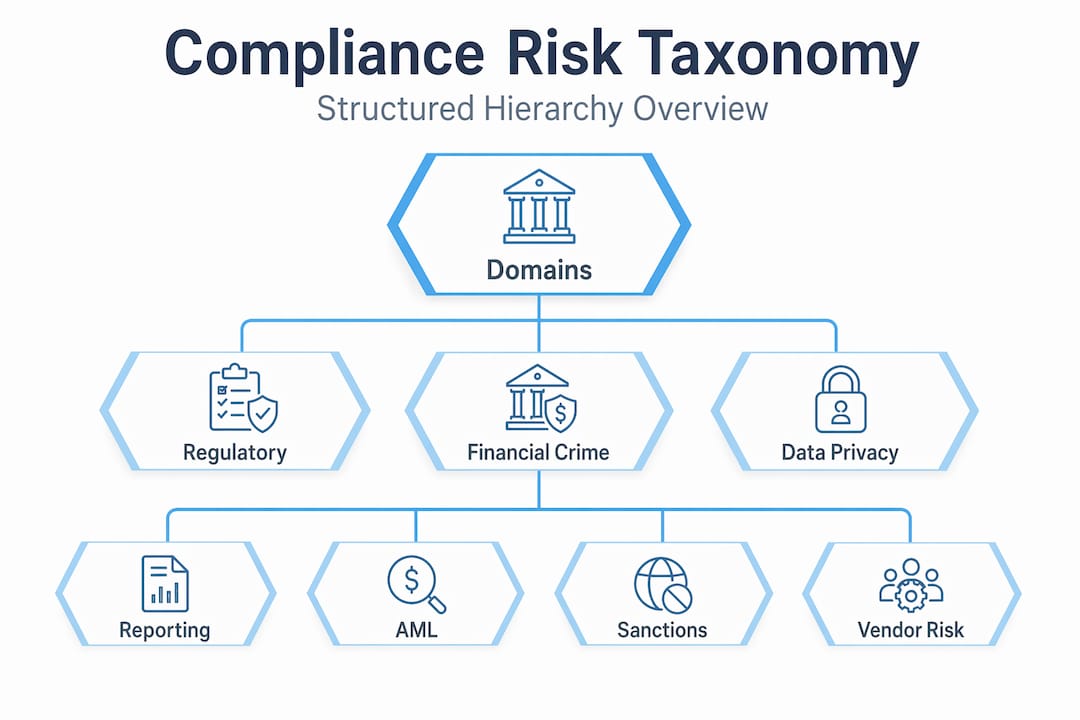
Compliance risk is commonly defined as potential legal, financial, or reputational consequences from failure to adhere to laws, regulations, or internal policies. In banking contexts, it covers risks such as AML and sanctions failures, privacy and data protection issues, inaccurate regulatory reporting, and third-party and vendor compliance issues. The taxonomy exists to sort all of these into a usable structure so that nothing gets missed and everything gets measured consistently.
The core components of an effective taxonomy include:
Risk categories and subcategories (the primary labels you assign to each risk type)
Attributes and flags (secondary descriptors that capture cross-cutting characteristics like jurisdiction or business line)
Regulatory mapping (explicit links from each category to the specific laws or rules driving the obligation)
Control mapping (identification of the controls designed to mitigate each risk category)
These components work together. Without regulatory mapping, your categories float free from their legal basis. Without control mapping, you can identify risks but cannot assess whether you’re actually doing anything about them.
“Large banking organizations are expected to implement firmwide compliance risk management programs with documented processes for identifying, assessing, controlling, measuring, monitoring, and reporting compliance risk.” Federal Reserve SR 08-8/CA 08-11
This regulatory expectation is not optional. It’s a baseline standard. And a well-designed taxonomy is the scaffolding on which that entire program hangs. Without it, applying consistent risk management best practices across a complex financial institution becomes nearly impossible.
The anatomy of an effective compliance risk taxonomy
Structure matters enormously here. A taxonomy that looks clean on a whiteboard can collapse in practice if the categories are not mutually exclusive or the hierarchy is only one level deep.
Taxonomy design should explicitly avoid category overlap and support a shared vocabulary across the firm. In practice, many frameworks target mutual exclusivity at the label level while still allowing additional attributes and flags to capture cross-cutting characteristics. This is the critical design insight: labels sort, attributes describe. A single compliance event can carry one label (its primary category) but multiple attributes (jurisdiction, product line, regulatory body). That combination gives you both clean aggregation and rich analytical detail.
A two-level structure tends to work well. Level 1 covers broad risk domains: regulatory compliance, financial crime, data protection, conduct risk, and so on. Level 2 adds granularity within each domain. For example, under financial crime you might find AML, sanctions screening failures, fraud facilitation, and bribery. This approach mirrors the framework used in operational risk, where the operational risk event taxonomy used in the EU follows the EBA’s two-level structure with additional attributes to capture risk characteristics independent of the top-level event type. The EBA’s design is a useful benchmark precisely because it has been stress-tested across dozens of large institutions.
Comparison: single-level vs. two-level taxonomy structure
Feature | Single-level taxonomy | Two-level taxonomy |
Aggregation quality | Low, broad categories only | High, rollups from granular to summary |
Category overlap risk | High | Lower with proper design |
Control mapping precision | Weak | Strong at level-2 categories |
Reporting flexibility | Limited | Supports multiple views |
Maintenance effort | Low initially, costly later | Moderate ongoing, sustainable |
Pro Tip: When you encounter a risk that seems to span two categories, resist the temptation to create a new hybrid category. Instead, assign the primary category that reflects the root cause of the risk, then use attributes to capture any secondary characteristics. Over time, consistent use of this approach will eliminate most of the overlap problems that plague siloed frameworks.
How compliance risk taxonomies power risk assessment and remediation
Once the taxonomy is built, it becomes the operating engine of your risk assessment cycle. The taxonomy tells you what to assess; the assessment process tells you how severe each risk is and what to do about it. These two things must stay tightly connected.
A practical compliance risk taxonomy usually maps regulatory obligations to controls and then scores and prioritizes compliance gaps using repeatable criteria, specifically likelihood and impact, to drive mitigation planning. That framework is simple in concept but requires discipline in execution. Here is a practical step-by-step approach:
Identify all applicable obligations within each taxonomy category, including laws, regulations, guidance, and internal policies.
Map each obligation to existing controls and document the control’s design adequacy and operating effectiveness.
Score the residual risk for each category using a consistent likelihood and impact scale (typically 1 to 5).
Prioritize gaps based on total risk score and the nature of the impact (financial penalty, regulatory action, reputational damage, or operational disruption).
Formulate action plans with clear owners, deadlines, and success criteria for each prioritized gap.
Monitor and report using the taxonomy categories as the consistent reporting structure so leadership sees risk data in a stable format period over period.
A structured scoring approach ensures that your risk assessment checklist is applied uniformly across all business units, not just where a particularly diligent compliance officer happens to be working.
Sample risk scoring matrix
Risk category | Likelihood (1-5) | Impact (1-5) | Residual risk score | Priority tier |
AML transaction monitoring | 3 | 5 | 15 | Critical |
Data subject access requests | 4 | 3 | 12 | High |
Vendor due diligence gaps | 3 | 4 | 12 | High |
Regulatory reporting accuracy | 2 | 5 | 10 | High |
Employee conduct disclosures | 2 | 3 | 6 | Medium |
Pro Tip: Tie your scoring criteria directly to your taxonomy categories during initial design. If you build the scoring rubric after the taxonomy is already in use, teams will interpret criteria differently and you will spend more time reconciling scores than managing actual risks.

When you take the time to evaluate compliance frameworks against your taxonomy structure, you often find that existing frameworks cover some categories well but leave others thin. That gap analysis is itself a valuable output of the taxonomy-driven assessment process.
Taxonomies in regulatory reporting: Beyond conceptual categories
Here is a distinction that trips up even experienced compliance professionals. The word “taxonomy” means two different things depending on context, and confusing them creates real problems.
In the conceptual sense, a compliance risk taxonomy is what we’ve been discussing: a human-readable classification structure that organizes risks for analysis, assessment, and management. But in banking supervision and regulatory reporting, taxonomies can also mean machine-readable data point models that standardize supervisory data definitions and validation rules, as opposed to purely conceptual risk categories.
The ECB’s supervisory reporting taxonomy, for example, defines specific data points, validation logic, and submission formats used by banks to file regulatory reports. This is a technical artifact, not a risk classification tool. Both types of taxonomy are necessary, but they serve entirely different purposes.
Comparison: conceptual vs. reporting taxonomy
Dimension | Conceptual taxonomy | Reporting taxonomy |
Primary user | Compliance officers, risk managers | IT, regulatory reporting teams |
Format | Human-readable categories and labels | Machine-readable (XBRL, data point models) |
Purpose | Risk identification, assessment, management | Supervisory data submission and validation |
Update driver | Regulatory change, business evolution | Supervisory authority data model updates |
Misalignment risk | Inconsistent risk categories across teams | Submission errors, validation failures |
The risk of misalignment between the two is real and underappreciated. If your conceptual risk categories don’t map cleanly to the data points your reporting taxonomy captures, you end up with a gap between how you think about risk and how you report on it to supervisors.
Closing that gap requires explicit mapping exercises, usually during taxonomy design or when either model is updated. Your risk assessment frameworks should account for both the conceptual and reporting dimensions, especially in heavily regulated sectors like banking, insurance, and capital markets.
Designing and benchmarking your compliance risk taxonomy
Design is where most organizations make their biggest mistakes. The taxonomy either grows too complex too fast, gets siloed within a single department, or fails to earn buy-in from the business lines that need to use it.
Here are the key steps to get the design right:
Define scope clearly before building categories. Decide which regulatory domains, jurisdictions, and business lines the taxonomy must cover from day one.
Pursue mutual exclusivity at the label level. Each risk event should have one primary label, not three possible ones.
Build in a structured review cycle. Regulations change, business models evolve, and taxonomies that aren’t updated become liabilities.
Bring in stakeholders early. Compliance, legal, internal audit, and the business lines all need to recognize their risks in the taxonomy. If they don’t, they won’t use it.
Avoid over-engineering. A taxonomy with 200 categories sounds thorough but is often unusable in practice. Start with Level 1 and Level 2 and add granularity only where it adds analytical value.
On benchmarking: empirical benchmarking is more visible in specific compliance sub-domains, such as jurisdiction-level money laundering risk indices, rather than in a single universal compliance risk taxonomy benchmark for all risk types. The Basel AML Index, for instance, provides a rigorous country-level benchmark for money laundering and terrorist financing risk. That kind of sub-domain benchmark is genuinely useful. A single universal taxonomy benchmark that covers conduct, data, AML, reporting, and environmental compliance all at once simply does not exist in a form that allows clean cross-firm comparison.
Pro Tip: When benchmarking your AML or sanctions taxonomy categories, use established frameworks like the FATF recommendations as the regulatory spine. For privacy compliance strategies and data protection categories, align your taxonomy labels to GDPR, CCPA, or other applicable data protection regimes so that your categories are directly traceable to the rules driving them.
Keeping pace with compliance trends is also part of good taxonomy design. As new regulatory requirements emerge, your taxonomy needs a mechanism to absorb them without requiring a full rebuild every 18 months.
Why most compliance risk taxonomies fail—and the practical fix
Having worked closely with compliance programs across multiple jurisdictions and organizational types, the failure pattern is remarkably consistent. Organizations build a taxonomy that looks good in a presentation, then watch it quietly become irrelevant within two years.
The most common failure is siloing. Each department builds its own risk categories, calls them something slightly different, and uses them for internal purposes only. When leadership asks for a firmwide view of, say, third-party compliance risk, three different teams produce three different numbers that can’t be reconciled. That is not a taxonomy problem. It is a governance problem that the taxonomy was supposed to prevent.
Compliance risk can transcend business lines, legal entities, and jurisdictions, so a taxonomy must support firmwide aggregation and rollups rather than siloed business-line-only categories. That requirement, explicit in Federal Reserve guidance, demands that the taxonomy be designed for aggregation from the start, not retrofitted for it later.
The second most common failure is treating the taxonomy as a static document rather than a living system. Regulations change. New products create new risk exposures. Enforcement trends shift. A taxonomy that accurately reflected your risk universe in 2023 may have significant blind spots by 2026 if no one has been maintaining it.
The practical fix is a three-part bridge: connect business operations, compliance function, and IT infrastructure into a shared ownership model for the taxonomy. Business lines own the accuracy of risk identification within their domain. Compliance owns the category structure and maintains mapping to regulations. IT owns the technical integration that ensures taxonomy categories flow into your GRC platform, reporting systems, and data governance structures. When all three are engaged, the taxonomy stays current, stays used, and stays valuable. Explore how firmwide compliance aggregation works in practice to understand what this looks like at scale.
Strengthen your compliance risk management with expert-led training
A well-designed compliance risk taxonomy is only as effective as the team using it. Staying current on evolving regulatory expectations, assessment methodologies, and taxonomy design principles requires structured, ongoing professional development.
Compliance-seminars.com offers CPE-accredited training specifically designed for compliance officers, risk managers, and internal auditors navigating complex regulatory environments. Whether you need to sharpen your skills in risk assessment frameworks, financial crime compliance, or regulatory reporting, the 2026 CPE event calendar features live in-person sessions across multiple U.S. cities and targeted internal auditor CPE webinars that fit your schedule. For teams managing cybersecurity-related compliance risks, explore the cybersecurity CPE events offered by industry experts with Big 4 backgrounds. Invest in the knowledge that keeps your taxonomy, and your entire compliance program, performing at its best.
Frequently asked questions
What is a compliance risk taxonomy?
A compliance risk taxonomy is a structured classification tool that categorizes and defines compliance risks, enabling effective assessment, monitoring, and management across an organization.
What are common categories in a financial compliance risk taxonomy?
Banking compliance risk categories commonly include AML, data privacy, regulatory reporting accuracy, and vendor and third-party compliance risks.
How do you ensure a compliance risk taxonomy covers all business areas?
Design the taxonomy with input from all stakeholders and ensure categories support aggregation across business lines, legal entities, and jurisdictions, as compliance risk can transcend any single organizational boundary.
Can compliance taxonomies be benchmarked across the industry?
Empirical benchmarking is more visible in specific sub-domains like AML rather than for all compliance risk types universally, so focus sub-domain comparisons where established indices exist.
What is the difference between a conceptual compliance taxonomy and a reporting taxonomy?
A conceptual taxonomy sorts risks for human analysis and management; a reporting taxonomy structures data points for regulatory submissions, validation rules, and supervisory oversight purposes.
Recommended
Comments