How to prepare for a regulatory audit: proven steps


TL;DR:
Effective regulatory audit readiness requires ongoing discipline, organized documentation, and clear ownership of records. Understanding current expectations, mapping controls, and conducting risk-based self-assessments help organizations address high-risk areas proactively. Continuous preparation fosters trust across teams and reduces the stress and errors associated with last-minute compliance efforts.
Walking into a regulatory audit without adequate preparation is a bit like handing an inspector a pile of unorganized receipts and hoping for the best. We’ve seen it happen: a team scrambles for weeks before an audit, discovers that their standard operating procedures haven’t been updated in two years, and realizes their training records are stored across three different systems. The result is citations that were entirely preventable. Inspection readiness guidance makes the point plainly: effective regulatory audit readiness is an ongoing discipline, not a last-minute blitz. This article walks through the proven steps compliance and audit professionals need to prepare with confidence.
Table of Contents
Key Takeaways
Point | Details |
Start readiness early | Continuous audit preparation avoids the stress and risk of last-minute scrambles. |
Map controls to regulations | Systematically link each regulatory requirement to documented internal controls and clear ownership for stronger evidence. |
Prioritize by risk | Self-assessments should focus on high-citation areas like procedures and quality control. |
Avoid common pitfalls | Update documents, maintain traceability, and test your controls routinely to prevent audit failures. |
Invest in ongoing learning | Professional training supports sustainable compliance and audit performance year-round. |
Understand what regulators expect in 2026
Now that the challenge of audit preparation is clear, it’s critical to understand exactly what regulators will expect this year and beyond. Regulatory standards are not static, and treating them as if they are is one of the fastest paths to a citation.
The most significant recent shift for device and life sciences compliance professionals is the FDA’s formal transition away from the Quality System Inspection Technique (QSIT). FDA withdrew QSIT on February 2, 2026, implementing a new risk-based inspection process in its place. Inspections are now scheduled based on risk factors specific to your organization, not on the calendar or on whether you hold an ISO certification. This is a meaningful change, and why audit matters in regulated industries is exactly why staying current on these shifts is non-negotiable.
One of the most persistent misconceptions in the field is the belief that ISO 13485 certification satisfies FDA regulatory requirements. It does not. As the FDA QMSR FAQ states directly, ISO conformance may not meet FDA requirements. Regulators assess compliance to their specific standards, regardless of what third-party certifications you hold. That distinction matters enormously when you’re planning your audit preparation strategy.
The broader industry shift is also moving toward continuous audit management rather than annual documentation reviews. Here’s a quick comparison of regulatory frameworks compliance professionals commonly work within:
Framework | Scope | Audit basis | Key focus area |
FDA QMSR (2026) | Medical devices (U.S.) | Risk-based, scheduled by risk | Compliance to FDA-specific regulations |
ISO 13485 | Medical devices (global) | Certification-based | Quality management systems |
ISO 19011 | General management auditing | Audit program methodology | Audit planning and execution principles |
SOX / COSO | Financial reporting (U.S.) | Annual, risk-focused | Internal controls over financial reporting |
“Regulators are not looking for paperwork. They are looking for evidence that your processes are actually functioning as documented, controlled, and understood by the people running them.”
Understanding which framework applies to your audit and what that framework specifically requires is step one. Everything else in your preparation flows from this baseline.
Build audit readiness foundations: Documentation, records, and ownership
With regulatory expectations set, the next step is building robust foundations by organizing your documentation and assigning clear accountability. This is where many audit preparations fall apart before they even begin.

There is an important distinction that every compliance professional should internalize: documents capture process intent (your SOPs, policies, and procedures), while records provide proof of execution (completed forms, training logs, deviation reports). Both must be current, retrievable, and accurate. Complete, retrievable records and personnel who can explain the quality management system as it is actually run are foundational inspection readiness requirements.
Here’s a practical comparison of what auditors examine and what ownership looks like:
Evidence type | Examples | Common ownership | Audit risk if missing |
Documents (intent) | SOPs, work instructions, policies | Quality/Compliance team | Process intent unclear |
Records (execution) | Training logs, CAPA records, deviation reports | Operations, QA | No proof of compliance |
Audit trails | System logs, change history | IT, QA | Integrity questions raised |
Traceability links | Risk files, design history files | Engineering, Regulatory | Gaps in evidence chain |
Among the common pitfalls in audit failure are obsolete documents still circulating in the workspace, incomplete records with missing signatures or dates, multiple versions of the same SOP causing confusion, and broken traceability between requirements and evidence. These are not complex problems, but they are persistent ones.
Best practices for avoiding them include:
Establish a version control system with documented approval workflows before an audit cycle begins
Assign a named owner to every document and record category, not a department but a specific person
Conduct quarterly document reviews to retire or update anything that no longer reflects current practice
Use internal controls documentation frameworks to ensure your evidence trail supports each regulatory requirement
When organizing evidence for an inspector, think of it as telling a story. The inspector should be able to follow a thread from a regulatory requirement, to your control, to the record that proves the control works. That narrative structure makes inspections faster and smoother for everyone. For additional insight, the guidance on connecting evidence to findings from experienced regulatory practitioners is worth reviewing. Solid audit evidence explained resources can further sharpen how your team approaches this.
Pro Tip: Before any audit, have someone outside your direct team attempt to locate and explain three key records from scratch. If they struggle, your evidence organization needs work.
Map regulations to your controls: Practical workflow
Once you’ve addressed foundational evidence and ownership, map regulations to operational controls for a tailored, audit-ready preparation. This is the step that transforms a generic checklist into a preparation process that actually reflects how your organization operates.
A strong audit preparation begins with systematically mapping each regulation or regulatory expectation to an internal control, then to an owner, and then to specific evidence sources. Here is a stepwise workflow to follow:
List each applicable regulation or requirement. Pull from your regulatory framework, inspection guidelines, or prior audit findings. Be specific: cite the clause or section number, not just the regulation title.
Identify the internal control that addresses each requirement. For example, a KYC (Know Your Customer) requirement maps to your customer onboarding verification control. A training requirement maps to your LMS records and competency assessment process.
Assign a control owner. This is the person accountable for maintaining the control and producing evidence on request. Not a team. One person.
Link each control to its evidence source. Where does the proof live? Which system, folder, or record set? Document this in a regulation-to-control matrix.
Prepare a targeted document and evidence pack. Gather the actual evidence that would be produced during an audit, review it for completeness, and note any gaps.
Build a remediation tracker. Any gaps identified in step five become action items with owners and due dates, reviewed weekly as the audit approaches.
The compliance audit best practices framework reinforces this structured approach, and regulatory compliance examples for auditors can help you see how these mappings work across different industries.
Pro Tip: Before the audit, conduct a walkthrough of two or three controls with the assigned owners. Ask them to produce the evidence in real time, as if an inspector just asked for it. This dry run reveals gaps that no spreadsheet review will catch.
Conduct risk-based self-assessments and prioritize audit focus
Mapped controls in place, focus your efforts on the highest-risk gaps and issues shown to trigger most citations. Not all controls carry equal risk, and your preparation resources are finite.
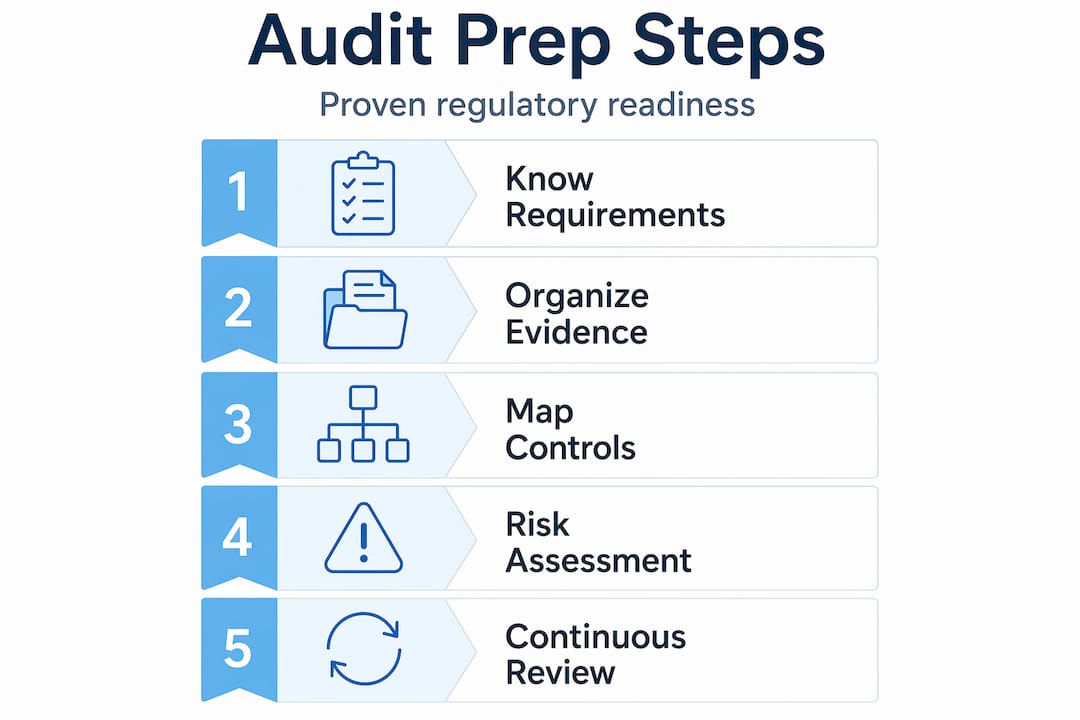
Risk-based self-assessment aligns to ISO 19011, which outlines a structured audit program methodology: plan the audit program, initiate the audit, prepare for the audit, conduct it, report findings, and complete follow-up actions. The same logic applies to internal self-assessments. You are, in effect, auditing yourself before the regulator does.
Here are the areas that consistently warrant the deepest scrutiny during self-assessment:
Written procedures: Are they current, approved, and actually followed? Procedural non-compliance is the most common finding.
CAPA (Corrective and Preventive Action) systems: Is every CAPA documented, tracked to closure, and effective? Incomplete CAPAs are a recurring citation.
Training records: Are all personnel trained on current procedures, with documented and dated evidence?
Quality control testing records: Is every test documented with results, reviewer signatures, and deviation notes where applicable?
Change control documentation: Are changes to processes, equipment, or systems properly documented and approved?
Supplier qualification records: Are your critical suppliers qualified and periodically re-evaluated?
The data reinforces why this focus matters: 82% of FDA citations are clustered in procedure-related failures, quality control deficiencies, and CAPA breakdowns. Directing the bulk of your self-assessment time toward these areas is not just prudent, it’s statistically defensible.
Finding category | Frequency among FDA citations | Priority level |
Procedure / SOP issues | Very high | Critical |
CAPA deficiencies | High | Critical |
Quality control records | High | Critical |
Training documentation | Moderate | High |
Change control gaps | Moderate | High |
Supplier qualification | Lower | Medium |
Risk-based sampling means you allocate more testing cycles and deeper reviews to high-frequency finding categories. For a structured approach to building this into your annual program, the risk assessment steps and audit planning best practices resources provide practical frameworks designed for audit professionals.
Common pitfalls and how to avoid them
The final preparatory step is learning from common industry missteps to ensure your process remains resilient and responsive. The good news: most audit failures are predictable and preventable.
Audit failures often result from evidence issues: outdated or incomplete documents, weak traceability, multiple conflicting versions of the same document, or training that was completed but never recorded. These patterns appear repeatedly across industries and regulatory environments.
The most frequent pitfalls to watch for include:
Incomplete or missing records: Evidence that something happened but the record was never completed or filed
Multiple document versions in circulation: Staff working from an outdated SOP while the approved version sits in a controlled system no one checks
Broken audit trails: System changes or process updates that weren’t captured in logs or change records
Process-to-SOP misalignment: The actual process has evolved, but the SOP was never updated to match
Weak training documentation: Training was delivered verbally or informally, with no record of who attended, when, and on which version of the procedure
Missing leadership involvement: Compliance preparation treated as a quality department task rather than an organizational priority
Continuous audit management is increasingly recognized as the smarter model, shifting from periodic evidence scrambling to real-time decision support.
“Organizations that maintain audit readiness year-round spend significantly less time preparing for any individual audit, and they make far fewer errors under the pressure of an approaching inspection date.”
Periodic self-checks, scheduled quarterly rather than annually, catch these issues before they accumulate. Leadership involvement is not optional: when executives treat audit readiness as a strategic priority, teams allocate resources appropriately, and the culture shifts from reactive to proactive. The effective audit planning guidance we regularly reference reinforces this point with practical workflows.
Our take: Why ‘continuous audit readiness’ beats last-minute prep
Having reviewed proven methods and pitfalls, here’s our practical perspective on long-term audit readiness: the organizations that perform best in regulatory audits are not the ones that prepare hardest in the final 30 days. They are the ones that never fully stop preparing.
We have seen teams invest three months of intense effort into audit preparation, only to produce the same results they would have achieved with a well-maintained, year-round readiness program that required a fraction of the effort. The math is not complicated. When documentation is current and records are organized as part of daily operations, the workload before any specific audit becomes manageable. When it isn’t, the workload becomes a crisis.
There is also a less obvious benefit: continuous readiness builds cross-team trust. When audit preparation is an ongoing team habit rather than a quarterly emergency, operations teams, quality teams, and leadership tend to communicate more openly about real process gaps. That communication surfaces actual risks earlier, which is the entire point of compliance management.
The real-world cost of waiting until 90 or 30 days before an audit is not just the sprint itself. It’s the errors introduced under deadline pressure, the gaps that get papered over rather than genuinely fixed, and the organizational fatigue that makes the next audit preparation just as painful. Embedding continuous readiness into team culture starts with leadership framing it as a business priority, not a compliance chore.
Investing in structured CPE training for audit success supports this cultural shift by giving your audit and compliance professionals the frameworks and updated knowledge they need to sustain readiness as a practice rather than a periodic event.
Advance your audit readiness with expert training
For those seeking to transform these proven methods into daily practice, targeted skill development and CPE training can elevate your program significantly.
At Compliance Seminars, we offer practical, standards-based training designed specifically for internal auditors, compliance officers, and risk professionals who need more than theory. Our 2026 in-person CPE events cover audit planning, documentation controls, risk-based assessment, and regulatory compliance frameworks across multiple U.S. cities. For professionals with a strong focus on systems and controls, our IT auditing CPE events address cybersecurity frameworks, CISA-relevant content, and technology risk. All programs are NASBA-recognized and delivered by instructors with hands-on regulatory and Big 4 experience. If continuous audit readiness is the goal, ongoing education is the mechanism that makes it sustainable.
Frequently asked questions
What is the difference between an internal audit and a regulatory audit?
An internal audit is conducted by the organization itself for self-assessment and continuous improvement purposes, while a regulatory audit is performed by an external authority to verify compliance with specific laws, regulations, or standards. The stakes and consequences of each differ significantly, with regulatory audits carrying potential enforcement actions.
Can ISO certification replace FDA regulatory audit requirements?
No. ISO conformance may not meet FDA requirements directly, and holding ISO 13485 certification does not exempt your organization from demonstrating compliance with FDA-specific regulations during an inspection.
When should audit readiness activities start before a regulatory audit?
Readiness should be a continuous, year-round process, but if you’re working toward a specific scheduled audit, a 90-day preparation timeline is a recognized minimum for structured targeted activities such as gap assessments, evidence reviews, and remediation tracking.
What areas do most regulatory audit failures involve?
Most failures cluster in procedure-related issues, quality control documentation gaps, and CAPA deficiencies. 82% of FDA citations fall into these three categories, making them the highest-priority focus for any risk-based self-assessment.
How can I keep audit evidence organized for regulatory inspection?
Link each regulatory requirement to its corresponding internal control, assign a named control owner, and maintain version-controlled documentation in a retrievable system. Documentation completeness and continuous self-assessment are the pillars of evidence organization that inspectors consistently look for.
Recommended
Comments