What Is Compliance Culture? Guide for Stronger Governance


TL;DR:
Compliance culture involves shared values and behaviors that prioritize adherence to laws and ethics.
Building a strong culture requires visible leadership, trust, ongoing education, and integration into daily operations.
Culture breakdowns occur due to toxic leadership, policy gaps, unaddressed subcultures, and inconsistent enforcement.
Ticking compliance checklists gives organizations a false sense of security. The real risk is not failing an audit; it is operating in an environment where employees do not understand why the rules exist, leadership does not model ethical behavior, and policies collect dust in a shared drive. Compliance culture is the invisible architecture holding governance together. This article breaks down what compliance culture actually means, what separates it from a compliance program, what causes it to unravel, and what compliance officers and risk managers can do right now to build something that genuinely holds up under pressure.
Table of Contents
Key Takeaways
Point | Details |
Embed compliance deeply | A compliance culture goes beyond policies—embed values and ethical behaviors in daily work. |
Address common failures | Toxic leadership, unrealistic expectations, and policy gaps undermine compliance efforts. |
Build lasting frameworks | Success depends on strong building blocks like training, risk mapping, and clear leadership. |
Take practical action | Leaders should act as role models, reinforce training, and constantly assess compliance attitudes. |
Defining compliance culture: Beyond rules and policies
Most organizations have a compliance program. Far fewer have a genuine compliance culture. Understanding the difference is the starting point for any serious governance improvement effort.
A compliance program is a set of documented policies, procedures, and controls. It tells employees what to do. A compliance culture, by contrast, shapes how employees actually think and make decisions when no one is watching. One is structural; the other is behavioral.
“Compliance culture is the shared values, attitudes, beliefs, and behaviors within an organization that prioritize adherence to laws, regulations, ethical standards, and internal policies, embedded into daily operations and decision-making.”
That definition is worth reading twice. Notice the phrase “embedded into daily operations.” It is not referencing the annual ethics sign-off or the quarterly compliance report. It is describing something alive and consistent, something that influences every meeting, every vendor negotiation, and every reporting decision.
So what does a strong compliance culture actually look like in practice? Several characteristics tend to appear consistently across high-functioning compliance environments:
Visible leadership commitment: Senior executives and board members actively model compliant behavior, not just endorse policies in memos.
Employee buy-in at every level: Staff understand why compliance matters to the business and to them personally, not just what the rules say.
Psychological safety: People feel comfortable raising concerns without fear of retaliation or being ignored.
Consistent ethical behavior: Decisions align with stated values even when no regulator is watching.
Transparent accountability: When something goes wrong, the organization investigates honestly and responds with appropriate consequences.
Ongoing education: Compliance is treated as a living skill, not a one-time orientation item.
The contrast with a box-checking mentality is stark. When compliance is reduced to documentation and audits, organizations expose themselves to what you might call “compliance theater.” The policies exist. The training records show completion. But the underlying behavior that regulations are designed to shape has not changed.
A well-structured compliance training overview makes clear that training effectiveness depends heavily on cultural readiness. Without a culture that reinforces learning, even the best training content dissipates quickly.
For compliance officers, the practical takeaway here is to diagnose your organization honestly. Ask whether your employees could explain the purpose of your compliance framework in plain language. Ask whether managers bring up ethical risk in routine conversations. If the answer to those questions is no, you have a compliance program. You do not yet have a compliance culture.
Building blocks of a successful compliance culture
Once you understand what compliance culture is, the next question is how you actually build it. There is no single lever. Strong compliance cultures emerge from several reinforcing elements working together over time.
Research across compliance methodologies identifies eight to ten building blocks that consistently appear in high-functioning compliance environments, including risk mapping, codes of conduct, whistleblower systems, training programs, disciplinary mechanisms, and executive leadership. Here is how those elements interact in practice:
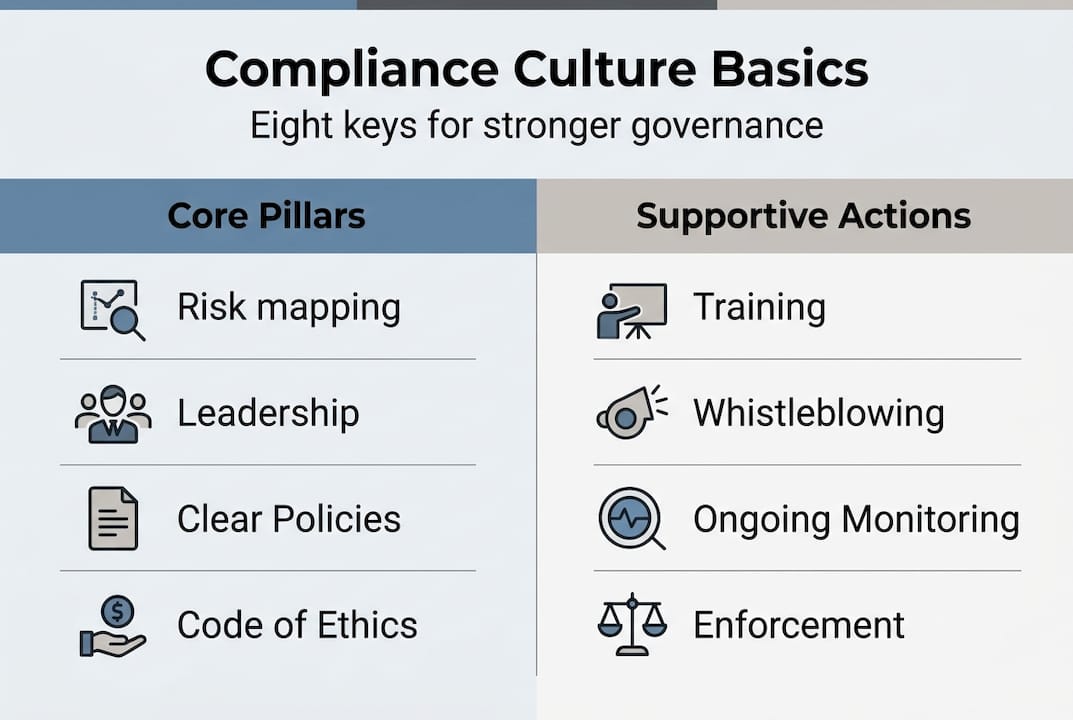
Building Block | What it does | Why it matters |
Risk mapping | Identifies where compliance exposure is highest | Prioritizes resource allocation |
Code of conduct | Sets clear behavioral expectations | Creates a shared ethical standard |
Whistleblower systems | Provides safe channels for reporting | Catches problems before they escalate |
Training programs | Builds knowledge and judgment | Turns policy into practice |
Disciplinary mechanisms | Enforces consequences consistently | Signals that rules are real |
Executive leadership | Models behavior from the top | Sets the cultural temperature |
Internal audits | Validates controls and identifies gaps | Creates accountability loops |
Communication strategy | Keeps compliance visible and relevant | Prevents cultural drift |
Each of these elements supports the others. Whistleblower systems fail if employees do not trust leadership. Training programs fall flat if disciplinary follow-through is inconsistent. Executive leadership loses credibility if policies are not enforced fairly. You need the whole system.
Essentials every compliance officer should implement, in priority order:
Conduct a formal risk assessment framework review at least annually to keep your compliance map current with business changes.
Establish an anonymous reporting channel that employees genuinely trust, with visible follow-up on reported issues.
Embed ethics discussions into performance reviews, not just compliance training completions.
Train managers specifically on how to model and reinforce ethical behavior in everyday conversations.
Use real cases, including internal near-misses, to make training concrete and relevant.
Follow through on compliance officer tips around measuring program effectiveness, not just activity.
Design ethics training strategies that address actual dilemmas employees face rather than hypothetical scenarios.
One common gap that deserves attention involves operational audit alignment. Many operational audit gaps surface specifically because front-line managers were never included in the compliance design process. Compliance culture cannot be imposed from the top alone. It must be co-owned by operations.

Pro Tip: Integrate compliance discussions into routine business meetings, not just dedicated compliance sessions. When a sales team reviews pipeline, ask about contract terms and third-party risk. When operations reviews process changes, include a brief compliance impact question. Normalizing the conversation is more powerful than any standalone training event.
Common pitfalls: Why compliance cultures fail
Even organizations with strong intentions and robust compliance programs can find their culture eroding. The warning signs are often subtle at first, and by the time they become visible, significant damage has already occurred.
Research on compliance breakdowns in complex organizations shows that failure often stems from subcultures, policy-practice gaps, complex reporting structures, toxic leadership, unrealistic performance targets, and ambiguous rules, all of which erode culture and traumatize employees into silence after incidents.
Here is what that looks like in a comparison:
Symptom | Weak compliance culture | Strong compliance culture |
Leadership behavior | Rules for others, not for leaders | Leaders visibly follow and explain rules |
Policy clarity | Vague or contradictory guidance | Clear, plain-language policies with examples |
Reporting culture | Silence and fear of retaliation | Open channels with trusted follow-through |
Training approach | Annual checkbox completion | Ongoing, scenario-based, role-specific |
Incident response | Blame and cover-up | Investigation, transparency, and correction |
Employee trust | Skepticism toward compliance function | Genuine belief in organizational fairness |
The subculture problem deserves special attention. In large organizations, divisions, regions, or even individual teams can develop their own unwritten rules that contradict the official compliance framework. A sales team that is rewarded exclusively for hitting targets regardless of how may develop a subculture that normalizes aggressive practices. If leadership does not actively address that dynamic, the compliance program becomes background noise.
Post-scandal silence is one of the least-discussed costs of weak compliance culture. When employees witness leadership respond to an incident with denial or blame, the instinct to speak up disappears. Trust does not recover quickly.
Steps to identify and address emerging compliance culture gaps:
Conduct anonymous employee surveys specifically focused on reporting willingness, leadership integrity, and policy clarity. Aggregate trends reveal culture, not just individual opinions.
Review reporting data patterns: A sudden drop in whistleblower reports often signals fear, not improvement. Silence is not evidence of compliance.
Assess manager behavior, not just policy documents. Interview employees at multiple levels about how their direct supervisors handle ethical gray areas.
Map your subcultures: Identify business units with distinct performance pressures or leadership styles and audit whether their practices align with stated values.
Check your disciplinary consistency: If enforcement varies by seniority or relationship, your compliance culture is effectively tiered, and employees will notice.
Managing executive risk in compliance means confronting the uncomfortable truth that leadership can be the single largest compliance risk factor in an organization. A technically sound program cannot compensate for a leader who signals, even indirectly, that results matter more than methods.
Action steps: How to strengthen compliance culture
Understanding what goes wrong is useful. Knowing what to do about it is essential. Here are practical actions compliance officers and risk managers can take to build or restore a genuine compliance culture.
Practical actions organized by time horizon:
Immediate wins (within 30 days):
Review your anonymous reporting system and assess whether employees actually use it or trust it.
Run a brief pulse survey asking employees how comfortable they feel raising concerns with their manager.
Identify three to five recent decisions where ethical considerations were not part of the discussion and determine why.
Confirm that compliance culture is embedded in onboarding for new hires, not treated as optional background reading.
Medium-term shifts (30 to 90 days):
Redesign at least one compliance training module to use scenarios that reflect actual dilemmas employees face in your industry.
Partner with HR to integrate compliance metrics into manager performance evaluations.
Schedule a compliance culture session with the board or audit committee and present honest data, not just program completion rates.
Conduct targeted interviews with front-line employees in high-risk business units to surface subculture dynamics.
Long-term culture shifts (90 days and beyond):
Build a compliance ambassador network within business units, so compliance has credible champions at the operational level.
Create a formal mechanism for employees to submit feedback on compliance policies, showing that the function is responsive, not just regulatory.
Develop a multi-year compliance culture maturity roadmap with measurable indicators and executive accountability.
To understand why attending compliance seminars matters in this context, consider that culture-building requires continuous learning. A compliance officer who updates their skills annually is better positioned to identify emerging risks, introduce new methodologies, and influence leadership conversations with current, credible insight.
Pro Tip: Model the desired behavior at every level, not just at the policy enforcement level. When a compliance officer speaks up in a senior meeting to flag a concern, it signals to the entire organization that raising issues is not only acceptable but expected. That visible act of professional courage is worth more than any policy document.
Our take: Why compliance isn’t just an audit function
We hear it often in training environments: “Compliance is something the compliance team handles.” It is one of the most limiting beliefs in organizational governance, and it consistently produces fragile programs that collapse under real-world pressure.
Reducing compliance culture to an audit function misses where most ethical failures actually originate. They do not start in the audit findings report. They start in a team meeting where someone with authority signals that a shortcut is acceptable. They start in a performance review where results are rewarded and methods are ignored. They start in a policy that is technically in place but never enforced consistently.
The role of risk assessment in culture-building is telling here. A robust risk assessment is not just a control document; it is a conversation starter. When done well, it forces leadership to name and own the exposures that live in their decisions. That ownership is the beginning of culture change.
Our honest view is that compliance culture is primarily a leadership accountability issue, not a documentation challenge. We have seen organizations with comprehensive policy libraries and weak cultures, and we have seen lean programs supported by leaders who genuinely live the values and create strong ones. The differentiator is always behavioral.
Ask yourself honestly: Is your leadership modeling the standards it expects from staff? Are the behaviors rewarded in your organization aligned with what your compliance framework says is acceptable? If there is a gap between those two realities, you have found your highest priority.
Lasting compliance culture is not built in annual reviews. It is built in the ten thousand small decisions that leadership makes visible every day.
Advance your compliance expertise
Strengthening compliance culture requires more than internal effort. It requires staying current with regulatory trends, emerging frameworks, and practical implementation strategies that only experienced instructors and real-world case studies can provide.
At Compliance Seminars, our CPE programs are designed for exactly the professionals navigating these challenges. Whether you prefer structured learning through our 2026 CPE event calendar or need flexible access through our internal auditor CPE webinars, we offer NASBA-recognized training that connects governance theory to practical application. Our instructors bring Big 4 experience and real organizational context to every session. Explore why compliance officers choose us as their trusted continuing education partner.
Frequently asked questions
What are the core elements of a good compliance culture?
Key elements include clear codes of conduct, proactive leadership, robust risk assessments and whistleblower systems, and open channels for reporting concerns without fear of retaliation.
How does compliance culture differ from compliance programs?
A compliance culture shapes daily attitudes and decision-making at every level, while a program is a formalized set of policies and procedures. As one definition captures it, culture is embedded into operations, not just documented in a manual.
What causes compliance cultures to break down?
Factors include toxic leadership, lack of policy clarity, and inconsistency between stated values and actual practice. Research shows that post-scandal silence and ambiguous rules are particularly damaging to employee trust over time.
How can organizations measure their compliance culture?
Regular internal surveys, anonymous reporting trend analysis, and periodic third-party audits help assess how deeply compliance values are embedded across the organization. Culture metrics should be reported to the board alongside program completion data.
Recommended
Comments