What is CMMC compliance? A 2026 guide for audit pros

Updated: Mar 31

Government contractors often assume CMMC compliance is a one-size-fits-all requirement, only to discover three distinct levels with varying certification demands. Many compliance professionals struggle to determine which level applies to their organization and how requirements cascade through supply chains. This guide clarifies the three CMMC levels, explains certification pathways for each tier, and provides actionable steps for auditors and risk managers to implement appropriate controls. You will learn how to assess your compliance obligations, manage supply chain requirements, and maintain cybersecurity posture in 2026.
Table of Contents
Key takeaways
Point | Details |
Three distinct levels | CMMC requires Level 1 self-assessment for basic safeguards, Level 2 for CUI protection, and Level 3 for advanced threat defense |
Supply chain obligations | Compliance requirements flow down to subcontractors based on data type, with minimum Level 1 for FCI and Level 2 for CUI |
Certification varies by level | Level 1 allows self-assessment, Level 2 permits self or third-party certification, and Level 3 mandates government assessment |
Ongoing maintenance required | Organizations must sustain compliance through regular evaluations, employee training, and alignment with evolving cybersecurity frameworks |
Understanding CMMC compliance levels and requirements
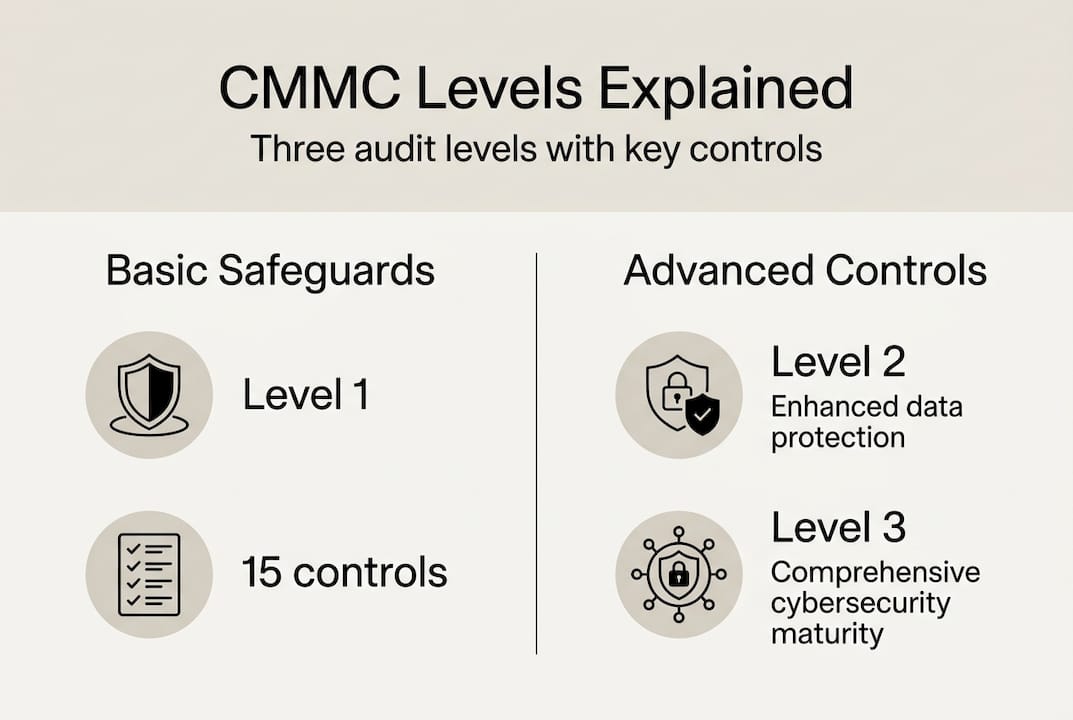
The Cybersecurity Maturity Model Certification framework establishes three progressive levels of cybersecurity protection for defense contractors. Each level corresponds to specific data types and threat scenarios, requiring different certification approaches and control implementations.
Level 1 requires self-assessment against 15 basic safeguards from FAR 52.204-21 for Federal Contract Information. Organizations handling only FCI, such as general contract information without technical specifications, demonstrate compliance through annual attestation. This tier focuses on fundamental cybersecurity hygiene like access control, media protection, and physical security.
Level 2 addresses Controlled Unclassified Information through NIST SP 800-171 requirements. Contractors can choose self-assessment or certification by a CMMC Third Party Assessment Organization (C3PAO). The 110 security controls span 14 domains including incident response, system integrity, and security assessment. Most defense contractors handling technical data or operational information fall into this category.
Level 3 involves certification by the Defense Industrial Base Cybersecurity Assessment Center for organizations supporting critical national security programs. This tier incorporates selected NIST SP 800-172 enhanced controls addressing advanced persistent threats. Requirements include threat hunting, insider threat programs, and enhanced supply chain risk management.
The table below compares key characteristics across all three levels:
Level | Certification Method | Primary Standards | Control Count | Data Type |
1 | Self-assessment | FAR 52.204-21 | 15 practices | FCI only |
2 | Self or C3PAO | NIST SP 800-171 | 110 controls | CUI |
3 | DIBCAC | NIST SP 800-171/172 | 110+ enhanced | Critical CUI |
Pro Tip: Map your contract data flows before selecting a compliance level to avoid implementing unnecessary controls or missing required protections.
How CMMC compliance requirements flow through the supply chain
Prime contractors bear responsibility for ensuring subcontractors meet appropriate CMMC levels based on data access and handling. The supply chain requirements mandate minimum compliance thresholds that flow down through multiple tiers.

Subcontractors receiving or generating FCI must achieve Level 1 through self-assessment. This applies even when subs perform administrative or support functions without direct CUI access. The prime contractor verifies compliance through attestation review and may conduct spot checks of security practices.
When subcontractors handle CUI, they must meet at least Level 2 requirements. Primes determine whether self-assessment suffices or if C3PAO certification is necessary based on contract sensitivity and risk tolerance. Many organizations require certification for all CUI-handling subs to ensure consistent protection across the supply chain.
Prime contractors can impose stricter requirements than regulatory minimums. A prime at Level 3 might mandate Level 2 certification for all subs handling CUI, even when self-assessment would satisfy baseline requirements. Contract language should clearly specify expected compliance levels and certification types.
The following scenarios illustrate common supply chain applications:
Software development firm accessing technical drawings must achieve Level 2 minimum
Logistics provider handling only shipping schedules requires Level 1
Cybersecurity consultant analyzing threat data needs Level 2 or Level 3 depending on classification
Manufacturing partner receiving specifications with CUI markings must meet Level 2 standards
Understanding CMMC compliance model requirements helps organizations negotiate realistic contract terms and budget appropriately for security investments across their supply networks.
Supply chain compliance creates cascading obligations where each tier must verify downstream partners meet applicable standards. This verification burden requires documented processes for vetting subcontractors, reviewing attestations or certificates, and monitoring ongoing compliance.
Determining and managing the appropriate CMMC compliance level
Compliance professionals must systematically evaluate contracts and data flows to identify correct CMMC levels. The DoD guidance provides decision frameworks for classifying information and applying appropriate controls.
Follow this process to determine your organization’s compliance obligations:
Review contract language for CUI markings, FCI designations, and security requirements clauses
Identify all information types your organization will receive, generate, or store during contract performance
Classify each information type as FCI, CUI, or neither using NIST SP 800-171 Appendix guidance
Determine if any CUI qualifies as critical to national security programs requiring Level 3
Assess whether your role as prime or subcontractor affects minimum certification requirements
Document your determination process with supporting evidence for audit purposes
Project managers should collaborate with security teams to trace data flows across systems and personnel. Many organizations discover CUI in unexpected places like email threads, meeting notes, or test environments. Comprehensive data mapping prevents gaps in protection.
Risk managers evaluate whether information meets CUI registry definitions and requires NIST SP 800-171 controls. Technical specifications, performance requirements, and source selection data typically qualify as CUI. General business information like invoices or personnel records usually constitutes FCI only.
For contracts requiring NIST SP 800-172 enhanced controls, organizations must implement additional safeguards against advanced threats. These programs involve sophisticated capabilities like deception technologies and predictive analytics that exceed standard Level 2 protections.
Waiver provisions allow temporary relief when compliance creates undue hardship or operational impacts. Organizations petition through contracting officers with justification showing good faith efforts and compensating controls. Waivers typically last 12 months and require remediation plans.
Pro Tip: Maintain a compliance determination matrix mapping each contract to its required CMMC level, certification type, and assessment timeline to streamline audit preparation and reduce oversight burden.
Best practices for achieving and maintaining CMMC compliance in 2026
Successful CMMC implementation requires structured approaches to policy development, control deployment, and ongoing monitoring. Organizations that treat compliance as a continuous program rather than a point-in-time assessment achieve better security outcomes and smoother certifications.
Establish comprehensive security policies documenting how your organization implements required controls. Policies should address all applicable NIST SP 800-171 families with specific procedures for your environment. Include roles, responsibilities, and escalation paths for security incidents.
Employee training programs ensure personnel understand their obligations for protecting sensitive information. Conduct initial training during onboarding and refresher sessions quarterly. Cover topics like CUI handling, incident reporting, and acceptable use of systems. Document all training with attendance records and comprehension testing.
Schedule periodic assessments matching your required certification frequency. Level 1 organizations conduct annual self-assessments reviewing control implementation and updating attestations. Level 2 entities plan for triennial C3PAO assessments if certification is required, with annual self-assessments between formal reviews. Level 3 programs undergo government assessments on schedules determined by program offices.
Technology solutions automate monitoring of security controls and provide evidence for assessments. Security information and event management systems track access attempts, configuration changes, and potential incidents. Vulnerability scanning identifies weaknesses before assessments. Configuration management tools enforce baseline security settings.
The comparison table highlights common implementation challenges with practical solutions:
Challenge | Solution |
Unclear CUI identification | Implement data classification tools with automated tagging |
Incomplete asset inventory | Deploy discovery scanning and maintain configuration database |
Inconsistent access controls | Centralize identity management with role-based permissions |
Inadequate incident response | Develop playbooks and conduct tabletop exercises quarterly |
Weak supply chain oversight | Require subcontractor attestations and conduct periodic audits |
Organizations must adapt to evolving CMMC regulations as DoD refines implementation guidance. Subscribe to official channels for policy updates and participate in industry working groups to share best practices.
Continuous improvement processes identify control gaps and strengthen security posture over time. Conduct lessons learned reviews after incidents or assessment findings. Update policies based on new threats or technology changes. Benchmark against peer organizations to adopt proven approaches.
Pro Tip: Leverage specialized CPE training covering NIST SP 800-171 control implementation to build internal expertise and reduce reliance on external consultants for routine compliance activities.
Enhance your CMMC compliance expertise with CCS training
Navigating CMMC requirements demands specialized knowledge of cybersecurity frameworks and defense contracting regulations. Compliance Seminars offers targeted training programs designed for auditors, risk managers, and compliance officers managing CMMC implementations.
Our 2026 CPE event calendar features live webinars and in-person seminars across multiple cities, delivering practical instruction from industry experts with Big 4 backgrounds. Courses cover NIST SP 800-171 control implementation, assessment preparation, and supply chain risk management tailored to defense contractors.
Stay ahead of evolving requirements through our cybersecurity CPE events offering NASBA-recognized credits for CPA, CIA, CISA, and CFE certifications. Build expertise in NIST CMMC readiness through hands-on workshops addressing real-world implementation challenges. Invest in professional development that translates directly to stronger compliance programs and career advancement.
What is CMMC compliance?
What are the three CMMC levels and their primary differences?
CMMC Level 1 requires self-assessment against 15 basic safeguards for Federal Contract Information. Level 2 mandates NIST SP 800-171 implementation for Controlled Unclassified Information with self-assessment or third-party certification options. Level 3 adds enhanced NIST SP 800-172 controls for critical national security programs with mandatory government assessment.
How does CMMC impact subcontractors in the government supply chain?
Subcontractors must meet minimum CMMC levels based on information types they handle. Those accessing only FCI need Level 1 self-assessment, while CUI handlers require at least Level 2. Prime contractors can impose stricter requirements and certification mandates beyond regulatory minimums.
Can an organization seek a waiver from certain CMMC requirements?
Yes, organizations may request waivers through contracting officers when compliance creates significant hardship. Waiver petitions must demonstrate good faith efforts toward compliance and propose compensating controls. Approvals typically last 12 months and require documented remediation plans.
What standards and controls does CMMC Level 2 primarily reference?
Level 2 implements the 110 security requirements from NIST SP 800-171 Revision 2 across 14 control families. These controls address access control, incident response, system integrity, media protection, and other cybersecurity domains. Organizations demonstrate compliance through self-assessment or C3PAO certification depending on contract requirements.
How often must organizations recertify their CMMC compliance?
Level 1 requires annual self-assessment with updated attestations. Level 2 organizations conducting self-assessments submit annual affirmations, while those using C3PAO certification recertify every three years. Level 3 assessment schedules are determined by government program offices based on mission criticality and risk factors.
Recommended
Comments