What is CIA certification: complete guide for auditors

Updated: Mar 31

Many accounting and finance professionals mistake the Certified Internal Auditor (CIA) designation for just another credential in a crowded field. In reality, the CIA stands apart as the only globally recognized certification exclusively for internal auditors, held by over 200,000 professionals across 170 countries. Since its inception in 1974 by The Institute of Internal Auditors (IIA), the CIA has become the gold standard for demonstrating expertise in internal audit principles, risk management, and governance. This guide walks you through what CIA certification entails, the requirements to earn it, exam structure and pass rates, and the tangible career benefits that make this credential worth pursuing.
Table of Contents
Key Takeaways
Point | Details |
Global internal auditor cert | The CIA is the only globally recognized certification exclusively for internal auditors, with more than 200,000 holders across 170 countries. |
Requirements and exams | Entry requires a bachelor’s degree or higher with eligible experience and you must pass three exams to complete the certification. |
Career benefits | CIA certification demonstrates technical mastery, professional credibility, ethical commitment, and broad career mobility across industries and borders. |
Exam difficulty | The CIA exams are rigorous with pass rates typically between 44 and 56 percent. |
Entry pathways | There are three entry pathways into the CIA program including an academic route and other professional pathways. |
What is CIA certification and why does it matter?
The Certified Internal Auditor (CIA) is the globally recognized certification for internal auditors, awarded by The Institute of Internal Auditors (IIA) since 1974, with over 200,000 holders in 170 countries. This credential validates your mastery of internal audit standards, risk assessment methodologies, governance frameworks, and control evaluation techniques. Unlike broader accounting certifications, the CIA focuses exclusively on the specialized competencies internal auditors need to protect organizational assets and drive operational improvements.
The IIA established the CIA program to professionalize internal auditing and create consistent standards worldwide. Before 1974, internal auditors had no universally accepted credential to demonstrate their expertise. Today, the CIA serves as the benchmark for internal audit competence across industries, from Fortune 500 corporations to government agencies and nonprofits. Organizations increasingly require or strongly prefer CIA certification when hiring for internal auditor positions, particularly at senior levels.
Earning your CIA signals several critical advantages to employers and clients:
Technical mastery: You understand IIA Global Standards, risk-based audit planning, data analytics applications, and emerging technologies in internal audit.
Professional credibility: The rigorous exam process and experience requirements prove you meet internationally recognized competency standards.
Ethical commitment: CIA holders agree to uphold the IIA Code of Ethics and maintain professional development requirements.
Career mobility: The global recognition lets you pursue internal audit roles across borders and industries without credential translation issues.
The CIA differs fundamentally from certifications like CPA, CISA, or CFE. While CPAs focus on external financial reporting and tax compliance, CIAs specialize in evaluating internal controls, operational efficiency, and organizational risk. CISA holders concentrate on IT audit and information security, whereas CIAs take a broader operational view. CFEs emphasize fraud investigation, while CIAs focus on fraud prevention through control design. Understanding these distinctions helps you position the CIA appropriately within your career development strategy.
“The CIA certification demonstrates that internal auditors possess the knowledge and competencies to effectively evaluate risk, implement strategic initiatives, and uphold the highest ethical and professional standards across global markets.” — The Institute of Internal Auditors
Requirements to become a Certified Internal Auditor
CIA entry requirements include a bachelor’s degree (or higher), active Internal Audit Practitioner (IAP), or 5 years relevant experience; exit requires passing 3 exams and 1-5 years experience based on education. The IIA structures requirements to balance academic preparation with practical expertise, ensuring CIA holders can apply theoretical knowledge in real-world audit situations.
You can enter the CIA program through three distinct pathways:
Academic route: Hold a bachelor’s degree or higher from an accredited institution in any field.
Practitioner route: Maintain active Internal Audit Practitioner status through the IIA, demonstrating ongoing professional engagement.
Experience route: Accumulate 5 years of verified professional experience in internal auditing or related fields like external audit, compliance, or risk management.
Once you meet entry requirements and pass all three exam parts, you must fulfill experience requirements to receive your certification. The IIA scales experience needs based on your educational background:
Master’s degree or higher: 12 months of internal audit experience or equivalent.
Bachelor’s degree: 24 months of internal audit experience or equivalent.
No degree: 60 months of internal audit experience or equivalent.
Experience must involve evaluating controls, assessing risks, or conducting audits. The IIA accepts related work in external audit, quality assurance, compliance, or risk management, but you need a supervisor to verify your responsibilities aligned with internal auditing functions.

The standard CIA certification path requires passing three separate exam parts, each testing distinct competency domains. However, accelerated paths exist through the Challenge Exam for qualified CPAs, CAs, or CISA holders, condensing overlapping content into a single exam. This recognizes that professionals holding these credentials already demonstrate certain audit competencies, reducing redundancy while maintaining rigor.
If you hold a valid CPA (US), CA (Canada, UK, Australia, New Zealand, South Africa, India), or CISA certification, you can take the Challenge Exam instead of Parts 1 and 2. You still must complete Part 3 separately, as it covers business knowledge and financial management specific to internal audit contexts. The Challenge Exam pathway can reduce your total study time by 30-40% while maintaining the credential’s integrity.
Before starting your CIA journey, verify your eligibility through the IIA Certification Candidate Management System. You’ll submit educational transcripts, work experience verification forms, and character references. The IIA typically processes applications within two weeks, after which you can schedule your first exam. Budget approximately 6-18 months from application to certification completion, depending on your study pace and exam scheduling.
Pro Tip: If you’re pursuing internal auditor advanced training while preparing for the CIA, align your course selections with exam content areas to maximize study efficiency and reinforce learning through practical application.
Exam structure, content areas, and pass rates
The CIA examination consists of three parts, each focusing on distinct competency domains that together represent comprehensive internal audit expertise. Part 1 covers Essentials of Internal Auditing (125 questions, 2.5 hours), testing your knowledge of internal audit fundamentals, independence, objectivity, and proficiency. Part 2 addresses Practice of Internal Auditing (100 questions, 2 hours), evaluating your ability to manage audit engagements, perform specific audit tasks, and apply audit tools. Part 3 examines Business Knowledge for Internal Auditing (100 questions, 2 hours), assessing your understanding of business acumen, information security, financial management, and organizational strategy.
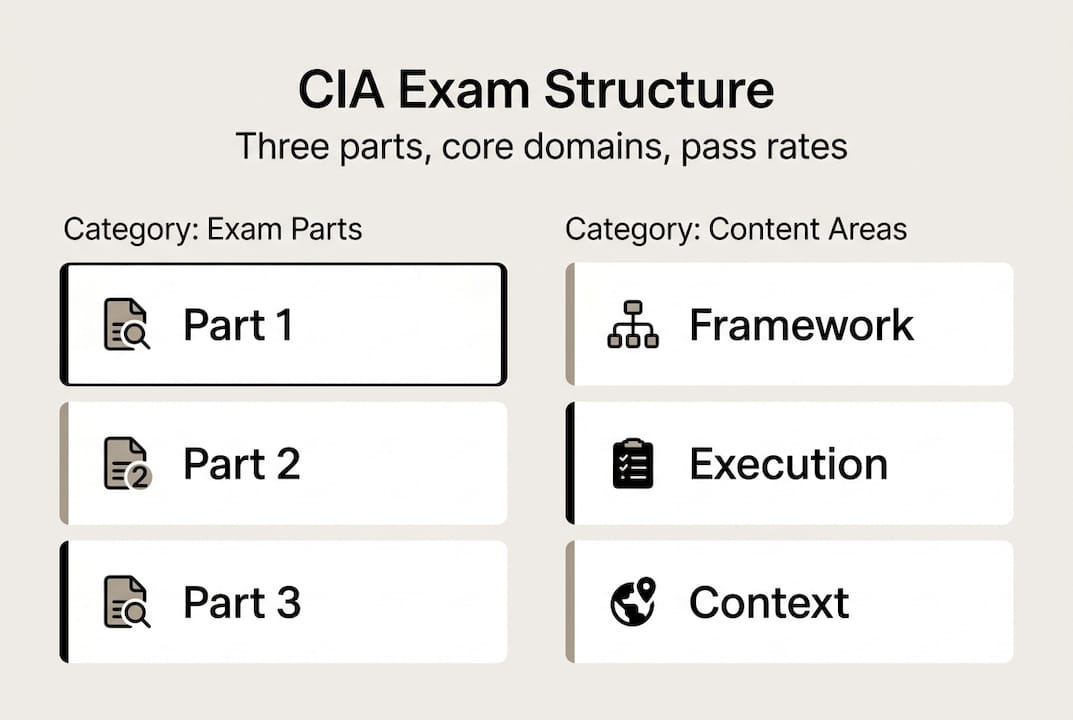
CIA emphasizes internal audit principles and practices per IIA Global Standards, including risk-based planning, governance, data analytics, IT, and business acumen. Each exam part integrates these themes across specific topic areas:
Exam Part | Core Content Areas | Question Count | Time Limit |
Part 1 | Internal audit basics, governance, fraud risks, audit standards | 125 | 150 minutes |
Part 2 | Engagement planning, audit procedures, communication, monitoring | 100 | 120 minutes |
Part 3 | Financial management, IT/cybersecurity, operations, strategy | 100 | 120 minutes |
Part 1 dives deep into the mandatory elements of the International Professional Practices Framework (IPPF), including the Definition of Internal Auditing, Code of Ethics, and International Standards. You’ll encounter scenarios testing your judgment on independence threats, objectivity requirements, and proficiency expectations. The exam also covers governance structures, risk management frameworks like COSO ERM, and fraud risk assessment methodologies.
Part 2 shifts from theory to application, presenting case studies where you must demonstrate audit execution skills. Questions assess your ability to develop risk-based audit plans, select appropriate testing procedures, evaluate evidence sufficiency, and communicate findings effectively. You’ll analyze control weaknesses, recommend remediation strategies, and prioritize audit observations based on risk severity. This part heavily emphasizes the Standards for the Professional Practice of Internal Auditing.
Part 3 broadens your perspective beyond audit mechanics to organizational context. You need working knowledge of financial statement analysis, budgeting processes, capital investment decisions, and performance metrics. The exam tests your understanding of information technology controls, cybersecurity frameworks, business process management, and strategic planning. This ensures you can add value beyond compliance by contributing to strategic discussions and business improvement initiatives.
Global pass rates range from 44-56%, reflecting preparedness and rigorous standards applied to diverse candidates worldwide. Part 1 typically shows the lowest pass rate (around 44%), as it covers the broadest conceptual foundation and many candidates underestimate its difficulty. Part 2 pass rates hover near 48%, while Part 3 reaches approximately 56% as candidates gain momentum and exam-taking confidence.
These pass rates reveal important preparation insights. The exams demand more than memorization; they require applying concepts to complex scenarios under time pressure. Many candidates fail because they rely solely on self-study materials without practicing scenario-based questions or understanding the IIA’s specific interpretation of standards. The diverse global candidate pool includes professionals from various industries and experience levels, contributing to pass rate variability.
Successful candidates typically invest 80-120 hours preparing for each exam part. Effective preparation combines:
Structured review courses: Instructor-led programs that clarify complex concepts and provide exam-taking strategies.
Practice questions: Thousands of scenario-based questions that mirror actual exam format and difficulty.
IIA Standards mastery: Deep familiarity with the IPPF, particularly the Definition, Code of Ethics, and Standards.
Time management drills: Simulated exams under timed conditions to build pacing skills and reduce test anxiety.
Pro Tip: Schedule your exam parts strategically, starting with Part 1 to build your conceptual foundation, then Part 2 to apply those concepts, and finishing with Part 3 when you have audit context for business knowledge questions. Taking parts sequentially within 6-9 months maintains momentum and reinforces learning across domains. For additional context on related certifications, review this CISA certification guide to understand how IT audit credentials complement the CIA.
Benefits of CIA certification for internal auditors
Salary benchmarks show CIAs earn up to 51% more than non-certified internal auditors in the US, with the premium varying by industry, geography, and experience level. In 2026, the median salary for CIA holders in the United States reaches approximately $98,000, compared to $65,000 for non-certified internal auditors in similar roles. Senior-level CIAs commanding audit manager or director positions often exceed $130,000 annually, with chief audit executives holding the CIA earning $180,000 or more in large organizations.
The salary advantage extends globally, though regional variations exist. CIAs in the Middle East and Asia Pacific regions see particularly strong premiums, as organizations in these markets actively recruit certified professionals to build internal audit capabilities. European CIAs also command higher compensation than their non-certified peers, though the gap narrows slightly compared to North American markets due to different certification traditions.
Career Level | Non-CIA Median Salary | CIA Median Salary | Premium |
Entry-level auditor | $52,000 | $65,000 | 25% |
Senior auditor | $68,000 | $85,000 | 25% |
Audit manager | $85,000 | $115,000 | 35% |
Director/CAE | $120,000 | $180,000 | 50% |
Beyond immediate compensation, the CIA opens doors to career advancement that remain closed to non-certified professionals. Many organizations establish the CIA as a prerequisite for promotion to senior auditor, manager, or chief audit executive positions. Board audit committees increasingly expect the CAE to hold the CIA, viewing it as evidence of professional commitment and technical competency. This credential requirement creates a clear ceiling for non-certified auditors’ career progression.
The CIA credential expands your professional responsibilities and influence within organizations:
Strategic advisory roles: CIAs participate in enterprise risk assessments, strategic planning sessions, and governance committee meetings, moving beyond compliance checking to value-added consulting.
Cross-functional leadership: The broad business knowledge required for Part 3 enables CIAs to lead projects spanning finance, operations, IT, and compliance, increasing organizational visibility.
External engagement: CIAs represent their organizations in industry forums, regulatory discussions, and professional associations, building networks that accelerate career opportunities.
Specialized expertise: The credential provides a foundation for developing niche specializations in areas like cybersecurity auditing, ESG assurance, or fraud examination, commanding premium compensation.
Maintaining your CIA requires ongoing professional development, which the IIA enforces through Continuing Professional Education (CPE) requirements. You must complete 40 CPE hours annually, with at least 20 hours in subjects directly related to internal auditing. This mandatory learning keeps your skills current as audit methodologies, technologies, and regulatory frameworks evolve. The CPE requirement also reinforces ethical standards through required ethics training every three years.
The CIA’s ethical framework extends beyond exam content to ongoing professional conduct. You must adhere to the IIA Code of Ethics, which emphasizes integrity, objectivity, confidentiality, and competency. Violations can result in certification revocation, creating accountability that enhances the credential’s market value. Employers trust CIAs to handle sensitive information, conduct objective assessments, and resist pressure to compromise audit independence, knowing ethical breaches carry serious professional consequences.
Pro Tip: Leverage your CIA credential immediately by updating your LinkedIn profile, email signature, and business cards with the designation. Actively participate in IIA chapter meetings and volunteer for leadership roles to maximize networking benefits. Many CIAs report that professional connections made through IIA activities led directly to job offers, consulting opportunities, or career mentorship that accelerated their advancement. Consider enrolling in basic training for internal auditors to strengthen foundational skills while building your professional network.
Enhance your CIA journey with expert training and CPE
Preparing for the CIA exams requires more than textbooks and practice questions. You need expert instruction that clarifies complex concepts, provides real-world context, and sharpens your exam-taking strategies. Our comprehensive internal auditing 101 basics training delivers the foundational knowledge Part 1 demands, taught by instructors with Big 4 backgrounds who understand exactly what the IIA expects.
Whether you’re beginning your CIA journey or maintaining your certification through CPE requirements, we offer live webinars and in-person seminars across major US cities that fit your schedule and learning preferences. Our ethics CPE training for CIAs fulfills your mandatory ethics hours while providing practical frameworks for navigating real-world ethical dilemmas in internal audit practice. Explore our complete 2026 CPE event calendar to find training that aligns with your certification timeline and professional development goals.
Frequently asked questions about CIA certification
How long does it take to complete the CIA certification?
Most candidates complete all three exam parts within 6-18 months, depending on study intensity and exam scheduling. You have four years from passing your first part to complete the remaining parts and fulfill experience requirements.
What is the difference between CIA and CPA certifications?
CIA focuses exclusively on internal auditing, risk management, and organizational controls, while CPA emphasizes external financial reporting, taxation, and public accounting. CIAs work primarily within organizations evaluating internal processes; CPAs often serve external clients providing assurance on financial statements.
Can I take the CIA exams in any order?
Yes, the IIA allows you to take exam parts in any sequence. However, most candidates benefit from taking Part 1 first to build conceptual foundations, followed by Part 2 for application skills, and Part 3 last to apply business knowledge within an audit context.
How much does CIA certification cost?
Total costs range from $1,200 to $3,000, including IIA membership ($115-$230 annually), exam fees ($410 per part for members), and study materials ($500-$1,500). Employer sponsorship often covers exam fees and study resources as professional development investments.
What CPE is required to maintain CIA certification?
You must complete 40 CPE hours annually, with at least 20 hours directly related to internal auditing. Every three years, you must complete two hours of ethics training. The IIA accepts various learning formats including webinars, conferences, and self-study courses. Explore internal auditor training options that qualify for CPE credit while advancing your technical skills.
Is CIA certification recognized internationally?
Absolutely. The CIA is the only globally recognized internal audit certification, held by professionals in over 170 countries. The IIA offers exams in multiple languages, and the credential requires no country-specific endorsement or reciprocity processes, making it ideal for international career mobility.
Recommended
Comments