Step-by-step guide to effective audit planning success


TL;DR:
Weak audit planning leads to missed risks, delays, and scope changes, increasing compliance costs.
Effective planning requires comprehensive risk assessment, stakeholder input, and ongoing plan updates.
Leveraging frameworks like COSO, data analytics, and AI enhances audit quality and responsiveness.
Missed risks, blown timelines, and last-minute scope changes are not bad luck. They are the predictable result of weak audit planning. In 2026, with regulatory expectations rising and audit environments growing more complex across industries, the cost of poor planning is higher than ever. Whether you lead an internal audit function or manage external engagements under PCAOB oversight, the quality of your plan shapes everything that follows. This guide walks you through a practical, modern audit planning process built for today’s compliance and risk management realities, covering prerequisites, risk assessment, strategy development, technology integration, and ongoing plan management.
Table of Contents
Key Takeaways
Point | Details |
Risk-based approach | Focusing on prioritized risks ensures resources address the most critical issues during audit planning. |
Use of frameworks | Leveraging COSO and other frameworks strengthens internal control evaluation for all types of audits. |
Technology advantage | Integrating data analytics and AI makes the planning process more accurate and adaptive. |
Continuous improvement | Reviewing and updating audit plans regularly keeps your audits relevant and effective. |
Stakeholder alignment | Effective communication and consensus with management and the board increase audit plan impact and support. |
Audit planning essentials: what you need before you start
With audit planning’s importance established, it’s crucial to start with the right foundation. Rushing into fieldwork without assembling the right inputs is one of the most common and costly mistakes audit teams make. Before you write a single audit objective, you need the right documents, people, and tools in place.
The core documents you need include:
Audit universe: A complete inventory of auditable entities, processes, and systems
Risk registers: Current organizational risk data, updated for recent business changes
Prior audit reports: Historical findings, open issues, and repeat observations
Organizational strategy: Business goals, major initiatives, and strategic priorities for the period
Stakeholder engagement is equally critical. You need input from the board and audit committee, senior management, and key process owners before finalizing any plan. Their perspectives surface risks that documentation alone will not reveal.
Your team composition matters too. Bring in IT specialists for technology risks, risk and compliance experts for regulatory exposure, and process owners who understand operational nuances. Audit planning for internal auditors follows a risk-based approach per IIA guidance, meaning team expertise must align with the risk profile of the audit universe.
On the technology side, data analytics platforms and AI-assisted tools are no longer optional extras. They accelerate risk identification and improve coverage. Diligent’s audit planning framework highlights how structured planning tools reduce preparation time and improve plan quality.
Planning input | Internal audit | External audit |
Risk register | Required | Informational |
Audit universe | Core driver | Scope-specific |
Prior reports | Template source | Reference only |
Regulatory standards | IIA Standards | PCAOB AS 2101 |
Stakeholder input | Board, management | Audit committee |
For a deeper look at the step-by-step risk assessment process that feeds directly into planning, that resource is worth reviewing before moving forward.
Pro Tip: Co-locate your planning team, even virtually, during the first two weeks of plan development. Using prior audit reports as working templates cuts drafting time significantly and surfaces recurring risk themes faster.
Step 1: Perform a comprehensive risk assessment
Once prerequisites are set, the first active phase is a robust risk assessment. This step determines where your audit resources go, so getting it right is non-negotiable.
Here is a practical sequence to follow:
Define the audit universe by listing all business units, processes, systems, and third-party relationships subject to audit coverage
Identify risks across each area, including operational, financial, compliance, strategic, and emerging risks such as cybersecurity and AI-related exposures
Apply qualitative and quantitative methods to measure likelihood and impact, using scoring models, heat maps, and risk matrices
Prioritize by combining risk scores with strategic relevance, mapping high-risk areas to audit resources first
Validate with stakeholders to ensure no significant risks are overlooked due to siloed perspectives
The annual plan based on organization-wide risk assessment is required under IIA Standard 9.4, and both IIA and PCAOB audit planning emphasize risk assessment as the central driver of plan quality.
A common mistake is treating risk assessment as a once-a-year exercise. Business conditions change. New regulations emerge. Acquisitions, leadership changes, and technology shifts all alter the risk landscape between annual cycles. Siloed assessments, where each department evaluates its own risks without cross-functional input, also produce blind spots.
“The audit plan is only as strong as the risk intelligence behind it. If your risk assessment is stale or incomplete, your plan will be too.”
For guidance on selecting the right methodology, the available risk assessment frameworks and a focused look at the role of risk assessment in audit planning provide practical context. External auditors should also reference risk-based internal audit standards for alignment.
Pro Tip: Schedule formal risk reassessments quarterly, not just annually. A mid-year reassessment often catches emerging risks before they become audit findings.
Step 2: Develop your audit strategy and detailed plan
With risks prioritized, you can now construct a focused, resource-efficient plan. This is where risk intelligence becomes a working document.
Follow this sequence to build a solid audit strategy:
Link audit tasks to risk priorities: Each planned audit engagement should trace directly to a high or medium risk area identified in your assessment
Determine timing and scope: Assign realistic timeframes and define what is in and out of scope for each engagement
Identify required skill sets: Match auditor competencies to the technical demands of each area, including IT, financial, and regulatory expertise
Coordinate with other assurance providers: Align with compliance, risk management, and external auditors to avoid duplicating coverage
Solicit feedback from management and the board: A plan that stakeholders have reviewed is far more likely to receive the resources and access it needs
PCAOB AS 2101 requires planning to address scope, resources, and continuous updates. For internal audits, coordination with other assurance providers and management feedback is equally central to a strong plan.

Plan element | Internal audit | External audit |
Scope driver | Risk-based, strategic | Financial statement assertions |
Resource planning | Internal team, co-source | Engagement team structure |
Stakeholder review | Board, management | Audit committee |
Regulatory standard | IIA Standards | PCAOB AS 2101 |
Update frequency | Quarterly or rolling | Continuous per AS 2101 |
For teams exploring how technology fits into strategy development, harnessing AI in audit planning offers a practical look at current tools and their limitations.
Pro Tip: Use collaborative workflow platforms to manage plan drafts in real time. When stakeholders can see and comment on updates as they happen, last-minute scope disputes become much less common.
Applying frameworks and technology: COSO, data analytics, and AI
A solid plan also leverages frameworks and technology to raise audit quality. Frameworks give structure; technology gives speed and depth.
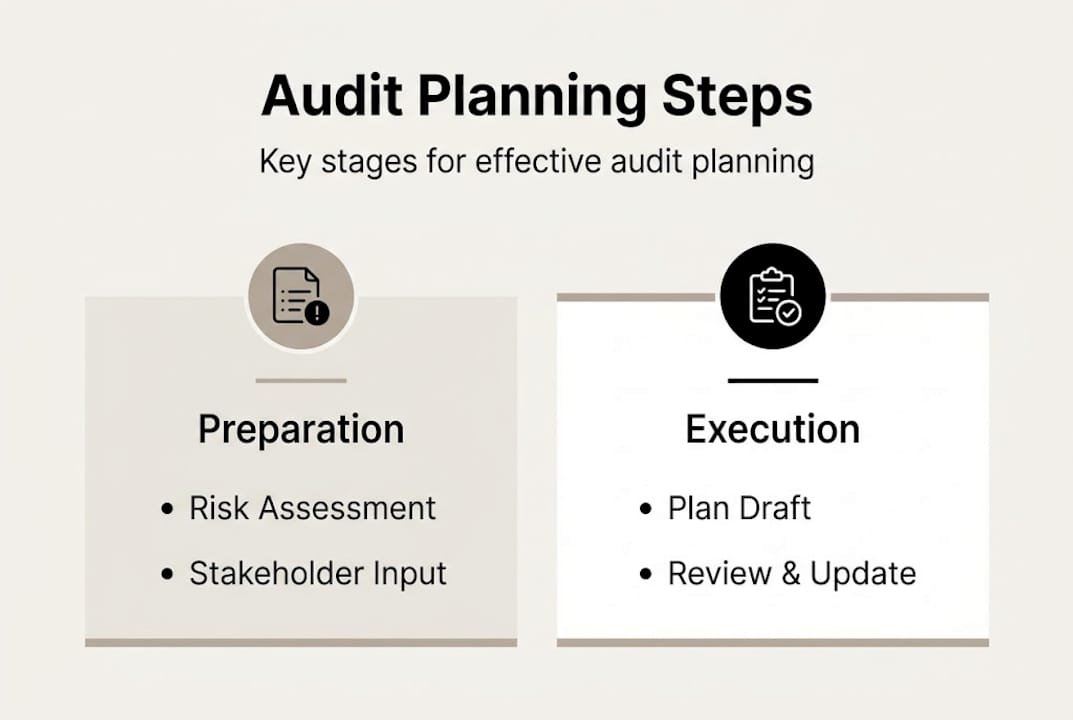
The COSO framework organizes internal control evaluation around five components: control environment, risk assessment, control activities, information and communication, and monitoring. Mapping your identified risks and controls to these five components ensures nothing falls through the gaps. It also gives you a defensible structure when explaining coverage decisions to the board.
Data analytics integration is no longer a differentiator. It is an expectation. Here is how to apply it in planning:
Anomaly detection: Run transaction data through analytics tools to flag unusual patterns before fieldwork begins
Trend analysis: Compare current period data to prior periods to identify risk shifts early
Population profiling: Understand the full data set before sampling, improving sample design and coverage
Continuous monitoring: Set automated alerts for key risk indicators between audit cycles
COSO integrates five components for internal control evaluation, and 92% of audit leaders see data analytics as a top priority skill for their teams. That number reflects where the profession is heading.
AI-powered planning tools go further, supporting resource allocation modeling, fraud risk identification, and continuous risk monitoring. AI enhances planning effectiveness especially for large and complex organizations, though the tools are becoming accessible to mid-size teams as well.
For practical guidance on applying these tools, the audit data analytics guide and an overview of advanced AI tools for auditing are both worth your time.
Finalizing, communicating, and updating your audit plan
Taking your detailed plan forward requires effective communication and agility. A plan that lives only in a shared drive and never gets reviewed is not a plan. It is a document.
Here is how to finalize and sustain your audit plan:
Circulate a draft to key stakeholders for review, including the board, audit committee, and senior management
Incorporate feedback systematically, documenting what was accepted, modified, or deferred and why
Obtain formal approval from the audit committee or board before committing resources
Communicate priorities clearly to the audit team and relevant business units, including timelines and expected outputs
Schedule quarterly reviews to assess whether the plan still reflects current risks and organizational priorities
Update transparently when changes occur, sharing revisions with stakeholders and documenting the rationale
The IIA guidance on drafting, soliciting feedback, and finalizing the audit plan is clear: communication and iteration are not optional steps. And audit planning is continual and iterative, not a discrete phase that ends once fieldwork begins, per PCAOB AS 2101.
A central repository for plan documents, accessible to all relevant team members, eliminates version control problems and makes quarterly updates far less painful. Teams that treat the plan as a living document consistently outperform those that revisit it only when something goes wrong.
For teams looking to build on these practices, the resource on audit excellence best practices covers how structured training supports sustained planning quality.
Pro Tip: Assign a single owner for plan updates. When everyone is responsible for keeping the plan current, no one actually does it.
A modern perspective: why agile, tech-enabled audit planning wins
Before closing, it is worth challenging some conventional audit planning wisdom. Static, template-driven planning models are not just inefficient. They are a liability.
I have seen audit teams spend weeks building elaborate annual plans, only to have a regulatory change or an acquisition make half the plan irrelevant by February. The problem is not the template. The problem is the mindset that planning is something you do once and then execute.
The teams that consistently deliver high-quality audits treat planning as an ongoing discipline. They hold quarterly risk reassessments. They use technology to surface emerging risks between cycles. They collaborate openly with management rather than treating the plan as an internal document that gets shared only after approval.
The uncomfortable truth is that most audit failures trace back to poor risk communication and a lack of plan iteration, not inadequate audit technique. A team with average methodology and excellent planning discipline will outperform a technically skilled team with a rigid, outdated plan.
Avoiding the pitfalls in audit AI adoption is part of this shift. Technology should support judgment, not replace it. The auditors who win in this environment are those who invest in both skills and systems, and who treat every plan update as an opportunity to improve.
Elevate your skills with practical CPE training
Ready to strengthen your audit planning process? The knowledge in this guide is a strong starting point, but applying it effectively takes practice, peer learning, and expert instruction.
At compliance-seminars.com, we offer expert-led CPE training designed specifically for internal and external auditors who want to sharpen their planning, risk assessment, and compliance skills. Explore our internal auditor CPE webinars for focused, time-efficient learning, or start with the internal auditing basics course to build a solid foundation. If risk assessment is your priority, the step-by-step risk assessment guide is a practical companion to your planning work. All training is NASBA-recognized and delivered by instructors with Big 4 experience.
Frequently asked questions
What is the most important step in audit planning?
A comprehensive risk assessment is the foundation of effective audit planning, ensuring focus on the most critical risks and alignment with organizational objectives. Per IIA Standard 9.4, the annual plan must be based on an organization-wide risk assessment.
How do internal and external audit planning differ?
Internal audit planning is risk-based and strategic, while external audit planning is compliance-focused and governed by PCAOB AS 2101, which requires documented procedures and continuous updates. Both approaches share a common emphasis on risk assessment as the central planning driver.
Why is COSO relevant to audit planning?
The COSO framework provides a structured model for evaluating internal controls across five components, helping auditors ensure all key risk areas are addressed systematically during planning. It also gives auditors a defensible framework for explaining coverage decisions to the board.
How often should audit plans be updated?
Audit plans should be reviewed and updated at least quarterly, or whenever major risks or significant business changes occur. Quarterly risk reassessment and rolling plan updates are recognized best practice for maintaining plan relevance.
What role does technology play in audit planning?
Data analytics and AI support risk identification, resource allocation, and continuous monitoring, making audit planning more precise and adaptive. AI enhances planning effectiveness particularly for large and complex organizations, and increasingly for mid-size teams as tools become more accessible.
Recommended
Comments