Audit Management Explained: Strategies, Tools, and Best Practices


TL;DR:
Effective audit management is a strategic process that reduces risk and strengthens internal controls.
Modern tools automate workflows and improve documentation, enhancing audit efficiency and compliance.
Viewing audits as a continuous intelligence function enables organizations to adapt quickly and build resilience.
Most compliance and audit managers have heard the phrase “just get through the audit” more times than they care to count. That mindset is exactly the problem. Audit management is not a paperwork exercise or a once-a-year scramble to satisfy regulators. It is a strategic discipline that coordinates every audit activity, from initial planning through final follow-up, and when done well, it actively reduces organizational risk, strengthens internal controls, and positions your organization to meet regulatory requirements with confidence. This guide breaks down the core components, processes, tools, and best practices you need to build a truly effective audit management function.
Table of Contents
Key Takeaways
Point | Details |
Strategic value | Audit management is fundamental to organizational compliance and risk reduction. |
Process stages | A successful audit management cycle moves from planning to follow-up. |
Tools and automation | Modern audit management software streamlines workflows and ensures regulatory adherence. |
Best practices | Clarity, communication, risk focus, and continuous improvement drive success in audit management. |
Compliance connection | Robust audit management is essential to navigating changing regulations. |
Understanding audit management: Fundamentals and purpose
Now that we have set the stage for why audit management matters, let us clarify exactly what it means and what it enables for organizations.
Audit management is the coordinated oversight of all activities related to audits. That includes planning, scheduling, executing fieldwork, documenting findings, reporting results, and tracking remediation. It is not just about running audits. It is about running them consistently, efficiently, and in a way that produces reliable, actionable information.
The primary goals of audit management are:
Ensuring compliance with applicable laws, regulations, and internal policies
Detecting and assessing risk before it becomes a liability
Improving internal controls through systematic review and follow-up
Supporting governance by giving leadership accurate, timely information
Aligning audit teams around shared objectives and standardized processes
Traditional auditing often treated each audit as a standalone event. Integrated audit management systems change that by creating a continuous cycle of planning, execution, and improvement. The difference is significant. A siloed audit tells you what happened. A well-managed audit program tells you what is likely to happen next.
Effective audit management supports compliance by ensuring organizational integrity and minimizing risks across every function touched by regulatory scrutiny.
Strong audit management also aligns the work of auditors and regulatory impact with broader organizational strategy. When audit findings feed directly into risk assessments and executive decision-making, the audit function stops being a cost center and starts being a genuine business asset. That shift in perception changes how teams engage with the process and how seriously findings are acted upon.
For a deeper look at audit management explained, the fundamentals above provide the foundation every compliance-driven organization needs before building out its program.
The audit management process: Stages, workflows, and roles
With a clear grasp of what audit management encompasses, let us break down its core process and the people who make it work.
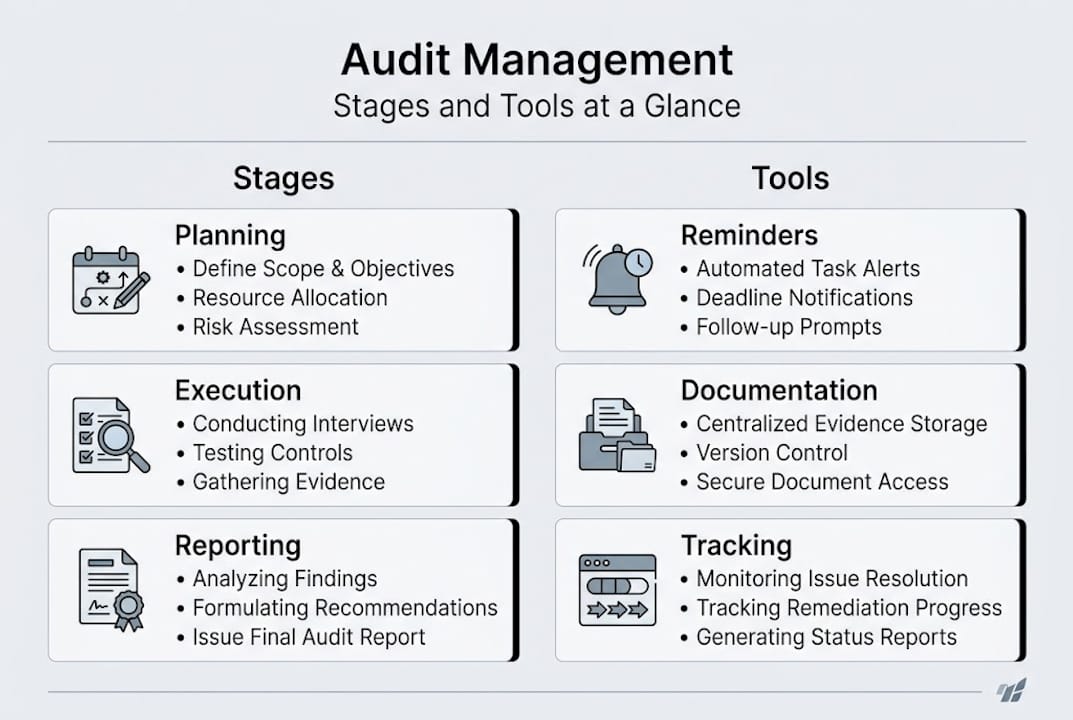
A structured audit management process follows four key stages:
Planning: Define the audit scope, objectives, and risk areas. Assign roles and establish timelines.
Fieldwork: Execute testing, gather evidence, and document findings in real time.
Reporting: Compile findings, draft the audit report, and present results to stakeholders.
Follow-up: Track remediation of findings and verify that corrective actions are implemented.
Each stage depends on clear role assignments. The audit manager owns the overall process and timeline. Audit team members execute fieldwork and document evidence. Stakeholders in audited departments provide access and respond to findings. Executive sponsors ensure resources are available and that findings receive appropriate attention.
Stage | Manual workflow | Automated workflow |
Planning | Spreadsheets, email chains | Centralized templates, auto-scheduling |
Fieldwork | Paper or local files | Cloud-based workpapers, real-time updates |
Reporting | Manual drafting, version control issues | Auto-generated reports, tracked revisions |
Follow-up | Email reminders, manual tracking | Automated alerts, dashboard monitoring |
The contrast is stark. Manual workflows introduce version control problems, communication gaps, and missed deadlines. Automated workflows reduce those risks significantly. A structured audit process improves organizational efficiency and effectiveness by removing ambiguity from every stage.

For organizations reducing risk through auditing, aligning the process with COSO internal control standards provides a recognized framework for structuring fieldwork and reporting.
Pro Tip: Assign clear responsibilities at the planning stage, not mid-fieldwork. Ambiguous ownership is the single most common cause of audit delays and communication breakdowns.
Audit management tools and software: Features, benefits, and limitations
Understanding the process is important, but using the right tools gives organizations the edge. Let us explore what modern audit management solutions offer.
Modern audit management tools streamline audits and help ensure regulatory compliance by centralizing workflows, documentation, and reporting in one platform.
The essential features to look for include:
Task tracking and assignment to keep every team member accountable
Document control for version management and evidence storage
Workflow automation to reduce manual hand-offs and missed steps
Reporting and analytics for real-time visibility into audit status
Integration capabilities with GRC (governance, risk, and compliance) platforms
Feature | Benefit | Watch out for |
Automated reminders | Reduces missed deadlines | Over-reliance without human review |
Centralized workpapers | Improves consistency | Poor user adoption if training is lacking |
Dashboard analytics | Supports executive reporting | Data quality depends on input accuracy |
Regulatory mapping | Links controls to requirements | Needs regular updates as regulations change |
The benefits are real. Organizations using audit software consistently report better documentation quality, faster report turnaround, and stronger audit trails for regulatory review. That last point matters enormously when regulators ask for evidence of control effectiveness.
For risk management through audit technology, the right platform does more than save time. It creates a defensible record of your audit program’s integrity.
The audit management software market continues to grow as organizations recognize the compliance value of purpose-built tools over generic project management software.
Pro Tip: Beware of over-customization. Heavily customized tools become difficult to maintain and upgrade. Start with industry-suited, scalable features and add complexity only when the need is clearly justified.
Best practices for efficient audit management
Tech and processes aside, how you manage audits day-to-day is what sets leading organizations apart. Here is how to get it right.
Applying compliance audit best practices leads to more effective and compliant organizations, and the difference between average and excellent audit programs often comes down to a handful of consistent habits.
The most impactful practices include:
Clear audit planning and scoping: Vague scope leads to scope creep, wasted effort, and inconclusive findings. Define boundaries early and document them.
Consistent communication: Regular status updates prevent surprises. Stakeholders who feel informed are more cooperative and responsive.
Risk-based audit methodology: Prioritize audit areas based on risk exposure, not just historical rotation schedules. Align with IIA audit standards for a recognized framework.
Documentation discipline: Every finding, every interview, every piece of evidence needs a clear record. Gaps in documentation undermine the entire audit’s credibility.
Continuous improvement: Use post-audit reviews to identify what worked and what did not. Benchmark against peer organizations where possible.
Organizations that invest in audit team leadership strategies see measurable improvements in both audit quality and team morale. Leadership matters as much as process.
Statistic callout: Over 70% of organizations using dedicated audit software reported improved compliance outcomes, according to Gartner research. That is not a marginal gain. It reflects a fundamental shift in how audit functions operate when given the right infrastructure.
Pro Tip: Schedule brief weekly check-ins during active audit fieldwork. Even a 15-minute touchpoint prevents bottlenecks from compounding and keeps communication channels open across teams.
Audit management and compliance: Navigating regulatory requirements
To round out the picture, it is vital to connect the daily work of audit management to the compliance outcomes organizations need.
Regulatory requirements do not stand still. SOX (the Sarbanes-Oxley Act) demands rigorous internal control documentation and testing. GDPR requires evidence of data protection controls. HIPAA mandates healthcare organizations demonstrate ongoing compliance with privacy and security standards. Industry-specific rules in banking, insurance, and government add further layers of obligation.
Audit management serves as the mechanism for evidencing compliance across all of these frameworks. Key benefits include:
Audit trails that demonstrate control effectiveness to regulators
Risk-integrated planning that aligns audit scope with current regulatory priorities
Proactive identification of control gaps before regulators find them
Consistent documentation that holds up under scrutiny
Audit management provides a roadmap for meeting regulatory challenges, turning reactive compliance into a proactive organizational strength.
Effective audit management is crucial to meeting SOX, GDPR, and other regulatory obligations, particularly as enforcement actions increase in frequency and severity.
The importance of compliance training cannot be overstated here. Even the best audit management system fails if the people running it lack current knowledge of applicable regulations. Pairing strong processes with ongoing education is what separates organizations that pass audits from those that excel at them.
Understanding the role of risk assessment within audit planning is equally critical. Risk assessment is not a preliminary step. It is the engine that drives every decision about where to focus audit resources and how to prioritize findings. SOX Act requirements make this integration non-negotiable for public companies.
A fresh perspective: Why audit management is the hidden driver of organizational resilience
After covering the essentials, let us step back for a candid look at what audit management really means for future-ready organizations.
Most organizations treat audit management as a compliance obligation. They staff up before an audit, scramble to gather documentation, and breathe a sigh of relief when it is over. That approach is understandable, but it misses the larger opportunity entirely.
The organizations that genuinely benefit from audit management are those that treat it as an intelligence function. Every audit surfaces information about how the organization actually operates, not how leadership assumes it operates. That gap between assumption and reality is where risk lives.
Strategically managed audits create organizational agility. When findings are tracked, remediated, and fed back into planning, the organization builds a living map of its own control environment. That map enables confident decision-making, faster responses to regulatory change, and a culture where accountability is normalized rather than feared.
We have seen firsthand that audit teams operating with clear processes and strong leadership consistently outperform those relying on institutional memory and manual tracking. The audit function is not overhead. It is infrastructure.
For lessons in audit excellence, the most durable improvement comes from investing in people and process together, not just technology.
Pro Tip: Use each audit cycle as a deliberate learning opportunity. Debrief with your team, capture what changed, and update your methodology. Audits that teach the organization something new are worth far more than audits that simply confirm what you already knew.
Advance your audit expertise with targeted training
Ready to put advanced audit management into practice? Staying current in audit and compliance requires more than reading articles. It demands structured, expert-led education that translates directly into better audit outcomes.
At compliance-seminars.com, we offer NASBA-recognized CPE courses, live webinars, and in-person seminars designed specifically for audit managers, internal auditors, and compliance professionals. Our instructors bring Big 4 experience and deep regulatory knowledge to every session. Check our CPE event calendar for upcoming in-person training across U.S. cities, or explore our internal auditor webinars for flexible, targeted skill-building that fits your schedule.
Frequently asked questions
What is audit management in compliance?
Audit management in compliance is the structured oversight of all audit activities to ensure adherence to laws, regulations, and internal controls, supporting organizational integrity and minimizing risk.
What are the main stages of the audit management process?
The main stages are audit planning, execution (fieldwork), reporting, and follow-up on findings. Structured audit processes create efficiency and more reliable results at every stage.
How do audit management tools help organizations?
Modern audit tools automate workflows, improve documentation quality, and help organizations meet regulatory requirements more efficiently than manual processes allow.
What are some best practices for audit management?
Clear scoping, consistent documentation, risk-based focus, and post-audit improvement cycles are the foundation. Applying these practices leads to stronger compliance outcomes and more credible audit results.
How does audit management support regulatory compliance?
It provides a clear framework for evidencing controls and addressing obligations under frameworks like SOX, GDPR, and HIPAA. Effective audit management turns regulatory requirements into manageable, documented processes rather than recurring crises.
Recommended
Comments