Mastering audit team leadership: strategies for effective management


TL;DR:
Modern audit leaders blend compliance, strategic advising, and technology skills to meet evolving demands.
Building cohesive, skilled teams with clear roles and continuous development is essential for high performance.
Embracing paradoxes and agility, including AI integration, enhances audit outcomes and team resilience.
Leading an audit team in 2026 is not the same job it was five years ago. The role now demands that you balance rigorous compliance oversight with strategic advisory input, manage talent in a tight labor market, and integrate AI and data analytics into daily workflows. Most audit leaders I speak with feel the pressure from all sides: boards want more insight, regulators want more rigor, and staff want more development. This guide walks through a practical framework covering preparation, team building, strategy, execution, and measurement. Each section delivers specific tools and benchmarks so you can lead with confidence and accountability.
Table of Contents
Key Takeaways
Point | Details |
Leadership evolution | Modern audit leaders must balance compliance, advisory skills, and adaptive thinking to meet growing organizational demands. |
Team development | Building and continuously developing the right team is essential for effective audit function performance. |
Strategic alignment | Aligning audit strategy with organizational goals secures resources and increases impact. |
Tech adoption | Leveraging AI and analytics transforms audit processes and drives team efficiency. |
Continuous improvement | Ongoing performance measurement and feedback are key to elevating audit team effectiveness. |
Understanding the audit leadership challenge
The expectations placed on audit team leaders have shifted dramatically. Where the role once centered on compliance verification and report delivery, today’s audit leader is expected to function as a strategic advisor, a talent developer, and a technology advocate all at once. That is a wide mandate, and it requires a different set of competencies than what most audit training programs historically emphasized.
According to the 2025 IIA Pulse Report, internal audit functions are targeting a shift toward advisory work at roughly 40% of total activity, with data analytics identified as the top skill for team development and notable growth in both staff headcount and budgets. Strategic alignment with organizational objectives is now directly tied to funding and influence.
The IIA Canada Tools for Lead Auditors program reinforces that lead auditors must master the full audit lifecycle while guiding teams using IIA standards. That means vision, mentoring, feedback, advocacy, and adaptability are not soft skills anymore. They are core competencies.
Traditional vs. modern audit leadership expectations
Dimension | Traditional focus | Modern expectation |
Primary role | Compliance verification | Strategic advisor and risk partner |
Key skill | Technical auditing | Data analytics and communication |
Team development | On-the-job learning | Structured mentoring and CPE |
Stakeholder engagement | Periodic reporting | Continuous dialogue with leadership |
Technology use | Spreadsheets and checklists | AI, continuous monitoring, dashboards |
Core competencies for modern audit leaders include:
Vision setting and communicating audit’s value to senior management
Mentoring and developing staff at every experience level
Providing timely, constructive feedback tied to performance outcomes
Advocating for the audit function’s resources and independence
Adapting to new standards, including key auditing standards and regulatory changes
Applying the IIA Competency Framework to identify team gaps
Pro Tip: Run a quick competency mapping exercise using the IIA Competency Framework at least once per year. Ask each team member to self-assess, then compare with your own observations. The gaps you find will drive your training and hiring priorities.
Building a high-performing audit team
Modern leadership is evolving fast, and practical team-building strategies matter more than ever. A technically skilled team that lacks cohesion, communication, or development pathways will underperform regardless of how well you plan your audits.

Effective team management involves four core steps: attract the right talent, reward performance meaningfully, manage day-to-day operations with clarity, and develop skills continuously. Each step requires intentional action, not just good intentions.
For smaller audit functions, the approach needs to scale appropriately. Small teams should leverage cosourcing arrangements, build professional networks for specialized expertise, adopt AI tools to extend capacity, and pursue flexible hiring strategies. A team of three can punch well above its weight when it uses the right resources.
Characteristics of high-performing audit teams:
Clear roles with shared accountability for audit outcomes
Open communication channels, including structured feedback loops
A commitment to ongoing learning through audit training programs and CPE
Psychological safety that allows team members to raise concerns without fear
Diversity of skills, including both technical auditing and analytical capabilities
Steps to develop staff through mentoring and training:
Assign each team member a formal mentor, either internal or external to the function
Build individual development plans tied to both short-term audit needs and long-term career goals
Schedule quarterly check-ins to review progress and adjust plans as priorities shift
Encourage participation in IIA, ISACA, or other professional events, including being an audit leader focused programs
Recognize and reward skill development publicly to reinforce the culture of growth
Most high-performing teams prioritize continual skill development and communication over static role definitions.
Developing a strategy aligned with organizational objectives
Once a strong team is built, the next step is to provide direction and alignment. Without a formal audit strategy, even skilled teams can drift toward low-value work or miss emerging organizational risks.
A robust audit strategy includes a clear vision statement, measurable objectives, a risk-focused audit universe, and a stakeholder engagement plan. The internal audit strategy must be formally documented, aligned with organizational objectives, and reviewed regularly with senior leadership and the board. This is now a requirement under the new Global Internal Audit Standards.
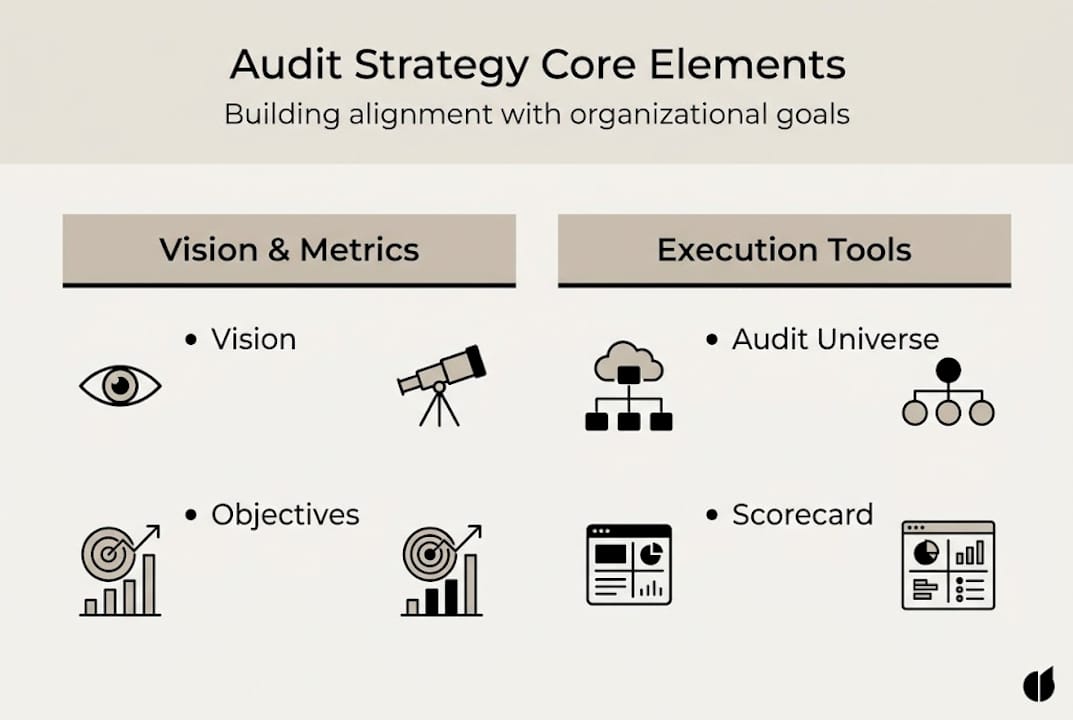
A balanced scorecard is one of the most practical tools for translating strategy into measurable outcomes. Here is an example framework:
Audit team balanced scorecard
Perspective | Metric | Target |
Coverage | Percentage of audit universe reviewed | 85% annually |
Efficiency | Average days per audit engagement | Reduce by 10% year over year |
Stakeholder satisfaction | Post-audit survey scores | 4.0 out of 5.0 or higher |
Recommendation implementation | Management action closure rate | 90% within agreed timeframe |
Team development | CPE hours completed per staff member | 40 hours annually |
Performance measurements should blend quantitative and qualitative SMART metrics to give a full picture of team effectiveness. Relying only on completion rates misses the quality story.
SMART performance indicators for audit teams include:
Specific: Percentage of high-risk areas audited in the fiscal year
Measurable: Number of findings with management-agreed action plans
Achievable: Reduction in average report issuance time by 15%
Relevant: Stakeholder satisfaction scores tied to advisory value delivered
Time-bound: Quarterly review of internal audit process metrics against targets
Pro Tip: Do not wait for year-end to review your strategy. Schedule quarterly sessions with both the board and senior management. Use those conversations to surface emerging risks and recalibrate your audit success guide priorities before they become problems.
Executing and optimizing the audit process
With clear strategy and metrics in hand, it is time to execute and refine your team’s work. Execution is where leadership intent meets operational reality, and the gap between the two is often where audit quality suffers.
The full audit lifecycle requires structured management at every phase. Here is a practical sequence:
Plan: Define scope, objectives, and resource requirements
Assess risks: Prioritize areas using a formal risk assessment model
Assign roles: Match staff skills to engagement complexity
Fieldwork: Supervise testing, document evidence, and maintain quality checkpoints
Reporting: Draft findings with root cause analysis and actionable recommendations
Wrap-up: Conduct engagement retrospectives and capture lessons learned
Quality assurance: Apply internal QA procedures aligned with IIA standards
Technology is no longer optional in this process. AI tools in auditing and audit data analytics now enable predictive risk identification and continuous monitoring that manual testing simply cannot match. Leaders who adopt structured dissent and continuous learning as team norms see measurably better audit outcomes.
Common mistakes to avoid when overseeing growing or remote teams:
Assuming communication is happening without verifying it explicitly
Skipping engagement retrospectives when timelines are tight
Allowing scope creep without formally reassessing risk and resources
Underinvesting in AI and audit efficiency tools due to change resistance
Relying on dynamic risk modeling without training staff to interpret the outputs
Pro Tip: Build structured dissent into your team culture. Assign a rotating devil’s advocate role during planning sessions to challenge assumptions. This simple practice surfaces blind spots before fieldwork begins and sharpens the quality of your audit conclusions.
Measuring, monitoring, and improving audit team performance
No audit process is complete without rigorous measurement and a culture of feedback. Leaders who skip this step often find themselves repeating the same inefficiencies year after year without understanding why.
SMART metrics combined with qualitative outcomes give you the full picture. Set KPIs at the start of each audit cycle and review them formally at least quarterly. Do not treat measurement as a year-end exercise.
Sample metrics for audit team performance:
Audit coverage rate: percentage of planned engagements completed on schedule
Finding quality: ratio of findings accepted by management without dispute
Report timeliness: average days from fieldwork completion to final report issuance
Recommendation implementation: percentage of agreed actions closed within the deadline
Team satisfaction: internal survey scores on collaboration, development, and leadership support
Stakeholder feedback: post-audit ratings from business unit leaders
92% of audit leaders now say data analytics is core to measuring and improving audit team performance, according to 2025 IIA Pulse data.
Strategic alignment with organizational goals also drives funding. Functions that demonstrate measurable advisory value consistently see greater budget support and expanded mandates. That connection between effective audit monitoring and organizational investment is not accidental. It is the result of deliberate measurement and communication.
Pro Tip: Combine quarterly scorecard reviews with team self-evaluation and peer feedback sessions. This three-way view catches performance issues early and builds a culture where improvement is expected, not feared.
What most audit leadership guides miss: Embracing paradoxes and agility
Most articles on audit leadership focus on process and tools. That is useful, but it misses the harder truth: the best audit leaders I have seen are not the ones with the most polished frameworks. They are the ones comfortable living with contradiction.
Audit leadership requires you to embrace paradox: balance certainty with skepticism, structure with agility, and compliance with resilience. These are not competing values. They are complementary tensions that, when managed well, produce the sharpest audit outcomes.
The teams that perform best are not the ones that follow the playbook perfectly. They are the ones that challenge each other respectfully, adapt quickly when circumstances shift, and stay curious even when the answer seems obvious. That requires a leader who models intellectual humility and rewards constructive disagreement.
Technology adds another layer to this. Integrating AI usage strategies into your function is not just a technical decision. It is a cultural one. Leaders who frame AI adoption as a threat to expertise will struggle. Those who frame it as a tool for deeper thinking will thrive.
‘The highest-performing teams are the ones comfortable with discomfort, balancing rigor with imagination, and compliance with curiosity.’
Advance your audit leadership journey with expert training
The strategies in this article are only as powerful as the skills behind them. Staying current in audit leadership requires more than reading. It requires structured learning, peer exchange, and exposure to the latest standards and practices.
Compliance Seminars offers expert CPE training designed specifically for audit professionals at every career stage. Whether you want to sharpen your technical skills or build stronger leadership capabilities, our CPE webinars for auditors and in-person events connect you with instructors who have real Big 4 and regulatory experience. Browse the 2026 CPE events calendar to find upcoming sessions in your area or online. Your team’s performance starts with your own development.
Frequently asked questions
What are the core responsibilities of an audit team leader?
Audit leaders oversee planning, risk assessment, team guidance, fieldwork direction, reporting, strategy alignment, and team development across the full audit lifecycle.
How can I measure the effectiveness of my audit team?
Use a balanced scorecard with both quantitative metrics like coverage and completion rates and qualitative measures like stakeholder satisfaction, following SMART measurement principles for a complete view.
What strategies work best for small audit teams?
Small teams should prioritize risk-based audit plans, leverage cosourcing for specialized work, adopt technology to extend capacity, and build flexible hiring and professional networks.
Which leadership skills are most critical for leading audit teams?
Mentoring, delivering timely feedback, promoting the audit function’s value, developing staff capabilities, and personal adaptability are the most essential competencies for audit leaders today.
How is technology changing audit team leadership?
AI, data analytics, and continuous monitoring are now central to audit effectiveness, and 92% of audit leaders report that analytics is essential, requiring leaders to drive agile skills development across their teams.
Recommended
Comments