Risk assessment guide: frameworks and practices for 2026
- John C. Blackshire, Jr.

- 19 hours ago
- 9 min read

Many professionals mistakenly view risk assessment as a purely defensive exercise focused on avoiding threats. In reality, effective risk assessment drives strategic value creation and informed decision making across organizations. For compliance officers and internal auditors, mastering risk assessment methodologies is essential to navigate evolving regulatory landscapes and enhance governance frameworks. This guide explores fundamental concepts, compares leading frameworks like ISO 31000 and COSO ERM, and examines how risk assessment supports compliance and audit functions in 2026.
Table of Contents
Key takeaways
Point | Details |
Risk assessment process | Identifies, analyzes, and evaluates uncertainties affecting organizational objectives systematically. |
ISO 31000 framework | Provides flexible, principle-based international guidance adaptable across industries and contexts. |
COSO ERM framework | Delivers prescriptive governance focus emphasizing internal controls and regulatory compliance. |
Complementary application | Organizations gain comprehensive coverage by implementing both frameworks strategically together. |
Market growth trajectory | Risk management market projected to reach $52 billion by 2032, reflecting strategic importance. |
Understanding risk assessment fundamentals
Risk represents uncertainty that affects objectives, whether positively or negatively. Risk assessment encompasses the systematic identification, analysis, and evaluation of these uncertainties to inform decision making. Risk management identifies, assesses, and controls threats to organizational capital, earnings, and operations.
The risk assessment process follows four core steps. First, identification catalogs potential risks from internal and external sources. Second, analysis examines likelihood and impact of identified risks. Third, evaluation prioritizes risks against organizational risk criteria and appetite. Fourth, treatment determines appropriate responses ranging from acceptance to mitigation.
Effective risk assessment aligns directly with organizational objectives rather than existing as a standalone compliance exercise. This alignment ensures resources focus on risks that genuinely threaten strategic goals or create opportunities for competitive advantage. Integration with broader risk management cycles enables continuous monitoring and adjustment as conditions evolve.
Pro Tip: Frame risk assessment discussions around strategic objectives and value protection rather than purely negative scenarios. This approach engages leadership more effectively and positions risk management as a business enabler.
Key elements distinguish robust risk assessment practices:
Systematic methodology ensuring consistency and completeness across risk categories
Stakeholder engagement capturing diverse perspectives on risk exposure and tolerance
Evidence-based analysis grounding assessments in data rather than assumptions
Documentation creating audit trails and supporting regulatory compliance requirements
Regular review cycles maintaining relevance as business environments shift
Risk assessment serves as the foundation for informed control design and resource allocation. Without accurate risk evaluation, organizations waste resources on low-impact concerns while overlooking critical exposures. For compliance officers and internal auditors, risk assessment provides step-by-step clarity on prioritizing audit activities and control testing.
The distinction between inherent and residual risk shapes assessment outcomes. Inherent risk reflects exposure before considering existing controls. Residual risk represents remaining exposure after controls operate. This distinction guides decisions about whether current controls adequately address risks or require enhancement.
Key frameworks: ISO 31000 and COSO ERM comparison
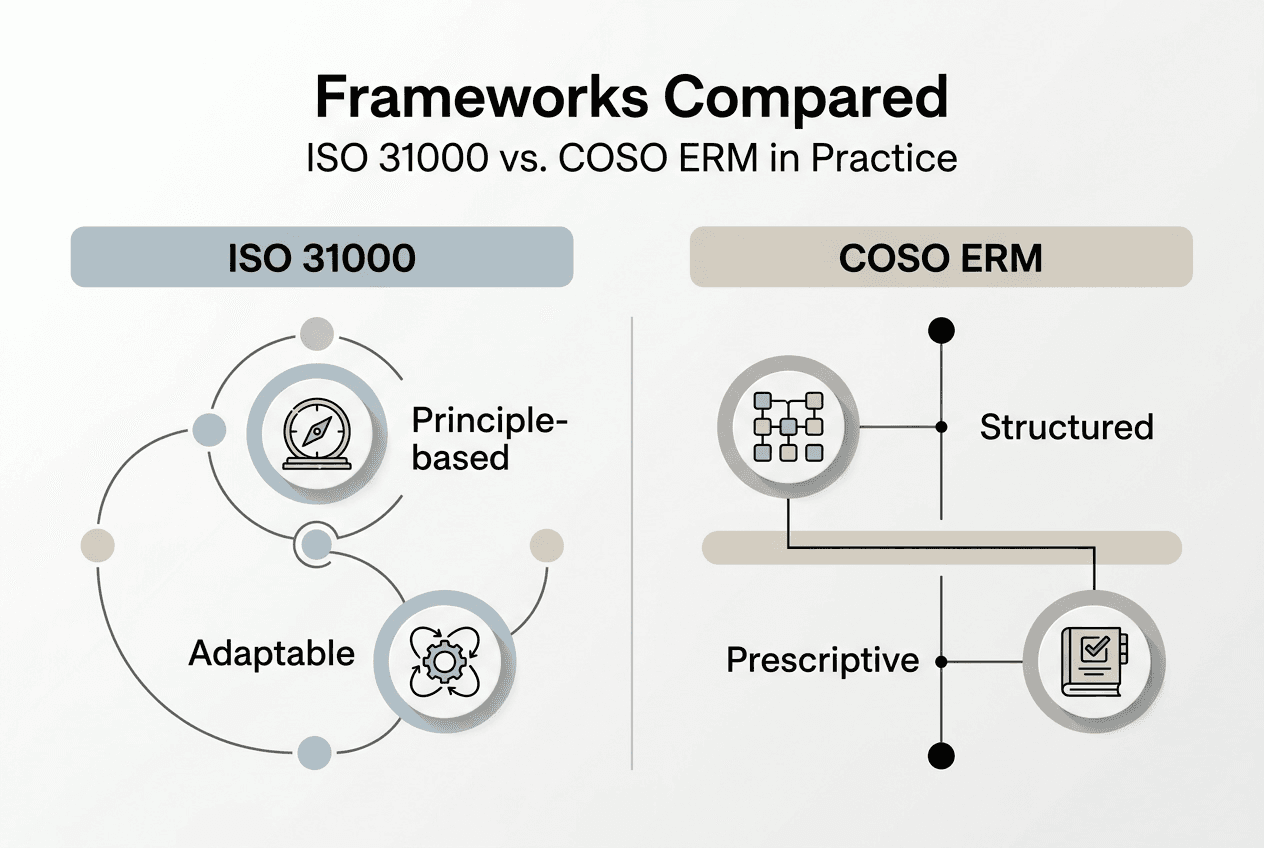
Two dominant frameworks guide risk management practices globally. ISO 31000 uses principle-based international standards while COSO ERM provides prescriptive U.S.-developed components. Understanding their differences and synergies enables strategic framework selection.

ISO 31000 emphasizes flexibility and adaptability across diverse organizational contexts. Its principle-based approach allows customization to industry-specific needs without mandating rigid structures. The framework focuses on creating value, integrating risk management into all organizational activities, and promoting continual improvement. Organizations appreciate ISO 31000 for its applicability across sectors and compatibility with existing management systems.
COSO ERM delivers detailed guidance on governance, strategy, performance, and reporting. Its prescriptive nature provides clear implementation roadmaps particularly valuable for organizations navigating complex regulatory requirements. The framework explicitly connects risk management to strategy setting and performance management, emphasizing how risk considerations should inform strategic choices.
| Framework aspect | ISO 31000 | COSO ERM | | — | — | | Origin and scope | International standard, principle-based | U.S.-developed, prescriptive framework | | Structure | Flexible guidelines adaptable to context | Detailed components and implementation steps | | Primary focus | System-wide risk integration | Governance, controls, and performance | | Best application | Diverse industries seeking adaptability | Regulatory compliance and internal controls |
Both frameworks share fundamental objectives around building organizational resilience, embedding risk culture, and creating stakeholder value. They recognize risk management as integral to achieving strategic objectives rather than a separate compliance function. Leadership commitment and clear accountability structures underpin success with either approach.
Organizations benefit from applying both frameworks complementarily: ISO 31000 for flexible system-wide guidance and COSO ERM for governance and compliance focus. This dual approach provides comprehensive coverage addressing both strategic adaptability and regulatory rigor. Financial institutions often adopt COSO ERM for regulatory alignment while using ISO 31000 principles for operational risk management.
Pro Tip: Map your organization’s specific needs before selecting frameworks. If regulatory compliance dominates concerns, COSO ERM provides structured guidance. For organizations prioritizing operational flexibility across diverse units, ISO 31000 offers adaptable principles.
Implementation considerations differ between frameworks. ISO 31000 requires organizations to develop customized processes fitting their unique context, demanding greater upfront design effort. COSO ERM provides ready-made structures reducing design time but potentially requiring adaptation to fit organizational realities. Evaluating internal controls becomes more systematic when frameworks align with existing governance structures.
The choice between frameworks often reflects organizational maturity and regulatory environment. Emerging organizations may prefer ISO 31000’s flexibility as they establish risk practices. Mature organizations in heavily regulated industries gravitate toward COSO ERM’s detailed requirements. Understanding why internal controls matter helps contextualize framework selection within broader governance objectives.
Comparative analysis reveals ISO 31000 and COSO ERM address different organizational priorities while sharing core risk management principles. Neither framework is universally superior; effectiveness depends on organizational context, regulatory requirements, and strategic priorities.
The strategic importance of risk assessment in compliance and auditing
Risk assessment forms the backbone of effective compliance and internal audit functions. Risk and Controls Self-Assessment is crucial for compliance officers and internal auditors ensuring proactive risk management and regulatory adherence. RCSA empowers business units to identify and evaluate risks within their domains, fostering ownership and accountability.
The RCSA process follows five key steps. First, scope definition establishes boundaries and objectives for the assessment. Second, risk identification catalogs potential exposures through workshops and interviews. Third, control evaluation assesses existing controls’ design and operating effectiveness. Fourth, gap analysis identifies control deficiencies requiring remediation. Fifth, action planning develops specific responses to address identified gaps.
Risk assessment directly supports audit risk evaluation by highlighting areas warranting detailed examination. Internal auditors leverage enterprise risk assessments to allocate limited audit resources toward highest-risk areas. This risk-based approach ensures audit coverage aligns with actual organizational exposures rather than historical patterns or arbitrary cycles.
Integrating risk assessment results into governance and reporting creates transparency around organizational risk posture. Board risk committees rely on comprehensive risk assessments to oversee management’s risk-taking activities and ensure alignment with approved risk appetite. Regular risk reporting enables timely intervention when exposures exceed acceptable thresholds.
Key benefits of risk assessment for compliance and auditing include:
Prioritized resource allocation focusing effort on material risks rather than spreading resources thinly
Enhanced regulatory compliance through systematic identification of regulatory requirements and associated risks
Improved control design by aligning control activities directly with assessed risks and their characteristics
Proactive issue identification enabling preventive action before risks materialize into losses or compliance failures
Stakeholder confidence building through demonstrated risk awareness and management capability
Evidence-based decision making replacing intuition with structured analysis of risk likelihood and impact
Compliance officers use risk assessments to prioritize monitoring activities and compliance testing. High-risk areas receive more frequent and intensive oversight while lower-risk areas undergo periodic validation. This differentiated approach optimizes compliance resource deployment and demonstrates risk-based thinking to regulators.
Risk assessment’s role in compliance extends beyond identifying current exposures to anticipating emerging risks from regulatory changes, market shifts, or technological disruption. Forward-looking risk assessment positions organizations to adapt proactively rather than react to crises.
Internal auditors leverage risk assessment findings to develop annual audit plans reflecting current risk landscapes. Dynamic risk assessment enables mid-year plan adjustments when new risks emerge or existing risks evolve. This agility ensures audit activities remain relevant and valuable to stakeholders.
The integration of risk assessment with performance management creates powerful synergies. Organizations that embed risk considerations into performance metrics and incentive structures align employee behavior with risk appetite. This cultural integration proves more effective than standalone risk policies in shaping actual risk-taking behavior.
Current market trends and future outlook for risk assessment practices
The risk management market demonstrates explosive growth reflecting increasing strategic importance. The global market reached $12.6 billion in 2022 and projects to $52 billion by 2032, growing at 15.4% CAGR during the forecast period. This expansion signals widespread recognition of risk management as a value driver rather than cost center.
| Market metric | 2022 baseline | 2032 projection | Growth rate | | — | — | | Market value | $12.6 billion | $52 billion | 15.4% CAGR | | Primary drivers | Regulatory pressure, technology adoption | Strategic integration, digital transformation | Accelerating |
Several factors fuel this dramatic market expansion. Regulatory complexity continues intensifying across industries, compelling organizations to invest in sophisticated risk management capabilities. Technology advancement enables more accurate and efficient risk assessment through data analytics, artificial intelligence, and automation. Strategic value recognition positions risk management as integral to competitive advantage rather than mere compliance.
Digital tools transform risk assessment accuracy and efficiency dramatically. Advanced analytics process vast datasets identifying risk patterns invisible to manual analysis. Machine learning algorithms detect anomalies signaling emerging risks before they manifest in traditional indicators. Real-time monitoring replaces periodic assessments, enabling faster response to changing risk profiles.
“The global risk management market was valued at $12.6 billion in 2022 and is projected to reach $52 billion by 2032, growing at a compound annual growth rate of 15.4% during the forecast period.”
Emerging trends reshaping risk assessment methodologies include:
Artificial intelligence integration automating routine risk identification and analysis tasks
Predictive analytics forecasting risk likelihood and impact with increasing sophistication
Continuous monitoring replacing point-in-time assessments with real-time risk visibility
Integrated risk platforms consolidating previously siloed risk data into unified views
Behavioral risk analytics examining human factors and culture as risk drivers
Climate risk assessment incorporating environmental exposures into enterprise risk frameworks
Cyber risk quantification translating technical vulnerabilities into financial impact metrics
The shift toward integrated risk management platforms reflects demand for holistic risk visibility. Organizations tire of fragmented point solutions requiring manual consolidation. Integrated platforms aggregate operational, financial, compliance, and strategic risks into unified dashboards enabling comprehensive risk oversight.
Risk culture receives growing attention as organizations recognize that frameworks and tools alone cannot ensure effective risk management. Leading organizations invest in risk awareness training, embed risk discussions in decision processes, and align incentives with risk appetite. This cultural emphasis complements technical risk assessment capabilities.
Regulatory expectations continue evolving toward more sophisticated risk management practices. Supervisory bodies increasingly expect dynamic risk assessment, scenario analysis, and stress testing rather than static compliance checklists. Organizations must enhance risk capabilities to meet these elevated expectations and demonstrate risk management maturity.
The integration of risk assessment with strategic planning represents a maturation of risk management practice. Forward-thinking organizations conduct risk assessments during strategy development rather than after strategy setting. This proactive approach ensures strategic choices reflect realistic risk-return tradeoffs and align with organizational risk capacity.
Advance your risk management skills with expert CPE training
Mastering risk assessment frameworks and methodologies requires ongoing professional development as practices evolve and regulations change. Compliance Seminars offers comprehensive CPE training designed specifically for internal auditors, compliance officers, and risk management professionals seeking to enhance their expertise.
Our 2026 training calendar features in-person CPE events across multiple cities covering risk assessment, internal controls, and compliance frameworks. These intensive sessions provide hands-on practice with ISO 31000, COSO ERM, and industry-specific risk methodologies. Led by instructors with Big 4 backgrounds, our courses deliver practical insights grounded in real-world experience.
For flexible learning, explore our internal auditor CPE webinars offering focused sessions on risk assessment techniques, control evaluation, and audit planning. These NASBA-approved programs fit busy schedules while maintaining rigorous educational standards. Whether you’re new to risk assessment or seeking advanced techniques, our internal auditing basics training provides the foundation for excellence in risk-based auditing.
Frequently asked questions
What is the difference between risk assessment and risk management?
Risk assessment identifies, analyzes, and evaluates specific risks to organizational objectives. Risk management encompasses the complete cycle including risk assessment, treatment, monitoring, and communication. Assessment represents one critical phase within the broader management process.
How do ISO 31000 and COSO ERM frameworks complement each other?
ISO 31000 provides flexible, principle-based guidance adaptable across diverse organizational contexts and industries. COSO ERM delivers detailed governance focus with prescriptive components for regulatory compliance and internal controls. Organizations using both frameworks gain comprehensive coverage addressing strategic adaptability and regulatory rigor simultaneously.
Why is risk assessment critical for compliance officers and internal auditors?
Risk assessment enables proactive identification of exposures before they materialize into compliance failures or operational losses. It supports regulatory adherence by systematically cataloging requirements and associated risks. For auditors, risk assessment drives resource allocation toward highest-impact areas ensuring audit coverage aligns with actual organizational exposures.
What emerging trends should risk professionals watch in 2026?
Artificial intelligence and advanced analytics increasingly automate risk identification and enable predictive risk modeling. Integration of risk considerations into strategic planning transforms risk management from reactive compliance to proactive value creation. Climate risk, cyber risk quantification, and behavioral risk analytics represent rapidly evolving specializations requiring new assessment methodologies and expertise.
Recommended
Comments