Internal audit reporting process 2026: Cut errors by 25%


Internal audit reports often get stuck in revision cycles or misunderstood by stakeholders, costing you credibility and time. Unclear language, missed compliance checkpoints, and delayed delivery frustrate audit teams and executives alike. This guide walks you through the essential prerequisites, step by step process, compliance requirements, common mistake fixes, and success metrics to produce clear, compliant reports that reduce errors by up to 25% and accelerate decision making in 2026.
Table of Contents
Key takeaways
Point | Details |
Prerequisites matter | Trained teams, standardized templates, and clear stakeholder maps set the foundation for quality reports. |
Follow structured steps | Planning, evidence collection, drafting, review cycles, and distribution ensure accuracy and compliance. |
Compliance is mandatory | SOX and COSO frameworks dictate content, timelines, and control documentation for U.S. public companies. |
Avoid common pitfalls | Simplify jargon, conduct multiple reviews, and focus on key findings to prevent rework and delays. |
Leverage tools | Templates and audit software cut preparation time, improve consistency, and reduce errors by 25%. |
Prerequisites: What you need before starting internal audit reporting
Before you draft a single finding, gather the right tools and knowledge. Skipping this step leads to rework, missed deadlines, and compliance gaps. Here’s what every audit team needs before launching the reporting process in 2026.
First, ensure your team has effective internal audit training on professional report writing and current regulatory standards. Audit staff must understand how to translate technical findings into clear, actionable language for executives and board members. Without this skill set, reports get stuck in revision loops.
Second, secure access to standardized, up to date reporting templates aligned with your organization’s compliance requirements. Templates save hours of formatting time and ensure consistent structure across all audit reports. They also reduce the risk of omitting mandatory sections like executive summaries or control deficiency classifications.
Third, develop a clear understanding of your organization’s risk profile, control environment, and applicable frameworks such as SOX and COSO. You can’t write a credible report without knowing which controls matter most and how they map to enterprise risks. Review prior audit findings, management action plans, and updated risk assessments.
Finally, define a stakeholder map for report distribution and communication strategy. Identify who receives draft reports, who approves final versions, and what format each audience prefers. Executives may want a one page summary, while audit committees need full documentation of control deficiencies.
Trained audit team with report writing skills and regulatory knowledge
Standardized templates that match compliance and organizational requirements
Clear grasp of risk, control environment, SOX, and COSO frameworks
Defined stakeholder map with distribution and communication protocols
Step by step internal audit reporting process
With prerequisites in place, follow this structured sequence to produce reports that meet 2026 compliance standards and stakeholder expectations. Each step builds on the previous one, so don’t skip ahead.
Step 1: Plan the reporting process and assign responsibilities
Plan the reporting process and assign responsibilities to ensure accountability and clarity throughout report preparation. Designate a lead author, identify reviewers, and set deadlines for each draft stage. Clear ownership prevents bottlenecks and confusion.
Step 2: Collect and analyze audit evidence
Gather all supporting documentation, interview notes, and test results before you start writing. Strong evidence backs up every finding and recommendation. Organize evidence by control objective or risk category to simplify drafting. Use the internal audit process guide to structure your evidence collection workflow.
Step 3: Draft clear, jargon free reports with executive summaries
Write in plain language. Avoid technical jargon that confuses non auditors. Start every report with a concise executive summary highlighting key findings, risks, and recommended actions. Executives read summaries first, so make them count. Consider audit report writing training to sharpen your drafting skills.

Step 4: Incorporate multiple review cycles with stakeholder feedback
Circulate draft reports to audit management, legal, and relevant business units. Collect feedback on clarity, accuracy, and tone. Multiple review cycles catch errors early and ensure findings align with organizational context. Schedule at least two internal reviews before submitting to audit committees.
Step 5: Finalize and distribute reports according to policy
Once all reviewers sign off, finalize the report and distribute it per your stakeholder map. Track acknowledgment and follow up on management action plans. Archive the final report and supporting documentation to meet retention requirements.
Plan responsibilities and deadlines for accountability
Collect and organize audit evidence by control objective
Draft reports in plain language with strong executive summaries
Conduct multiple review cycles with stakeholder input
Finalize, distribute, and archive per organizational policy
Compliance with SOX and COSO frameworks in reporting
U.S. public companies must adhere to Sarbanes Oxley Act requirements and align control evaluations with the COSO framework. Non compliance exposes your organization to regulatory penalties, restatements, and reputational damage. Here’s how to embed compliance into every audit report in 2026.
SOX Section 404 mandates that internal audit reports include documentation of significant findings and control deficiencies for SOX compliance per PCAOB auditing standards. Material weaknesses and significant deficiencies must be clearly identified, with evidence supporting each classification. Ambiguous language or incomplete documentation can trigger regulatory scrutiny.
Align control evaluations explicitly with COSO framework components: control environment, risk assessment, control activities, information and communication, and monitoring. Each audit finding should map to at least one COSO component to demonstrate comprehensive coverage. This alignment also helps management understand how deficiencies impact overall internal control effectiveness.
Meet SOX reporting timelines to ensure timely delivery. Public companies must file annual assessments of internal controls over financial reporting within required deadlines. Late or incomplete reports delay SEC filings and erode investor confidence. Build buffer time into your reporting schedule to accommodate unexpected issues.
Integrate SOX and COSO key compliance elements into report templates for consistency. Standardized templates prompt auditors to address mandatory sections like control deficiency classifications, management responses, and remediation timelines. Templates also reduce the risk of omitting critical compliance information.
“SOX compliance isn’t optional. Every audit report must document control deficiencies with clear severity classifications and evidence trails. Failing to meet PCAOB standards puts your organization at regulatory risk.”
Document significant findings and deficiencies per PCAOB standards
Align every control evaluation with COSO framework components
Meet SOX reporting deadlines to avoid filing delays
Use templates that embed SOX and COSO compliance checkpoints
For practical guidance on SOX requirements, review SOX compliance steps to ensure your reports meet all regulatory expectations.
Common mistakes and resolution strategies in audit reporting
Even experienced audit teams make reporting errors that trigger rework and delays. Recognizing these pitfalls early helps you avoid them and deliver higher quality reports faster.
Excessive technical jargon causes miscommunication and delays
Audit reports filled with acronyms, complex frameworks, and industry jargon confuse stakeholders who lack technical backgrounds. Executives and board members need plain language explanations of risks and recommendations. Simplify your writing and define technical terms on first use. Add executive summaries that distill findings into clear, actionable insights.
Insufficient review cycles increase errors and rework
Rushing through one quick review before submission leads to factual errors, inconsistent formatting, and unclear recommendations. Multiple review stages with diverse stakeholders catch mistakes early and improve report quality. Schedule at least two internal reviews plus one management review before finalizing.
Overloaded reports with irrelevant details get rejected or reissued
Including every minor observation or control test result buries key findings and frustrates readers. Focus reports on material findings, significant deficiencies, and high priority recommendations tailored to your audience’s needs. Save detailed test results for appendices or separate workpapers.
Pro Tip: Before submitting any audit report, read the executive summary aloud. If you stumble over jargon or can’t explain a finding in one sentence, rewrite it. Clarity beats complexity every time.
Replace jargon with plain language and define technical terms
Conduct at least two internal reviews plus management feedback
Focus on material findings and trim irrelevant details
Test readability by reading summaries aloud before submission
Learn from common audit mistakes to prevent issues before they derail your reporting process.
Tools, templates, and automation to streamline reporting
Technology transforms audit reporting from a manual, error prone process into a streamlined, consistent workflow. The right tools cut preparation time and improve accuracy without sacrificing quality.
Standardized templates significantly reduce report preparation time and improve format consistency. Templates provide pre built sections for executive summaries, findings, recommendations, and management responses. They ensure every report includes mandatory compliance elements and follows organizational branding standards. Teams using templates report 30% faster drafting times compared to starting from scratch.
Audit management software automates report generation and workflow, cutting errors and accelerating timelines. These platforms integrate evidence collection, finding documentation, and report drafting into one system. Automated workflows route drafts to reviewers, track changes, and maintain version control. Software also generates standard reports with one click, reducing manual formatting work.
Balancing automation with manual review ensures accuracy and contextual relevance. Technology handles repetitive tasks like formatting and data integration, freeing auditors to focus on analysis and narrative quality. However, automated reports still need human review to ensure findings make sense in organizational context and recommendations are practical.
Efficiency gains can be measured by tracking report preparation time and error rates pre and post adoption. Establish baseline metrics before implementing new tools, then compare results after three to six months. Most teams see 20 to 30% reductions in preparation time and 25% fewer errors with templates and software.
Approach | Preparation Time | Error Rate | Consistency | Cost |
Manual drafting | 6-8 weeks | High | Variable | Low upfront |
Standardized templates | 4-6 weeks | Medium | High | Low |
Audit management software | 3-5 weeks | Low | Very high | Medium to high |
Pro Tip: Start with standardized templates before investing in expensive software. Templates deliver immediate time savings and consistency improvements with minimal training. Once your team masters templates, evaluate whether software will add enough value to justify the cost.
Explore latest audit reporting tools to find solutions that fit your organization’s size, complexity, and budget.
Expected outcomes and success metrics for effective reporting
Implementing a structured reporting process with the right tools and compliance focus delivers measurable improvements. Here’s what you should expect after following this guide.
Typical completion timeframe is 4 to 6 weeks after audit fieldwork. This includes evidence review, drafting, multiple review cycles, management responses, and finalization. Teams using templates and software often complete reports in 3 to 5 weeks. Track your average completion time to identify bottlenecks and improve efficiency.
Unresolved audit findings decrease by approximately 15% within three months. Clear, actionable recommendations with management buy in lead to faster remediation. Well written reports help management understand risks and prioritize fixes, reducing the backlog of open findings.
Stakeholder decision making speed improves by 35% after receiving clear reports. Executives and board members can quickly grasp key risks and approve action plans when reports use plain language and strong executive summaries. Faster decisions mean faster risk mitigation.
Audit report errors and rework rates can reduce by up to 25% with effective review processes. Multiple review cycles, stakeholder feedback, and standardized templates catch mistakes before submission. Fewer errors mean less time spent on revisions and higher credibility with stakeholders.
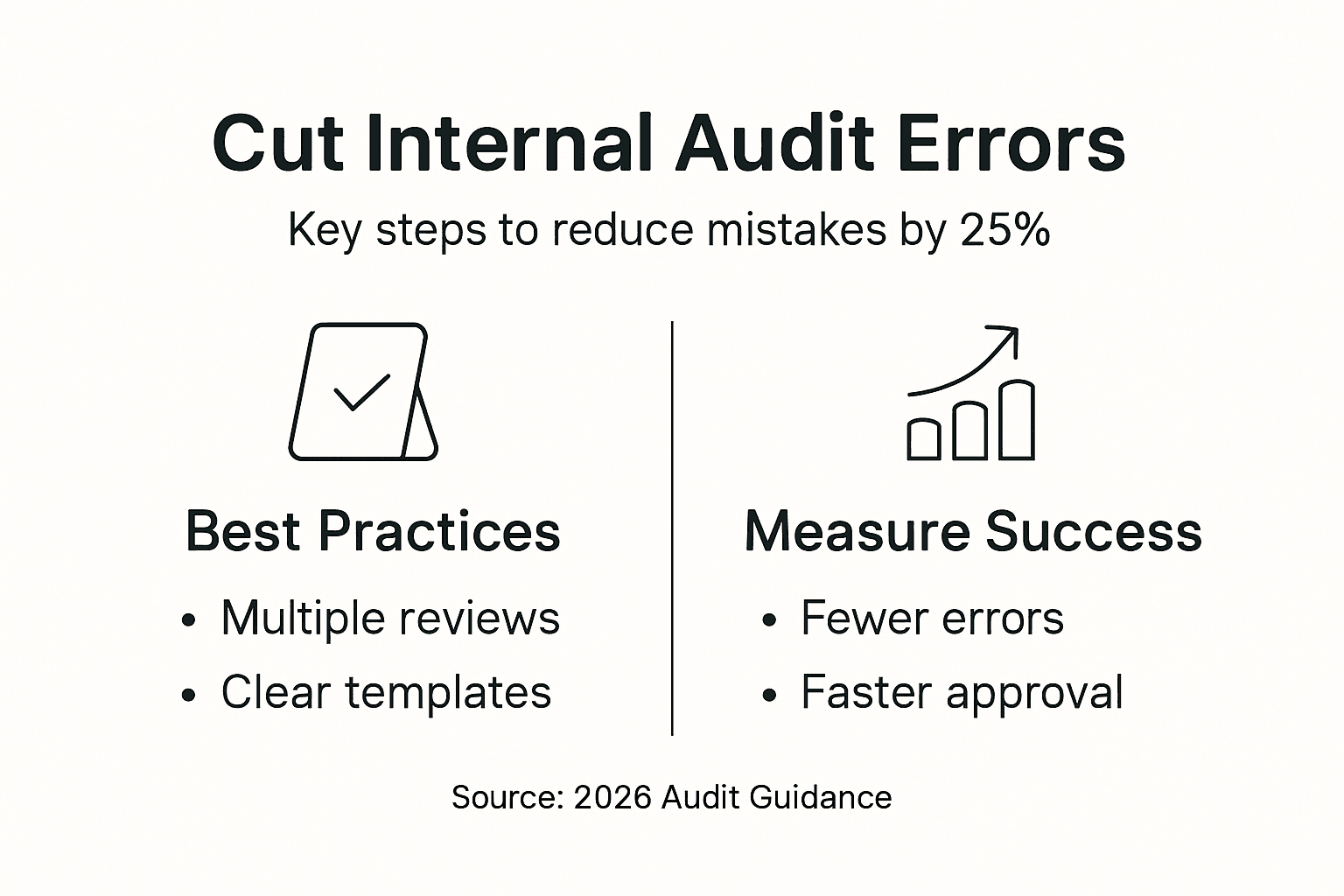
Metric | Baseline | Target Improvement | Measurement Period |
Report completion time | 6-8 weeks | 4-6 weeks | Per audit cycle |
Unresolved findings | Varies | 15% reduction | 3 months |
Stakeholder decision speed | Varies | 35% faster | Per report |
Error and rework rate | Varies | 25% reduction | 6 months |
Track these metrics quarterly to assess your reporting process effectiveness. Share results with audit leadership and use them to justify investments in training, templates, or software. For more guidance on measuring success, review audit reporting success metrics.
Enhance your internal audit skills with expert training
Mastering audit reporting requires continuous learning and staying current with evolving standards. Professional training sharpens your skills, keeps you compliant, and advances your career in 2026.
Access live CPE webinars covering internal audit reporting, SOX compliance, COSO frameworks, and control testing through internal auditor CPE webinars. These sessions provide practical guidance from industry experts with Big 4 backgrounds. Earn CPE credits while learning techniques you can apply immediately.
Attend in person training events tailored to audit, compliance, and cybersecurity professionals. Live events offer networking opportunities and hands on exercises that deepen your understanding of complex topics. You’ll leave with templates, checklists, and frameworks ready to use in your organization.
Stay updated with the 2026 CPE event calendar to fulfill professional education requirements and maintain your CPA, CIA, CISA, or CFE certifications. Regular training keeps you ahead of regulatory changes and industry best practices.
FAQ
What are the common pitfalls to avoid in internal audit reporting?
Avoid excessive jargon that confuses stakeholders by simplifying language and using executive summaries. Conduct multiple review cycles to catch errors before submission. Focus reports on material findings tailored to audience needs rather than overloading with irrelevant details. Maintain stakeholder involvement throughout the process to ensure clarity and buy in.
How do SOX and COSO frameworks influence the reporting process?
SOX requires documenting significant findings and control deficiencies per PCAOB standards for public companies. COSO guides control evaluations by mapping findings to framework components like control environment, risk assessment, and monitoring. Both frameworks dictate report content, timelines, and evidence requirements to ensure comprehensive audit coverage and regulatory compliance.
What tools can improve efficiency in audit report preparation?
Standardized templates ensure consistency and cut drafting time by 30% compared to starting from scratch. Audit management software automates data integration, workflow routing, and version control, reducing errors by 25%. Balance automation with manual review to maintain contextual accuracy. Track preparation time and error rates to measure tool effectiveness.
How can audit teams measure the success of their reporting process?
Track report completion times with a target of 4 to 6 weeks after fieldwork ends. Monitor reduction in unresolved findings, aiming for a 15% decrease within three months. Assess stakeholder decision making speed improvements, expecting a 35% boost from clearer reports. Evaluate reduction in report errors and rework, targeting a 25% decrease over six months.
Recommended
Comments