How to evaluate compliance frameworks for effective oversight


TL;DR:
Evaluating your compliance framework’s effectiveness is challenging because on-paper programs often lack real-world verification.
Using layered methodologies like gap analysis, risk assessment, maturity models, and the DOJ’s test provides comprehensive, credible insights into program performance and improvement opportunities.
Evaluating whether your compliance framework actually works is one of the most demanding responsibilities a compliance or risk executive faces. It’s easy to build a program that looks strong on paper. It’s far harder to verify that it performs under real regulatory scrutiny. Only 37% of leaders express confidence in their ability to assess compliance program effectiveness, which means the majority are operating with significant blind spots. This guide cuts through surface-level checklists and walks you through proven methodologies, practical measurement tools, and the evaluative lens that regulators actually use.
Table of Contents
Maturity models for measuring compliance program effectiveness
The DOJ’s three-pronged test: How prosecutors evaluate compliance
Key metrics, benchmarks, and common pitfalls in compliance framework evaluation
Why most compliance framework evaluations fall short—our take
Get hands-on with compliance evaluation: Next steps for your team
Key Takeaways
Point | Details |
Use multiple evaluation methods | Combine gap analysis, risk assessment, maturity models, and DOJ criteria for a thorough compliance framework assessment. |
Prioritize high-impact gaps | Remediate risks by scoring and addressing critical compliance gaps first for efficient resource use. |
Emphasize continuous improvement | Apply maturity models and benchmarking to ensure your compliance program evolves with your industry and regulation. |
Track the right metrics | Regularly monitor hotline activity, testing success, and audit response times for actionable insight. |
Avoid paper programs | Integrate compliance assessment into daily operations and monitor continually to prevent static or siloed frameworks. |
Core methodologies for evaluating compliance frameworks
To address assessment gaps, you first need a clear picture of the evaluation tools available to you. Each methodology brings different strengths, and the best programs combine several of them.
Core evaluation methodologies include gap analysis, risk assessment, maturity models, and the DOJ’s three-pronged test. No single approach gives you a complete view on its own. Gap analysis tells you where you fall short against a specific regulatory standard. Risk assessment helps you quantify exposure and prioritize resources. Maturity models measure program sophistication over time. The DOJ test reveals whether your program would survive prosecutorial scrutiny.
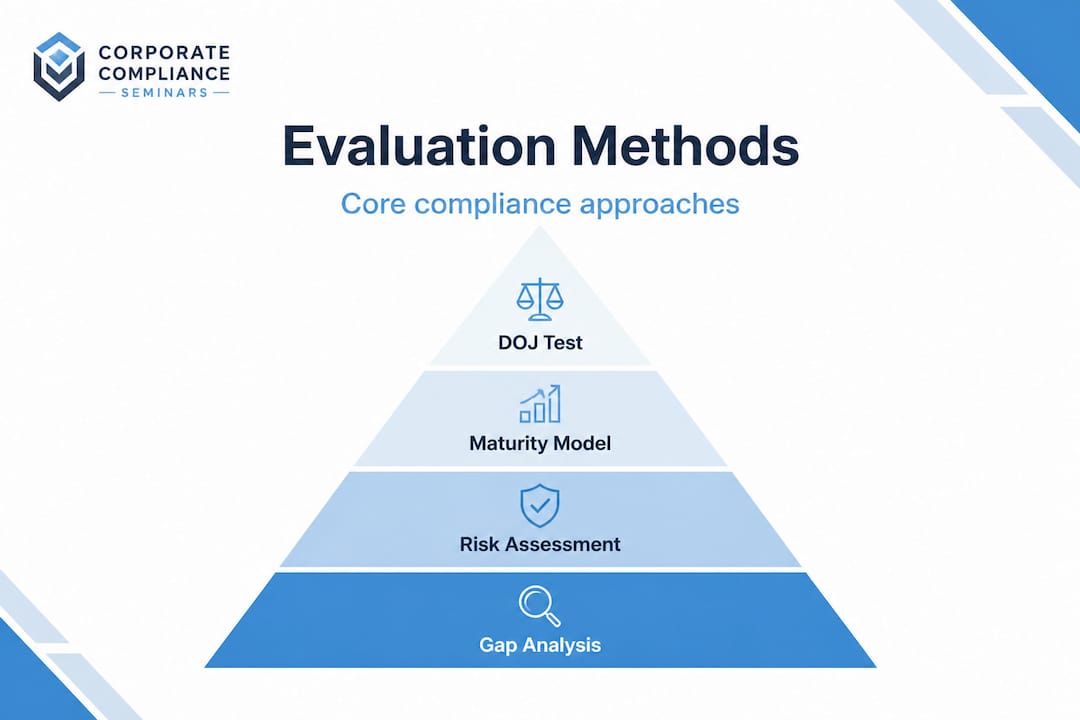
Here’s how they compare at a glance:
Methodology | Primary question answered | Best used for |
Gap analysis | Where do we fall short vs. requirements? | Regulatory readiness assessments |
Risk assessment | What risks pose the greatest threat? | Prioritizing control investments |
Maturity model | How sophisticated is our program? | Continuous improvement roadmaps |
DOJ three-pronged test | Would we pass enforcement review? | Pre-investigation self-assessments |
When building your evaluation approach, consider layering these methodologies. A common pattern is to start with a cybersecurity framework assessment grounded in gap analysis, then apply a maturity model to understand program trajectory. You can also anchor the process in a structured COSO compliance assessment, which provides an internal control framework most audit professionals already understand.
Key benefits of a combined approach include:
Broader coverage: Each methodology catches blind spots the others miss.
Defensibility: Multiple evaluation inputs produce more credible findings.
Prioritization clarity: Combining risk scoring with gap analysis tells you not just what’s broken, but what to fix first.
Stakeholder alignment: Maturity benchmarks communicate program progress in terms leadership understands.
Strong risk assessment practices underpin all of these methodologies. Without a reliable understanding of your risk landscape, even a well-structured gap analysis can lead you to remediate low-priority items while high-exposure gaps go unaddressed.
How to perform gap analysis: Step-by-step process
Among the methodologies, gap analysis is often the critical starting point. It produces concrete, actionable findings tied directly to regulatory requirements, making it essential for any compliance evaluation.
A rigorous gap analysis follows seven defined steps:
Define regulatory scope: Identify which regulations, standards, or frameworks apply. Be specific. A financial institution may need to scope across BSA/AML, SOX, and state-level licensing requirements simultaneously.
Inventory existing controls: Document every control currently in place, including policies, procedures, system configurations, and manual oversight activities.
Map requirements to controls: Link each regulatory requirement to the controls designed to satisfy it. Orphaned requirements with no control mapping are immediate red flags.
Evaluate control effectiveness: Assess whether existing controls actually work. A policy that exists but isn’t followed is not an effective control.
Score identified gaps: Assign each gap a risk score based on impact and likelihood. This is where professional judgment plays a critical role.
Prioritize remediation: Address high-impact, high-likelihood gaps first. Resist the temptation to remediate easy items before critical ones.
Monitor progress: Track remediation completion and verify that new controls are functioning as intended.
Here’s an example of how to structure your gap tracking data:
Requirement | Existing control | Effectiveness rating | Gap severity | Remediation priority |
Data retention policy | Written policy exists | Low (not enforced) | High | Critical |
Access control reviews | Quarterly reviews | High | None | N/A |
Incident reporting SLA | Verbal process only | Low | High | Critical |
Vendor risk assessments | Annual assessments | Moderate | Medium | High |
This kind of structured inventory makes it far easier to communicate findings to leadership and to track closure over time. Aligning your gap findings with key regulatory requirements ensures you’re not missing emerging obligations that may not have been part of prior assessments.
Pro Tip: If you’re conducting a SOX-specific gap analysis, a structured SOX compliance checklist can accelerate the scoping phase and help ensure you don’t overlook financial reporting control requirements unique to banking environments.
The scoring step is where many evaluations lose rigor. Severity ratings need to reflect actual business and regulatory exposure, not just how difficult the control gap is to close. A gap that is easy to fix but low in risk should never crowd out a complex gap with significant enforcement consequences.
Maturity models for measuring compliance program effectiveness
While gap analysis reveals present gaps, maturity models provide a roadmap for ongoing enhancement. They answer a different question: not just “are we compliant today?” but “how capable and sustainable is our compliance program over time?”
Compliance maturity models typically assess programs across four to five levels, moving from reactive to proactive to optimized. Each level represents a distinct stage of program sophistication:
Level 1 (Reactive): Compliance is ad hoc and driven by incidents or regulatory findings. Controls exist informally if at all.
Level 2 (Developing): Basic policies and procedures are documented, but implementation is inconsistent and monitoring is limited.
Level 3 (Defined): Controls are formally documented, systematically implemented, and subject to periodic review. Most organizations at this level meet minimum regulatory expectations.
Level 4 (Managed): Compliance functions are data-driven, with quantitative metrics guiding decisions. Testing and monitoring are continuous rather than periodic.
Level 5 (Optimized): The program is fully integrated into business operations, with predictive analytics and continuous improvement embedded in the culture.
Most organizations we encounter in our training programs fall between Level 2 and Level 3. That gap matters considerably because Level 3 is often the threshold regulators expect for programs in complex industries.
The key dimensions evaluated in a maturity model include:
Governance structure: Is there clear ownership of compliance at the board and executive level?
Risk assessment processes: Are risks identified systematically and updated regularly?
Training and awareness: Are employees receiving targeted, effective training rather than generic annual check-the-box sessions?
Monitoring and testing: Is there an ongoing program to verify control effectiveness?
Response and reporting: How quickly and thoroughly does the organization respond to identified failures?
“Maturity models are not just diagnostic tools—they are strategic roadmaps. The goal is not to achieve a score. The goal is to understand where your program is and what it takes to operate at the next level.”
Benchmarking your maturity level against industry peers provides additional context. Understanding how your program compares to sector norms is particularly important when preparing for regulatory examinations. Reviewing engagement metrics benchmarks can inform how to set realistic improvement targets aligned with sector performance expectations.

The DOJ’s three-pronged test: How prosecutors evaluate compliance
As regulators raise the bar, it’s essential to understand how enforcement agencies actually evaluate your program’s substance. The Department of Justice’s Evaluation of Corporate Compliance Programs (ECCP) is the framework federal prosecutors use when assessing whether a company’s compliance program deserves credit in charging decisions and sentencing.
The DOJ’s ECCP organizes its evaluation around three core questions:
Is the program well-designed? Prosecutors examine whether risk assessments are current, policies are comprehensive and clear, and training is targeted to relevant roles and actual risk exposures.
Is it adequately resourced and empowered to function? This means having dedicated compliance personnel, sufficient budget, and genuine independence from business units whose conduct is being overseen.
Does it work in practice? This is the hardest question to answer. It asks whether the program actually changes behavior, catches misconduct, and is continuously improved based on real-world experience.
Notice what the DOJ is not asking: they’re not asking whether policies exist. They’re asking whether those policies translate into real behavioral change.
Important: The ECCP emphasizes that static documentation tells prosecutors very little. What prosecutors look for is evidence of program evolution: updated risk assessments, revised training in response to new violations, and metrics that show the program actually informs decisions.
This framing should inform how you document your program. Keep records that show the program adapts. Maintain dated versions of risk assessments and training materials. Document the rationale for how you allocate compliance resources. These aren’t bureaucratic exercises. They are the evidence a regulator or prosecutor reviews when deciding whether your organization was genuinely committed to compliance.
Pro Tip: Review your compliance monitoring methods against the DOJ’s third question specifically. If your monitoring program is not producing documented findings and driving visible improvements, it will not satisfy prosecutorial expectations for an effective compliance program.
Key metrics, benchmarks, and common pitfalls in compliance framework evaluation
For rigorous evaluation, you need real-world indicators. Gut feel and anecdotal evidence are not sufficient when defending your program to regulators or your audit committee.
Critical compliance metrics to track include:
Hotline reports per 100 employees: Industry benchmarks range from 1 to 3.6 reports per 100 employees. Consistently low figures may indicate a culture where employees don’t trust the reporting system.
Control testing pass rates: Track what percentage of tested controls pass on first evaluation. Declining pass rates signal deteriorating program health.
Audit response time: Measure how many days it takes to close audit findings. Organizations at higher maturity levels close critical findings in days, not weeks.
Automated evidence collection rate: Higher-maturity programs automate 50 to 95 percent of compliance evidence collection, significantly reducing manual burden and human error.
Compliance cost savings: Organizations with mature compliance programs reduce compliance-related costs by 30 to 40 percent, largely through automation and proactive risk management.
Benchmarking these metrics against industry peers adds strategic value. Internal improvement trends matter, but understanding how you compare to organizations of similar size and regulatory profile tells you whether your program is genuinely strong or just incrementally better than a weak baseline.
Common pitfalls to avoid:
“Paper programs”: Policies that exist on paper but are not operationalized. Regulators and prosecutors dismiss these immediately.
Siloed assessments: Compliance evaluations that occur in isolation from operations, legal, IT, and HR produce incomplete findings.
Static programs: Compliance is not a project. Programs that are not continuously updated to reflect new risks, regulatory changes, and organizational events deteriorate quickly.
Over-complexity: Frameworks that are too elaborate for the organization’s actual risk profile create confusion and reduce practical compliance rates.
“The most dangerous compliance programs are the ones that look complete. They give executives false confidence while real risks go unmanaged.”
Review your financial compliance benchmarks periodically to ensure your measurement framework evolves alongside industry expectations. Integrate ongoing monitoring as a standing operational practice, not an annual exercise.
Why most compliance framework evaluations fall short—our take
Even with the right methodologies in hand, most evaluations underperform. We’ve seen this pattern repeatedly, and it nearly always traces back to a few predictable blind spots.
The first is over-reliance on documentation. Organizations invest significant effort producing detailed policies, control inventories, and training records, and then conclude the program is strong because the documentation looks comprehensive. Documentation is necessary but it is not evidence of effectiveness. An auditor or prosecutor can spot this distinction immediately. Real evaluation requires testing whether controls work, not just whether they’re written down.
The second blind spot is siloed evaluation. Compliance teams often assess the compliance function in isolation, without meaningful input from operations, finance, IT, or legal. This produces findings that are technically accurate but operationally incomplete. A control may pass a compliance review while failing to account for how the business actually processes transactions. Cross-functional evaluation is harder to organize, but it produces findings that genuinely reflect program performance.
The third issue is infrequency. Many organizations treat compliance framework evaluation as an annual project. In practice, regulatory environments, organizational structures, and risk landscapes change far more frequently than that. Embedding continuous monitoring strategies into your operational rhythm converts evaluation from a periodic audit into an ongoing intelligence function.
Technology can bridge much of this gap. Automated control testing, real-time monitoring dashboards, and integrated GRC platforms allow compliance teams to detect issues as they emerge rather than discovering them during annual reviews. The organizations that invest in these capabilities consistently outperform those that rely on manual, point-in-time assessments.
The bottom line is this: a compliance evaluation is only as strong as the process and independence behind it. If the team conducting the evaluation has a conflict of interest in the findings, or if the methodology is not rigorous enough to surface uncomfortable truths, the results will not protect you when it matters most.
Get hands-on with compliance evaluation: Next steps for your team
Translating these methodologies into practice requires more than reading about them. Compliance leaders who invest in structured, practitioner-led training apply evaluation frameworks with far greater precision and confidence.

At compliance-seminars.com, we offer targeted CPE training designed specifically for compliance officers, risk managers, and internal auditors who need to build and evaluate programs that hold up under real scrutiny. Our 2026 CPE event calendar features in-person events across major U.S. cities, covering framework evaluation, control testing, and regulatory assessment in depth. If scheduling requires flexibility, our internal auditor webinars deliver NASBA-recognized CPE in focused, one-to-two-hour formats that fit demanding executive schedules. For teams with specific cybersecurity compliance obligations, our cybersecurity CPE training addresses NIST, CMMC, and related frameworks in practical detail. Every course is developed and delivered by instructors with Big 4 and regulatory backgrounds who understand how evaluations perform under real-world conditions.
Frequently asked questions
What is the difference between gap analysis and maturity models?
Gap analysis identifies specific deficiencies against defined regulatory requirements and prioritizes remediation steps, while maturity models rate your program on a structured scale to support continuous improvement and long-term program development.
How often should compliance frameworks be reassessed?
Frameworks should be formally reviewed at least annually and whenever triggered by regulatory changes, significant organizational events such as mergers or leadership transitions, or after a compliance incident.
What are the main pitfalls to avoid when evaluating compliance frameworks?
Avoid over-complexity, siloed assessments, and static programs; integrate with business operations and use technology-driven monitoring to prevent your program from becoming a “paper program” that fails under enforcement scrutiny.
What metrics should we track to measure compliance program success?
Track hotline reports per 100 employees (industry benchmark: 1 to 3.6), control testing pass rates, audit response time, and automated evidence collection rates, as these metrics reflect actual program health rather than just documentation completeness.
Recommended
Comments