Enterprise risk management steps for effective compliance


TL;DR:
Fragmented risk management creates critical vulnerabilities and operational risks.
An effective ERM relies on a structured framework like COSO 2017 for coordination across organization levels.
Successful ERM implementation requires leadership sponsorship, cross-functional teams, data access, and clear risk ownership.
Fragmented risk management is not just inefficient. It is genuinely dangerous. When risk identification lives in one silo, response planning in another, and reporting somewhere else entirely, critical vulnerabilities slip through the gaps and surface as compliance failures, regulatory penalties, or operational crises. Organizations that treat risk management as a collection of disconnected activities consistently underperform those with a structured, organization-wide process. This guide walks through the essential enterprise risk management (ERM) steps that compliance officers, internal auditors, and risk professionals rely on to build defensible, auditable, and truly effective programs.
Table of Contents
Key Takeaways
Point | Details |
Follow a structured process | Using a proven framework like COSO’s 8 steps enables consistent, scalable risk management. |
Ensure organizational readiness | Strong governance, clear roles, and leadership buy-in are prerequisites for successful ERM. |
Integrate ERM with strategy | ERM delivers value when tied to organizational objectives and reviewed for continual improvement. |
Prioritize culture and communication | Effective ERM requires open dialogue, risk awareness, and engagement across teams. |
Understanding the foundations: Enterprise risk management essentials
With the need for robust ERM clear, it is vital to establish what makes up an effective framework. Enterprise risk management is the discipline of identifying, assessing, and responding to risks in a coordinated way across an entire organization. It moves risk oversight from departmental isolation into a unified, strategic function that informs decisions at the board level, the operational level, and everywhere in between.
The dominant standard in the field is the COSO 2017 ERM Framework. The COSO ERM framework organizes risk management into five integrated components: Governance and Culture, Strategy and Objective-Setting, Performance, Review and Revision, and Information, Communication, and Reporting. These five components are supported by 20 principles that guide practical application.
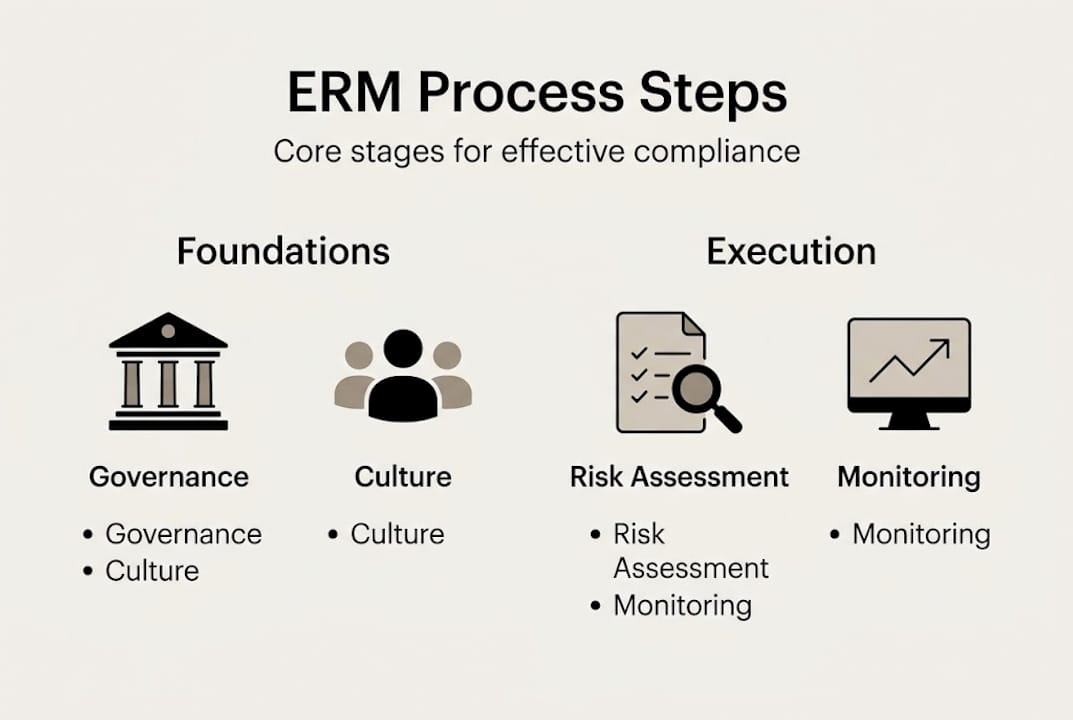
Here is a summary of how those principles cluster across the five components:
COSO component | Core focus areas |
Governance and Culture | Board oversight, operating structure, core values, talent commitment |
Strategy and Objective-Setting | Risk appetite, strategy formulation, business objectives |
Performance | Risk identification, assessment, prioritization, and response |
Review and Revision | Tracking changes, reviewing results, improving ERM over time |
Information, Communication, and Reporting | Risk data, reporting systems, communication across the entity |
Key principles embedded in these components include:
Establishing board risk oversight and management accountability
Defining risk appetite at the strategic level
Identifying and assessing risks by type, velocity, and severity
Selecting appropriate risk responses and aligning them with appetite
Building risk reporting systems that serve decision-makers
Performing ongoing reviews and incorporating lessons learned
Why does a defined framework matter? Because without it, ERM becomes whatever each team thinks it means. A framework creates a shared language, enables auditable processes, and allows internal controls to connect logically to risk responses. You can explore current ERM frameworks for 2026 that build on these foundations for modern organizations.
“A framework without cultural reinforcement is just documentation. The COSO ERM Framework succeeds when leaders treat it as a management philosophy, not a filing requirement.”
For professionals who want structured exposure to these principles, world-class ERM events bring framework theory into practical, applied learning contexts.
Preparing for ERM: Prerequisites and organizational readiness
Understanding the framework, the next step is building readiness so ERM launches smoothly and is sustained. Many ERM programs fail not because of poor execution but because the organization was not ready when implementation began.
According to COSO ERM implementation guidance, the first implementation step is to clarify purpose, scope, and governance. That alone requires significant preparation. Before any risk inventory is built, you need these prerequisites in place:
Executive sponsorship: A named C-suite or board-level champion who actively supports ERM, not just endorses it in writing.
Cross-functional risk team: Representatives from finance, operations, IT, legal, HR, and compliance who bring diverse risk perspectives.
Access to information systems: ERM requires data. Confirm access to financial reporting tools, operational dashboards, and audit management platforms.
Baseline policy framework: Existing policies on internal controls, code of conduct, and incident reporting provide the foundation ERM builds on.
Defined risk ownership: Someone must own each risk category. Ownership without accountability is a structural flaw.
Here is how each prerequisite directly affects ERM success:
Prerequisite | Impact on ERM |
Executive sponsorship | Drives adoption and resource allocation |
Cross-functional team | Prevents blind spots in risk identification |
Information system access | Enables data-driven risk assessment |
Baseline policy framework | Provides context for risk appetite setting |
Defined risk ownership | Ensures accountability and follow-through |
Pro Tip: Before launching ERM formally, conduct a brief readiness assessment covering governance clarity, data access, and cultural openness to risk discussion. This surfaces gaps that would otherwise derail implementation within the first six months.

Common pitfalls in rushed ERM launches include skipping the governance definition step, failing to communicate ERM’s purpose to business units, and treating the risk register as the end goal rather than one tool within a broader process. You can find detailed risk strategies for compliance officers that address exactly these structural challenges.
Step-by-step: Deploying the enterprise risk management process
Once prerequisites are met, the focus shifts to hands-on execution. Here is the practical guide to sequencing ERM deployment effectively.
Following the COSO ERM implementation steps, the process unfolds across eight core actions:
Clarify scope and purpose: Define what ERM covers, who is accountable, and what decisions it should inform.
Define risk appetite and taxonomy: Set the level of risk the organization is willing to accept, and categorize risks consistently using a shared taxonomy.
Build the risk inventory: Identify risks across strategic, operational, financial, compliance, and IT domains.
Create a portfolio view and prioritize: Use impact and likelihood assessments to prioritize risks across the full organization, not just by department.
Design risk responses: For each prioritized risk, select a response: avoid, accept, reduce, or share. Match response intensity to risk severity.
Integrate with strategy: Connect risk responses to strategic objectives. Risks that threaten strategic goals deserve the most attention.
Develop reporting structures: Create reporting mechanisms that give the board, audit committee, and compliance teams the information they need, at the right level of detail.
Launch periodic reviews: Build a review calendar into ERM governance. Risk environments change. Reviews keep ERM current.
One critical integration point is IT risk. Many organizations treat IT risk as a separate track. It belongs inside the main ERM inventory, assessed and prioritized alongside strategic and operational risks. A useful reference is the website security checklist for CPAs, which illustrates how IT risk touches every function.
Here is a comparison of qualitative versus quantitative risk metrics:
Metric type | Strengths | Limitations |
Qualitative (High/Medium/Low) | Fast, accessible, good for early-stage ERM | Subjective, inconsistent across teams |
Quantitative (KRIs, financial loss estimates) | Objective, supports trend analysis and benchmarking | Requires data infrastructure and modeling expertise |
For deeper guidance on sequencing these steps, review risk assessment steps for auditors and risk-based auditing methods that align with this process.
Pro Tip: Standardize your risk taxonomy early. Organizations that allow each business unit to name risks differently spend enormous time reconciling duplicates and miss systemic patterns that only appear when risks are consistently categorized.
Review, reporting, and continual improvement in ERM
After executing the ERM steps, it is essential to focus on how organizations keep the process alive and effective. Execution without review is incomplete. ERM that does not adapt to new information degrades quickly.
Reporting should follow the Three Lines Model. The Three Lines Model and quantitative KRIs create clear accountability: business units own risk at the first line, risk and compliance functions provide oversight at the second, and internal audit provides independent assurance at the third. This structure prevents reporting gaps and ensures the board receives objective information.
Essential elements of an ERM report for boards and compliance teams include:
A risk heat map showing current prioritization across the portfolio
Status updates on all high-priority risk responses
Key Risk Indicators (KRIs) with trends over the reporting period
Emerging risks flagged since the last report
Results from any risk events or near-misses
A summary of completed and planned reviews
Regular reviews do more than verify accuracy. They drive the cultural habit of risk thinking. When teams know that KRIs are tracked quarterly and results reported to leadership, risk management becomes part of how work gets done, not a separate compliance exercise.
“The organizations that get the most value from ERM are those where the risk review meeting is as routine as the monthly budget review. Frequency normalizes the discipline.”
Organizations that conduct regular ERM audits consistently report stronger operational resilience and fewer compliance surprises. Tracking lessons learned from each review cycle accelerates improvement far faster than annual overhauls. Explore risk management best practices that support this continual improvement model.
Beyond checklists: What leading ERM practitioners know
Understanding process is vital, but true success in ERM comes from thinking one level above the typical checklist. Here is what separates organizations that merely document ERM from those that actually use it.
Most ERM failures are not technical. The risk register is usually fine. The taxonomy is often reasonable. What breaks down is cultural buy-in and leadership action. When executives treat ERM reports as compliance artifacts rather than decision inputs, the process loses its purpose. Risk teams produce documents. Decisions get made elsewhere. That gap is where vulnerability grows.
Qualitative risk scores alone are misleading. A risk rated “High” in one business unit may represent a fraction of the exposure of a “Medium” risk in another. Quantitative KRIs, expressed in financial terms, operational metrics, or statistical thresholds, give leaders something they can act on with precision. We consistently see organizations shift from reactive to proactive risk management once they move beyond color-coded heat maps.
Successful ERM integrates with OKRs and strategic objectives. When risk responses are tied to the same goals the organization is measuring for performance, ERM becomes a value driver, not a compliance checkbox. This connection is what earns ERM a permanent seat at the strategy table.
Pro Tip: Foster open, structured communication between risk teams and business unit heads at least quarterly. Risk ownership works only when the people who own risks feel informed and supported, not policed.
For a fuller picture of what this looks like in practice, review 2026 ERM best practices that reflect current expectations from regulators and boards.
Advance your ERM expertise with specialized training
Ready to put these ERM steps into action? Professional training accelerates your progress from framework knowledge to practical, defensible execution.
Compliance Seminars offers CPE-eligible training designed specifically for risk management professionals, compliance officers, and internal auditors. Whether you need to strengthen your IT risk integration skills through IT auditing CPE events or want to build a complete ERM skillset, our faculty brings Big 4 experience and real-world case studies to every session. Browse our 2026 CPE event calendar for in-person and live webinar options across multiple U.S. cities. For professionals focused on digital risk, our cybersecurity CPE events address the intersection of ERM and cyber resilience that boards are demanding today.
Frequently asked questions
What is the first step in implementing enterprise risk management?
The first step is clarifying ERM’s purpose, scope, and governance within your organization to ensure alignment and leadership support before any risk inventory work begins.
How often should ERM processes be reviewed and updated?
ERM processes should be reviewed at least annually or whenever there are significant organizational changes, strategic shifts, or material risk events that alter the risk landscape.
What role does risk culture play in ERM success?
A strong risk culture ensures that ERM processes are followed consistently because governance and culture form the foundational component of the COSO ERM Framework, underpinning every other component.
Can ERM be integrated with other management systems like OKRs?
Yes. Integrating ERM with OKRs and other strategic management frameworks creates direct alignment between risk mitigation priorities and the goals the organization is actively measuring for performance.
Recommended
Comments