Compliance monitoring explained: Methods, value, and best practices


TL;DR:
Compliance monitoring is a continuous process linking operational behavior to regulatory requirements.
It differs from compliance testing by providing ongoing oversight versus periodic validation.
Effectively integrating monitoring results into organizational actions enhances regulatory credibility.
Many organizations still treat compliance as something you do before an audit, not something you maintain every single day. That mindset is costly. Regulatory bodies are no longer satisfied with polished policy manuals and clean audit reports if the day-to-day operations tell a different story. Compliance monitoring is the operational backbone that connects your written obligations to real-world behavior, and it runs continuously, not on a quarterly schedule. This guide covers what compliance monitoring actually means, how it differs from compliance testing, what modern methods look like in practice, and how to build a program that holds up when regulators look closely.
Table of Contents
Key Takeaways
Point | Details |
Continuous oversight | Effective compliance monitoring is a nonstop process, not just a periodic audit. |
Monitoring vs testing | Continuous monitoring tracks behavior and environment, while testing audits specific samples or controls. |
Outcomes-driven credibility | Regulatory confidence relies on proven results and changes, not just having compliance actions documented. |
Practical application | Integrating risk assessment with monitoring and remediation ensures compliance programs work in the real world. |
What is compliance monitoring?
Let’s clear up the most common misunderstanding first. Compliance monitoring is not a synonym for an audit, and it is not a checklist you run through once a year. Compliance monitoring is the continuous process of checking whether an organization’s systems, processes, and behaviors adhere to regulatory and legal obligations as well as internal policies. That word “continuous” is doing a lot of heavy lifting in that definition.
Compliance monitoring is not about finding problems after the fact. It is about maintaining visibility into operational behavior so that gaps are identified and addressed before they become regulatory findings or enforcement actions.
This distinction matters enormously in practice. A periodic audit tells you where you stood on a particular date. Continuous compliance monitoring tells you whether your controls are functioning as intended on an ongoing basis. These are fundamentally different questions, and regulators increasingly expect organizations to be able to answer both.
The core goals of a compliance monitoring program are:
Identify non-compliance early, before gaps escalate into material violations
Enable timely corrective action by routing findings to the right owners immediately
Defend your regulatory posture with documented evidence of ongoing oversight
Inform policy and control updates by surfacing operational patterns over time
The activities involved are equally specific. Regular evaluation of controls and transactions, systematic documentation of evidence, structured responses to findings, and escalation protocols for high-risk issues are all part of what a functioning monitoring program looks like on the ground.
If you are still building a foundational understanding of the obligations your program needs to cover, reviewing compliance training basics is a practical starting point. And if you already have a program in place but suspect it is underperforming, working through how to strengthen your compliance program is worth the time investment.
Compliance monitoring vs compliance testing: Key differences
Now that you understand what compliance monitoring is, it is critical to separate it from activities it is often confused with, especially compliance testing. These two functions are related but serve distinct purposes, and conflating them creates serious blind spots.
Compliance monitoring and testing are distinct disciplines: monitoring is continuous or near-continuous observation of operational activity, while testing is episodic evaluation typically tied to a specific point in time or audit cycle. Here is how the differences break down in practical terms:
Dimension | Compliance monitoring | Compliance testing |
Frequency | Ongoing, real-time or near-real-time | Periodic, scheduled |
Scope | Broad operational observation | Targeted sample or transaction review |
Purpose | Detect and respond to issues as they arise | Validate control effectiveness at a point in time |
Output | Operational alerts, dashboards, escalations | Audit findings, test results, assurance opinions |
Owner | Compliance or risk management function | Internal audit or independent assurance |
Neither approach replaces the other. Monitoring gives you operational visibility and early warning capability. Testing provides structured, independent validation that your controls are actually working as designed. Think of monitoring as the immune system and testing as the annual physical exam. You need both, and they give you different kinds of information.
A key insight that many programs miss: monitoring informs operational decisions in real time, while testing supports independent assessment and assurance. When monitoring detects a pattern, testing can be targeted to validate whether the underlying control has failed, making both functions more efficient when they are designed to work together. This is the logic behind continuous auditing, which integrates both disciplines into a unified framework.
Pro Tip: If your compliance testing is always finding the same issues year after year, that is a signal your monitoring program is not catching problems between test cycles. Use testing results to recalibrate your monitoring priorities.
How compliance monitoring works: Methods and modern practices
Understanding the distinction is step one. Seeing how monitoring is actually implemented, especially as organizations move toward real-time automation and risk-based calibration, is where the real operational work begins.
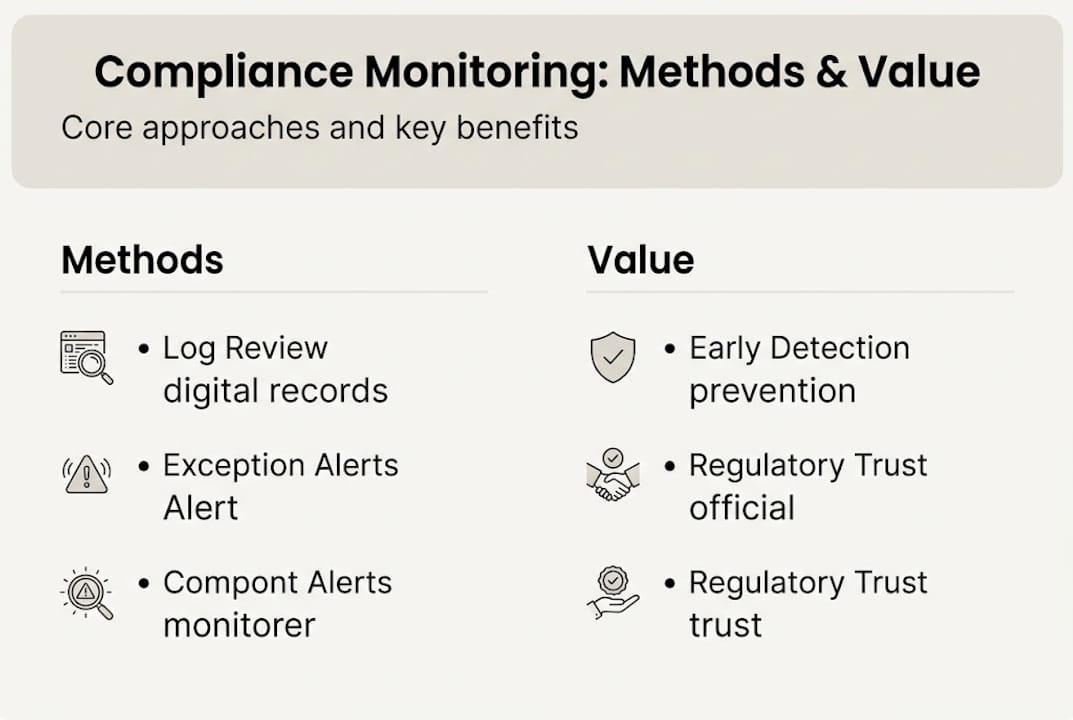
Continuous compliance monitoring in cloud and enterprise environments is commonly operationalized by repeatedly assessing infrastructure and configuration, then evaluating collected state against machine-readable policy rules. But the underlying logic applies beyond cloud infrastructure to any area where controls need to be continuously verified.
Here is a practical implementation sequence:
Map your obligations to specific controls. Every regulatory requirement or internal policy should link to a measurable control. If you cannot measure it, you cannot monitor it.
Calibrate your monitoring cadence to risk materiality. High-risk areas warrant continuous or daily monitoring. Lower-risk areas may justify weekly or monthly reviews. Over-monitoring everything creates noise that desensitizes your team.
Integrate automation where data flows are structured. Automated dashboards, policy-as-code engines, and alert systems handle volume that manual review cannot. Use policy-as-code best practices to make your rules machine-enforceable.
Establish human review at the right escalation points. Automation catches anomalies, but judgment is required to assess context, materiality, and appropriate response.
Close the loop with documented remediation. Every finding that triggers a response needs a recorded outcome. That documentation is your evidence of effective oversight.
The table below illustrates how different monitoring methods align with common compliance risk areas:
Risk area | Monitoring method | Cadence |
Access controls | Automated log review | Continuous |
Transaction limits | Rule-based alerting | Real-time |
Policy attestations | Workflow tracking | Quarterly |
Vendor compliance | Periodic assessment | Annual or triggered |
Data handling | Configuration scanning | Daily |
Pro Tip: Build your monitoring program around risk management best practices and your risk assessment frameworks to ensure your monitoring intensity matches actual exposure, not just perceived importance.
Tying compliance monitoring to regulatory outcomes and credibility
A modern monitoring approach is not just about tools and frequency. It is about producing defensible results when real regulatory scrutiny arrives. And that scrutiny is increasingly focused on outcomes rather than process documentation.
Regulatory defensibility depends on outcomes and actual decision-making, not just policies and process documentation. Regulators want to see that your monitoring influenced behavior, corrected gaps, and escalated material issues to the right level of authority.
A compliance program that generates dashboards but never changes a business decision is infrastructure without impact. The question regulators ask is not “did you monitor?” but “what did you do when monitoring found something?”
Building regulatory credibility through monitoring means creating a traceable record of outcomes. Here are the evidence points that actually strengthen your regulatory posture:
Documented incident remediation with timestamps, responsible owners, and closure confirmation
Follow-up actions tied to specific findings, showing that monitoring outputs drive operational change
Board or senior management escalations for high-risk issues, with meeting minutes or written briefings as evidence
Trend analysis that shows your program is detecting patterns, not just individual events
Control improvements implemented in response to monitoring findings, with before-and-after documentation
For organizations in financial services, audit importance for compliance is directly tied to this kind of evidence record. Regulators in banking, insurance, and securities sectors specifically evaluate whether governance functions are influencing real decisions, not just producing reports.
The organizations that fare best in regulatory examinations are those that can show a clear line from monitoring observation to organizational response. That chain of accountability is what separates a credible program from a paper one.

Why most compliance monitoring fails: What the checklists miss
Here is an uncomfortable observation we have seen play out repeatedly: most compliance monitoring programs are technically functional and operationally ineffective. They generate reports. They run on schedule. They check the right boxes. And they have almost no influence on what actually happens in the business.
The failure usually stems from a disconnect between monitoring outputs and decision escalation. Findings land in a compliance inbox, get logged into a tracker, and sit there while the underlying behavior continues. Nobody owns the fix. No executive is accountable. The board has no visibility. That is not a monitoring program. That is a paper trail.
Real compliance monitoring changes what people do. It surfaces issues to the leaders who can act on them. It creates urgency around remediation, not just documentation. And it feeds back into your risk assessment so that next year’s program is smarter than last year’s.
Our advice: resist the instinct to measure your program by output volume. Measure it by how often monitoring findings actually caused the organization to change course. If you are looking for a practical framework for building that kind of influence into your compliance function, the guidance on practical compliance leadership is where to start.
Advance your compliance expertise: Next steps
If you are ready to move beyond checklists and build a monitoring program that delivers real regulatory credibility, professional education is a meaningful accelerant.
At compliance-seminars.com, our CPE training for compliance professionals covers internal controls, monitoring frameworks, and risk-based oversight with instruction grounded in actual regulatory expectations. Our CPE event calendar includes live sessions across major U.S. cities, giving you the structured learning and peer interaction that webinars alone cannot replicate. For those managing cybersecurity obligations specifically, our cybersecurity compliance courses connect monitoring practice to NIST, CMMC, and related frameworks in practical terms. Your compliance program is only as strong as the knowledge behind it.
Frequently asked questions
What is the main goal of compliance monitoring?
Compliance monitoring’s core goal is to ensure continuous adherence to laws, regulations, and company policies, identifying gaps early so they can be corrected before they escalate into enforcement issues.
How is compliance monitoring different from compliance testing?
Monitoring is continuous observation focused on real-time risk detection, while testing is a periodic, sample-based process used to validate control effectiveness for assurance purposes. Both are necessary but serve fundamentally different functions.
Why is compliance monitoring important to regulators?
Regulators evaluate whether monitoring drives operational outcomes and real decision-making, not just whether policies and documentation exist. A program that cannot show it influenced behavior offers little regulatory protection.
What are examples of compliance monitoring tools?
Continuous compliance monitoring tools include automated dashboards, cloud policy-as-code engines, real-time alerting systems, and integrated workflow trackers that link findings to remediation actions and escalation records.
Recommended
Comments