Why update internal controls? Key reasons for audit success


TL;DR:
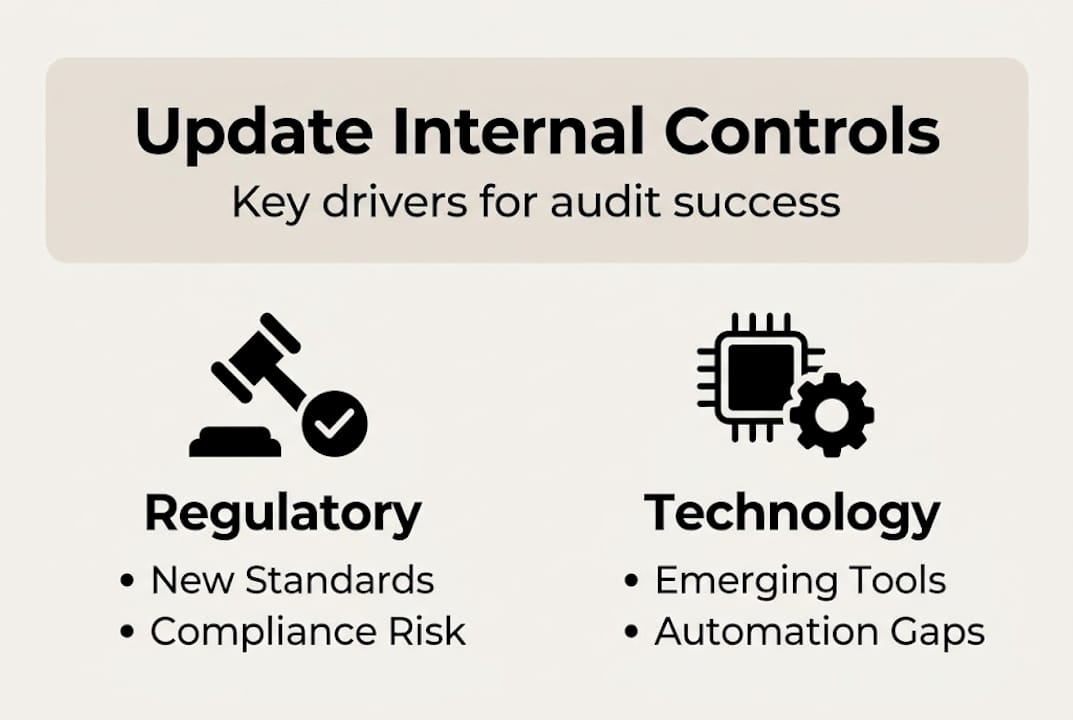
Regulatory standards now demand dynamic, continuously updated internal controls that adapt to emerging risks.
Technological advances like GenAI and cloud shift control requirements toward real-time monitoring and oversight.
Proactive control updates improve fraud detection, accountability, audit efficiency, and organizational resilience.
Internal controls are not a one-time installation. Many organizations treat them as permanent fixtures, set during an initial audit cycle and revisited only when something breaks. That assumption is increasingly dangerous. COSO’s 2026 guidance on generative AI risks signals that regulators and standard-setters expect controls to evolve alongside the threats they are meant to address. PCAOB and GAO have both released updated frameworks that demand a more dynamic approach. This guide explains what is driving those demands, what you gain by responding proactively, and how to take actionable steps right now.
Table of Contents
Key Takeaways
Point | Details |
Regulations demand updates | New standards from PCAOB, COSO, and GAO make regular control updates non-negotiable. |
Tech brings new risks | Emerging technologies like GenAI create complex risks that old controls cannot handle. |
Proactive updates pay off | Organizations see clear benefits in efficiency, fraud prevention, and governance by updating controls proactively. |
Continuous approach wins | Ongoing monitoring and improvement now deliver far better outcomes than periodic reviews. |
The regulatory drivers for updating internal controls
Regulatory pressure is no longer subtle. Standard-setters are explicitly signaling that static control environments are inadequate for today’s risk landscape. If you are operating under the assumption that controls written five years ago still satisfy current requirements, you are likely already behind.
PCAOB AS 2201 and AS 1000, effective December 15, 2026, redefine what an integrated audit of internal control over financial reporting must look like. These standards require auditors to reassess control design and operating effectiveness in light of evolving business processes, technology use, and risk profiles. A control that once satisfied AS 2201 may fall short under the modernized version if it does not account for automated processes or data integrity risks.
On the government side, the GAO 2025 Green Book introduces stronger mandates around information security, improper payments, and fraud risk management. Federal agencies and their contractors now face more explicit documentation and monitoring requirements across all five components of internal control.
Here is a quick comparison of how the old and new standards shift expectations:
Control area | Previous standard focus | Updated standard focus |
IT general controls | Basic access and change management | Cybersecurity, AI oversight, data integrity |
Fraud risk | Periodic assessment | Continuous monitoring and documented response |
Improper payments | Compliance reporting | Proactive identification and remediation |
Documentation | Annual walkthroughs | Ongoing, evidence-based recordkeeping |
Key changes driven by these regulatory updates include:
Fraud risk assessments must now be embedded into the control design, not treated as a separate exercise
IT and cybersecurity controls are no longer optional overlays; they are core components under both PCAOB and GAO standards
Improper payment controls in federal environments require documented root cause analysis and corrective action plans
Risk-based scoping under updated PCAOB guidance requires auditors to justify which controls they test and why
For a broader view of 2026 regulatory compliance tips and how they intersect, it helps to understand why internal controls matter as a governance foundation before layering in the new requirements.
Technology and emerging risk: The modern imperative
Regulations push from one direction. Technology pulls from another. Together, they make a compelling case for continuous control evolution.
Generative AI (GenAI) is arguably the most disruptive force audit and compliance professionals are navigating right now. Unlike traditional software, GenAI systems produce probabilistic outputs, meaning they can generate different results from identical inputs. That variability is a control problem. COSO’s 2026 roadmap on GenAI risks identifies specific capabilities that each carry unique control considerations.
GenAI capability | Control consideration |
Text generation | Output accuracy verification and bias review |
Data summarization | Source traceability and completeness checks |
Code generation | Security review and change management |
Decision support | Human oversight requirements and audit trail |
Document processing | Data privacy and access controls |
Predictive analytics | Model validation and performance monitoring |
Customer interaction | Compliance with disclosure and fair treatment rules |
Process automation | Exception handling and fallback procedures |
Beyond GenAI, other technology-driven risks deserve attention:
Robotic process automation (RPA): Automated workflows can bypass traditional manual controls without proper bot governance
Cloud environments: Shared responsibility models shift some control obligations to third-party vendors, requiring updated vendor risk assessments
Data privacy regulations: Expanding state-level privacy laws create new compliance obligations that existing controls may not address
Pro Tip: When prioritizing tech-driven control updates, start with processes where automation has already replaced manual steps. Those are the highest-risk gaps, because the original control may no longer even exist in practice.
For professionals building or refreshing control programs, the internal controls implementation guide offers a structured starting point. And if your organization is exploring continuous auditing methods, integrating tech-risk controls into that cycle is far more effective than treating them separately.
Organizational benefits of proactive internal control updates
Updating controls is not just about staying compliant. Done well, it delivers real operational value that goes well beyond satisfying an auditor.
Here are four concrete benefits organizations gain from proactive internal control updates:
Reduced detection lag. Updated controls that leverage automated monitoring catch errors and anomalies in near real time. Waiting for a quarterly close or an annual audit to surface issues is a costly delay that modern control environments can eliminate.
Stronger fraud prevention. Fraud schemes evolve. Controls that were designed to catch yesterday’s schemes miss today’s. Regular updates keep your detection logic aligned with current threat patterns, including those involving digital transactions and insider access.
Clearer accountability. When controls are updated with current roles and responsibilities in mind, ownership becomes explicit. That clarity reduces the ambiguity that allows issues to fall through the cracks between departments.
Improved audit efficiency. Auditors spend less time remediating deficiencies when controls are current. That translates to shorter audit cycles, lower cost, and fewer uncomfortable findings.
“Modernized controls enable continuous monitoring and dynamic response to risk, rather than reactive remediation after the fact.” This shift in posture separates organizations that lead on governance from those that simply survive audits.
Pro Tip: When you update a control, document the specific risk it addresses and how you will measure its effectiveness. That linkage makes it far easier to demonstrate control value to leadership and external auditors alike.
The internal control checklist 2026 is a practical tool for mapping each control update to an audit efficiency gain, which helps build the internal business case for ongoing investment in control quality.

Practical steps: How to approach internal control updates
Knowing you need to update controls is one thing. Knowing how to do it systematically is another. Here is a structured approach that works across PCAOB, COSO, and GAO-aligned environments.
Conduct a current-state assessment. Map your existing controls against current regulatory requirements and your organization’s active risk profile. Identify gaps where controls are missing, outdated, or no longer operating as designed.
Prioritize by risk impact. Not all gaps are equal. Focus first on areas with the highest financial, legal, or reputational exposure. Use your risk assessment results to rank remediation priorities.
Design updated controls with built-in monitoring. New controls should not just fix the identified gap. They should include a mechanism for ongoing evaluation, whether automated alerts, periodic testing, or documented management review.
Document changes thoroughly. The GAO 2025 Green Book specifically emphasizes documented assessments of change and risk. Every control update should be accompanied by evidence of why the change was made, who approved it, and how it will be tested.
Communicate changes to control owners. A well-designed control that nobody understands or follows is no control at all. Training and clear communication are part of the implementation, not afterthoughts.
Build a continuous improvement cycle. Schedule periodic reviews tied to your risk assessment cadence, not just your audit cycle. This prevents controls from becoming stale between formal reviews.
When aligning updates with specific frameworks, keep this checklist in mind:
For PCAOB alignment: Reassess control design for automated processes, IT dependencies, and management review controls
For COSO alignment: Revisit all five components, with particular attention to the control environment and risk assessment components
For GAO Green Book alignment: Ensure documentation supports the 17 principles, especially around fraud risk and information security
Useful resources for this work include the guide on how to evaluate internal controls 2026 and the reference on documenting internal controls to ensure your evidence meets examiner expectations.
Why waiting for the next audit is a mistake
Here is a perspective that does not get enough airtime: treating internal control updates as an audit-driven activity is itself a control weakness.
I have seen organizations where the entire control improvement conversation happens in the six weeks before an external audit. Everything outside that window is business as usual. That mindset made sense when risks were predictable and frameworks changed slowly. It does not make sense when a new GenAI capability can introduce material risk exposure in a matter of months.
The uncomfortable truth is that annual review cycles were designed for a slower world. Technology moves faster. Fraud schemes adapt faster. Regulatory expectations are tightening faster. When your control update cadence lags behind all three of those forces simultaneously, you are not managing risk. You are documenting it after it has already caused damage.
Cultural resistance is the bigger obstacle. Many teams default to checking boxes because that is what gets them through the audit. Real control improvement requires someone in the room willing to ask, “Does this control actually work, or does it just look like it works on paper?” That is a harder question to ask, and a harder answer to act on.
Organizations that treat control updates as an ongoing discipline rather than a periodic event consistently outperform their peers on governance metrics. Staying current with financial compliance trends 2026 is one way to keep that discipline connected to what regulators are actually watching.
Advance your skills: Internal control and audit training options
Understanding the “why” behind control updates is essential. Translating that understanding into practice requires current, standards-based training.
At compliance-seminars.com, we offer a range of CPE-eligible training designed specifically for audit and compliance professionals navigating evolving internal control requirements. Our internal auditor CPE webinars cover COSO, PCAOB, and GAO frameworks in practical, application-focused formats. For professionals managing technology risk, our IT auditing CPE events address cybersecurity controls, GenAI governance, and IT audit methodology. Whether you prefer live instruction or flexible online formats, our 2026 CPE event calendar offers sessions across multiple U.S. cities and online. Keeping your skills current is how you keep your controls current.
Frequently asked questions
What triggers the need to update internal controls?
New regulations, technology adoption, fraud incidents, and organizational changes typically trigger the need to update internal controls. Any shift in your risk environment or operating model is a signal to reassess.
How often should internal controls be updated?
Internal controls should be reviewed whenever new risks, business processes, or regulatory changes occur. Continuous monitoring and dynamic change assessments are now the expected standard, not annual reviews alone.
What are the risks of not updating internal controls?
Failing to update controls can result in compliance failures, financial losses, and increased fraud vulnerability. Unaddressed control gaps create documented deficiencies that regulators and auditors will surface, often at the worst possible time.
Do internal control updates always require large-scale changes?
Not always. Sometimes a minor process adjustment or documentation update is sufficient to close a gap. However, the 2025 Green Book requires that even minor changes be documented, reviewed, and tied to a risk rationale.
Recommended
Comments