Compliance Auditing: Reducing Risk for Executives
- Леонид Ложкарев
- Feb 17
- 7 min read


Regulatory expectations are never static, leaving Chief Audit Executives and Compliance Officers across North America facing constant shifts in law, policy, and industry standards. Strengthening internal controls and preventing costly regulatory missteps depend on a clear understanding of compliance auditing principles. This guide offers a practical look at essential audit definitions, types, and key processes, providing actionable insights to support robust risk management and greater organizational accountability.
Table of Contents
Key Takeaways
Point | Details |
Compliance Auditing Essentials | Compliance audits are systematic reviews that assess adherence to regulations, internal policies, and standards, serving to identify risks and ensure ongoing alignment. |
Dynamic Regulatory Landscape | Compliance auditing must adapt to evolving regulations, necessitating a proactive rather than reactive strategy for organizations. |
Technology in Auditing | Leveraging advanced technologies like data analytics and AI enhances compliance audit effectiveness by providing deeper insights and automated tracking. |
Structured Roles and Responsibilities | Clearly defined roles within compliance auditing are crucial for effective risk management, requiring collaboration across various departments to avoid common pitfalls. |
Defining Compliance Auditing and Key Concepts
A compliance audit is a systematic and independent review process designed to evaluate an organization’s adherence to external regulations, internal policies, and established standards. These comprehensive assessments help executive leadership understand their organization’s risk profile and ensure ongoing regulatory alignment.
At its core, compliance auditing involves examining organizational practices against mandated requirements. The process encompasses multiple critical dimensions:
Reviewing operational procedures
Assessing financial transactions
Evaluating internal control mechanisms
Identifying potential regulatory vulnerabilities
Recommending corrective actions
Compliance audits serve several essential strategic functions for organizations. They provide executive leadership with:
Risk identification and mitigation strategies
Evidence of regulatory conformance
Opportunities for operational improvement
Protection against potential legal sanctions
Modern compliance auditing recognizes that regulatory landscapes are dynamic and continuously evolving. Successful audits require not just checking boxes, but developing a comprehensive understanding of an organization’s unique operational context and potential exposure points.
Compliance Audit Typologies include:
Regulatory compliance audits
Internal policy compliance reviews
Industry-specific standard assessments
Financial reporting compliance checks
Compliance auditing is not a one-time event but an ongoing process of organizational vigilance and continuous improvement.
Pro tip: Develop a proactive compliance strategy that anticipates regulatory changes rather than merely reacting to them.
Major Types of Compliance Audits Explained
Compliance audits are not a one-size-fits-all approach, but rather a sophisticated set of targeted reviews designed to address specific organizational risks and regulatory requirements. Compliance audit types vary widely depending on the industry, regulatory landscape, and organizational objectives.
The primary categories of compliance audits include:
Regulatory Compliance Audits: Assess adherence to external laws and government regulations
Internal Policy Compliance Audits: Evaluate alignment with company-specific guidelines and procedures
Financial Compliance Audits: Examine financial reporting accuracy and accounting standards
Industry-Specific Compliance Audits: Target unique requirements in sectors like healthcare, finance, and technology
Some notable examples of specialized compliance audits include:
Below is a summary comparing the major types of compliance audits and their key focus areas:
Audit Type | Primary Focus | Common Industries |
Regulatory Compliance | Adherence to laws & regulations | Banking, Healthcare |
Internal Policy | Conformance to internal policies | All sectors |
Financial Compliance | Accurate financial reporting | Publicly traded companies |
Industry-Specific | Sector standards & certifications | Healthcare, Technology |
HIPAA Audits (Healthcare)
PCI DSS Audits (Payment Card Industry)
SOX Compliance Reviews (Financial Reporting)
ISO Certification Assessments (Quality Management)
Understanding the nuanced differences between these audit types is crucial for executive leadership. Audit objectives can range from risk mitigation and regulatory conformance to operational improvement and stakeholder confidence.
Effective compliance auditing is not about checking boxes, but creating a comprehensive risk management framework that evolves with organizational complexity.
Modern compliance audits increasingly leverage advanced technologies like data analytics and artificial intelligence to conduct more comprehensive and efficient reviews. These technological approaches enable deeper insights, more accurate risk assessments, and proactive identification of potential compliance vulnerabilities.
Pro tip: Develop a cross-functional compliance audit strategy that integrates insights from legal, finance, and operational teams to create a holistic risk management approach.
Core Steps and Tools in the Audit Process
Compliance audits require a structured and methodical approach to effectively assess an organization’s regulatory adherence. Compliance audit processes follow a systematic framework that enables comprehensive evaluation and risk management.
The core steps in a typical compliance audit include:
Planning Phase: Defining audit scope, objectives, and preliminary risk assessment
Preparation Phase: Gathering documentation, identifying key control points
Execution Phase: Conducting detailed testing and evidence collection
Reporting Phase: Documenting findings and recommending corrective actions
Monitoring Phase: Tracking implementation of audit recommendations
Key tools and technologies supporting modern compliance audits encompass:
Advanced analytics platforms
Automated compliance tracking software
Risk assessment frameworks
Document management systems
Secure evidence collection technologies
Audit Documentation represents a critical component of the compliance review process. Effective documentation requires meticulous record-keeping, clear evidence trails, and systematic categorization of findings.
Successful compliance audits transform regulatory requirements from bureaucratic obligations into strategic organizational improvements.
Technological innovations are rapidly transforming compliance audit methodologies. Artificial intelligence and machine learning now enable more sophisticated risk detection, predictive analytics, and real-time monitoring capabilities that go beyond traditional manual review processes.

Pro tip: Invest in integrated compliance management platforms that provide seamless documentation, tracking, and reporting capabilities across multiple regulatory domains.
Legal Standards and Regulatory Frameworks
Compliance auditing operates within a complex landscape of legal frameworks that establish critical guidelines for organizational accountability and risk management. These frameworks create standardized expectations for how businesses must assess, document, and maintain regulatory adherence.
Key regulatory frameworks and standards include:
Sarbanes-Oxley Act (SOX): Financial reporting and corporate governance standards
HIPAA: Healthcare data privacy and security regulations
PCI DSS: Payment card industry data protection standards
GDPR: European data privacy and protection requirements
NIST Cybersecurity Framework: Information security and risk management guidelines
The primary objectives of these regulatory frameworks encompass:
Establishing clear compliance requirements
Defining accountability mechanisms
Creating standardized reporting protocols
Implementing risk mitigation strategies
Protecting stakeholder interests
Compliance Frameworks serve as critical blueprints for organizations, providing structured approaches to managing regulatory risks and maintaining operational integrity. They transform abstract legal requirements into actionable organizational strategies.
Effective regulatory frameworks are not static documents but dynamic systems that evolve with changing business landscapes and emerging technological challenges.
Modern regulatory standards increasingly emphasize technological integration, requiring organizations to develop sophisticated digital compliance management systems that can adapt to rapidly changing legal requirements and global business environments.
Pro tip: Develop a cross-functional compliance team that regularly reviews and updates regulatory frameworks to ensure ongoing organizational alignment with emerging legal standards.
Roles, Responsibilities, and Common Mistakes
Compliance auditing requires clear organizational structures and well-defined responsibilities to ensure effective risk management. Compliance office roles and internal audit functions are critical for maintaining organizational integrity and regulatory adherence.
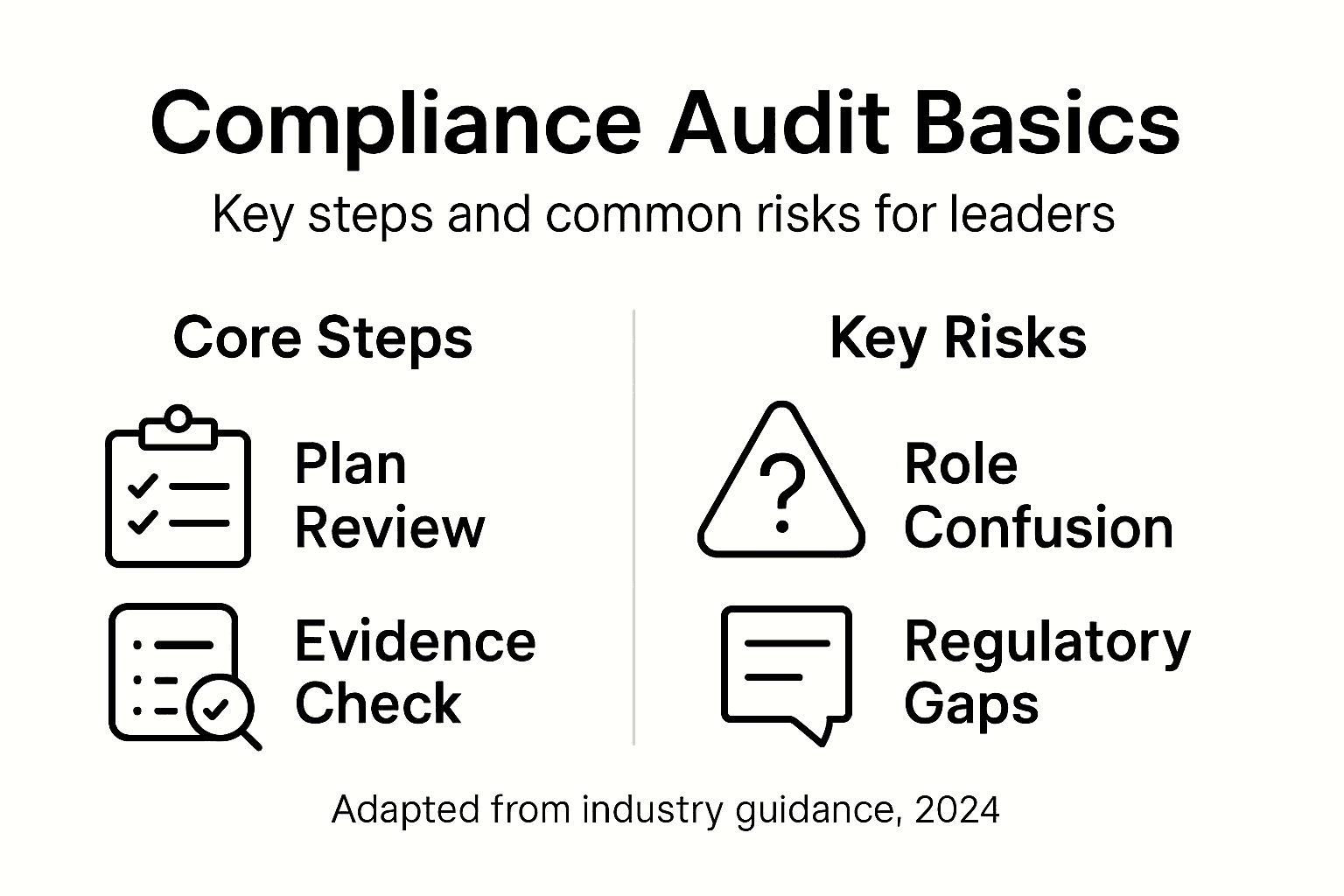
Key organizational roles in compliance auditing include:
Here is an at-a-glance comparison of key compliance roles and their primary organizational responsibilities:
Role | Main Responsibility | Example Tasks |
Chief Audit Executive | Audit program oversight | Set audit agenda, approve plans |
Compliance Officer | Oversee organizational compliance | Draft policies, training |
Internal Auditor | Independent control assessment | Review controls, report gaps |
Risk Management Pro | Identifying and reducing risk | Analyze risk scenarios |
Legal Department | Regulatory interpretation | Advise on legal changes |
Chief Audit Executive: Strategic oversight of audit functions
Compliance Officer: Developing and managing compliance programs
Internal Auditors: Independent evaluation of controls and governance
Risk Management Professionals: Identifying and mitigating organizational risks
Legal Department: Providing regulatory interpretation and guidance
Critical responsibilities for each role encompass:
Establishing clear compliance protocols
Conducting independent risk assessments
Documenting potential regulatory vulnerabilities
Implementing corrective action plans
Reporting to senior leadership
Potential Conflicts and Common Mistakes can significantly undermine compliance effectiveness. Organizations frequently encounter challenges such as role overlap, insufficient communication, and inadequate resource allocation.
Effective compliance requires a delicate balance between independent oversight and collaborative organizational strategy.
Technological advancements and evolving regulatory landscapes demand continuous adaptation of compliance roles. Modern organizations must develop flexible, integrated approaches that transcend traditional departmental boundaries and embrace cross-functional collaboration.
Pro tip: Create a formal charter that explicitly defines the responsibilities, reporting structures, and interdependencies between compliance, audit, and risk management functions.
Strengthen Your Compliance Audit Skills to Reduce Executive Risk
Compliance auditing is essential for executive leaders facing the challenge of managing complex regulatory frameworks and ever-changing risks. This article highlights critical issues like risk identification, regulatory conformance, and the importance of a proactive, cross-functional compliance strategy. As these challenges grow, it becomes vital to develop in-depth knowledge of audit processes, legal standards, and effective organizational roles to transform audits from burden to business advantage.
At Compliance Seminars, we offer tailored continuing professional education designed specifically for audit and compliance professionals seeking to master these very concepts. Our expert-led webinars, in-person seminars, and CPE courses cover everything from internal control frameworks like COSO and SOX to industry-specific regulatory compliance. You can build the confidence and skills needed to lead sophisticated compliance audits and manage risk proactively.
Take control of your organization’s compliance future today. Explore our offerings at Compliance Seminars and join the hundreds of professionals who sharpen their audit expertise with practical, standards-based training. Don’t wait until regulatory demands escalate. Visit our site now and start advancing your compliance leadership with proven education solutions.
Frequently Asked Questions
What is the purpose of a compliance audit?
A compliance audit evaluates an organization’s adherence to regulations, internal policies, and standards, helping identify risks and opportunities for improvement.
What are the main types of compliance audits?
The major types include regulatory compliance audits, internal policy compliance audits, financial compliance audits, and industry-specific compliance audits, each focusing on different aspects of adherence.
How can compliance audits reduce organizational risk?
Compliance audits identify regulatory vulnerabilities and provide corrective action recommendations, ultimately reducing the risk of legal sanctions and improving operational integrity.
What steps are involved in a compliance audit process?
The compliance audit process includes planning, preparation, execution, reporting, and monitoring phases to systematically assess regulatory adherence and manage risks.
Recommended
Comments