Audit scope explained: defining boundaries for effective audits

Updated: 2 hours ago

TL;DR:
Audit scope defines the boundaries, objectives, and parameters of an engagement, guiding efficient and credible audits. Clear documentation, risk assessment, and ongoing communication are vital for managing scope effectively and adapting to changing circumstances during fieldwork. Proper scope management enhances audit quality, stakeholder confidence, and the defensibility of final reports.
Audit scope is not a simple checklist you hand to a client and forget about. Audit scope defines the boundaries, parameters, extent, and objectives of an entire engagement, which means every decision you make during fieldwork flows from how well you set it at the start. When scope is vague, auditors waste time, stakeholders lose confidence, and findings get challenged. When scope is precise and well-documented, the engagement runs efficiently and the final report carries real weight. This guide breaks down what audit scope includes, how it differs across audit types, what shapes it, and how to manage the limitations that inevitably arise.
Table of Contents
Key Takeaways
Point | Details |
Audit scope is essential | The scope defines what, why, and how of every audit, shaping its effectiveness. |
Scope differs by audit type | Internal and external audits have distinct scope drivers, objectives, and frameworks. |
Regulations and risk drive scope | Risk assessment and compliance requirements are major influencers of audit scope. |
Manage limitations proactively | Communicating and addressing scope barriers early prevents adverse opinions. |
Adaptability matters | Effective auditors continuously reassess and adapt their scope to dynamic business conditions. |
What is audit scope? Key definitions and elements
With our focus set on the central importance of audit scope, we need to break down its core components before anything else.
At its most precise, audit scope specifies what is audited, why, how, and the time frame covered in an engagement. It is not a vague statement of intent. It is a deliberate set of boundaries agreed upon by auditors and stakeholders before a single test is run. Think of scope as the architectural blueprint for the entire engagement. Without it, you are building without a plan.
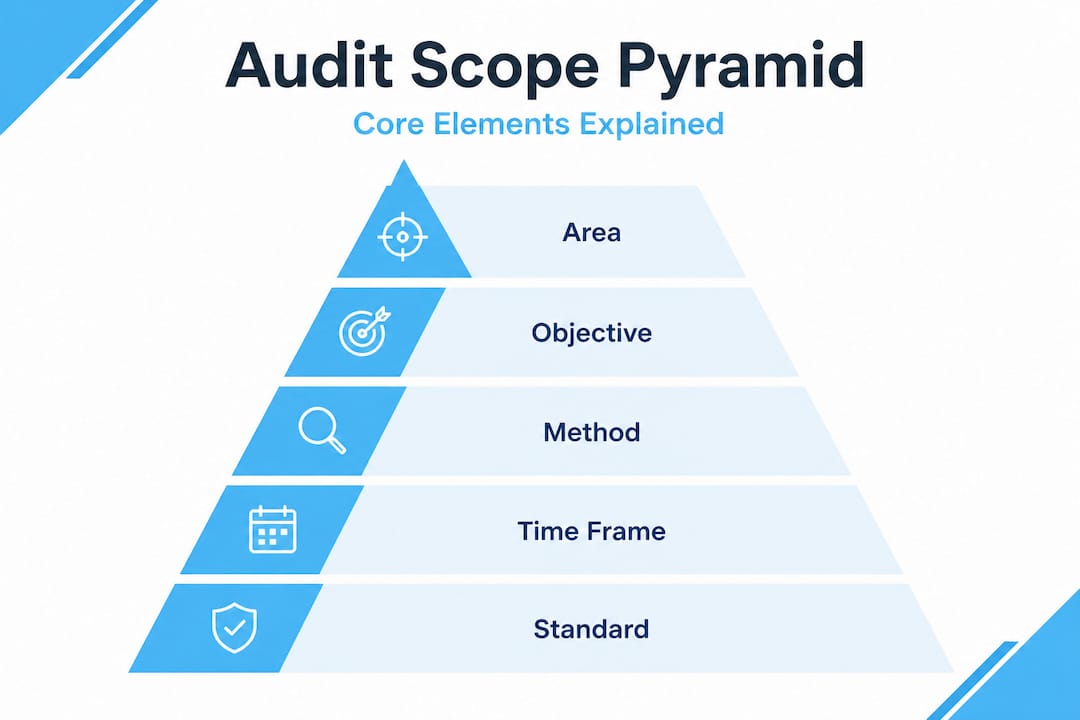
The key elements of scope include specific financial statements or accounts under review, the time period covered, the audit objectives, and the level of assurance being provided. Each element carries weight. Miss one, and you risk either overextending your resources or leaving critical areas unexamined.
Scope element | What it defines | Example |
Accounts/areas | Which accounts, processes, or systems are included | Accounts payable, IT general controls |
Time period | The fiscal period or date range under review | January 1 to December 31, 2025 |
Objectives | What the audit aims to achieve or conclude | Assess completeness of revenue recognition |
Assurance level | The degree of assurance provided | Reasonable (financial) vs. limited (review) |
Methodology | How the work will be conducted | Sampling, interviews, walkthroughs |
Solid audit planning steps are what translate scope definitions into a workable execution strategy. Without that translation, even the clearest scope statement becomes theoretical.
Here is why a clear scope statement matters in practice:
It keeps the audit team focused on agreed-upon areas, preventing wasted effort on out-of-scope items.
It sets realistic expectations for clients and stakeholders before fieldwork begins.
It provides a defensible framework if audit findings are challenged after the fact.
It helps allocate resources efficiently by identifying high-risk areas early.
It reduces the risk of scope creep, which quietly inflates cost and timelines.
The engagement letter is the formal vehicle for communicating scope to clients. A well-drafted engagement letter eliminates ambiguity before fieldwork begins. It should explicitly state what is included, what is excluded, and under what conditions scope may need to be revisited. Disputes about scope almost always trace back to a letter that was too vague.
The internal audit process also depends on scope clarity to prioritize audit activities across different business units. When internal auditors document scope in planning memos, they create accountability for themselves and transparency for audit committees. The effective internal audit guide reinforces this point: scope documentation is not bureaucratic overhead, it is a professional obligation.
Internal vs. external audit scope: What’s different?
Now that you know what constitutes the scope of an audit, it is essential to see how internal and external scopes diverge and why auditors must tailor their approach accordingly.
The differences are significant. Internal audits cover business processes, compliance, operations, risk management, and IT security, while external audits focus on financial statement assertions and internal control over financial reporting (ICFR). This is not a minor distinction. It shapes the entire engagement from objective setting through to reporting.
Factor | Internal audit | External audit |
Primary goal | Improve operations, manage risk | Express opinion on financial statements |
Standards | IIA standards, organizational policy | GAAS/AICPA or PCAOB standards |
Scope setter | Chief audit executive, management | External audit firm, regulated by standards |
Subject areas | Operations, IT, compliance, fraud | Financial statements, ICFR |
Report audience | Audit committee, board, management | Investors, regulators, public |
Independence | Organizationally independent | Legally and professionally independent |
External audits governed by GAAS/AICPA or PCAOB standards follow a rigorous, standardized scope-setting process. PCAOB audit standards in particular dictate how public company audits define their scope around financial statement risk and ICFR effectiveness.
Consider a real-world scenario. An internal audit team at a manufacturing firm scopes an engagement around procurement process efficiency, vendor approval controls, and purchasing card compliance. The scope covers operations and compliance, not financial statement assertions. Simultaneously, the external auditor scopes work around the existence and valuation of inventory balances and the accuracy of cost of goods sold. Both teams are auditing the same company, but their scopes serve entirely different masters.
Key differences in setting scope between the two audit types:
Authority: External auditors cannot accept client-imposed scope restrictions without consequence. Internal auditors may face organizational resistance that limits access to certain business units.
Risk basis: Internal audit scope is driven by the organization’s own risk assessment. External scope is driven by financial statement materiality and auditor risk evaluation.
Flexibility: Internal auditors can pivot scope mid-engagement with appropriate approval. External auditors are bound by standards that require formal documentation of any scope changes.
Stakeholder input: Internal audit scope often reflects the priorities of the audit committee and senior management. External audit scope is driven primarily by professional standards and legal requirements.
Pro Tip: When internal and external auditors coordinate their scope planning through a risk-based audit approach, they avoid duplicating effort and can provide broader coverage with the same resources. Many organizations formalize this coordination through joint planning meetings at the start of each audit cycle.
Factors that influence audit scope
Understanding various audit types, it is vital to know what forces shape scope in every engagement.
Scope does not emerge from thin air. Scope is determined by risk assessment, regulations such as SOX and ERISA, business complexity, auditor risk evaluation, materiality, organizational structure, and geography. Each factor demands deliberate consideration during planning.

The most important driver is the risk assessment. High-risk areas demand broader scope. Low-risk areas may justify limited scope or exclusion altogether. This is not about cutting corners. It is about applying professional judgment to allocate finite resources where they matter most. A thorough set of risk assessment steps helps auditors translate risk ratings into concrete scope decisions before fieldwork begins.
Factors that commonly influence audit scope include:
Regulatory requirements: SOX Section 404 mandates specific scope elements for public companies. ERISA governs employee benefit plan audits. HIPAA compliance audits have their own scope requirements. Regulation is often the non-negotiable floor.
Organizational structure: A multinational organization with subsidiaries across six countries requires broader geographic scope than a single-entity domestic business.
Industry-specific risks: A bank faces liquidity and credit risk considerations that a software company does not. Scope must reflect industry context.
Previous audit findings: Repeat findings from prior engagements signal that certain areas need continued scrutiny. Auditors who ignore prior findings undermine the value of continuous auditing.
Materiality thresholds: Materiality directly limits what is worth auditing. Immaterial items rarely justify scope inclusion unless they carry qualitative risk.
Management and stakeholder input: While auditors set scope independently, input from operational leaders and the audit committee often surfaces risks that would otherwise be missed.
Statistic callout: Following the enactment of the Sarbanes-Oxley Act, the scope of audits for public companies expanded dramatically. PCAOB inspections have consistently found that inadequate scope in ICFR audits is among the most cited deficiencies in Big Four audit firm reviews. Scope inadequacy is not just a planning failure. It is a quality control failure.
Following compliance audit best practices means documenting the rationale for every scope decision made during planning. If a business unit is excluded from scope, that exclusion should be justified in writing. This protects auditors from second-guessing and strengthens the defensibility of the final report.
Pro Tip: Document your scope determinants as early as the kickoff meeting. Create a simple scope matrix that maps each risk factor to specific audit areas. This becomes invaluable when management pushes back on scope boundaries later in the engagement. Good risk management strategies for compliance officers reinforce the same principle: early documentation prevents late disputes.
Common scope limitations and how to address them
Knowing what determines audit scope, professionals must also prepare for real-world constraints that can jeopardize the intended scope.
Scope limitations are a reality in practice. They range from circumstantial obstacles to deliberate management-imposed restrictions. Either way, how an auditor handles them defines the credibility of the final report.
The most common scope limitations auditors encounter include:
Late appointment or engagement timing: When auditors are engaged after year-end inventory counts, for example, they cannot observe physical inventory directly. This is a circumstantial limitation with significant implications for the audit opinion.
Restricted access to records or systems: Management may deny access to certain files, claiming confidentiality or legal privilege. This client-imposed restriction directly limits what can be audited.
Missing or destroyed documentation: Records may be unavailable due to system failures, natural disasters, or deliberate destruction. Without evidence, certain assertions cannot be tested.
Geographic limitations: International subsidiaries may have records subject to foreign privacy laws or practical access challenges that prevent testing.
Resource and time constraints: Budget-driven decisions sometimes force auditors to narrow scope in ways that compromise coverage of higher-risk areas.
Scope limitations, whether caused by late appointment, restricted access, or missing evidence, can lead to qualified or disclaimer opinions in the audit report. A qualified opinion states that, except for the effects of the limitation, the financial statements are fairly presented. A disclaimer of opinion goes further: the auditor is unable to express any opinion at all because the limitation is so pervasive. Neither outcome is desirable. Both are avoidable with proactive planning.
When a scope limitation arises, auditors should first evaluate whether alternative procedures can satisfy the original audit objective. For instance, if physical inventory observation was missed, substantive analytical procedures and third-party confirmations may partially compensate. The AS 2201 integrated audit standards acknowledge that alternative procedures may be appropriate depending on the nature and severity of the limitation.
Practical guidance for addressing limitations is straightforward. Communicate the limitation to management and the audit committee as soon as it surfaces. Do not wait until the reporting phase. Document every management refusal to provide access, including dates, names, and the specific information requested. This creates a clear record that protects the auditor if the report is challenged. Strong audit planning best practices emphasize that scope limitations are not audit failures when they are identified, documented, and communicated promptly. They become failures only when they are ignored or minimized.
The reality of audit scope: What most professionals overlook
Most audit training focuses on getting scope right at the start. That is important, but it is only half the story. The other half is what happens when scope assumptions collide with reality mid-engagement.
I have seen engagements where the initial scope was textbook-perfect and still resulted in credibility problems, not because the scope was wrong, but because the team treated it as immovable. Scope is a living document. When a material acquisition closes two months into fieldwork, or when a new regulatory requirement takes effect, a rigid scope becomes a liability.
Conventional wisdom stresses boundary-setting. That matters. But scope creep, resource constraints, and changing environments present real challenges, and internal and external audits can complement each other when well-coordinated. The professionals who navigate these dynamics best are not the ones with the most precise initial scope statements. They are the ones with the clearest processes for adapting scope when circumstances demand it.
Scope creep is often characterized as a failure of discipline. Sometimes it is. But in complex, fast-moving organizations, a scope that never adjusts is not a sign of discipline. It is a sign of inflexibility. The key is structured adaptation: any scope change should be documented, approved, communicated to stakeholders, and assessed for its resource implications. That is very different from quietly expanding scope because someone found an interesting anomaly during fieldwork.
“Managing expectations via engagement letters is just the start. Ongoing dialogue with management, the audit committee, and even external auditors is what sustains scope integrity throughout an engagement. The letter sets the contract. The conversation maintains it.”
The auditors and compliance officers who build the most credible practices are those who use executive risk reduction tactics to build scope adaptation into their standard methodology rather than treating every change as an exception. Create a formal scope change log. Define the approval threshold for scope modifications. Brief the audit committee when significant changes occur. These are not extra steps. They are what separates reactive auditors from professionals who lead with confidence.
Pro Tip: Chasing the perfect scope statement at planning is less important than building a robust process for adapting scope mid-engagement. Perfection at the start is noble. Resilience throughout is essential.
Grow your audit expertise with practical training
With real-world perspective in mind, ongoing learning ensures your approach to audit scope remains sharp and compliant.
Audit scope is one of those topics that looks manageable in theory and gets complicated fast in practice. The difference between an auditor who handles scope limitations gracefully and one who stumbles is usually training rooted in real-world application.
At compliance-seminars.com, we offer CPE-eligible courses and seminars specifically designed for audit professionals who want to sharpen their scope design, risk assessment, and audit execution skills. Whether you are building foundational knowledge with our internal auditor basic training or expanding into technology-focused engagements through IT auditing CPE events, our curriculum is built by professionals with Big 4 backgrounds who know how scope decisions play out in real engagements. Review our 2026 CPE event calendar and find the training that fits your next professional development goal.
Frequently asked questions
What is usually included in an audit scope statement?
An audit scope statement typically includes the areas under review, the time period covered, audit objectives, methodology, and the level of assurance being provided. Key elements also specify which financial statements or accounts are included and what is explicitly excluded.
How does audit scope differ between internal and external audits?
Internal audits cover operations, compliance, risk management, and IT, while external audits focus primarily on financial statement assertions and ICFR. Internal scope is broad and set by organizational objectives, while external scope is tightly governed by professional standards such as GAAS or PCAOB requirements.
What factors influence the determination of audit scope?
Risk assessment, regulations, business complexity, and materiality are the primary drivers, along with industry-specific risks, prior audit findings, and organizational structure. Geography and stakeholder priorities also shape scope in multi-entity or multinational engagements.
What happens if there are limitations in audit scope?
Scope limitations lead to qualified or disclaimer opinions depending on the severity and pervasiveness of the restriction. Auditors must communicate limitations promptly, explore alternative procedures where possible, and document all management refusals to provide access.
How can auditors manage scope creep during an engagement?
Maintaining continuous communication with stakeholders and documenting every scope change through a formal scope change log are the most effective controls. Defining an approval threshold for modifications at the start of the engagement ensures that adjustments are structured rather than reactive.
Recommended
Audit planning best practices: proven steps for effective internal audits
Audit planning best practices: proven steps for effective internal audits
Audit Management Explained: Strategies, Tools, and Best Practices
Internal Audit Process Guide for Enhanced Compliance Success
Business Audit: Essential Insights for Retail Growth – Reddog Consulting Group
Comments