What Is Internal Audit and Why It Matters Now


Internal audit is often misunderstood as a routine formality in American financial organizations, but its true impact goes far deeper. For internal audit professionals and compliance officers, recognizing that internal audit is a disciplined, systematic process is essential for managing risk and aligning with regulatory requirements. This article clarifies key concepts, core responsibilities, and best practices so you can position your audit function as a proactive driver of compliance, efficiency, organizational strength and change.
Table of Contents
Key Takeaways
Point | Details |
Importance of Independence | Internal auditors must maintain independence from the areas they audit to ensure credibility and objective findings. |
Risk-Based Auditing | Focus on high-risk areas rather than merely complying with regulations to enhance audit effectiveness. |
Effective Communication | Engage with stakeholders throughout the audit process to ensure findings are understood and actionable by management. |
Continuous Improvement | Regularly evaluate audit processes and outcomes to foster ongoing development and adapt to emerging risks. |
Defining Internal Audit and Core Concepts
Internal audit isn’t what many people imagine when they first encounter the term. It’s not a compliance checkbox or an annual ritual that the first and second lines of defense departments tolerate. Rather, internal audit is a disciplined, systematic process performed by trained professionals to assess communications, risk management, control, and governance within organizations. This distinction matters because it separates the real work of internal auditing from the superficial auditing that many organizations attempt without proper structure or expertise.
At its core, internal audit serves a specific purpose: ensuring organizational goals are met efficiently and effectively. But here’s what separates this from external auditing or regulatory compliance reviews. Internal auditors operate from within the organization, giving them unique access to management, operational teams, and sensitive information that external parties don’t possess. This internal vantage point creates both opportunity and responsibility. You’re in a position to influence how controls are designed and implemented, not just whether they exist on paper.
The function rests on three foundational pillars that define modern internal audit practice. First, independence means you can’t report to the departments you’re auditing or the operations team you’re evaluating. Your reporting line matters more than you might initially believe because it determines whether your findings carry weight with decision makers. Second, objectivity requires that you approach every audit without predetermined conclusions, even when you suspect problems exist. This sounds straightforward until you’re 20 hours into a control testing project and pressure mounts to wrap it quickly. Third, continuous improvement recognizes that internal audit itself must evolve. You’re not just identifying control deficiencies; you’re helping the organization learn from them and strengthen its overall governance structure.
What makes internal audit essential now, more than ever, is that organizations face unprecedented complexity. You’re managing regulatory requirements from multiple agencies, integrating technology systems at breakneck speed, responding to cybersecurity threats that evolve weekly, and navigating governance expectations that keep expanding. External auditors can only scratch the surface of these challenges. Boards of directors increasingly recognize that internal audit provides the continuous monitoring and risk assessment they need to fulfill their fiduciary responsibilities. The Committee of Sponsoring Organizations (COSO) framework emphasizes that internal control is everyone’s responsibility, but internal audit serves as the testing ground where these controls actually prove their value.
For professionals in the U.S. financial sector, this framework carries particular weight. Your regulatory environment demands documented evidence of control effectiveness. Your risk management processes must be demonstrable and repeatable. Your governance structure requires audit committees that understand what internal audit actually does versus what they assume it does. Many compliance officers and auditors operating in banks, credit unions, and financial services firms struggle because they lack clear definition around scope, authority, and reportability. Understanding how internal audit functions within this formal structure helps you avoid the common pitfall of internal audit operating as a reactive firefighting function instead of a proactive risk management tool.
Pro tip: Document your internal audit function’s charter clearly, specifying your independence from the first and second lines of defense, your direct reporting line to the audit committee or board, and your authority to access records and personnel without restriction. This document becomes your foundation for resisting scope creep and maintaining the objectivity that makes your audit work credible.
Key Types of Internal Audit Activities
Internal audit isn’t a monolithic function where auditors do the same work every day. The reality is far more varied and specialized. Organizations need different types of audits to address different risks and assurance needs. Understanding these distinct audit types helps you position your audit function strategically within your organization and allocate your limited resources where they matter most.
The most common audit types fall into several categories. Financial and control audits examine how transactions are recorded and reported, ensuring that your general ledger, financial statements, and underlying accounting systems operate with integrity. These audits verify that controls exist to prevent errors and fraud in transaction processing. Compliance audits focus on whether your organization adheres to applicable laws, regulations, and internal policies. This distinction matters tremendously in the financial services sector, where regulatory compliance carries both legal and reputational weight. A compliance audit at a bank might verify that loan origination follows Fair Lending standards, that deposit insurance rules are followed correctly, and that customer privacy regulations are observed. Operational audits evaluate the efficiency and effectiveness of processes and internal controls. Rather than asking “Is this recorded correctly?” operational audits ask “Could we be doing this better?” and “Are we using resources wisely?” An operational audit might examine your loan servicing process, your vendor management approach, or your branch staffing model. Information technology audits assess IT management controls and system security, evaluating everything from access controls to disaster recovery capabilities. These have become mission critical as financial institutions operate increasingly through digital channels. Special investigations address specific allegations or suspected irregularities, functioning more like forensic audits when fraud is suspected.

Some organizations also conduct integrated audits combining financial and IT assessments, recognizing that financial systems and technology controls are inseparable. Construction audits for capital projects have become more common as organizations invest in branch expansion or technology infrastructure. The key insight is that no single audit type tells the complete story. Your audit plan should blend these types strategically based on your organizational risk profile. A regional bank might allocate 40 percent of audit resources to compliance activities given regulatory scrutiny, 35 percent to operational audits addressing efficiency concerns, and 25 percent to IT and financial control audits. A credit union might weight these differently based on its specific risk landscape and organizational priorities.
Here’s a comparison of internal audit activities and their organizational value:
Audit Activity Type | Main Focus | Typical Value Created |
Financial/Control Audits | Accuracy of records, fraud prevention | Financial integrity, reduced fraud risk |
Compliance Audits | Legal and regulatory adherence | Regulatory approval, reputation protection |
Operational Audits | Process efficiency, resource use | Cost savings, improved effectiveness |
IT Audits | System security, access controls | Reduced cyber risk, business continuity |
Special Investigations | Irregularities, suspected fraud | Fraud detection, swift issue resolution |
Here’s what many auditors miss: the distinction between assurance and advisory work. Assurance audits provide objective evaluation of whether controls are operating effectively. Advisory audits help management improve processes without formally assessing control effectiveness. Compliance audits are almost always assurance work because you’re verifying adherence to external requirements. Operational audits can be either assurance or advisory depending on how you frame the engagement. This matters because audit committees need to understand which findings represent control failures versus which represent management opportunities to enhance operations. The most successful internal audit functions clearly distinguish between these work types in their reporting because it affects how audit results should be interpreted and actioned.
Your audit universe should be documented and categorized by audit type, frequency, and risk significance. This helps your audit committee understand what work is planned and why. It also prevents audit plan drift where you perpetually audit the same low-risk areas because they’re easier while leaving significant risks unexamined. The most common problem in smaller audit functions is spending too much time on routine financial audits because that’s what external auditors used to do, while neglecting compliance and operational audits where your internal perspective creates genuine value. Your board expects you to take reasonable risks in how you allocate resources, focusing deeper where organizational risk is highest.
Pro tip: Map your planned audits by type and document the risk rationale for each engagement. Present this audit universe to your audit committee annually so they understand your resource allocation and can challenge any apparent gaps before you’ve committed months to lower-priority work.
Internal Audit Process and Best Practices
The internal audit process follows a predictable arc, but executing it well requires discipline and rigor that many organizations underestimate. Think of it as a journey with distinct waypoints. You start with planning, move through execution, and conclude with reporting. What separates mediocre audits from those that actually change organizational behavior is attention to detail at every stage and commitment to best practices that keep your work credible and defensible.
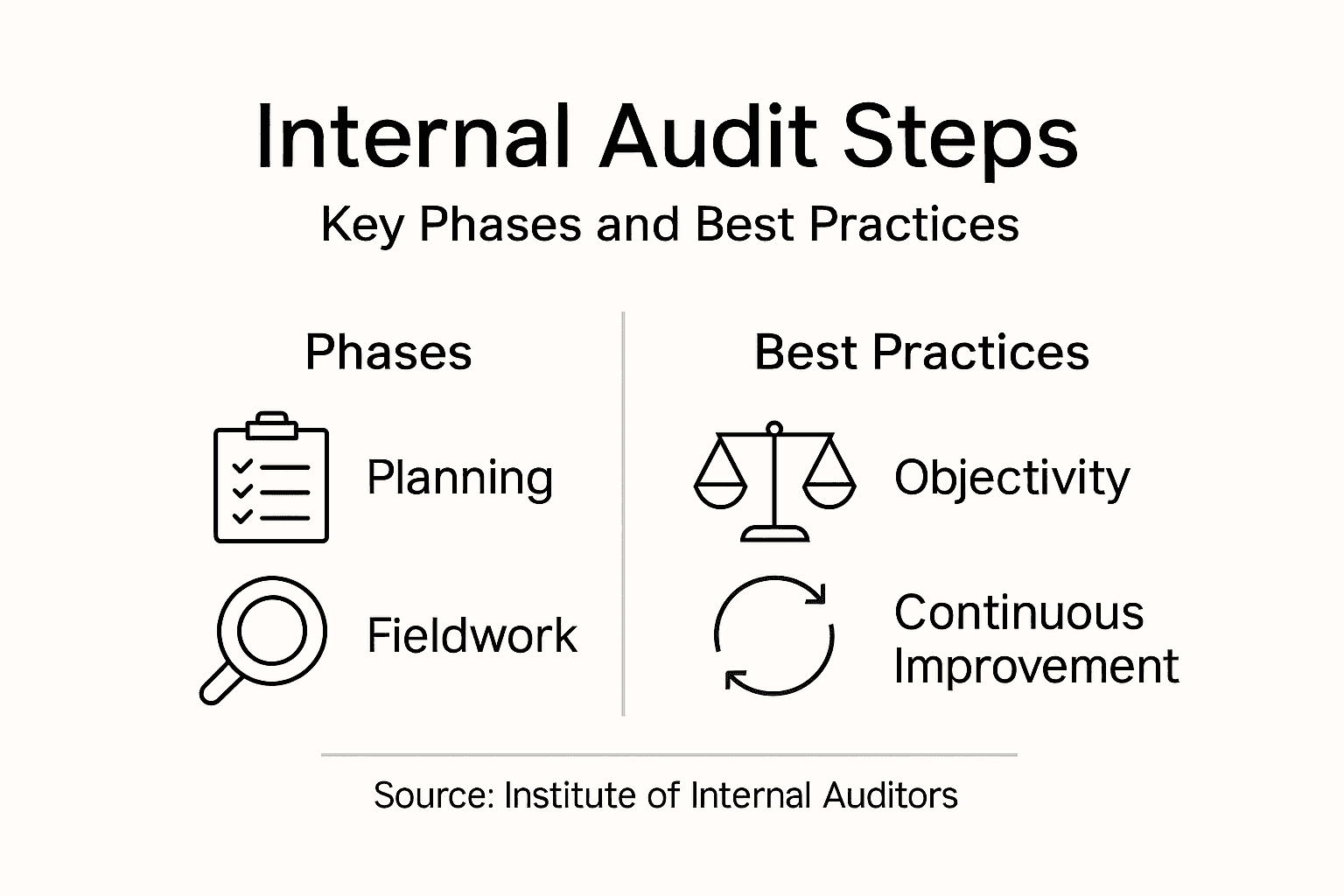
Planning is where audit success is determined, though many auditors want to rush through it. This phase requires you to develop clear scope and audit objectives that answer a specific question: what control or process failure are we trying to evaluate, and how will we know if it’s working? A vague audit objective like “evaluate lending controls” produces vague findings. A precise objective like “verify that loan files contain documented credit analysis before funding approval for loans exceeding $250,000” gives you a target you can actually test against. During planning, you also assess the inherent risk in the area being audited. Is this a high-volume transaction process where errors could affect thousands of customers? Is this a new system with uncertain controls? Is this an area with a history of control breakdowns? Your risk assessment determines how deeply you need to test. You also establish the scope by defining what will be included in the audit and what won’t be, preventing scope creep that consumes months without delivering focused insights.
Execution is where you perform detailed testing and document your findings meticulously. This is the work that most people imagine when they picture an auditor: selecting samples, testing transactions, interviewing process owners, and evaluating whether controls operate as designed. Professional skepticism becomes critical here. Don’t accept management’s assertion that a control works. Actually test it. Review the actual approval before the transaction posted. Verify that the manual step didn’t get skipped. The temptation exists to move quickly through sample testing, especially when early results suggest controls are working well. Resist this. A common audit failure occurs when auditors find excellent compliance in the first ten items tested and mentally conclude the control is working, then reduce their sample size. That’s how you miss the exception that creates the biggest loss. Best practices emphasize detailed testing and documentation that would withstand external auditor review or regulatory examination. Your workpapers should tell the story of your audit clearly. Someone reading your workpapers three years later during an examination should understand what you tested, how you tested it, what you concluded, and why.
Reporting transforms your testing into clear findings and recommendations. Here’s where many internal audits stumble. You’ve spent weeks testing and gathered tremendous detail, and now you must distill it into something management can act on. A good audit finding answers four questions: what should be happening, what actually happened, why does the gap matter, and what management has decided to do about it? Some organizations make the mistake of flooding management with every deviation you found, resulting in audit reports that management files away without action. More effective audits distinguish between control failures that demand immediate correction and lower-priority improvements that enhance but aren’t essential. Your audit committee needs to know which is which.
Beyond the basic process, best practices distinguish successful audit functions from those that struggle. Professional skepticism means you question assumptions and don’t accept explanations at face value. Risk-based auditing means your plan focuses on areas where control failures would matter most to the organization. Quality assurance means you have a second reviewer evaluate your conclusions before you report them, catching gaps or unsupported conclusions before they reach management. Compliance with standards ensures your audit meets professional expectations. Many U.S. financial institutions operate under expectations that internal audits follow the International Standards for the Professional Practice of Internal Auditing (ISPPIA), and increasingly, regulators examine whether your audit function actually complies with these standards rather than simply claiming to.
One practice that separates exceptional audit functions from adequate ones is continuous improvement focused on your own processes. You should evaluate every audit you complete: Did we answer the question we set out to answer? Did management act on our findings? Would a different audit approach have been more efficient? Did we identify what we missed? This discipline forces you to improve systematically rather than repeating the same inefficient patterns year after year.
Pro tip: Document your audit process and methodologies in an audit program that your team can follow consistently. This reduces dependency on individual auditor judgment, ensures quality, and makes your function easier to scale as your organization grows or your audit universe expands.
Legal Standards and Professional Frameworks
Internal audit doesn’t operate in a vacuum. Your work exists within a web of professional standards, ethical codes, and regulatory requirements that define what competent internal auditing actually looks like. Understanding these frameworks isn’t an optional compliance exercise. It’s foundational to your credibility and your ability to influence organizational decision-making. When regulators examine your audit function, they’re evaluating whether you comply with these standards, not just whether you completed audits.
The International Standards for the Professional Practice of Internal Auditing (often called the IIA Standards or simply the Standards) represent the global baseline for internal audit competence. These standards establish requirements for how internal audits should be planned, executed, and reported. They define what independence means in practice, how you should maintain objectivity, and what professional care requires. The Standards are specific about attributes like competence, meaning your audit team needs individuals with accounting knowledge, systems understanding, and specialized expertise depending on what you’re auditing. They mandate due professional care, which means you can’t cut corners or rely on incomplete testing. The Standards also require confidentiality of audit information unless disclosure is legally mandated. These aren’t suggestions. Regulators in the U.S. financial sector increasingly examine whether your audit function actually complies with these Standards rather than simply claiming to follow them. The difference matters. Claiming compliance while your audit plan doesn’t cover key risks or your auditors lack specialized IT knowledge creates credibility problems when examiners ask detailed questions.
Companion to the Standards is the IIA Code of Ethics, which establishes principles around integrity, objectivity, confidentiality, and competence. The Code of Ethics is more than flowery language about doing the right thing. It creates specific obligations. Integrity means you don’t participate in any activity that undermines your audit function’s credibility. If management wants you to suppress findings, integrity requires you to escalate rather than comply. Objectivity requires that you approach audits without predetermined conclusions or conflicts of interest. This is why audit independence matters so much. If you report to the CFO and you’re auditing the accounting department, objectivity is immediately questioned. The Code establishes these principles as non-negotiable.
Beyond professional standards, internal auditors operate under professional standards, ethical codes, and regulatory frameworks that vary by industry and organization type. For U.S. financial institutions, regulatory frameworks add layers of specific requirements. The Sarbanes-Oxley Act (SOX) established requirements for audit committees and internal control assessments that influence how internal audit operates in publicly traded companies. Banking regulators emphasize internal audit’s role in assessing compliance with Bank Secrecy Act requirements, consumer protection rules, and safety and soundness standards. Credit union regulators expect internal audit to assess compliance with specific regulatory requirements and the effectiveness of management’s risk management processes. Insurance regulators focus on internal audit’s role in validating financial reporting and assessing operational risks. These aren’t uniform requirements. A community bank and a regional bank of similar size may operate under different regulatory expectations depending on their charter type and regulatory jurisdiction.
Governance codes like the COSO Internal Control Integrated Framework also influence internal audit’s role. COSO establishes that internal control is everyone’s responsibility within an organization, but internal audit typically serves as the function that tests whether those controls actually work. This creates a distinction between audit’s role in assessing control effectiveness versus management’s responsibility for maintaining controls. The most effective audit functions understand this distinction clearly and communicate it to audit committees and management. You’re not responsible for implementing controls. You’re responsible for evaluating whether they operate as designed.
For compliance officers and internal auditors in the U.S. financial sector, the practical reality is that you’re operating under overlapping standards. Your audit function must demonstrate compliance with IIA Standards and Code of Ethics while also satisfying industry-specific regulatory expectations and governance frameworks. Regulators increasingly examine this overlap. An examination finding about inadequate internal audit might reference IIA Standards, specific regulatory requirements, and governance expectations simultaneously. Building your audit function with awareness of all these frameworks prevents the common mistake of meeting one requirement while inadvertently creating gaps against another.
Pro tip: Document your audit function’s alignment with applicable standards and regulatory requirements in a standards compliance matrix. This helps your audit committee understand your compliance posture and provides a defensive document during regulatory examinations when auditors question specific practices.
Roles, Responsibilities, and Common Pitfalls
Internal audit sounds straightforward until you’re actually doing it. Your job involves conducting risk assessments, evaluating whether controls work, ensuring compliance with regulations, and improving operational efficiency. That’s not one job. That’s several jobs squeezed into one function. Understanding where your responsibilities begin and end, and recognizing the pitfalls that trap even experienced auditors, helps you focus your limited resources on work that creates organizational value.
Your core responsibilities fall into distinct categories. Risk assessment means you must understand your organization’s risk profile and prioritize audit resources accordingly. In a bank, this means understanding which business lines pose the highest operational, compliance, and financial reporting risks. You can’t audit everything, so you need a disciplined process for deciding what matters most. Control effectiveness evaluation means you test whether the controls management has implemented actually prevent or detect errors and fraud. This requires technical understanding of the specific business process and what could go wrong within it. Compliance assurance means verifying that your organization adheres to applicable laws and regulations. For financial institutions, this spans a sprawling landscape from Fair Lending requirements to Anti-Money Laundering statutes to consumer protection rules. Operational improvement means you identify inefficiencies and recommend better ways of doing business. This is where internal audit shifts from pure assurance into advisory territory. You’re not just saying what’s broken; you’re helping fix it.
Where many audit functions stumble is in misunderstanding their scope. Internal auditors face challenges such as evolving regulatory environments and complexity of organizational processes, and these challenges often expose fundamental misconceptions about what audit should be doing. One common pitfall is becoming a compliance calendar rather than a risk-based function. You get pulled into auditing because a regulatory requirement exists, not because the area represents significant risk to the organization. This is reactive auditing. The better approach is proactive risk-based auditing where you identify areas where control failures would matter most to the organization, regardless of whether regulators specifically mandate annual audits there.
Another pitfall is inadequate understanding of operational context. You can’t effectively audit what you don’t understand. An auditor who doesn’t comprehend how commercial lending actually works will miss control deficiencies that are obvious to lenders. This is why many audit functions struggle when evaluating new products or business lines. Your auditors need time to learn the process before they can meaningfully assess its controls. Organizations sometimes pressure audit to move quickly, resulting in superficial audits that miss the real risks. Pushing back on unrealistic timelines is part of your responsibility.
Lack of stakeholder engagement creates another common failure mode. You can conduct the most technically sound audit ever, but if you don’t communicate with process owners during the audit and report findings in language they understand, your work gets shelved without action. The best audit functions build relationships with management throughout the year, not just when an audit is pending. You understand their challenges, they understand audit’s value, and findings land with credibility because they’ve been discussed continuously rather than arriving as a surprise. Ineffective communication extends to your audit committee as well. You need to help audit committee members understand what you actually found and why it matters. This means moving beyond detailed audit workpapers and crafting communications that an audit committee member without deep technical audit knowledge can comprehend.
Maintaining objectivity while building these relationships requires discipline. You can be collegial without being compromised. You can understand management’s perspective without adopting it. The pitfall is moving so close to management that you lose the critical distance necessary for objective evaluation. This is particularly dangerous when you’re evaluating areas where you previously worked as an operational manager. That operational experience gives you valuable context, but it also creates threats to objectivity that you must actively manage.
Finally, many audit functions neglect continuous learning and skill development. The regulatory environment evolves. Technology changes. New risks emerge. Your auditors need ongoing professional development to stay current. Compliance officers and internal auditors operating in the U.S. financial sector face particularly rapid change. What you knew about cybersecurity risks three years ago is outdated. What you knew about Third-Party Risk Management before recent regulatory emphasis was incomplete. Building a learning culture within your audit function prevents the slow drift toward obsolescence that many audit teams experience.
This summary outlines common pitfalls versus best practices in internal audit:
Challenge Faced | Why It Happens | Best Practice to Mitigate |
Reactive, compliance-only audits | Over-focus on regulations | Use risk-based audit planning |
Superficial audit scope | Rushed timelines, weak process | Define scope clearly, address depth |
Weak operational understanding | Lack of process knowledge | Train auditors on business context |
Ineffective communication | Technical report language | Engage stakeholders, clarify findings |
Loss of objectivity | Too close to management | Separate relationships and findings |
Skill and knowledge gaps | Infrequent training | Promote continuous professional development |
Pro tip: Establish a formal intake process for audit requests from management and the audit committee. Evaluate each request against your organization’s risk profile and your audit universe before committing resources. This prevents the common drift toward reactive auditing while demonstrating to stakeholders that you make intentional resource allocation decisions.
Elevate Your Internal Audit Expertise to Meet Today’s Challenges
Internal audit today demands more than routine checks. This article highlights key challenges such as maintaining true independence, conducting risk-based audits, and mastering continuous improvement under increasing regulatory scrutiny. If you face the pressure of evolving compliance standards and need clarity on frameworks like COSO or IIA Standards, you are not alone. Developing strong operational understanding and effective communication skills is essential to transform your internal audit from a reactive task to a proactive organizational asset.
Discover practical solutions through expert-led Continuing Professional Education that directly addresses your daily audit hurdles. At Compliance Seminars, we offer targeted courses and webinars designed to sharpen your control evaluation skills, deepen regulatory knowledge, and build the objectivity and independence your role demands. Don’t wait until audit findings are questioned by regulators or your audit committee. Take control now with training tailored for internal auditors, compliance officers, and risk managers. Visit our homepage and explore how ongoing professional development can secure your credibility and enhance your audit impact.
Frequently Asked Questions
What is the primary role of internal audit?
Internal audit’s primary role is to assess and improve the governance, risk management, and control processes within an organization to ensure that goals are met efficiently and effectively.
How does internal audit differ from external audit?
Internal audit operates from within the organization and focuses on continuous monitoring and improvement of processes, while external audit is conducted by independent parties to evaluate financial statements and compliance.
Why is independence important in internal auditing?
Independence is crucial because it ensures that internal auditors can objectively assess and report on operations and controls without conflicting interests, allowing their findings to carry weight with decision-makers.
What are some common types of internal audits?
Common types of internal audits include financial and control audits, compliance audits, operational audits, IT audits, and special investigations, each focusing on different aspects of organizational risk and effectiveness.
Recommended
Comments