Role of Compliance Officers – Safeguarding Financial Integrity


Managing compliance in a rapidly changing financial environment can feel overwhelming for even the most experienced professionals. The sheer breadth of regulatory demands from major frameworks and evolving standards across global jurisdictions means every compliance officer must stay vigilant. Understanding the multifaceted responsibilities and specialized roles within financial services not only strengthens your risk management strategy but also helps you uphold ethical excellence while safeguarding your institution’s reputation. Strategic compliance management goes far beyond rule enforcement, requiring ongoing expertise and adaptability in a complex landscape.
Table of Contents
Key Takeaways
Point | Details |
Importance of Compliance Officers | Compliance officers safeguard financial institutions by ensuring adherence to regulations and ethical standards, evolving their roles post the 2008 financial crisis. |
Specialized Compliance Roles | Various compliance roles exist, each focusing on distinct regulatory challenges, contributing to a comprehensive risk management framework. |
Regulatory Landscape Complexity | The financial compliance landscape demands a dynamic approach to adapting to new regulations and comprehensive risk management practices. |
Core Competencies for Success | Key skills include analytical assessment, strong communication, and technological proficiency to effectively manage compliance responsibilities. |
Defining Compliance Officers in Financial Services
Compliance officers are critical professionals in financial services who protect organizations by ensuring strict adherence to regulatory standards and ethical practices. They function as guardians of financial integrity, monitoring complex regulatory landscapes and mitigating potential risks within financial institutions.
These professionals play a multifaceted role that has significantly evolved since the 2008 financial crisis. Strategic compliance management now encompasses far more than simple rule enforcement - it involves comprehensive risk assessment, strategic advisory, and proactive organizational protection.
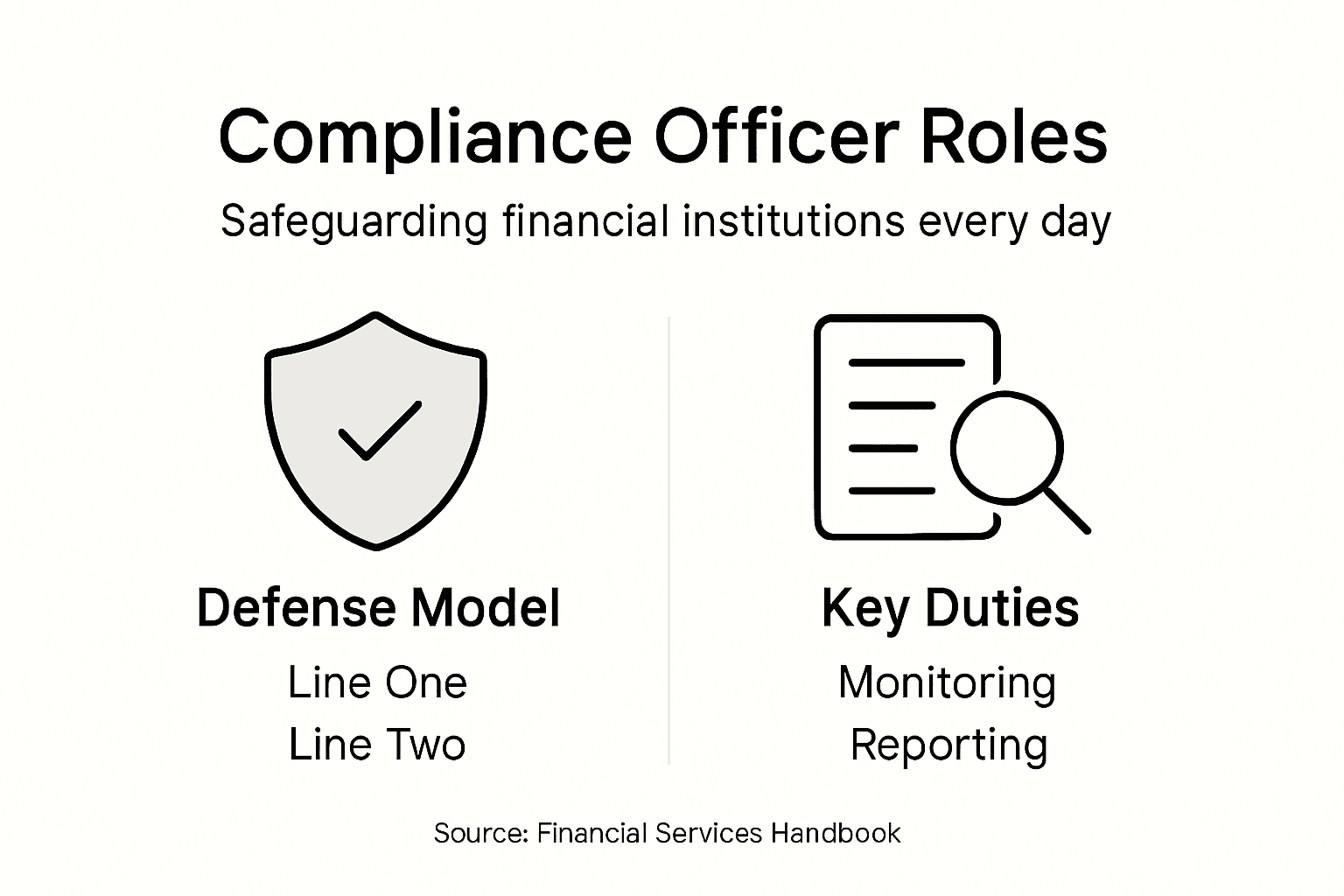
Key responsibilities of compliance officers include:
Monitoring organizational activities for regulatory conformity
Developing and implementing comprehensive compliance programs
Conducting regular risk assessments and internal audits
Reporting potential violations to senior management
Training staff on regulatory requirements and ethical standards
Maintaining documentation of compliance activities
Compliance officers operate within what is known as the three lines of defense model, which strategically distributes risk management responsibilities across an organization. They typically work closely with legal departments, internal audit teams, and senior executives to create robust governance frameworks that protect the institution’s financial and reputational interests.
Pro tip: Always maintain meticulous documentation of compliance activities and stay continuously updated on evolving regulatory standards to effectively manage organizational risk.
Types of Compliance Roles and Their Functions
Compliance roles in financial services are diverse and highly specialized, each designed to address specific regulatory and risk management challenges. Compliance roles range from regulatory oversight to specialized risk management strategies that protect organizational integrity across multiple dimensions.
The primary categories of compliance roles include:
Regulatory Compliance Officers: Ensure adherence to external laws and regulations
Financial Compliance Analysts: Focus on financial data accuracy and regulatory alignment
Data Compliance Managers: Oversee data privacy and protection protocols
Environmental Compliance Specialists: Monitor adherence to environmental regulations
Risk Compliance Managers: Develop and implement comprehensive risk mitigation strategies
Ethics Compliance Officers: Maintain organizational ethical standards and conduct investigations
Each compliance role operates within a structured framework that contributes to the organization’s overall governance. These professionals work collaboratively to create a comprehensive three-tier compliance system that addresses potential risks from multiple perspectives. Their functions typically involve monitoring, reporting, advising, and implementing compliance strategies that protect the financial institution’s operational and reputational integrity.
Here’s a comparison of compliance roles and their unique contributions to financial institutions:
Role Type | Primary Focus | Typical Outcomes |
Regulatory Compliance Officer | Interpreting laws & rules | Reduced regulatory fines |
Financial Compliance Analyst | Monitoring financial accuracy | Improved reporting reliability |
Data Compliance Manager | Protecting sensitive data | Enhanced privacy safeguards |
Environmental Compliance Specialist | Overseeing eco-regulations | Lowered risk of environmental penalties |
Risk Compliance Manager | Mitigating operational risks | Fewer major compliance incidents |
Ethics Compliance Officer | Upholding ethical conduct | Stronger organizational trust |
Compliance professionals must maintain deep expertise in their specific domain while also understanding the broader regulatory landscape. This requires continuous learning, adaptability, and a proactive approach to identifying and mitigating potential compliance challenges before they escalate into significant issues.
Pro tip: Develop a comprehensive understanding of multiple compliance domains to enhance your professional versatility and create more robust organizational risk management strategies.
Regulatory Expectations and Legal Frameworks
The landscape of financial services compliance has become increasingly complex, driven by evolving global regulatory standards and technological transformations. Global regulatory frameworks demand comprehensive risk management that address multiple dimensions of organizational risk and accountability.
Key regulatory expectations for financial institutions include:
Maintaining robust financial stability protocols
Ensuring comprehensive consumer protection strategies
Implementing rigorous data privacy safeguards
Developing operational resilience frameworks
Promoting transparent ethical governance
Establishing proactive regulatory change management systems
Compliance officers must navigate a multifaceted legal environment that encompasses various critical regulations:
Anti-Money Laundering (AML) regulations
Data Protection standards
Market Conduct guidelines
Cybersecurity requirements
Financial Reporting compliance
Consumer Protection laws
The modern regulatory landscape requires financial institutions to adopt a dynamic and adaptive approach. Compliance is no longer a static checklist but a continuous process of monitoring, analyzing, and responding to changing regulatory requirements. Professionals in this field must demonstrate exceptional adaptability, deep technical knowledge, and a proactive mindset to effectively manage emerging risks.
Pro tip: Develop a systematic approach to tracking regulatory changes, leveraging technology and continuous professional development to stay ahead of evolving compliance requirements.
Daily Responsibilities and Core Competencies
Compliance officers in financial services engage in a dynamic and multifaceted role that requires exceptional skills and constant vigilance. Daily tasks involve comprehensive compliance monitoring and proactive risk management across multiple organizational dimensions.
Typical daily responsibilities include:
Conducting internal compliance audits
Monitoring financial transactions for suspicious activities
Updating organizational compliance policies
Coordinating cross-departmental compliance efforts
Preparing detailed compliance reports
Responding to regulatory inquiries and investigations
Core competencies essential for success in this role encompass:
Analytical Risk Assessment skills
Advanced Policy Development expertise
Comprehensive Regulatory Knowledge
Strong Communication capabilities
Technological Proficiency
Strategic Problem-Solving abilities
Modern compliance officers must blend technical expertise with interpersonal skills, serving as both strategic advisors and meticulous investigators. They translate complex regulatory requirements into actionable organizational strategies, bridging the gap between legal mandates and practical implementation. This requires continuous learning, adaptability, and a proactive approach to emerging regulatory challenges.

The following table summarizes core competencies needed for compliance officers and the value they create:
Competency | Business Value | Example Application |
Analytical Assessment | Early risk identification | Flagging suspicious transactions |
Policy Development | Consistent regulatory response | Creating compliance manuals |
Communication | Organization-wide engagement | Leading staff training |
Technological Skill | Efficient compliance monitoring | Automating audit processes |
Pro tip: Develop a systematic approach to continuous learning, leveraging professional development resources and technology to stay ahead of evolving compliance requirements.
Risks, Liabilities, and Best Practices
Compliance officers in financial services navigate an increasingly complex landscape of potential risks and legal challenges that demand strategic management and proactive approaches. Compliance officers face significant liability risks that require comprehensive understanding and careful mitigation strategies.
Key potential risks and liabilities include:
Personal enforcement actions
Regulatory investigations
Direct financial penalties
Professional reputation damage
Potential legal prosecution
Organizational sanctions
Best practices for managing these risks involve:
Establishing clear organizational compliance frameworks
Creating transparent communication channels
Developing comprehensive policy documentation
Implementing robust monitoring systems
Conducting regular risk assessments
Maintaining comprehensive training programs
Encouraging a culture of ethical transparency
Successful compliance officers understand that risk management is not about eliminating all potential issues, but about creating resilient systems that can identify, assess, and effectively respond to emerging challenges. This requires a holistic approach that balances regulatory requirements with practical organizational needs, leveraging technology, human expertise, and strategic thinking.
Pro tip: Develop a proactive risk management strategy that anticipates potential compliance challenges and creates flexible, adaptable response mechanisms.
Elevate Your Compliance Expertise to Safeguard Financial Integrity
Navigating the complex role of compliance officers demands not only understanding evolving regulatory frameworks but also mastering strategic risk management and proactive compliance practices. If you aim to transform your daily responsibilities into confident actions that protect your organization from regulatory risks and liabilities, specialized training is essential. Enhance your skills in analytical risk assessment, policy development, and compliance monitoring with focused education designed for compliance and financial professionals.

Unlock your full potential by joining comprehensive Continuing Professional Education (CPE) programs at Compliance Seminars. Whether you seek live webinars, in-person seminars, or customized corporate training, our expert-led courses align with standards required for certifications such as CPA, CIA, and CISA. Gain practical tools to implement robust compliance frameworks and stay ahead of regulatory changes. Visit Compliance Seminars now to start mastering the skills that safeguard your organization’s financial integrity and reputation.
Frequently Asked Questions
What are the primary responsibilities of compliance officers in financial services?
Compliance officers are responsible for monitoring organizational activities for regulatory conformity, developing compliance programs, conducting risk assessments, reporting violations, training staff, and maintaining compliance documentation.
How do compliance officers contribute to risk management in financial institutions?
Compliance officers operate within a three lines of defense model, working with legal and audit teams to mitigate potential risks by implementing compliance strategies, conducting audits, and fostering a culture of ethical transparency.
What skills are essential for a successful compliance officer in financial services?
Key competencies include analytical risk assessment skills, policy development expertise, regulatory knowledge, strong communication capabilities, technological proficiency, and strategic problem-solving abilities.
How have compliance roles evolved since the 2008 financial crisis?
Since the 2008 financial crisis, compliance roles have shifted from basic rule enforcement to comprehensive risk management, emphasizing proactive strategies, organizational protection, and the need for continuous adaptation to changing regulatory landscapes.
Recommended
Comments