How to Develop CPE Training Program for Audit Success
- Леонид Ложкарев
- Jan 31
- 8 min read


Meeting evolving regulatory expectations is never a simple checklist for North American compliance officers and internal auditors. Each certification brings its own set of professional education standards, credit hour requirements, and documentation rules that can shift with each review cycle.
Building an effective Continuing Professional Education program means mastering these details from the ground up. This guide offers practical steps for mapping out requirements, designing engaging curriculum paths, and selecting expert-led, flexible learning formats aligned with the latest industry standards.
Table of Contents
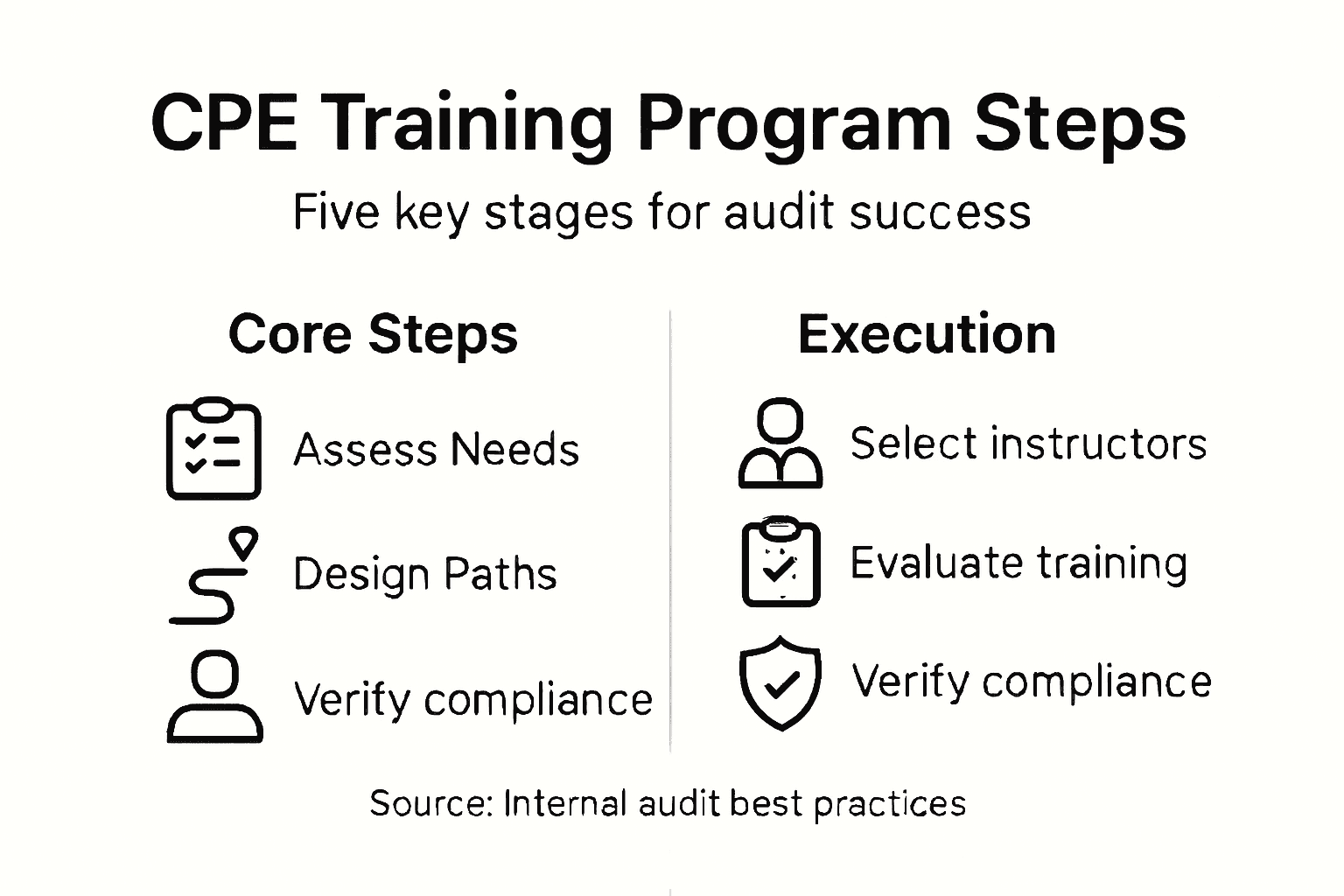
Quick Summary
Key Insight | Explanation |
1. Understand Certification Requirements | Thoroughly map out certification needs and state board licensing mandates to guide your CPE program design. |
2. Design a Structured Curriculum | Create learning paths that build skills systematically, ensuring alignment with professional education standards. |
3. Select Experienced Instructors | Choose instructors with proven expertise and real-world experience to enhance the training experience. |
4. Implement Robust Evaluation Methods | Use comprehensive assessment frameworks to measure knowledge retention and skill enhancement beyond completion rates. |
5. Ensure Compliance Verification | Maintain detailed documentation and quality monitoring to validate that your training meets regulatory standards. |
Step 1: Assess regulatory and certification requirements
Developing a robust Continuing Professional Education (CPE) training program requires a comprehensive understanding of the complex regulatory landscape facing audit professionals. Your goal in this critical first step is to thoroughly map out the specific certification requirements and professional standards that will guide your training design.
Begin by examining the professional education standards established by authoritative bodies like IIA, ISACA, ACFE, NASBA and AICPA. These organizations provide detailed frameworks that specify precise requirements for maintaining professional competence. Key areas to analyze include:
State board licensing requirements
Specific CPE credit hour mandates
Acceptable fields of study
Reporting and documentation standards
Renewal cycle specifications
Your assessment should systematically review professional certification requirements across different audit specialties. For instance, Certified Public Accountants (CPAs), Certified Internal Auditors (CIAs), Certified Information Systems Auditors (CISAs) and Certified Fraud Examiners (CFEs) may have distinct training expectations. Create a detailed matrix documenting the unique requirements for each certification type.
The following table summarizes key differences among major audit professional certifications:
Certification | Primary Focus Area | CPE Hour Requirements | Unique Training Needs |
CPA | Public accounting | 40 credits/year | Ethics, tax updates |
CIA | Internal audit | 80 credits/2 years | Risk, governance |
CFE | Fraud examination | 20 credits/year | Fraud detection |
Successful CPE program development starts with meticulous regulatory research and precise mapping of professional standards.
Ensure you capture nuanced details like minimum credit hour requirements, acceptable learning formats (live events, online courses, self-study), and specific content areas that qualify for professional development credits. Some professional organizations require training in specialized domains like ethics, technology, or emerging regulatory compliance.
Pro tip: Maintain a dynamic tracking system that allows you to quickly adapt your training program as professional standards evolve, typically reviewed every two years.
Step 2: Design standards-based curriculum and learning paths
Developing a comprehensive CPE training curriculum requires strategic planning and a deep understanding of professional learning progression. Your primary objective is to create structured learning paths that systematically build audit professionals’ skills from foundational knowledge to advanced expertise.
Begin by mapping out a curriculum that follows the professional education standards established by regulatory bodies. This involves creating a tiered approach that addresses different competency levels and certification requirements. Key components of an effective curriculum design include:
Identifying prerequisite knowledge for each learning module
Developing clear, measurable learning objectives
Sequencing content from basic to advanced skill levels
Ensuring alignment with current professional standards
Incorporating diverse learning formats (workshops, online courses, webinars)
Break down your curriculum into progressive learning modules that build upon each other. For example, a typical audit professional development path might start with foundational courses in accounting principles, then progress through specialized topics like risk assessment, compliance frameworks, and advanced analytical techniques.
Effective curriculum design transforms disconnected training into a cohesive professional development journey.
Ensure each learning path includes comprehensive content review, practical application opportunities, and assessment mechanisms. Work closely with subject matter experts to validate the technical accuracy and relevance of your training materials, keeping them current with evolving industry standards and regulatory requirements.

Pro tip: Implement a flexible curriculum framework that allows periodic updates and can be easily customized to meet specific certification requirements across different audit specialties.
Step 3: Select expert instructors and delivery formats
Building an exceptional CPE training program hinges on carefully selecting expert instructors and strategically designing learning delivery formats. Your mission is to create a dynamic training experience that combines professional expertise with flexible learning options that meet diverse professional needs.
Start by identifying instructors with proven credentials and real-world experience. CPE delivery formats range from group live programs to internet-based learning, each with unique advantages. Consider these critical selection criteria for instructors:
Extensive professional background in audit and compliance
Advanced certifications and ongoing industry involvement
Demonstrated ability to translate complex concepts
Strong presentation and engagement skills
Current understanding of regulatory landscape
Develop a comprehensive evaluation framework for potential instructors that goes beyond traditional credentials. Look for professionals who have practical industry experience and can provide real-world context to theoretical concepts. This might include former Big 4 consultants, current regulatory professionals, or experienced audit executives who can offer nuanced insights.
Exceptional instructors transform technical training from mundane information transfer to transformative professional development.
Explore diverse delivery formats to accommodate different learning preferences and professional constraints. This might include live webinars, in-person workshops, self-paced online modules, and hybrid learning experiences. Ensure each format maintains high educational standards and provides meaningful professional development opportunities.
Here is a comparison of common CPE delivery formats and their benefits:
Delivery Format | Flexibility Level | Best Use Case | Typical Interaction Style |
Live Workshops | Low | Hands-on skill practice | In-person, interactive |
Online Self-Study | High | Independent learning | On-demand, self-paced |
Live Webinars | Medium | Timely regulation updates | Virtual, real-time Q&A |
Hybrid Experiences | High | Broad accessibility | Mix of live/online |
Pro tip: Develop a rotating instructor pool that allows periodic refreshment of teaching talent and ensures continuous alignment with evolving industry standards and emerging professional competencies.
Step 4: Implement robust training evaluation methods
Designing an effective CPE training program requires more than just delivering content - you need a comprehensive evaluation strategy that measures actual learning impact and professional development. Your goal is to create a systematic approach that goes beyond simple completion rates and truly assesses knowledge retention and skill enhancement.
Training evaluation methods should incorporate multiple dimensions to capture the full learning experience. Consider implementing a comprehensive assessment framework that includes:
Pre and post-training knowledge assessments
Skills demonstration and practical application tests
Performance metric tracking
Learner feedback and satisfaction surveys
Long-term competency progression analysis
Utilize established evaluation frameworks like the Kirkpatrick Model, which examines training effectiveness across four critical levels: reaction, learning, behavior, and results. This approach ensures a holistic view of your training program’s impact, moving beyond surface-level metrics to understand genuine professional skill development.
Effective training evaluation transforms educational programs from passive experiences to strategic professional development investments.
Design your evaluation processes to be both quantitative and qualitative. Use standardized assessment tools that can objectively measure knowledge gain while also incorporating subjective feedback mechanisms that capture the nuanced learning experiences of audit professionals.
Pro tip: Implement a continuous feedback loop that allows for real-time program adjustments, ensuring your CPE training remains agile and responsive to evolving professional development needs.
Step 5: Verify program compliance and learner outcomes
Ensuring the integrity of your CPE training program requires a rigorous compliance verification process that goes beyond surface-level assessments. Your objective is to systematically validate that your training meets both regulatory standards and professional development objectives.
CPE compliance standards demand comprehensive documentation and ongoing quality monitoring. Key verification steps include:
Documenting participant attendance and engagement
Tracking individual learner credit accrual
Verifying instructor qualifications
Maintaining detailed training records
Conducting periodic internal audits
Aligning with state board requirements
Develop a robust record-keeping system that captures detailed metrics about learner performance, course effectiveness, and regulatory compliance. This system should enable you to generate comprehensive reports that demonstrate your program’s adherence to professional education standards.
Meticulous compliance verification transforms training programs from administrative requirements into strategic professional development tools.
Implement a multi-layered verification approach that combines quantitative assessments with qualitative feedback mechanisms. This ensures you’re not just meeting minimum requirements but actively enhancing professional competencies across your training ecosystem.
Pro tip: Create a digital compliance dashboard that provides real-time tracking of learner outcomes and regulatory alignment, enabling proactive adjustments to your CPE training program.
Elevate Your CPE Training Program for Audit Success Today
Developing a CPE training program that truly meets certification requirements and drives professional growth can feel overwhelming. You need to navigate evolving regulations, design standards-based curricula, choose expert instructors, and implement effective evaluation methods. At Compliance Seminars, we understand these challenges and offer proven solutions tailored to your needs. Whether you require NASBA-recognized courses for CPA, CIA, or CFE certifications or want to ensure robust compliance verification, our expert-led webinars, in-person seminars, and online modules provide the structured, practical training your audit team needs.
Ready to transform your audit professionals’ skills and stay ahead in the complex regulatory landscape See how our comprehensive professional education courses align with the latest standards and certification requirements. Visit Compliance Seminars now and take the next step toward building an impactful CPE program recognized by major boards. Your pathway to audit success starts here.
Frequently Asked Questions
What are the key certification requirements to develop a CPE training program for audit professionals?
To develop a CPE training program, you need to understand the certification requirements set by professional organizations. Review licensing mandates, CPE credit hour requirements, and specific acceptable fields of study to ensure you meet all necessary standards.
How can I design an effective curriculum for my CPE training program?
Start by mapping out a structured curriculum aligned with professional education standards. Create learning paths that build from foundational skills to advanced expertise, ensuring each module includes measurable objectives and diverse learning formats.
What criteria should I use to select instructors for my CPE training program?
Choose instructors who have extensive experience in audit and compliance, along with relevant certifications. Evaluate their ability to convey complex concepts engagingly and effectively, as this will enhance the learning experience for your participants.
How do I implement an evaluation method to measure training effectiveness?
Utilize a combination of pre and post-training assessments, feedback surveys, and long-term competency tracking. Implement a comprehensive evaluation framework like the Kirkpatrick Model to accurately assess learning outcomes and areas for improvement.
What steps should I take to ensure compliance in my CPE training program?
Establish a robust record-keeping system to document attendance, credit accrual, and instructor qualifications. Conduct regular internal audits to verify compliance with state board requirements and maintain high-quality training standards.
How can I adapt my CPE training program as regulatory standards change?
Maintain a dynamic tracking system that allows for adjustments based on evolving professional standards. Regularly review the program every six months to ensure your training content remains relevant and compliant with current certification requirements.
Recommended
Comments