Step-by-step guide to financial statement audit excellence


TL;DR:
Strict adherence to audit phases and continuous professional skepticism are essential for high-quality work.
Thorough risk assessment and well-linked internal control testing reduce inspection deficiencies and errors.
Ongoing training and iterative review processes build an audit culture resilient to increasing regulatory scrutiny.
Missing a single step in a financial statement audit can expose your firm to regulatory findings, restatements, and reputational damage that takes years to repair. Auditors working under PCAOB and AICPA standards face mounting scrutiny, with inspection reports consistently flagging the same weaknesses across engagements. The pressure is real, and the margin for error is shrinking. This guide walks you through each phase of the audit process, from initial engagement acceptance through final reporting, grounded in 2026 standards and shaped by the recurring pitfalls that inspectors actually find. If you want a process that holds up under review, this is where to start.
Table of Contents
What you need before starting: Preparation and prerequisites
Risk assessment: Understanding the entity and its environment
Evaluating internal controls: Design and operating effectiveness
Completion and reporting: Reaching and documenting audit conclusions
The real-world key: Why strict process alone isn’t enough in 2026
Key Takeaways
Point | Details |
Structured audit process | Five phases guide audits from planning to reporting to ensure compliance and clarity. |
Risk-driven focus | Effective audits target areas of highest misstatement risk for deeper review and evidence collection. |
Internal control testing | Testing both the design and operation of controls is essential for reliable audit outcomes. |
Regulatory expectations | Following PCAOB and AICPA standards is critical to passing inspections and avoiding deficiencies. |
Continuous professional learning | Ongoing CPE is key to keeping audit skills sharp amid changing standards and inspection trends. |
What you need before starting: Preparation and prerequisites
Before executing the audit, it’s essential to lay a solid foundation with the proper prerequisites. Skipping this phase is one of the most common reasons engagements go sideways before fieldwork even begins.
Financial statement audits follow a structured process with five major phases, starting with Engagement Acceptance and Planning under PCAOB AS 2101 and AICPA AU-C 210. Getting this phase right means assembling the right documents, confirming independence, and scoping the engagement clearly.
Here are the must-have items before you begin:
Signed engagement letter with clearly defined scope and deliverables
Independence confirmation for all team members, including any specialists
Client background package: prior-year financials, industry benchmarks, and organizational charts
Applicable industry guidance and any relevant regulatory requirements
Predecessor auditor communications if this is a new engagement
Must-have documents | Nice-to-have items |
Signed engagement letter | Prior audit workpapers |
Independence confirmations | Management self-assessments |
Prior-year financial statements | Benchmarking data |
Organizational chart | Board meeting minutes |
Regulatory filings | Internal audit reports |
Common pitfalls at this stage include insufficient engagement scoping and vague audit objectives. Both create downstream problems, especially when audit deficiency areas surface during inspection. Regulators expect to see a clear, documented rationale for every scoping decision you make.
Review the PCAOB audit planning standard before finalizing your engagement plan, particularly the updated requirements effective December 2026.
Pro Tip: Automate your engagement letter generation using a standardized template system. Consistency across engagements reduces the risk of missing key provisions and speeds up the acceptance process significantly.
Risk assessment: Understanding the entity and its environment
With the foundation in place, your next priority is to identify which areas merit the closest scrutiny. Risk assessment is not a box to check. It is the analytical engine that drives every subsequent audit decision.
AS 2110 governs the identification and assessment of Risks of Material Misstatement (RMM) at both the financial statement and assertion levels, including fraud risk. The PCAOB 2024 inspection findings repeatedly cite inadequate risk assessment as a root cause of broader audit failures.
Follow these steps in sequence:
Conduct client walkthroughs of key business processes, including revenue recognition and procurement
Research the industry environment: competitive pressures, regulatory changes, and economic conditions
Review internal controls at a high level to understand the control environment
Hold a fraud brainstorming session with the full audit team, documenting all scenarios considered
Map identified risks to assertions at the account and disclosure level
Audit risk model: Audit Risk = Inherent Risk x Control Risk x Detection Risk
This formula is not just a textbook concept. It is the logical structure behind every testing decision you make. When inherent and control risks are high, detection risk must be driven down through more rigorous substantive procedures.
Risk area | Risk level | Primary concern |
Revenue recognition | High | Premature or fictitious revenue |
Accounting estimates | High | Management bias |
Related party transactions | High | Undisclosed or mispriced transactions |
Inventory valuation | Medium | Obsolescence and costing errors |
Debt covenants | Medium | Misclassification or omission |
Review the detailed risk assessment steps and cross-reference them with PCAOB audit standards frequency data to understand which standards inspectors focus on most.
Pro Tip: Use data analytics tools to scan full transaction populations during risk assessment. Outlier detection at this stage can redirect your testing focus before you commit significant resources to the wrong areas.
Evaluating internal controls: Design and operating effectiveness
Once major risks are understood, focus on controls that mitigate those targeted risks. This phase separates audits that hold up under inspection from those that generate findings.

AS 2201 requires an integrated audit of internal control over financial reporting for public companies under SOX Section 404(b). For private company audits, control testing is scoped based on the reliance you plan to place on those controls. The distinction matters because it shapes your entire testing strategy.
Testing design effectiveness means asking: could this control, if operating as intended, prevent or detect a material misstatement? Testing operating effectiveness means asking: did it actually work, consistently, during the period under audit? Both questions require evidence, not assumptions.
Recurring control deficiency areas flagged in ICFR inspection deficiencies include:
Revenue recognition controls, particularly around contract modifications and variable consideration
Management review controls over significant estimates, where documentation of the review itself is often absent
IT general controls, including access management and change management processes
Period-end financial reporting controls, especially in complex consolidation environments
Segregation of duties in smaller entities where compensating controls are poorly documented
Review the SOX 404 audit steps for a structured approach to ICFR testing, and understand the internal controls risk factors that make certain control environments more fragile than they appear.
Pro Tip: Link every control test explicitly to a specific assertion and the RMM it addresses. When inspectors review your workpapers, the connection between risk, control, and test must be immediately visible. Gaps in that linkage are one of the most cited deficiency patterns.
Conducting substantive procedures: Evidence and sampling
Effective controls are not enough. Independent verification through robust substantive work is essential. This is where the audit’s credibility is built or lost.
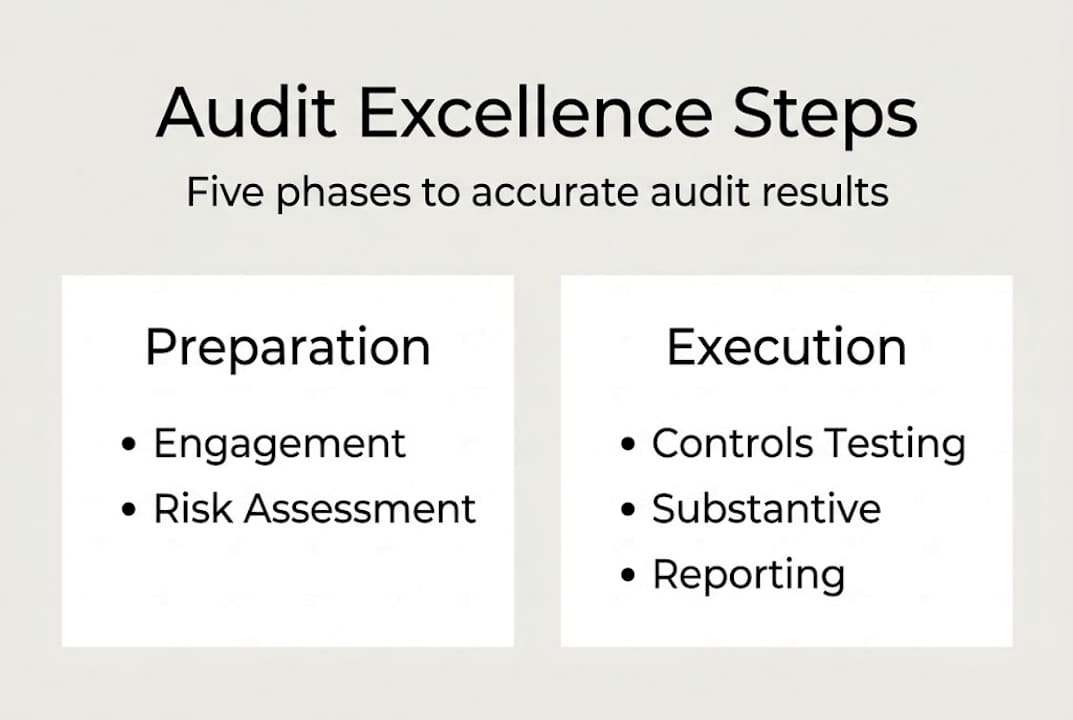
Substantive procedures include tests of details such as confirmations and vouching, substantive analytical procedures, and testing of estimates, all governed by sampling standards under PCAOB AS 2315 and AICPA AU-C 530. Recurring substantive procedure deficiencies show deficiency rates tied to evidence in revenue and estimates ranging from 27 to 40 percent across inspected firms.
Here is the sequence to follow:
Select your sample using a method appropriate to the risk level: statistical sampling for high-volume populations, judgmental sampling for complex transactions
Perform the tests: confirmations, vouching to source documents, recalculations, and cutoff testing
Analyze the results: document exceptions, evaluate their nature and cause, and determine whether they indicate broader issues
Update your risk assessment if results reveal conditions not previously identified
Common substantive procedures you should be executing include:
Accounts receivable confirmations to verify existence and valuation
Revenue cutoff tests around period-end to detect premature recognition
Inventory observation and test counts to confirm physical existence
Analytical procedures comparing current-period results to prior periods and budget
Estimate testing using independent models or management’s own methodology scrutinized for bias
Full-population analytics tools are changing how this work gets done. Rather than testing a sample of 60 transactions, some firms now scan every transaction in a population and flag anomalies for targeted follow-up. This approach reduces sampling risk and often surfaces issues that traditional methods miss. Review recent audit evidence issues to understand where evidence gaps are most likely to draw inspector attention.
Completion and reporting: Reaching and documenting audit conclusions
With all evidence gathered, your next step is to consolidate, evaluate, and formally report your findings to stakeholders. This phase demands careful judgment, not just administrative wrap-up.
Completion and reporting requires evaluating misstatements against materiality, assessing going concern under AU-C 570 and AS 2415, reviewing subsequent events, obtaining management representations, and issuing the audit opinion. Each step carries its own documentation requirements.
Follow this sequence:
Aggregate all identified misstatements, both corrected and uncorrected, and compare them to your materiality threshold
Perform going concern analysis and document your evaluation of management’s plans to address any identified conditions
Review subsequent events through the report date and determine whether any require disclosure or adjustment
Obtain signed management representations covering completeness, accuracy, and disclosure of all known matters
Generate the audit opinion, selecting the appropriate report type based on your findings
Closing task | Deliverable |
Misstatement aggregation | Summary of audit differences |
Going concern evaluation | Documented conclusion with rationale |
Subsequent events review | Memo or workpaper with cutoff date |
Management representations | Signed representation letter |
Audit opinion | Signed audit report |
Review industry audit findings to understand how sector-specific risks influence reporting conclusions and what inspectors look for at the completion stage.
The real-world key: Why strict process alone isn’t enough in 2026
Following the five phases precisely is necessary. But I want to be direct with you: it is not sufficient. The auditors who consistently produce high-quality work are not just better at following checklists. They ask harder questions, and they are willing to revisit conclusions when new information surfaces.
Regulatory scrutiny is intensifying. Inspection findings are becoming more granular, and the expectation that auditors exercise genuine professional skepticism, not just document that they considered it, is clearer than ever. Automation is handling more of the routine work, which means the judgment-intensive decisions are where auditors now earn their credibility.
Great auditors don’t just follow steps; they ask better questions and embrace the unexpected.
The audit evidence standard reinforces that iterative planning continues throughout the engagement. Risk assessment is not a one-time event at the start. It is a living process that should be revisited as evidence accumulates.
Build iterative reviews into every phase, not just at reporting. When a substantive test produces an unexpected result, treat it as a signal, not an anomaly to explain away. The firms that perform best under inspection are those that have institutionalized this mindset, not just the process. Explore how audit training perspective can help your team build that culture of continuous improvement.
Sharpen your audit skills with expert-led CPE training
Process knowledge is the starting point. Staying current with evolving PCAOB and AICPA requirements, inspection trends, and emerging audit methodologies requires ongoing, structured learning.
Compliance Seminars offers CPE training built specifically for audit and finance professionals who need more than a refresher. Our instructors bring Big 4 experience and real-world inspection insight to every session. Browse the CPE event calendar for in-person training across multiple U.S. cities, join a live session through our internal auditor webinars, or enroll your team in the Auditing 101 in-person course to build foundational skills that hold up under scrutiny. Your next inspection is closer than you think.
Frequently asked questions
What are the five main steps in a financial statement audit?
The five audit phases are engagement acceptance and planning, risk assessment, internal control evaluation, substantive procedures, and completion and reporting. Each phase builds directly on the one before it.
What is the role of risk assessment during an audit?
Risk assessment helps auditors identify high-risk areas and tailor procedures to address Risks of Material Misstatement. Under PCAOB AS 2110 and AICPA AU-C 315, this includes evaluating fraud risk at both the financial statement and assertion levels.
How do auditors test internal controls for effectiveness?
Auditors test both design and operating effectiveness through walkthroughs, sampling, and direct observation, as required by AS 2201. Documentation must clearly link each test to the specific risk it addresses.
What are common deficiencies found in audits by inspectors?
Frequent issues include weak controls testing, insufficient risk documentation, and missing links between evidence and assessed risks, as highlighted in PCAOB inspection findings. Revenue recognition and estimates are the most cited problem areas.
How are audit findings reported at the end of an engagement?
Auditors evaluate all findings against materiality thresholds, obtain management representations, and issue a formal opinion, following the completion and reporting framework under AU-C 570 and AS 2415. The report type depends on the nature and significance of identified misstatements.
Recommended
Comments