Inherent risk in audit: definition, frameworks, and best practices


TL;DR:
Many auditors mistakenly believe that strong internal controls automatically lower overall audit risk, but inherent risk exists independently of controls. Inherent risk reflects an assertion’s natural susceptibility to material misstatement, driven by transaction complexity, estimates, volume, past misstatements, and fraud susceptibility. Proper assessment of inherent risk, separate from control risk, is essential for effective audit planning and compliance with PCAOB standards.
Many auditors walk into a fieldwork engagement assuming that strong internal controls mean lower overall risk. That assumption is one of the most persistent and consequential misconceptions in the profession. Inherent risk, by definition, exists before controls enter the picture at all. It reflects the natural susceptibility of an assertion to material misstatement based on the characteristics of the business, transaction, or account itself. Understanding this distinction is not just an academic exercise. It directly shapes how you plan your audit, allocate your resources, and satisfy regulatory requirements under PCAOB and other authoritative frameworks.
Table of Contents
Key Takeaways
Point | Details |
Inherent risk definition | Inherent risk is the chance of material misstatement before considering any internal controls. |
Role in audit planning | Properly assessing inherent risk is crucial for targeting audit work where errors are most likely. |
Audit risk model components | Audit risk is a combination of inherent, control, and detection risks, each influencing auditor decisions. |
Controls do not change inherent risk | Strong controls reduce control risk, but inherent risk always starts before controls are considered. |
Defining inherent risk in audit
Now that we’ve surfaced the confusion, let’s clarify exactly what inherent risk is in the context of an audit.
According to PCAOB AS 2110, which becomes effective December 15, 2026:
“In financial statement audits, inherent risk is the susceptibility of an assertion (about a class of transactions, account balance, or disclosure) to material misstatement before considering related controls.”
This definition carries significant weight. It tells us that inherent risk is a property of the subject matter itself, not a product of the control environment surrounding it. Think of it as measuring the flammability of a material before you account for whether a fire suppression system is present. The material’s flammability doesn’t change because you installed sprinklers.
Several factors consistently drive higher inherent risk in practice. Auditors should be alert to these during planning:
Transaction complexity: Structured financing arrangements, derivatives, and multi-step revenue recognition scenarios increase the chance that transactions are recorded incorrectly, even without bad intent.
Reliance on estimates: Fair value measurements, warranty reserves, impairment analyses, and actuarial assumptions all involve significant judgment, which increases variability and error potential.
Volume and frequency: High-volume, routine transactions like payroll or accounts payable can carry elevated inherent risk simply because errors have more opportunities to occur and accumulate.
History of misstatements: If prior audits or management reviews have surfaced errors in a particular account, that history signals elevated susceptibility going forward.
Susceptibility to fraud: Certain accounts, especially cash, revenue, and accounts receivable, carry higher inherent risk because they are more attractive targets for manipulation.
The critical distinction auditors must internalize is the difference between inherent risk and control risk. Inherent risk asks, “How susceptible is this assertion to error on its own?” Control risk asks, “How likely is it that the entity’s controls will fail to catch that error?” They are assessed separately and serve distinct purposes in the audit risk model.
How inherent risk fits in the audit risk model
With an understanding of inherent risk, let’s see how it integrates into the standard audit risk model.
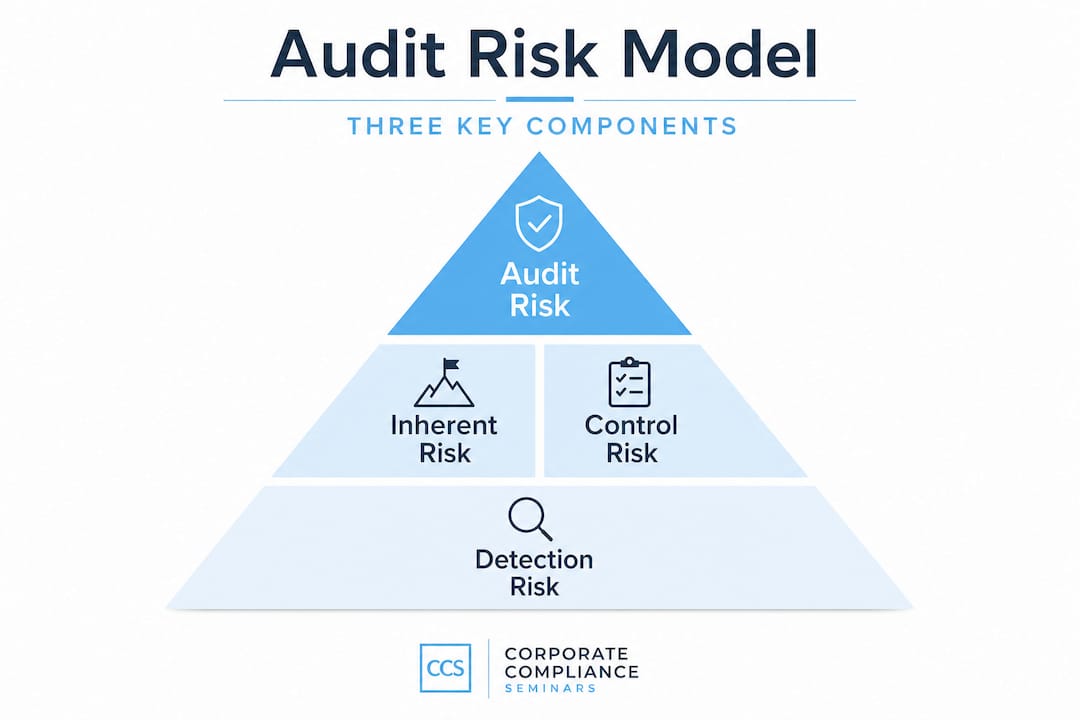
PCAOB AS 2315) establishes that audit risk for the overall audit is composed of three components: inherent risk, control risk, and detection risk. Inherent risk and control risk together form what is known as the risk of material misstatement (RMM), which represents the likelihood that an assertion contains a material error before the auditor’s own procedures are applied. Detection risk, the third component, reflects the probability that the auditor’s procedures fail to catch a misstatement that exists.
Here is how the three components break down in practice:
Risk component | What it measures | Who influences it | Effect on audit |
Inherent risk | Susceptibility before controls | Nature of the business and transactions | Shapes the level of scrutiny needed |
Control risk | Likelihood controls fail to prevent/detect errors | Management’s design and operation of controls | Determines reliance on controls vs. substantive testing |
Detection risk | Probability auditor procedures miss a misstatement | Auditor’s procedures and judgment | Calibrated to achieve acceptable overall audit risk |
The model functions as an equation. When inherent and control risk are high, auditors must drive detection risk as low as possible, which requires more substantive testing, larger sample sizes, and more sensitive procedures. This is a foundational concept in any risk assessment framework and directly informs how audit programs are built.
A critical point is that auditors cannot simply reduce inherent risk by pointing to strong controls. Controls affect control risk. What you can do is recognize that strong controls allow you to reduce detection risk requirements because the combined RMM is lower. This nuance has real budgetary and planning consequences. Misunderstanding it leads to under-auditing high-risk areas or over-auditing well-controlled ones.
Pro Tip: Document your inherent risk assessments at the assertion level, not just at the account level. An account like “revenue” may carry different inherent risk levels across different revenue streams within the same company. Granular documentation strengthens the quality and defensibility of your audit plan.
Assessing and identifying inherent risk in audits
Understanding the model is only half of the equation. Next, auditors need a practical approach to assessing inherent risk in their own engagements.
PCAOB inspection findings consistently show that common audit quality themes relate to deficiencies in risk assessment and the subsequent responses to identified or assessed risks, including fraud and significant risks. This is not a minor observation. It means that risk assessment shortfalls represent some of the most frequently cited weaknesses in audit engagements subject to regulatory scrutiny. Getting this step right is foundational.
Here is a practical, step-by-step approach to identifying and assessing inherent risk:
Understand the entity and its environment. Start with the business model, industry, competitive dynamics, and regulatory landscape. A pharmaceutical company’s revenue recognition from licensing deals carries different inherent risk than a retailer’s point-of-sale transactions.
Identify significant accounts and disclosures. Focus attention on material balances and transactions. Not all accounts carry the same risk, and prioritization matters for effective planning.
Evaluate susceptibility factors at the assertion level. For each significant account, ask which assertions (existence, completeness, valuation, rights and obligations, presentation) are most vulnerable and why.
Assess the role of accounting estimates. Estimates are fertile ground for inherent risk because they require judgment, involve uncertainty, and can be influenced by management bias. Fair value measurements and credit loss provisions deserve careful attention.
Consider fraud risk explicitly. Fraud risks always represent significant risks under auditing standards. Integrating fraud detection in audits into your inherent risk assessment is not optional. It is required.
Factor in management incentives and pressures. Bonus structures tied to earnings, debt covenant compliance, and analyst expectations create environments where fraud risk and estimation bias tend to increase.
Review prior period results and audit findings. Recurring adjustments, prior year misstatements, or management override events in the same area are strong signals of elevated inherent risk.
The fraud risk assessment steps that experienced internal auditors apply are directly transferable here. Both processes require systematic thinking about who has motive, opportunity, and the ability to rationalize misconduct.
Pro Tip: When assessing complex accounting estimates, involve a specialist in your planning conversation early. Waiting until fieldwork to recognize that you need expertise in actuarial science or real estate valuation costs time and increases the chance of audit deficiencies.
Following audit planning best practices means tying your inherent risk conclusions directly to your audit program design. High inherent risk in a particular assertion should result in more extensive procedures, lower reliance on analytical techniques alone, and increased unpredictability in your testing approach.

Interaction between inherent risk, control risk, and audit response
Now that you’ve learned how to assess inherent risk, it’s equally critical to understand how it interacts with other audit risks and shapes auditor actions.
One of the most important regulatory distinctions in this space comes directly from PCAOB AS 2110:
“Inherent risk is assessed before controls are considered; therefore, strong internal controls reduce control risk and detection risk requirements, but they do not change the underlying inherent susceptibility used to plan audit effort.”
This distinction matters in practice because many audit teams work backward. They observe strong controls, lower their overall risk rating for an account, and inadvertently compress their inherent risk assessment in the process. The standards are explicit: inherent susceptibility is a fixed characteristic for planning purposes, separate from what controls do downstream.
Here is how different combinations of inherent and control risk translate into audit strategy:
Inherent risk level | Control risk level | Risk of material misstatement | Implied audit response |
High | High | Very high | Extensive substantive testing; large samples; specialist involvement |
High | Low | Moderate to high | Moderate substantive testing; some reliance on controls after testing |
Low | High | Moderate | Targeted testing; focus on completeness and accuracy |
Low | Low | Low | Reduced substantive testing; broader use of analytical procedures |
Several common mistakes auditors make in this analysis are worth naming directly:
Allowing control quality to influence inherent risk ratings. This conflates two separate assessments and can result in insufficient audit coverage for genuinely complex or fraud-susceptible assertions.
Assessing risk at the account level only. Inherent risk varies by assertion. Valuation risk for inventory is different from existence risk, even within the same account.
Failing to reassess as the engagement progresses. Inherent risk should be revisited when new information surfaces, such as a management estimate that differs significantly from an auditor’s independent estimate.
Treating significant risks as routine. When an area is identified as a significant risk, the auditor must perform substantive procedures regardless of control effectiveness. This is a non-negotiable requirement.
Inadequate linkage between risk assessment and audit response. The risk assessment in regulatory audits framework is only effective when identified risks are visibly connected to specific planned procedures.
Understanding internal control challenges also helps auditors calibrate control risk realistically, avoiding the trap of assuming well-designed controls are operating effectively without testing that assumption.
What most auditors miss about inherent risk
With the technical details behind us, let’s shift to a grounded perspective on why these concepts matter in practice.
Here’s something I’ve observed repeatedly across audit engagements and training conversations: the auditors who struggle most with inherent risk are often the most experienced ones. Not because they lack technical knowledge, but because they have built mental shortcuts over years of working with the same clients or in the same industries. When you know that a client has excellent controls and a strong finance team, it becomes almost instinctive to rate overall risk as low. The trap is that you’re subconsciously folding control quality into your inherent risk assessment and ending up with a compressed combined rating that isn’t supportable on its merits.
Discipline in the separation of these assessments is not a bureaucratic exercise. It is a quality safeguard. The moment you let your appreciation for a client’s internal control environment color your view of how susceptible an assertion is to error by its very nature, you’ve compromised the conceptual foundation of your audit plan.
There’s also a regulatory dimension that reshapes how sophisticated auditors should think about inherent risk frameworks. Inspections consistently flag risk assessment deficiencies as a leading driver of audit quality issues. The implication is that many audit teams are not just making errors in their procedures. They’re making errors in their thinking before procedures even begin. Getting inherent risk right at the front end is where audit quality is either built or eroded.
My contrarian take is this: it is always better to over-document your inherent risk assumptions than to under-address them in planning. An audit workpaper that shows a thoughtful, assertion-level analysis of inherent risk factors, even if some of those factors are ultimately assessed as low risk, tells a regulator or reviewer that the auditor exercised genuine professional judgment. A workpaper that simply states “inherent risk: low” with no supporting rationale is a liability, regardless of how strong the controls turned out to be.
For teams focused on sharpening these skills, planning for inherent risk requires building frameworks that are replicable, documented, and directly traceable to audit program decisions. That discipline separates defensible audits from vulnerable ones.
Advance your audit risk expertise with CPE training
If you’re ready to strengthen your own audit approach to inherent risk, there are in-depth resources and training opportunities available.
Translating these concepts from theory into fieldwork requires more than reading standards. It requires guided practice, discussion of real inspection findings, and exposure to how experienced auditors navigate complex judgment calls in live engagements.

Our internal auditor CPE webinars cover risk assessment, audit planning, and fraud risk in formats designed for working professionals. For auditors with technology and cybersecurity responsibilities, our cybersecurity audit events address how inherent risk concepts apply in digital environments, where complexity and estimation uncertainty are increasingly prominent. We also offer focused IT auditing CPE training that integrates risk assessment frameworks with current regulatory expectations. All programs are NASBA-recognized and developed by practitioners with direct Big 4 and regulatory experience, so the content reflects what auditors actually encounter in practice.
Frequently asked questions
What is the difference between inherent risk and control risk?
Inherent risk is susceptibility before considering related controls, while control risk is the chance that a misstatement will not be prevented or detected by the entity’s internal controls. They are assessed separately and serve distinct roles in determining the risk of material misstatement.
Why can’t strong internal controls reduce inherent risk?
Because inherent risk is assessed before controls are considered, strong internal controls reduce control risk but do not change the underlying inherent susceptibility that the auditor uses to plan the engagement. The two assessments are conceptually and procedurally separate.
How do auditors identify areas of high inherent risk?
Auditors look for complex transactions, significant estimates, susceptibility to fraud, and areas with a prior history of errors, as risk assessment focuses on these specific characteristics. Management incentives and industry-specific pressures are also strong signals worth evaluating during planning.
How does inherent risk affect audit planning?
High inherent risk requires auditors to design more rigorous procedures and direct greater attention to those assertions. Per PCAOB AS 2110, significant risk determinations are based on inherent risk without regard to controls, meaning controls cannot offset the need for thorough substantive testing in high-risk areas.
Recommended
Comments