Harnessing AI in audit: efficiency, quality, and skills for 2026


TL;DR:
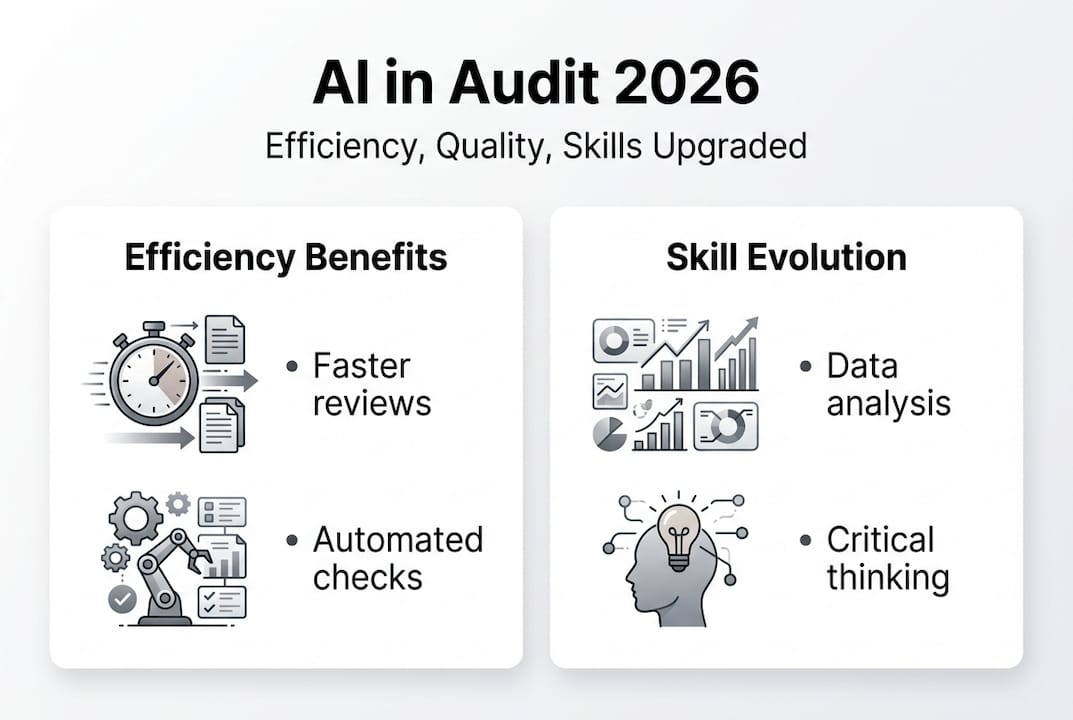
AI reshapes audits by enabling full-population testing and automating repetitive tasks.
It improves efficiency, accuracy, and risk detection while requiring new auditor skills.
Successful AI adoption depends on transparency, ethical practices, and cultural change.
Artificial intelligence is not coming for your audit career. It is reshaping it. The misconception that AI will replace auditors has caused more anxiety than action in the profession, and that anxiety is getting in the way of real progress. AI automates repetitive audit tasks like data extraction, journal entry testing, and anomaly detection, freeing auditors to apply judgment where it matters most. The result is not a smaller audit team. It is a more capable one. This guide breaks down exactly how AI fits into modern audit workflows, what the evidence says about quality and efficiency gains, and what skills you need to stay ahead.
Table of Contents
Key Takeaways
Point | Details |
AI automates core audit tasks | AI handles repetitive audit steps like data extraction and anomaly detection, freeing auditors for higher-level analysis. |
Efficiency and quality gains | Firms adopting AI report notable time savings, more accurate findings, and continuous monitoring capabilities. |
Human oversight still essential | AI augments, not replaces, auditors—judgment, communication, and ethical oversight remain critical to audit quality. |
Ethical and regulatory care needed | AI’s opacity, data bias, and explainability risks must be managed with ethics and compliance in mind. |
How artificial intelligence is redefining audit processes
Building on that overview of AI augmentation, let’s detail exactly where AI fits into core audit processes. The shift is significant, and it goes well beyond simply automating a few spreadsheet tasks.
Traditional auditing relies heavily on sampling. You select a subset of transactions, test them, and draw conclusions about the whole population. It works, but it leaves gaps. AI changes that equation entirely. By enabling 100% population testing instead of sampling, AI allows audit teams to examine every transaction in a dataset, not just a representative slice. That is a fundamental shift in how assurance is delivered.
Here is a practical look at what AI now handles in a modern audit workflow:
Data extraction and normalization: AI pulls structured and unstructured data from multiple sources and standardizes it for analysis, cutting hours of manual prep work.
Journal entry testing: Machine learning models flag unusual entries based on patterns, timing, preparer behavior, and account combinations.
Anomaly detection: Algorithms identify outliers in large transaction sets that would be nearly impossible to catch through manual review.
Evidence matching: AI cross-references documents, invoices, and approvals to verify completeness and accuracy at scale.
Predictive analytics and transaction scoring: Models assign risk scores to transactions, helping auditors prioritize where to focus their time.
The before-and-after contrast is stark. Before AI, an auditor testing accounts payable might manually review 200 invoices from a population of 50,000. After AI, the system flags 300 anomalous transactions from that same population, and the auditor reviews those specific items with full context. Coverage improves. Risk focus sharpens.
Workflow stage | Traditional approach | AI-enabled approach |
Data collection | Manual extraction, spreadsheets | Automated ingestion from multiple systems |
Transaction testing | Sample-based (5-10%) | Full population testing (100%) |
Anomaly identification | Auditor judgment on samples | Algorithm-driven flagging across all data |
Evidence review | Manual document matching | Automated cross-referencing with exceptions flagged |
Risk prioritization | Experience-based | Predictive scoring models |
“The move from sampling to full-population testing is not just an efficiency gain. It is a quality leap that changes what assurance actually means.”
For a deeper look at the tools driving this change, explore AI tools for internal audit and how leading teams are putting them into practice.
Boosting efficiency and audit quality: Evidence and data
Having assessed the mechanism by which AI changes audit processes, let’s explore the concrete gains in efficiency and quality. The numbers tell a compelling story.
72% of audit firms expect to prioritize AI for anomaly detection, and the outcomes back up that confidence. AI reduces manual effort across the audit cycle, enables continuous monitoring rather than point-in-time testing, and enhances risk assessment accuracy in ways that traditional methods simply cannot match.

Consider what continuous monitoring means in practice. Instead of reviewing controls quarterly or annually, AI-powered systems flag control failures in real time. An unusual journal entry posted at 2 a.m. by an account that rarely posts entries gets flagged immediately, not six months later during the next audit cycle.
Here are four measurable ways AI is improving audit outcomes right now:
Reduced vouching hours: Automated evidence matching cuts the time auditors spend manually tracing transactions to supporting documents, often by 30 to 50 percent on data-heavy engagements.
Higher accuracy in risk identification: Predictive models trained on historical audit findings identify high-risk areas with greater consistency than experience-based judgment alone.
Improved going concern opinions: Research shows AI-assisted analysis leads to more accurate assessments of financial distress indicators.
Scalability without proportional headcount growth: Audit teams can take on larger, more complex engagements without a corresponding increase in staff, because AI handles the volume.
Pro Tip: Before rolling out AI tools, establish a baseline. Document current hours spent on data extraction, vouching, and anomaly review. After implementation, measure the same tasks. This gives you a defensible, quantified case for AI adoption that resonates with leadership and audit committees.
For teams still building their approach, a structured AI usage strategy in auditing is the foundation that separates successful adoption from costly missteps.
Key challenges and limitations of AI in audits
With benefits come risks. The next step is to understand where AI’s power in audit runs up against its limits. And those limits are real.
Research identifies six key challenges for AI in audit that every team must address before scaling adoption. Ignoring them does not make them go away. It just means they surface at the worst possible moment, during a regulatory review or a client dispute.
Here is what audit leaders need to keep front of mind:
Black box opacity: Many AI models, particularly deep learning systems, cannot explain why they flagged a specific transaction. That is a serious problem in an environment where auditors must document their reasoning.
Data bias: AI learns from historical data. If that data reflects past errors, biases, or gaps, the model will replicate them at scale. Garbage in, garbage out applies here with serious consequences.
Explainability requirements: Regulators and audit standards increasingly require that conclusions be traceable and explainable. An AI-generated finding that cannot be explained to a client or regulator is not a finding you can rely on.
Data privacy risks: AI systems that ingest client financial data create new exposure points. Data handling, storage, and access controls must meet both regulatory and contractual requirements.
Overreliance: There is a real danger that auditors defer too heavily to AI outputs without applying the professional skepticism that standards require. The tool flags; the auditor decides.
Regulatory gaps: Audit standards have not fully caught up with AI capabilities. Firms operating in this space are navigating evolving guidance from the PCAOB, AICPA, and international bodies.
Pro Tip: Build explainability into your AI adoption from day one. Require that every AI-generated finding be accompanied by a plain-language explanation that a senior auditor can review and a client can understand. If your tool cannot produce that, reconsider the tool.
For teams thinking through governance, the intersection of AI compliance strategy and audit methodology is where the hard decisions live. And if your team uses AI in client interviews, the risks of AI transcription in audit interviews deserve careful attention.
The evolving role of auditors in the AI era
Now that we understand the technical and ethical landscape, let’s pinpoint what it means for you and your team’s evolving skill set. The short answer is that your judgment is worth more, not less.
AI augments auditors rather than replacing them, and the data supports this. Research shows a 4.3% increase in auditor jobs, particularly at the junior and midlevel, as AI adoption grows. More accurate internal control opinions and improved going concern assessments are direct results of human-AI collaboration, not AI operating alone.
What changes is the nature of the work. Here is how the auditor’s role is shifting:
From data handler to data interpreter: AI manages the volume. You manage the meaning. Translating AI outputs into defensible audit conclusions requires deep professional judgment.
From process executor to oversight provider: Auditors increasingly serve as the control layer over AI systems, reviewing model outputs, validating assumptions, and catching errors the algorithm cannot see.
From technical specialist to strategic advisor: With routine tasks automated, auditors have more bandwidth to advise clients and management on risk, controls, and business implications.
From individual contributor to cross-functional collaborator: Effective AI adoption requires auditors to work alongside IT, data science, legal, and compliance teams. Communication and collaboration skills are now audit skills.
“The auditor who thrives in the AI era is not the one who knows the most about machine learning. It is the one who knows how to ask the right questions of both the algorithm and the client.”
Professional skepticism, critical thinking, and clear communication are not soft skills anymore. They are core competencies. For practical guidance on using AI effectively in audits and developing the auditor skills for the AI era, the learning curve is real but manageable.
A seasoned take: What most audit guides miss about AI
Most articles about AI in audit focus on the technology. Which tools, which algorithms, which platforms. That framing misses the harder problem.
In our experience, the teams that struggle with AI adoption are not struggling because they chose the wrong software. They are struggling because they treated implementation as a procurement decision rather than a cultural one. They bought the tool, ran a pilot, and then watched adoption stall because senior auditors did not trust the outputs and junior staff did not know how to challenge them.
Effective AI integration requires transparency about what the model does and does not do, cross-functional buy-in from IT, legal, and audit leadership, and a clear escalation path when AI outputs conflict with auditor judgment. None of that is a technology problem.
The future of audit belongs to teams that are adaptable, not just technically current. That means building a culture where ethics in AI-driven audits is a standing agenda item, not an afterthought. Prioritize transparency and human accountability over speed of rollout, and you will build something that actually holds up under scrutiny.
Upgrading your audit skills for the AI future
Knowing how AI reshapes audit is one thing. Building the skills to lead that change is another.
At compliance-seminars.com, we offer NASBA-recognized CPE courses and in-person events designed specifically for audit and finance professionals navigating the AI era. Whether you are looking to build foundational knowledge through Internal Auditing 101, stay current with IT auditing CPE events covering cybersecurity and data governance, or find your next training opportunity through our CPE event calendar, we have practical, expert-led options ready for you. Invest in the skills that keep your judgment sharp and your career ahead of the curve.
Frequently asked questions
Does AI automation reduce the need for human auditors?
No. AI augments auditors rather than replacing them, with research showing a 4.3% increase in auditor jobs as adoption grows, driven by higher demand for professional judgment and oversight.
What auditing tasks can AI automate effectively?
AI excels at automating data extraction, journal entry testing, anomaly detection, transaction scoring, and evidence matching, enabling full-population testing rather than traditional sampling.
What are the biggest challenges of using AI in audit?
The most significant challenges include AI’s black box opacity, bias from incomplete or flawed data, explainability requirements, data privacy exposure, overreliance by audit staff, and gaps in regulatory guidance.
How does AI improve audit quality and efficiency?
AI enables continuous monitoring, sharpens anomaly detection, and reduces manual effort across the audit cycle, resulting in faster execution, broader coverage, and more accurate risk assessments.
Recommended
Comments